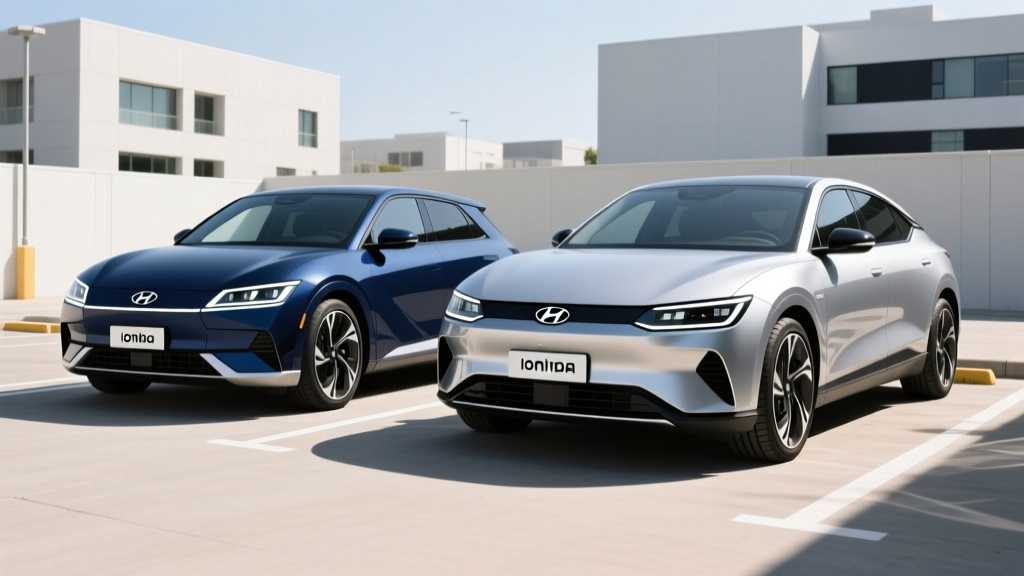
The Hyundai Ioniq 5 has been one of the best-selling mainstream electric crossovers since its launch, and the 2026 model year brings incremental but meaningful refinements. Built on Hyundai Motor Group's E-GMP (Electric Global Modular Platform) with its signature 800V electrical architecture, the Ioniq 5 remains a benchmark for charging speed and interior packaging in the midsize EV crossover segment. But for buyers researching cargo practicality, one question comes up constantly: what about the Ioniq 5 frunk — and does it actually add useful storage?
This review covers everything a buyer needs to know about the 2026 Ioniq 5, from real-world range and charging performance to the front-trunk utility, pricing, and federal tax credit qualification under current IRS §30D rules.
2026 Hyundai Ioniq 5 at a Glance: Key Specs
| Spec | SEL / SE RWD | SEL / SE AWD | Limited AWD | Ioniq 5 N |
|---|---|---|---|---|
| EPA Range | 318 mi | 290 mi | 275 mi | 221 mi |
| Battery (usable) | 84.0 kWh, NMC (Nickel Manganese Cobalt) | 84.0 kWh, NMC | ||
| Horsepower | 168 hp | 320 hp | 320 hp | 641 hp (N Grin Boost) |
| 0–60 mph | 7.0 sec | 4.5 sec | 4.5 sec | 3.25 sec |
| Drivetrain | RWD (single motor) | AWD (dual motor) | AWD (dual motor) | |
| Max DC Fast Charge | ~238 kW peak (800V architecture) | ~238 kW peak | ||
| 10–80% DCFC Time | ~18 minutes (optimal conditions) | |||
| Level 2 Home Charging | 10.9 kW (48A) — ~37 mi/hr added | |||
| MPGe (combined) | 117 MPGe | 110 MPGe | 101 MPGe | 85 MPGe |
| Frunk Volume | 0.85 cu ft (24 liters) — all trims | |||
| Rear Cargo (behind 2nd row) | 27.2 cu ft | |||
| Total Cargo (seats folded) | 59.3 cu ft | |||
| Base MSRP | $43,600 | $47,100 | $54,200 | $67,500 |
| Battery Warranty | 8 years / 100,000 miles | |||
Source: EPA fueleconomy.gov and Hyundai USA spec sheets. Prices exclude destination charge (~$1,395). Specs may vary by model year update.
Ioniq 5 Frunk: How Much Cargo Space Do You Actually Get?
The Ioniq 5 frunk (front trunk) is one of the most debated features among prospective buyers. Unlike the Tesla Model Y's ~4.1 cu ft frunk or the Ford Mustang Mach-E's ~4.7 cu ft front storage, the Ioniq 5 offers just 0.85 cubic feet (24 liters) of front cargo volume across all trims, including the performance-oriented Ioniq 5 N.
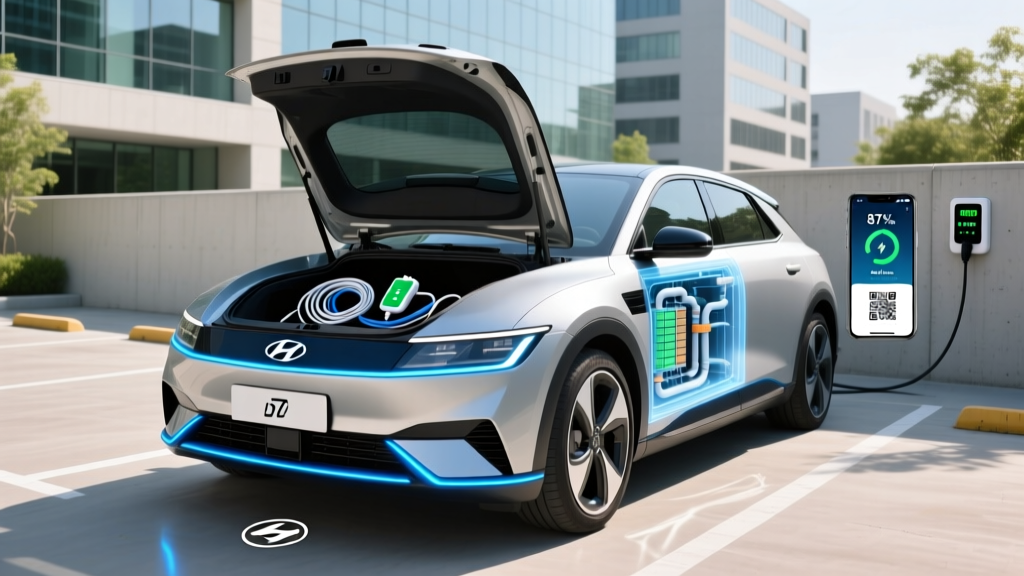
Why so small? The E-GMP platform houses power electronics, the HVAC compressor, and the onboard charger under the front hood. Hyundai opted not to sacrifice ground clearance or cabin space for a larger front compartment. In practice, the Ioniq 5 frunk fits:
- A standard charging cable bag (the included portable charger and adapters)
- A small gym bag or laptop backpack
- A compact emergency kit with jumper cables and first-aid supplies
It will not fit a carry-on suitcase or a full grocery load. Think of the Ioniq 5 frunk as a dedicated charging-cable and essentials compartment rather than a secondary cargo bay. For buyers who prioritize frunk space — say, for separating dirty gear or stowing a second week's groceries — the Tesla Model Y or Rivian R1S offer substantially more front storage.
The real cargo story with the Ioniq 5 is its rear hatch. With 27.2 cu ft behind the second row and 59.3 cu ft with seats folded, the rear area is competitive with the Toyota RAV4 and larger than the Mach-E's 29.7 cu ft. The flat floor and wide opening make loading bulky items straightforward.
Real-World Range: What to Expect Beyond the EPA Sticker
EPA Estimated: 318 mi (RWD) / 290 mi (AWD) / 275 mi (Limited AWD)
Real-World Highway (70–75 mph, mild weather): ~260–285 mi (RWD) / ~240–260 mi (AWD)
Cold-Weather Highway (below 32°F): ~210–240 mi (RWD) — expect 20–30% range loss
City / Mixed Driving (moderate temps): Close to or slightly above EPA estimates thanks to regenerative braking
The EPA's 318-mile rating for the RWD Ioniq 5 is among the best in its class, trailing only the Tesla Model Y Long Range (~330 mi). But EPA testing cycles include substantial low-speed and city driving where regenerative braking recovers energy. On sustained highway runs at 70–75 mph, expect to see roughly 80–90% of the sticker number in moderate temperatures.
Cold weather hits all EVs hard. The Ioniq 5's NMC battery loses efficiency in freezing temperatures, and cabin heating draws significant power. In sub-30°F conditions, plan for 20–30% range reduction. The available heat pump (standard on AWD and Limited trims) mitigates this somewhat by scavenging waste heat from the powertrain, but physics is physics — a 318-mile RWD Ioniq 5 may deliver closer to 210–240 miles on a frigid January highway drive.
For most daily commutes under 60 miles round-trip, even the AWD trim's 290-mile EPA range means charging just once or twice per week on a home Level 2 charger. Range becomes a real planning factor primarily on road trips exceeding 250 miles between charging stops.
Charging Performance: The 800V Advantage in Practice
The Ioniq 5's standout engineering feature is its 800V electrical architecture — shared with the Kia EV6 and Genesis GV60 on the E-GMP platform. Most mainstream EVs still use 400V systems, which limits peak charge rates. The 800V setup allows the Ioniq 5 to accept up to ~238 kW at compatible DC fast chargers, translating to a 10–80% charge in approximately 18 minutes under optimal conditions.
| Charging Level | Power / Voltage | Charge Rate | Miles Added per Hour | Notes |
|---|---|---|---|---|
| Level 1 (120V household) | ~1.4 kW | Very slow | ~3–5 mi/hr | Emergency/trickle only; ~55+ hours for full charge |
| Level 2 (240V home) | 10.9 kW (48A) | Fast home charging | ~37 mi/hr | Full charge in ~8 hours; requires NEMA 14-50 or hardwired install |
| DC Fast (50 kW station) | 50 kW | Moderate | ~180 mi/hr | Older CCS stations; 10–80% in ~60 min |
| DC Fast (150 kW station) | ~150 kW | Fast | ~550 mi/hr | Common Electrify America / EVgo CCS; 10–80% in ~25 min |
| DC Fast (350 kW station) | ~238 kW peak | Very fast | ~850+ mi/hr | Requires 350 kW-capable CCS charger; 10–80% in ~18 min |
Charging curve reality: The Ioniq 5 does not sustain 238 kW for the entire session. Like all EVs, charge speed peaks at a low state of charge (roughly 10–40% SoC) and tapers progressively above 60%. A typical session on a 350 kW Electrify America stall might look like this:
- 10–40% SoC: averaging ~210–235 kW (fastest phase)
- 40–60% SoC: averaging ~150–180 kW
- 60–80% SoC: tapering to ~80–120 kW
- Above 80%: drops sharply to protect battery longevity — avoid DCFC past 80% unless necessary
For home charging, a Level 2 wall connector at 48 amps (10.9 kW) adds roughly 37 miles of range per hour. Most owners plug in overnight and wake up to a full or near-full battery. Installation costs for a 240V/50A circuit typically range from $500 to $2,000 depending on panel proximity and local permit requirements — consult a licensed electrician for your specific setup.
Public charging network tip: The Ioniq 5 uses the CCS1 connector on most 2026 models. Hyundai has begun transitioning to the NACS (Tesla-style) port on newer vehicles. Verify your specific build's connector before planning road trips, and use adapters as needed for Supercharger access.
Performance, Efficiency, and Daily Driving
The RWD Ioniq 5's 168 hp single-motor setup is adequate for commuting and highway merging — the 7.0-second 0–60 time feels brisk enough in real traffic. The dual-motor AWD trims (320 hp, 4.5 seconds to 60) transform the character entirely, delivering sports-sedan acceleration in a practical crossover body.
Efficiency varies meaningfully by trim. According to fueleconomy.gov:
- SEL/SE RWD: 117 MPGe combined (29 kWh/100 mi)
- SEL/SE AWD: 110 MPGe combined (31 kWh/100 mi)
- Limited AWD: 101 MPGe combined (33 kWh/100 mi) — heavier with more equipment
At a national average electricity cost of ~$0.16/kWh, the RWD Ioniq 5 costs roughly $4.64 per 100 miles to charge at home — compared to $12–15 per 100 miles for a 28 MPG gas crossover at $3.50/gallon. That's a fuel cost savings of approximately $750–1,000 per year at 12,000 miles driven annually.
The Ioniq 5's ride quality is firm but well-damped, and the low center of gravity from the floor-mounted battery pack keeps body roll minimal. Hyundai's regenerative braking system offers four levels (including i-PEDAL for near one-pedal driving), selectable via steering-wheel paddles. The strongest regen setting recovers meaningful energy in stop-and-go traffic.
Pricing, Trims, and Federal Tax Credit Eligibility
The 2026 Ioniq 5 lineup spans four primary trims, with the high-performance N model sitting above:
| Trim | Base MSRP | As-Tested (typical) | §30D Credit Eligibility | Effective Price (with credit) |
|---|---|---|---|---|
| SE Standard Range RWD | $41,550 | $42,200 | Eligible (up to $7,500) | ~$34,700 |
| SEL RWD | $43,600 | $45,500 | Eligible (up to $7,500) | ~$38,000 |
| SEL AWD | $47,100 | $49,000 | Eligible (up to $7,500) | ~$41,500 |
| Limited AWD | $54,200 | $57,000 | Eligible (up to $7,500) | ~$49,500 |
| Ioniq 5 N | $67,500 | $69,000 | Eligible (up to $7,500) | ~$61,500 |
Prices exclude ~$1,395 destination charge. Tax credit figures assume full eligibility — see caveats below.
- Vehicle MSRP cap: SUVs/crossovers must be under $80,000 MSRP — all Ioniq 5 trims qualify
- Buyer income cap: Modified AGI ≤ $150,000 (single) / ≤ $300,000 (joint filing) / ≤ $225,000 (head of household)
- Battery sourcing: A percentage of critical minerals and battery components must meet North American sourcing thresholds (these percentages increase annually under the Inflation Reduction Act)
- Point-of-sale transfer: Eligible buyers can apply the credit as an upfront discount at the dealership rather than waiting for tax filing — confirm with your dealer
- Not a flat $7,500 for all: Partial credits ($3,750) may apply if only one of the two sourcing requirements (critical minerals or battery components) is met
Rules change frequently. Always verify current eligibility at IRS.gov and consult a tax professional before purchasing.
Hyundai's U.S.-assembled Ioniq 5 (built at the Metaplant in Ellabell, Georgia, since late 2024) strengthened its tax credit position significantly. Vehicles assembled in North America are a baseline requirement for §30D eligibility. However, the critical-mineral and battery-component sourcing percentages tighten each year, so always confirm the specific model year's qualification status with your dealer and the IRS.
Technology, Safety, and Driver Assistance
The Ioniq 5's tech suite is competitive but not class-leading. Standard features include:
- Infotainment: Dual 12.3-inch displays (instrument cluster + touchscreen), wireless Apple CarPlay and Android Auto, built-in navigation on SEL and above
- Hyundai SmartSense (ADAS): Forward collision-avoidance assist, blind-spot monitoring, rear cross-traffic alert, lane-keeping assist, adaptive cruise control with stop-and-go
- Highway Driving Assist 2 (HDA2): Combines adaptive cruise with lane-centering on divided highways — this is an SAE Level 2 system requiring constant driver supervision
- Vehicle-to-Load (V2L): The Ioniq 5 can output up to 3.6 kW of AC power via an interior outlet or exterior adapter — useful for powering tools, camping equipment, or a small appliance during outages
- Digital Side Mirrors (Limited trim): Camera-based mirrors reduce drag but take acclimation; conventional mirrors remain standard on lower trims
Notable drawbacks include the capacitive-touch climate controls (no physical knobs, which frustrates some drivers), the absence of a rear wiper on earlier builds (addressed on 2025+ models), and the infotainment system's occasional lag when loading navigation routes. The Ioniq 5 earned an IIHS Top Safety Pick+ rating and a 5-star NHTSA overall score.
Warranty Coverage
Hyundai's warranty is one of the strongest in the EV space:
- Battery: 8 years / 100,000 miles (capacity retention above 70% of original)
- Powertrain: 8 years / 100,000 miles
- New Vehicle Limited: 5 years / 60,000 miles
- Roadside Assistance: 5 years / unlimited miles
The 8-year battery warranty is standard across the industry (mandated in California-emissions states for 10 years/150,000 miles). Hyundai's NMC cells have shown modest degradation in real-world fleet data — most early Ioniq 5 owners report 95–97% state of health after 30,000–50,000 miles, well within the warranty threshold.
Pros and Cons: The Honest Summary
- Class-leading DC fast-charge speed (800V, ~18 min 10–80%)
- Spacious rear cabin with 27.2 cu ft cargo + flat floor
- Strong efficiency (117 MPGe RWD)
- V2L capability for off-grid and emergency power
- Generous warranty coverage
- Eligible for up to $7,500 federal tax credit (verify sourcing)
- Comfortable ride quality with minimal road noise
- Tiny 0.85 cu ft frunk — barely fits a charge cable bag
- No physical climate control knobs (capacitive touch only)
- AWD and Limited trims see notable range drops
- Cold-weather range loss of 20–30% without preconditioning
- Infotainment can lag during heavy nav use
- Public CCS charger reliability still inconsistent in some regions
- No frunk power outlet (some competitors offer one)
Who Should Buy the 2026 Hyundai Ioniq 5?
- Choose the Ioniq 5 RWD if: You commute under 80 miles daily, want maximum range (318 mi), and can charge at home. The SEL RWD at ~$38,000 after tax credit is arguably the best value in the midsize EV crossover segment.
- Choose the Ioniq 5 AWD if: You live in a snow-belt state, need the traction, and can accept ~28 miles less EPA range for the dual-motor security.
- Choose the Limited AWD if: Premium features (ventilated seats, HUD, digital mirrors) matter more than squeezing every mile of range, and your budget accommodates the ~$49,500 effective price.
- Look elsewhere if: Frunk space is a priority (consider the Tesla Model Y or Ford Mustang Mach-E), you need three rows (Kia EV9), or you tow frequently (Rivian R1S or F-150 Lightning are better suited).
The Ioniq 5 excels as a daily commuter and road-trip EV for households that don't need a third row. Its 800V charging architecture means less time plugged in at highway rest stops — a tangible quality-of-life advantage over 400V competitors like the Volkswagen ID.4 or Subaru Solterra. The small frunk is a genuine limitation for gear-heavy buyers, but the rear cargo space and cabin comfort more than compensate for most families.
Frequently Asked Questions
How big is the Hyundai Ioniq 5 frunk?
The Ioniq 5 frunk measures 0.85 cubic feet (24 liters) across all trims. It fits a charging cable bag and a small backpack but not a suitcase or large grocery haul. It's best used for stowing the portable charger, tire inflator, and emergency supplies.
What is the real-world highway range of the Ioniq 5?
The RWD model's 318-mile EPA estimate translates to roughly 260–285 miles on real-world highway driving at 70–75 mph in mild weather. AWD trims deliver about 240–260 miles. In freezing temperatures, expect a further 20–30% reduction.
How fast does the Ioniq 5 charge at a DC fast charger?
On a 350 kW CCS charger, the Ioniq 5 peaks at ~238 kW and charges from 10–80% in approximately 18 minutes. On more common 150 kW stations, plan for about 25 minutes. The 800V architecture enables faster charging than 400V rivals like the ID.4 or bZ4X.
Does the 2026 Ioniq 5 qualify for the $7,500 federal tax credit?
The Ioniq 5 is assembled in Georgia and falls under the $80,000 SUV MSRP cap, meeting two key §30D requirements. However, full eligibility depends on battery critical-mineral and component sourcing thresholds (which tighten annually) and your personal income (≤$150K single / ≤$300K joint). Check current status at IRS.gov and confirm with your dealer before purchase.
Is the Ioniq 5 better than the Tesla Model Y?
It depends on priorities. The Model Y offers a larger frunk (~4.1 cu ft), access to the Supercharger network (without adapters), and a slightly longer EPA range. The Ioniq 5 counters with faster peak DC charging (800V), V2L capability, a more comfortable ride, and a more traditional interior layout. For buyers who value charging speed and build quality over ecosystem lock-in, the Ioniq 5 is a compelling alternative.
How long does the Ioniq 5 battery last?
Hyundai warranties the battery for 8 years/100,000 miles with a 70% capacity retention threshold. Real-world data from early adopters suggests the NMC cells lose roughly 3–5% capacity in the first 50,000 miles, with degradation slowing significantly thereafter. Most owners can expect well over 150,000 miles before approaching the warranty threshold.
Can I charge the Ioniq 5 at Tesla Superchargers?
Depending on your model year and connector, you may need a CCS-to-NACS adapter. Hyundai has been transitioning to NACS ports on newer vehicles. Tesla has opened select Supercharger stalls to non-Tesla EVs via the Magic Dock adapter built into some stations. Check your specific vehicle's port and Tesla's compatibility map before relying on Supercharger access for trip planning.