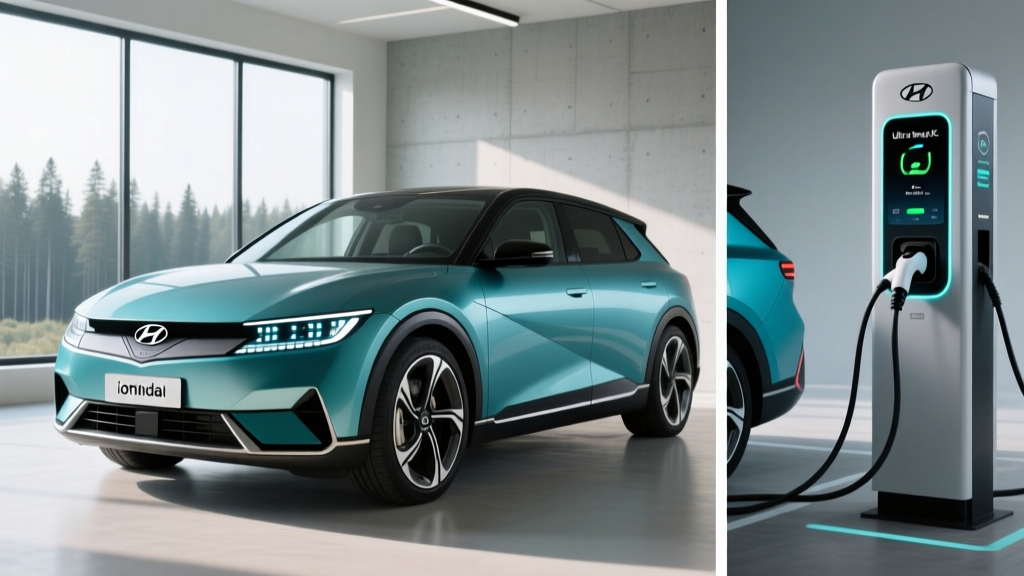
The Hyundai Ioniq 5 has been one of the most compelling mid-size electric crossovers since its launch, and the 2026 model year continues to refine the formula. But for buyers researching whether it actually fits their garage, their family, and their road-trip habits, the details matter far more than the marketing. This guide breaks down every critical Ioniq 5 dimension alongside real-world range data, charging performance, pricing, and tax credit eligibility — the exact numbers you need before signing a purchase agreement.
Exterior and Interior Dimensions: Will the Ioniq 5 Fit Your Life?
The Ioniq 5 sits on Hyundai's E-GMP (Electric Global Modular Platform), which uses a flat skateboard-style battery pack to maximize cabin space relative to its footprint. Here are the exact measurements that matter for garage fitment, parking, and daily usability:
| Dimension | Measurement |
|---|---|
| Overall Length | 182.7 in |
| Overall Width (without mirrors) | 74.4 in |
| Overall Height | 63.0 in |
| Wheelbase | 118.1 in |
| Ground Clearance | 6.1 in |
| Curb Weight (RWD / AWD) | 4,343 lb / 4,619 lb |
| Front Headroom | 39.7 in |
| Rear Headroom | 38.7 in |
| Front Legroom | 41.7 in |
| Rear Legroom | 39.4 in |
| Cargo Volume (behind 2nd row) | 27.2 cu ft |
| Cargo Volume (seats folded) | 59.3 cu ft |
| Frunk (front trunk) | 0.85 cu ft (RWD) / 0.42 cu ft (AWD) |
| Towing Capacity (AWD w/ tow package) | 2,300 lb |
The 118.1-inch wheelbase is the key figure here — it's longer than a Toyota RAV4's wheelbase by nearly 13 inches, which translates directly to that generous 39.4 inches of rear legroom. Adults well over six feet tall can sit behind a tall driver without knee contact. However, the 27.2 cu ft of cargo space behind the second row is modest for the class. A Tesla Model Y offers roughly 30.2 cu ft in the same area, and a Ford Mustang Mach-E provides about 29.7 cu ft. If you regularly haul bulky cargo with passengers aboard, the Ioniq 5's trunk is adequate but not class-leading. Fold the rear seats and the 59.3 cu ft opens up substantially, though it still trails the Model Y's ~72 cu ft maximum.
The frunk (front trunk) is essentially a small storage cubby — useful for charging cables or a laptop bag, but not meaningful cargo space. AWD models sacrifice half of it to accommodate front-axle drivetrain components.
Battery, Range, and Efficiency: EPA Numbers vs. the Real World
The 2026 Ioniq 5 is available with two battery configurations depending on trim and drivetrain:
| Trim / Drivetrain | Battery (usable kWh) | Chemistry | EPA Range | EPA MPGe | EPA kWh/100 mi |
|---|---|---|---|---|---|
| SE Standard Range RWD | 58.0 kWh | NMC | 245 mi | 114 MPGe | 30 |
| SEL / Limited RWD | 84.0 kWh | NMC | 318 mi | 117 MPGe | 29 |
| SEL / Limited / XRT AWD | 84.0 kWh | NMC | 288 mi | 104 MPGe | 32 |
The EPA 318-mile estimate for the Long Range RWD is achieved under mixed city/highway driving at moderate temperatures. In our experience and consistent third-party testing, expect the following adjustments:
- Highway-only (70-75 mph, 70°F): ~260–275 miles — sustained high-speed driving increases aerodynamic drag significantly on this boxy crossover shape.
- Cold weather (below 30°F, mixed driving): ~220–250 miles — battery chemistry slows and cabin heating draws substantial energy, even with the Ioniq 5's standard heat pump.
- City/stop-and-go (70°F): ~310–330 miles — regenerative braking recovers energy efficiently in traffic, sometimes exceeding the EPA estimate.
For AWD models rated at 288 miles EPA, subtract roughly 15–20% for highway or cold-weather scenarios. Plan road trips assuming 240 usable miles between charges on the AWD Long Range in favorable conditions, and 200 miles in winter.
Hyundai uses NMC (nickel manganese cobalt) chemistry across the Ioniq 5 lineup rather than LFP (lithium iron phosphate). NMC delivers higher energy density — which is how Hyundai fits 84 kWh of usable capacity into this footprint — but it carries different long-term care recommendations. Hyundai advises against routinely charging to 100% on NMC packs; setting a daily charge limit to 80% will slow degradation over years of ownership. The heat pump, standard on all trims, meaningfully reduces cold-weather range loss compared to EVs that rely on resistive cabin heating.
For the latest official efficiency data, refer to fueleconomy.gov.
Charging Speed: DC Fast Charging and Home Level 2
Charging speed is where the Ioniq 5's 800-volt E-GMP architecture pays dividends. Most competing EVs in this price range use 400-volt systems, which limits their peak DC fast-charge rate. The Ioniq 5 can accept significantly higher power at compatible chargers.
| Charging Level | Power / Rate | Time / Recovery | Notes |
|---|---|---|---|
| Level 1 (120V household) | ~1.4 kW | ~3–4 mi/hr | Emergency/trickle only; 0–100% in 60+ hours (84 kWh pack) |
| Level 2 (240V home, 48A) | 10.9 kW | ~37 mi/hr; 0–100% in ~8 hrs | Requires NACS connector (2025+ models); 40A circuit minimum |
| DC Fast Charge (peak) | 240 kW (peak) | 10–80% in ~18 min | Requires 350 kW-class charger; charge curve tapers sharply above 80% |
| DC Fast Charge (50 kW station) | 50 kW | 10–80% in ~75 min | Common at older ChargePoint / EVgo stations |
A few critical nuances on the charging curve: the 240 kW peak is achieved between roughly 10% and 45% state of charge (SoC). From 45–65%, the rate typically sustains around 180–190 kW, and from 65–80% it tapers to approximately 120–140 kW. Above 80%, charging slows dramatically to protect battery health — expect 80–100% to take an additional 20+ minutes at rapidly declining rates. This is why road-trip strategy should target 10–80% charging sessions rather than full charges.
For the 2026 model year, the Ioniq 5 ships with the NACS (North American Charging Standard / Tesla-style) connector natively. This grants access to Tesla Supercharger stalls via Hyundai's partnership, dramatically expanding the available fast-charging network beyond Electrify America, EVgo, and ChargePoint. If you're installing a home Level 2 charger, plan for a 60-amp circuit to support the full 48-amp (10.9 kW) onboard charger — a licensed electrician should verify your panel capacity first.
Performance and Drivetrain
| Configuration | Horsepower | Torque (lb-ft) | 0–60 mph | Drivetrain |
|---|---|---|---|---|
| Standard Range RWD | 168 hp | 258 | 7.4 sec | Rear-wheel drive, single motor |
| Long Range RWD | 225 hp | 258 | 6.7 sec | Rear-wheel drive, single motor |
| Long Range AWD | 320 hp | 446 | 4.5 sec | Dual-motor all-wheel drive |
The Long Range AWD is the enthusiast pick — 4.5 seconds to 60 mph in a 4,600-pound crossover is genuinely quick, and the instant torque delivery makes highway merging effortless. The RWD models are less exciting but perfectly adequate for commuting and are noticeably more efficient. The single-motor RWD models also feel lighter through corners thanks to the lower front-axle weight.
Ride quality is a standout. The Ioniq 5 uses a multi-link rear suspension that absorbs road imperfections more gracefully than the torsion-beam setups found in some rivals. Road noise is well-controlled at highway speeds, though the boxy shape does generate some wind noise around the A-pillars above 75 mph.
Pricing, Trims, and Federal Tax Credit Eligibility
| Trim | Drivetrain | Base MSRP | Est. After §30D Credit* |
|---|---|---|---|
| SE Standard Range | RWD | $42,600 | $35,100 |
| SE Long Range | RWD | $46,100 | $38,600 |
| SE Long Range | AWD | $49,600 | $42,100 |
| SEL Long Range | RWD | $49,100 | $41,600 |
| SEL Long Range | AWD | $52,600 | $45,100 |
| Limited | AWD | $58,200 | $50,700 |
| XRT | AWD | $55,500 | $48,000 |
*Prices include destination charge. Federal tax credit estimates assume full §30D eligibility. Final pricing may vary by dealer and model-year adjustments.
- MSRP Cap: SUVs/crossovers must have an MSRP at or below $80,000. All Ioniq 5 trims qualify.
- Buyer Income Cap: Modified adjusted gross income must not exceed $150,000 (single), $225,000 (head of household), or $300,000 (joint filers).
- Battery Sourcing: Critical minerals and battery components must meet phased-in domestic/free-trade-partner sourcing thresholds. Hyundai has shifted significant battery production to the Georgia Metaplant, but verify current-year compliance on the specific VIN with your dealer.
- Point-of-Sale Transfer: The credit can be applied as an upfront discount at the dealership rather than waiting for a tax refund — this effectively reduces your out-of-pocket cost immediately.
- One Credit Per Vehicle: The vehicle must be new, purchased for personal use, and primarily driven in the United States.
Always confirm eligibility for your specific purchase on IRS.gov or consult a tax professional before relying on the credit in your budget.
Tech, Safety, and Driver-Assistance Features
The Ioniq 5's tech suite is comprehensive without being overwhelming. Standard and notable features include:
- Dual 12.3-inch displays: A combined digital cluster and infotainment screen running Hyundai's latest UI with wireless Apple CarPlay and Android Auto.
- Hyundai SmartSense (ADAS): Forward collision-avoidance assist with pedestrian/cyclist detection, blind-spot collision-avoidance, rear cross-traffic collision-avoidance, lane-keeping assist, and highway driving assist (HDA-2) with lane-change assist.
- Highway Driving Assist 2 (HDA-2): A Level 2 driver-assistance system combining adaptive cruise control with stop-and-go and lane-centering. The driver must keep hands on the wheel — this is not an autonomous system.
- Vehicle-to-Load (V2L): The Ioniq 5 can output up to 3.6 kW of AC power through an interior outlet or exterior adapter, enough to run appliances, power tools at a campsite, or provide emergency backup power to essentials during an outage.
- Digital Side Mirrors (available): Camera-based mirrors that reduce drag and improve visibility in rain/night conditions, though some drivers find the screen placement requires adaptation.
- Over-the-Air (OTA) Updates: Firmware, navigation, and feature updates delivered remotely.
Hyundai's Highway Driving Assist 2 is a Level 2 system under SAE J3016 classification. The driver must remain fully engaged — eyes on the road, hands on or near the wheel — at all times. The system assists with steering, acceleration, and braking on marked highways but does not handle construction zones, unmapped roads, or complex urban scenarios. It is not "self-driving."
On safety ratings, the Ioniq 5 earned a 2024 IIHS Top Safety Pick+ award (the highest designation) and a 5-star overall NHTSA rating. Check current ratings at iihs.org and nhtsa.gov.
Pros, Cons, and Who Should Buy the Ioniq 5
- 800V architecture delivers class-leading DC fast-charge speeds (10–80% in ~18 min)
- Spacious rear cabin with 39.4 in of legroom
- NACS connector provides native Supercharger access
- V2L capability (3.6 kW) for camping, job sites, or backup power
- Heat pump standard on all trims — reduces cold-weather range loss
- Strong IIHS and NHTSA safety ratings
- Distinctive retro-futuristic design stands out in a growing segment
- Cargo volume (27.2 cu ft) trails Model Y and Mach-E with seats up
- Frunk is small — especially on AWD models
- No frunk on Standard Range RWD (limited utility)
- Infotainment can lag when running multiple apps simultaneously
- Road noise from the boxy profile at highway speeds
- Rear wiper was absent on earlier model years (added on 2025+ refresh)
- AWD efficiency drops noticeably vs. RWD (288 vs. 318 mi EPA)
- Daily commuters (20–60 mi round trip): The Long Range RWD is ideal — 318 miles of EPA range means charging once or twice a week at home, and the heat pump keeps winter efficiency respectable.
- Families needing rear-seat space: The 39.4-inch rear legroom accommodates rear-facing car seats with a front passenger still comfortable. Cargo space is sufficient for strollers and groceries, though a week-long family road trip will require strategic packing.
- Road-trippers who plan around chargers: The 18-minute 10–80% DC fast-charge time is among the fastest in the segment, making highway travel practical on Electrify America and Supercharger corridors.
- Off-grid/camping enthusiasts: V2L at 3.6 kW powers a campsite — electric grills, lights, laptops — without a generator.
Consider alternatives if: You need maximum cargo capacity (Tesla Model Y), you want a larger frunk (Rivian R1S/R1T), or you prioritize one-pedal driving feel (the Ioniq 5's regen is adjustable but doesn't quite achieve full stop-on-its-own in all conditions without brake pedal input).
Warranty Coverage
| Coverage | Term |
|---|---|
| New Vehicle Limited | 5 years / 60,000 miles |
| Powertrain | 10 years / 100,000 miles |
| EV Battery (capacity retention) | 10 years / 100,000 miles (below 70% SoH triggers replacement) |
| Corrosion Perforation | 7 years / unlimited miles |
| Roadside Assistance | 5 years / unlimited miles |
Hyundai's 10-year/100,000-mile battery warranty is among the best in the industry. The 70% state-of-health threshold is standard — if the battery degrades below 70% of original capacity within the warranty period, Hyundai will repair or replace it. In practice, NMC batteries in Hyundai's E-GMP platform with active thermal management have shown modest degradation in early real-world data — most owners report 90%+ SoH after 50,000 miles when following recommended charging practices (avoiding routine 100% charges and extreme-heat fast-charging without preconditioning).
Frequently Asked Questions
What is the real-world range of the 2026 Hyundai Ioniq 5?
The Long Range RWD is EPA-rated at 318 miles. In real-world highway driving at 70–75 mph in moderate temperatures, expect 260–275 miles. In cold weather (below 30°F), plan for 220–250 miles. The AWD Long Range is EPA-rated at 288 miles, with real-world highway range around 230–250 miles in favorable conditions.
How fast does the Ioniq 5 charge at home and on the road?
At home on a Level 2 (240V, 48A) charger, the Ioniq 5 charges at up to 10.9 kW, adding roughly 37 miles of range per hour and fully charging the 84 kWh pack in about 8 hours. On a 350 kW-class DC fast charger, it peaks at 240 kW and charges from 10–80% in approximately 18 minutes. On a 50 kW DC charger, 10–80% takes roughly 75 minutes.
How much does the Ioniq 5 cost after the federal EV tax credit?
If you qualify for the full $7,500 §30D credit (income within limits, vehicle meets battery-sourcing requirements), the Long Range RWD SE drops from roughly $46,100 MSRP to about $38,600. The Limited AWD drops from approximately $58,200 to $50,700. The credit can be transferred at point of sale as an upfront discount. Verify eligibility on IRS.gov for your specific income and the vehicle's VIN.
Does the 2026 Ioniq 5 qualify for the federal EV tax credit?
All Ioniq 5 trims fall below the $80,000 SUV MSRP cap, and Hyundai's Georgia Metaplant production helps satisfy domestic assembly and battery-sourcing requirements. However, eligibility depends on your income (single filers: MAGI ≤ $150,000; joint filers: ≤ $300,000) and the specific battery-component and critical-minerals sourcing of your vehicle's VIN. Always verify on IRS.gov before purchase.
Is the Ioniq 5 worth buying vs. the Tesla Model Y or Ford Mustang Mach-E?
The Ioniq 5 wins on DC fast-charge speed (18-minute 10–80% vs. roughly 25–30 minutes for most competitors) and rear-seat comfort. The Tesla Model Y offers more cargo space (~30.2 cu ft seats-up, ~72 cu ft max) and access to the Supercharger network — though the Ioniq 5 now has native NACS access to Superchargers as well. The Mach-E is sportier to drive but has a smaller battery and slower peak charging. If fast charging and passenger space top your priorities, the Ioniq 5 is arguably the strongest all-around choice in this segment.
What are the Ioniq 5's biggest drawbacks?
Cargo space is the most common complaint — 27.2 cu ft behind the rear seats trails key rivals. The frunk is small and largely useful only for cables. AWD models sacrifice range and efficiency. The boxy design, while distinctive, generates more wind noise at highway speeds than sleeker alternatives. And while Hyundai's infotainment is functional, it doesn't match Tesla's or Rivian's responsiveness.
Can the Ioniq 5 use Tesla Superchargers?
Yes. Starting with the 2025 model year, the Ioniq 5 ships with a native NACS (Tesla-style) charge port. This means direct access to Tesla Supercharger stalls without an adapter, significantly expanding the fast-charging network available to Ioniq 5 owners on road trips.
Does the Ioniq 5 support vehicle-to-load (V2L) power output?
Yes. The Ioniq 5 can output up to 3.6 kW of AC power through a standard interior 120V outlet and an available exterior V2L adapter. This is sufficient to power a campsite, run power tools, or provide emergency backup for essential home circuits during an outage (though it does not provide full whole-home backup like a V2H system with a compatible bidirectional charger).