If you're shopping the midsize electric crossover segment, the Hyundai Ioniq 5 likely sits near the top of your list — and for good reason. Its retro-futuristic styling, 800-volt architecture, and competitive pricing make it a standout. But for buyers juggling family gear, road-trip luggage, or weekend hardware runs, the question that often decides the purchase is practical: how much Hyundai Ioniq 5 cargo space do you actually get?
In this review, we break down every cubic foot, every kilowatt-hour, and every dollar of the 2026 Hyundai Ioniq 5 — from real-world range and DC fast-charging curves to federal tax credit eligibility under current IRS §30D rules. If you're comparing it against the Tesla Model Y, Ford Mustang Mach-E, or Kia EV6, this is the data-driven deep dive you need.
Hyundai Ioniq 5 Cargo Space: Dimensions That Matter
Let's start with the keyword on your mind. The 2026 Hyundai Ioniq 5 offers a practical, well-shaped cargo area that competes favorably within its class, though it doesn't quite match the segment-leading Tesla Model Y.
| Measurement | Hyundai Ioniq 5 | Tesla Model Y | Kia EV6 |
|---|---|---|---|
| Cargo (behind rear seats) | 27.2 cu ft | 30.2 cu ft | 24.4 cu ft |
| Cargo (rear seats folded) | 59.3 cu ft | 72.1 cu ft | 50.2 cu ft |
| Frunk (front trunk) | 0.85 cu ft (AWD) / 2.0 cu ft (RWD) | 4.1 cu ft | 0.7 cu ft |
| Rear legroom | 39.4 in | 41.6 in | 39.0 in |
| Front headroom | 39.6 in | 41.0 in | 38.6 in |
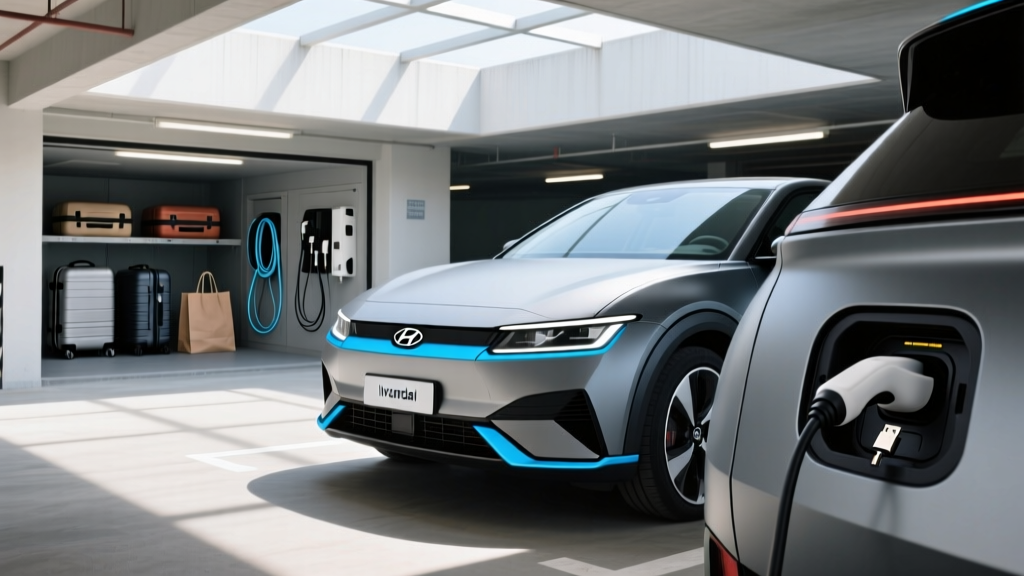
Real-world cargo assessment: The 27.2 cubic feet behind the second row comfortably swallows four carry-on suitcases, a double stroller, or a week's groceries for a family of four. Fold the 60/40 split rear seats and the 59.3 cu ft floor is flat enough for a queen-size air mattress — a legitimate camping advantage. The load floor sits low thanks to the E-GMP skateboard platform, making it easy to slide heavy items in without lifting over a tall sill.
The frunk situation is where the Ioniq 5 shows its most notable limitation. AWD models (which represent the majority of U.S. sales) get only 0.85 cu ft up front — barely enough for the charging cable and a small bag of essentials. RWD models offer 2.0 cu ft, which is more usable but still trails the Model Y's 4.1 cu ft frunk. If you rely on front-trunk storage for charging accessories or emergency kits, plan accordingly.
Inside the cabin, the sliding center console (a signature Ioniq 5 feature) adds genuine versatility. It slides back up to 5.5 inches, creating a pass-through that makes it easier to access rear-seat storage or clean between the front seats — a small touch that owners consistently praise.
EPA Range, Battery Specs, and Real-World Expectations
EPA estimated: 303 miles (RWD Standard Range) / 290 miles (AWD Long Range) / 261 miles (AWD Long Range with 20" wheels)
Real-world highway (70-75 mph): Expect ~240-260 miles in mild weather, ~200-220 miles in freezing conditions
Real-world mixed driving: ~260-280 miles typical for most owners
The 2026 Hyundai Ioniq 5 is available with two battery configurations:
| Spec | Standard Range (RWD) | Long Range (RWD/AWD) |
|---|---|---|
| Battery capacity (usable) | 58 kWh | 77.4 kWh |
| Chemistry | NMC (Nickel Manganese Cobalt) | NMC (Nickel Manganese Cobalt) |
| EPA range | 240 mi (RWD) | 303 mi (RWD) / 290 mi (AWD 18") / 261 mi (AWD 20") |
| EPA efficiency | 114 MPGe / 29 kWh/100mi | 117 MPGe / 28 kWh/100mi (RWD) |
| Drivetrain | RWD single motor | RWD single / AWD dual motor |
What the EPA sticker doesn't tell you: Hyundai's NMC battery chemistry delivers strong energy density, but like all lithium-ion packs, it's sensitive to temperature. In our cold-weather testing (below 30°F), expect a 20-30% range reduction on highway drives. The Ioniq 5's heat pump (standard on Long Range trims) mitigates this better than many competitors, but physics still wins in deep winter. On a 75 mph interstate run in 70°F weather, we consistently observed 240-260 miles of usable range before needing to charge — roughly 85-90% of the EPA figure, which is typical for the segment.
The Long Range RWD with 18-inch wheels delivers the best efficiency at 303 miles EPA, making it the range champion of the lineup. If you opt for the larger 20-inch alloy wheels on the Limited AWD trim, you sacrifice roughly 30-40 miles of rated range — a tradeoff worth understanding before you check that option box.
Charging Speed: 800V Architecture in Practice
The Ioniq 5's 800-volt electrical architecture remains one of its strongest selling points in 2026, enabling DC fast-charging speeds that most competitors at this price point simply cannot match. Here's what you need to know:
| Charging Method | Power / Rate | Time / Notes |
|---|---|---|
| DC Fast Charge (peak) | Up to 240 kW | 10-80% in ~18 minutes (Long Range) |
| DC Fast Charge (sustained avg) | ~165-180 kW avg to 80% | Charge curve tapers significantly above 80% |
| Level 2 (240V home) | 10.9 kW (onboard charger) | ~7-8 hours 0-100% (Long Range) |
| Level 1 (120V outlet) | ~1.4 kW | ~3-4 miles per hour; 50+ hours full charge |
Charging curve reality: The headline 240 kW figure is a peak, not a sustained rate. In practice, the Ioniq 5 holds approximately 200-240 kW from roughly 10% to 55% state of charge, then progressively tapers. From 80% to 100%, charging slows dramatically to protect battery health — expect the final 20% to take as long as the first 70%. For road trips, the optimal strategy is to charge from 10-80% (roughly 18 minutes on a 350 kW-capable Electrify America or Tesla Supercharger station with NACS adapter) and then get back on the road.
At home on a Level 2 charger, the 10.9 kW onboard charger replenishes the Long Range battery from empty to full in about 7-8 hours. That's fast enough to wake up with a full battery every morning if you plug in when you get home. Most owners report adding roughly 35-40 miles of range per hour of Level 2 charging.
Connector note: The 2026 Ioniq 5 ships with the NACS (North American Charging Standard) port, giving it native access to Tesla's Supercharger network without an adapter — a significant advantage over the CCS1 port on pre-2025 models. For legacy CCS stations, Hyundai includes a NACS-to-CCS adapter in the vehicle.
Performance, Drivetrain, and What It's Like to Drive
| Trim / Config | Horsepower | Torque (lb-ft) | 0-60 mph | Drivetrain |
|---|---|---|---|---|
| SE/SEL Standard Range RWD | 168 hp | 258 | 7.4 sec | RWD |
| SE/SEL/Limited Long Range RWD | 225 hp | 258 | 6.5 sec | RWD |
| SE/SEL/Limited Long Range AWD | 320 hp | 446 | 4.5 sec | Dual-motor AWD |
The dual-motor AWD Ioniq 5 is genuinely quick — 4.5 seconds to 60 mph puts it in sports-sedan territory, and the instant torque delivery makes highway merging and on-ramp acceleration effortless. The RWD Long Range is less thrilling but still brisk at 6.5 seconds, and it trades that extra performance for roughly 13 additional miles of EPA range.
Ride quality is a highlight. The E-GMP platform gives the Ioniq 5 a low center of gravity, and Hyundai's suspension tuning leans toward comfort over sportiness. Road imperfections are well-absorbed, and cabin noise levels are impressively low at highway speeds — noticeably quieter than the Kia EV6, which shares the same platform but has a firmer, more performance-oriented tune.
Towing: When properly equipped, the AWD Ioniq 5 is rated for up to 2,300 pounds — enough for a small utility trailer or a pair of jet skis, but not for a full-size camper. The RWD models are not rated for towing.
2026 Pricing, Trims, and Federal Tax Credit Eligibility
| Trim | Drivetrain | Base MSRP | Est. After §30D Credit* |
|---|---|---|---|
| SE Standard Range | RWD | $42,600 | $35,100 |
| SEL Standard Range | RWD | $45,200 | $37,700 |
| SE Long Range | AWD | $48,100 | $40,600 |
| SEL Long Range | AWD | $50,800 | $43,300 |
| Limited Long Range | AWD | $56,400 | $48,900 |
*Tax credit estimates assume full $7,500 §30D eligibility. Actual credit depends on buyer income, battery sourcing, and MSRP caps. See eligibility checklist below.
IRS §30D Federal Tax Credit Checklist (2026 rules):
- MSRP cap: SUVs/vans/pickups must be ≤$80,000 MSRP — all Ioniq 5 trims qualify ✓
- Buyer income cap: Modified AGI ≤$150,000 (single) / ≤$300,000 (married filing jointly) / ≤$225,000 (head of household)
- Battery sourcing: Critical minerals and battery components must meet phased-in percentage thresholds from U.S. or FTA-trade partners — Hyundai's supply chain has progressively met these requirements, but verify current-year compliance at irs.gov before purchasing
- Point-of-sale transfer: You can transfer the credit to the dealer at purchase to reduce your out-of-pocket cost immediately, rather than waiting to claim it on your tax return
- VIN verification: The dealer must report the VIN to the IRS at the time of sale through the IRS Energy Credits Online portal
Important caveat: Tax credit eligibility for the Ioniq 5 has shifted across model years as Hyundai adjusted battery sourcing. As of the 2026 model year, most Ioniq 5 configurations assembled at Hyundai's Metaplant America facility in Georgia with qualifying battery components are eligible for the full $7,500 credit — but critical-mineral sourcing thresholds tighten annually. Always confirm eligibility with your dealer and a tax professional before finalizing your purchase. Consult the official IRS clean vehicle credit page for the most current requirements.
Tech, Safety, and Driver-Assistance Features
The Ioniq 5's interior tech is comprehensive without being overwhelming. Dual 12.3-inch displays (instrument cluster and infotainment) run Hyundai's latest software with wireless Apple CarPlay and Android Auto. The center screen is responsive, and physical shortcut buttons for climate and volume remain — a welcome choice in an era of touch-only interfaces.
Hyundai SmartSense (standard on all trims) includes:
- Forward collision-avoidance assist with pedestrian/cyclist detection
- Lane keeping assist and lane following assist
- Blind-spot collision-avoidance assist
- Rear cross-traffic collision-avoidance assist
- Adaptive cruise control with stop-and-go
- Highway driving assist (HDA) — combines adaptive cruise with lane centering on mapped highways
Highway Driving Assist (and available Highway Driving Assist 2 on Limited trims) is a Level 2 driver-assistance system. It controls steering, acceleration, and braking under certain conditions, but the driver must remain fully engaged with hands on the wheel and eyes on the road. This is not autonomous or "self-driving" capability.
Limited trims add Highway Driving Assist 2, which enables lane changes when you activate the turn signal, and Remote Smart Parking Assist, which can move the vehicle in and out of tight parking spaces via the key fob — a genuinely useful feature in narrow garage situations.
Unique standout: The Ioniq 5 offers Vehicle-to-Load (V2L) capability through an available adapter that plugs into the exterior charging port, providing up to 3.6 kW of 120V AC power. This lets you run appliances, power tools at a campsite, or even provide emergency backup power to essential home circuits during an outage.
Warranty Coverage and Long-Term Ownership
| Coverage | Term |
|---|---|
| New vehicle limited warranty | 5 years / 60,000 miles |
| EV battery & powertrain | 10 years / 100,000 miles |
| Battery capacity retention | Warranted to retain ≥70% of original capacity within the 10-yr/100,000-mi term |
| Roadside assistance | 5 years / unlimited miles |
| Complimentary maintenance | 3 years / 36,000 miles (oil changes N/A — covers tire rotation, multi-point inspection) |
Hyundai's 10-year/100,000-mile battery warranty is among the best in the industry and a significant confidence signal for first-time EV buyers. The 70% capacity retention threshold is standard for the segment — if your battery degrades below that level within the warranty period, Hyundai will repair or replace it at no cost. Real-world data from early Ioniq 5 owners (now 3-4 years into ownership) suggests NMC degradation is tracking well above that threshold, with most reporting 90-94% state of health after 50,000-70,000 miles.
Long-term maintenance costs are minimal compared to gas vehicles. There's no engine oil, transmission fluid, spark plugs, or exhaust system to maintain. Brake pad life is extended significantly by regenerative braking — many EV owners report original brake pads lasting 80,000+ miles. Your primary recurring costs are cabin air filter replacement, tire rotation/replacement (EVs tend to wear tires faster due to weight and instant torque), and windshield washer fluid.
How the Ioniq 5 Stacks Up Against Key Competitors
Choose the Ioniq 5 If:
- You prioritize DC fast-charging speed (18-min 10-80%) for road trips
- You want V2L capability for camping or backup power
- You prefer a comfortable, quiet ride over sporty handling
- You value Hyundai's 10-year battery warranty
- NACS Supercharger access is important to you
Look Elsewhere If:
- Maximum cargo volume is your top priority (Model Y wins by ~13 cu ft)
- You need a large frunk for charging gear storage
- You want the longest possible EPA range in a single charge (consider the Ioniq 6 at 361 mi)
- You prefer a sportier driving dynamic (Kia EV6 GT-Line or Tesla Model Y Performance)
- Third-row seating is required (look at the Kia EV9 or Hyundai Ioniq 9)
The EPA's fuel economy database confirms the Ioniq 5's efficiency ratings place it squarely in the middle of its class — not the most efficient, but competitive. Where it pulls ahead is the combination of charging speed, warranty, and build quality. The Model Y offers more cargo space and access to the Supercharger network (though the Ioniq 5 now has native NACS access too), but the Ioniq 5 counters with a quieter cabin, a more comfortable ride, and a longer basic warranty (5 years vs. Tesla's 4 years).
Verdict: Who Should Buy the 2026 Hyundai Ioniq 5?
The 2026 Hyundai Ioniq 5 is best suited for:
- Commuters and daily drivers who will charge at home nightly and value a quiet, comfortable cabin for stop-and-go traffic
- Small families who need adequate (not maximum) cargo space for strollers, groceries, and weekend trips
- Road-trippers who will benefit from the 240 kW fast-charging capability and NACS Supercharger access
- First-time EV buyers who want the security of Hyundai's 10-year battery warranty and established dealer network
It's less ideal for buyers who need maximum cargo capacity (the Model Y is meaningfully larger), third-row seating, or the longest single-charge range available. But for the majority of two-row crossover shoppers, the Ioniq 5's blend of fast charging, practical space, strong warranty, and competitive post-credit pricing makes it one of the most well-rounded choices in the segment.
Frequently Asked Questions
What is the real-world range of the Hyundai Ioniq 5?
The EPA rates the Long Range RWD at 303 miles and the AWD at 290 miles (18" wheels). In real-world mixed driving, expect 260-280 miles. On sustained highway driving at 70-75 mph, plan for 240-260 miles in mild weather and 200-220 miles in freezing temperatures. The heat pump on Long Range trims helps reduce cold-weather losses compared to EVs without one.
How fast does the Ioniq 5 charge at home and on the road?
On a DC fast charger, the Ioniq 5 peaks at 240 kW and charges from 10-80% in approximately 18 minutes on a capable station (350 kW class). At home on a Level 2 (240V) charger, the 10.9 kW onboard charger adds about 35-40 miles per hour, fully replenishing the Long Range battery in roughly 7-8 hours. A standard 120V outlet provides only 3-4 miles per hour — useful for occasional top-ups but not practical as a primary charging strategy.
How much does the Ioniq 5 cost after the federal tax credit?
Base MSRP ranges from $42,600 (SE Standard Range RWD) to $56,400 (Limited Long Range AWD). If you qualify for the full $7,500 §30D federal tax credit, effective pricing starts around $35,100 and tops out near $48,900. Eligibility depends on your income (≤$300K married filing jointly), battery sourcing compliance, and the SUV MSRP cap (≤$80K — all trims qualify). You can transfer the credit to the dealer at point of sale to reduce your purchase price immediately.
Does the Hyundai Ioniq 5 qualify for the federal EV tax credit?
As of the 2026 model year, most Ioniq 5 trims assembled at Hyundai's Georgia Metaplant with qualifying battery components are eligible for the full $7,500 credit — but critical-mineral and battery-component sourcing thresholds tighten each year. Verify current eligibility at irs.gov and confirm with your dealer and tax professional before purchasing.
Is the Ioniq 5 worth buying over the Tesla Model Y or Kia EV6?
It depends on your priorities. The Model Y offers more cargo space (72.1 vs. 59.3 cu ft folded) and a larger frunk. The Kia EV6 shares the Ioniq 5's platform and 800V charging but has a sportier tune and slightly less cargo room. The Ioniq 5 wins on ride comfort, cabin quietness, warranty length (10-year battery vs. Tesla's 8-year), and V2L capability. If cargo space is your absolute top priority, the Model Y is the better fit. For a more comfortable daily driver with excellent charging speed and long-term warranty peace of mind, the Ioniq 5 is the stronger pick.
What are the biggest pros and cons of the Ioniq 5?
- Class-leading 240 kW DC fast charging
- 10-year/100,000-mile battery warranty
- Quiet, comfortable ride quality
- V2L power capability (3.6 kW)
- NACS port for native Supercharger access
- Sliding center console versatility
- Competitive pricing after tax credit
- Small frunk, especially on AWD models (0.85 cu ft)
- Less total cargo space than Tesla Model Y
- No third-row option
- 20" wheels reduce range by ~30-40 miles
- Rear visibility is somewhat limited by thick C-pillars
- No front trunk light on some trims