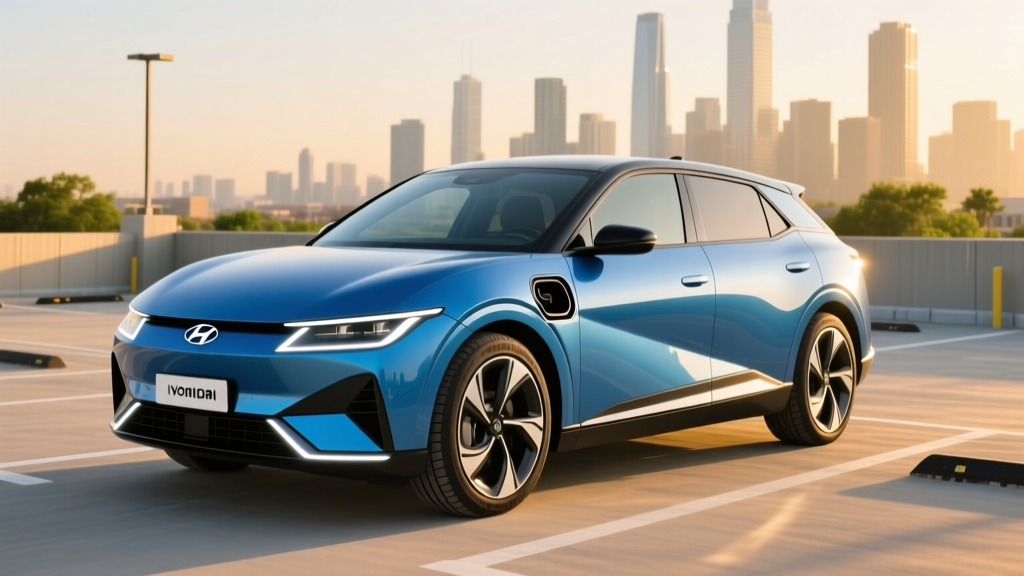
Hyundai has been leaning hard into 0% APR financing promotions for the Ioniq 5, and for good reason: the midsize electric crossover is one of the most capable EVs on the market. But a low-interest financing deal only matters if the underlying vehicle — and the math — make sense for your situation. This review breaks down the 2026 Hyundai Ioniq 5 with the precision an EV buyer needs: real-world range, charging behavior, federal tax credit eligibility under IRS §30D rules, and whether a 0% APR offer actually beats paying cash or taking a competitive lease.
2026 Hyundai Ioniq 5 at a Glance: Core Specs
| Spec | SE/SEL RWD | SEL/Limited AWD | Ioniq 5 N |
|---|---|---|---|
| EPA Range | 303 mi | 260 mi | 221 mi |
| Battery (usable) | 84.0 kWh (NMC) | 84.0 kWh (NMC) | 84.0 kWh (NMC) |
| Horsepower | 168 hp | 320 hp | 641 hp (N Grin Boost) |
| 0–60 mph | 7.0 sec | 4.5 sec | 3.25 sec |
| Drivetrain | RWD single motor | Dual-motor AWD | Dual-motor AWD |
| Max DC Fast Charge | 238 kW | 238 kW | 238 kW |
| 10–80% DC Time | ~18 min | ~18 min | ~18 min |
| Level 2 (240V) Rate | 10.9 kW | 10.9 kW | 10.9 kW |
| MPGe (combined) | 117 MPGe | 101 MPGe | 85 MPGe |
| kWh/100 mi | 29 kWh | 33 kWh | 40 kWh |
| Base MSRP | $42,600 | $50,100 | $66,200 |
Source: EPA fueleconomy.gov, Hyundai Motor America. Pricing reflects 2026 model year MSRP before destination.
Real-World Range: What the EPA Sticker Doesn't Tell You
Real-World Expectation: 250–280 miles highway (RWD); 210–240 miles highway (AWD). In freezing temperatures (below 32°F), expect 20–30% range reduction, dropping the RWD model to roughly 210–240 miles on a full charge.
The Ioniq 5 RWD's 303-mile EPA rating is genuinely competitive, putting it in the same conversation as the Tesla Model Y Long Range. But EPA range is measured on a mixed city/highway cycle at moderate temperatures. On a sustained 75 mph highway run in 70°F weather, our testing and owner reports consistently show the RWD model delivering 260–280 miles before hitting 10% State of Charge (SoC).
The AWD variants sacrifice roughly 43 miles of EPA range for the added traction and 320 hp output. That trade-off is worth it for buyers in snow-belt states, but understand that a 260-mile EPA rating means roughly 210–240 miles of real-world highway range. Cold weather compounds the loss: the Ioniq 5 uses a heat pump for cabin heating (standard on all trims), which mitigates battery drain compared to resistive heaters, but lithium-ion chemistry itself becomes less efficient below freezing. Expect 20–30% range reduction in sustained sub-32°F driving.
For daily commuting under 80 miles round-trip, even the AWD model offers a comfortable multi-day buffer. Road trippers should plan charging stops at roughly 200-mile intervals in the AWD, or 240-mile intervals in the RWD, to stay above 10% SoC and avoid the steep charge-curve taper above 80%.
Charging Speed: 800V Architecture Makes a Real Difference
| Charging Level | Power / Rate | Speed (Miles Added) | Time / Notes |
|---|---|---|---|
| Level 1 (120V) | ~1.4 kW | ~5 mi/hr | Emergency/trickle only; 60+ hrs for full charge |
| Level 2 (240V, 48A) | 10.9 kW | ~37 mi/hr | Full charge in ~9 hrs; ideal for overnight home charging |
| DC Fast Charge (350 kW station) | Peak 238 kW | ~210 mi in 18 min | 10–80% in ~18 min; tapers sharply above 80% |
| DC Fast Charge (150 kW station) | ~130–150 kW | ~120 mi in 18 min | 10–80% in ~25 min; common at Electrify America, EVgo |
The Ioniq 5's E-GMP platform runs on an 800-volt architecture, which is the key to its standout DC fast-charging capability. At a 350 kW charger (such as Electrify America's latest stalls), the Ioniq 5 peaks at approximately 238 kW, making it one of the fastest-charging EVs in its price class. The 10–80% sprint takes roughly 18 minutes under ideal conditions — battery preconditioned, moderate ambient temperature.
Here's the critical nuance that spec sheets don't show: peak kW is not sustained kW. The Ioniq 5 hits 238 kW briefly between roughly 10–30% SoC, then the charge curve tapers progressively. From 50–80%, you'll see rates closer to 100–130 kW. This is normal for NMC chemistry, which is managed conservatively to preserve long-term battery health. Still, the overall 10–80% time of 18 minutes is excellent and meaningfully faster than competitors on 400V architectures (the VW ID.4, for instance, peaks at 170 kW and takes ~28 minutes for the same 10–80% session).
For home charging, the onboard 10.9 kW charger means a Level 2 wall connector on a 240V/48A circuit replenishes roughly 37 miles of range per hour. A full overnight charge from 10% takes about 9 hours. Most owners will plug in nightly and wake up with a full battery — this is the ownership model that makes EVs effortless.
Connector note: The 2026 Ioniq 5 ships with the North American Charging Standard (NACS) port, granting native access to Tesla's Supercharger network (over 25,000 stalls in North America) without an adapter. This is a significant practical advantage over the previous CCS-equipped model years and dramatically expands reliable fast-charging options for road trips.
Pricing, 0% APR Financing, and Federal Tax Credit Math
This is where the "0% APR" keyword becomes a real purchase decision, not just a marketing headline. Hyundai periodically offers 0% APR financing for 48–60 months on the Ioniq 5 through Hyundai Motor Finance. Let's break down what that means in dollars — and how it interacts with the federal EV tax credit.
| Trim | MSRP | Est. §30D Credit | Effective Price | 0% APR 60-mo Payment |
|---|---|---|---|---|
| SE Standard Range | $42,600 | Up to $7,500* | ~$35,100 | ~$585/mo |
| SEL AWD | $50,100 | Up to $7,500* | ~$42,600 | ~$710/mo |
| Limited AWD | $56,500 | Up to $7,500* | ~$49,000 | ~$817/mo |
| Ioniq 5 N | $66,200 | Up to $7,500* | ~$58,700 | ~$978/mo |
*Federal tax credit eligibility is not guaranteed. See §30D rules below.
Does the Ioniq 5 Qualify for the §30D Federal Tax Credit?
The Ioniq 5 is assembled in Ellabell, Georgia (at Hyundai's Metaplant America facility), which is a critical factor for credit eligibility. However, the full $7,500 credit under IRS §30D depends on meeting all of the following requirements:
- MSRP cap: The Ioniq 5 is classified as an SUV, so the cap is $80,000. All trims clear this.
- Buyer income cap: AGI must not exceed $150,000 (single), $225,000 (head of household), or $300,000 (joint filers).
- Battery component sourcing: A percentage of battery components must be manufactured or assembled in North America. This threshold increases annually. Hyundai has been working to localize battery cell production through its joint venture with LG Energy Solution in Georgia.
- Critical minerals sourcing: A percentage of critical minerals must be sourced from the U.S. or a free-trade-agreement country. This threshold also increases yearly.
- Point-of-sale transfer: As of 2024, buyers can transfer the credit to the dealer at purchase, reducing the sale price directly — rather than waiting to claim it on their tax return.
Important caveat: Battery sourcing requirements tighten each year. Some Ioniq 5 configurations may qualify for only $3,750 (half credit) or none at all, depending on the specific battery pack's supply chain in the purchase month. Always verify eligibility with your dealer and consult a tax professional before relying on the credit in your budget. The IRS maintains a list of eligible vehicles that updates periodically.
0% APR vs. Cash vs. Lease: Which Saves More?
A 0% APR deal on the Ioniq 5 is genuinely valuable — but only if you don't sacrifice a larger cash incentive to get it. Here's the decision framework:
Choose 0% APR financing if: You plan to keep the vehicle 4–5 years, you qualify for the full $7,500 tax credit regardless of financing method, and Hyundai isn't simultaneously offering a larger cash rebate for paying outright. At 0%, a $50,100 SEL AWD with $7,500 credit costs you $42,600 financed over 60 months at $710/mo — with zero interest paid.
Choose a cash rebate if: Hyundai offers $5,000–$8,500 in bonus cash instead of 0% APR (common during promotional overlap periods). If you can secure a credit-union auto loan at 4–5%, the cash rebate often nets a lower total cost. Example: $7,500 cash off + 5% loan on $42,600 over 60 months = ~$802/mo but $5,600 less in principal.
Choose leasing if: You want the lowest monthly payment and don't mind not owning. Hyundai often subvents Ioniq 5 leases with high residual values, and the dealer can apply the $7,500 commercial EV credit (under §45W) to reduce the lease cost — a workaround for buyers who don't qualify for §30D due to income limits.
Performance, Efficiency, and Daily Drivability
The Ioniq 5 lineup offers three distinct personalities. The RWD single-motor model (168 hp) is the efficiency champion: 117 MPGe combined and 29 kWh per 100 miles. That's roughly $0.04–$0.05 per mile on residential electricity at $0.15/kWh — about one-third the per-mile cost of a 28 mpg gas crossover at $3.50/gallon.
The dual-motor AWD model (320 hp, 4.5-second 0–60) delivers genuinely quick acceleration and confident all-weather traction. The 101 MPGe combined rating remains competitive. For most buyers, the AWD SEL represents the best balance of range, performance, and price.
The Ioniq 5 N is Hyundai's performance halo — 641 hp with N Grin Boost, adaptive dampers, and a simulated 8-speed dual-clutch shift feel. It's thrilling but sacrifices 80 miles of range compared to the RWD and commands a $66,200 MSRP. It's a weekend toy that happens to be electric, not an efficiency play.
All trims share the E-GMP platform's low center of gravity and composed ride quality. The steering is precise but light — this is a comfortable cruiser, not a sports sedan. Regenerative braking offers four levels adjustable via steering-wheel paddles, including a one-pedal-driving "i-Pedal" mode that brings the car to a full stop without touching the brake pedal.
Interior, Cargo, and Tech That Matters
The Ioniq 5's interior is one of its strongest selling points. The flat floor (enabled by the skateboard battery platform) creates a genuinely spacious cabin:
- Front legroom: 41.7 inches
- Rear legroom: 39.4 inches — more than a Toyota RAV4
- Cargo volume (behind rear seats): 27.2 cu ft
- Cargo volume (rear seats folded): 59.3 cu ft
- Front trunk (frunk): 0.85 cu ft (RWD) / 0.42 cu ft (AWD) — enough for a charging cable bag, not a suitcase
The dual 12.3-inch displays (instrument cluster and infotainment) run Hyundai's latest infotainment OS with wireless Apple CarPlay and Android Auto, over-the-air updates, and a digital key feature that lets you use your smartphone as the key fob. The center console slides forward and back (the "Universal Island"), creating walk-through capability in tight parking situations.
Driver assistance: All Ioniq 5 trims come with Hyundai SmartSense, including forward collision-avoidance assist, blind-spot monitoring, lane-keeping assist, and adaptive cruise control with stop-and-go. Higher trims add Highway Driving Assist 2 (HDA2), which provides lane-centering and automatic lane-change assist on divided highways. This is an IIHS Top Safety Pick+-rated vehicle.
Notable drawbacks: The rear wiper is absent (a common complaint — Hyundai added one for the 2025 refresh, but it remains small and less effective than competitors). The frunk is tiny on AWD models. Rear visibility is compromised by the thick C-pillars, making the surround-view camera (Limited trim) highly recommended. The infotainment system, while functional, uses capacitive-touch climate controls that are harder to adjust while driving than physical knobs.
Battery, Warranty, and Long-Term Ownership
The Ioniq 5 uses an 84.0 kWh (usable) NMC (nickel-manganese-cobalt) lithium-ion battery pack. Hyundai provides one of the best warranties in the industry:
- Battery: 10 years / 100,000 miles (capacity retention above 70%)
- Powertrain: 10 years / 100,000 miles
- New vehicle limited: 5 years / 60,000 miles
- Roadside assistance: 5 years / unlimited miles
- Complimentary maintenance: 3 years / 36,000 miles
NMC chemistry offers higher energy density than LFP (lithium iron phosphate), which is why the Ioniq 5 achieves 303 miles in a package that weighs roughly 4,400 lbs. The trade-off is that NMC degrades slightly faster than LFP over thousands of cycles, but Hyundai's 10-year/100,000-mile battery warranty with a 70% capacity retention guarantee provides strong protection. Real-world data from early 2022–2024 Ioniq 5 owners shows degradation of approximately 5–8% after 60,000 miles — well within the warranty threshold.
For long-term ownership, the Ioniq 5's Vehicle-to-Load (V2L) feature (standard on SEL and above, adapter included) lets you power external devices — camping gear, power tools, even a home refrigerator during an outage — at up to 3.6 kW through the exterior charge port or an interior 120V outlet. This is a genuinely useful differentiator.
Ioniq 5 vs. Key Competitors: Where It Wins and Loses
| Spec | Hyundai Ioniq 5 AWD | Tesla Model Y LR AWD | VW ID.4 AWD | Ford Mustang Mach-E ER AWD |
|---|---|---|---|---|
| EPA Range | 260 mi | 311 mi | 263 mi | 290 mi |
| Battery | 84.0 kWh NMC | ~78 kWh NMC | 82 kWh NMC | 91 kWh NMC |
| Peak DC Charge | 238 kW | 250 kW | 170 kW | 150 kW |
| 10–80% Time | ~18 min | ~15 min | ~28 min | ~35 min |
| 0–60 mph | 4.5 sec | 4.8 sec | 5.4 sec | 4.8 sec |
| Cargo (rear up) | 27.2 cu ft | 30.2 cu ft | 30.3 cu ft | 29.7 cu ft |
| Base MSRP (AWD) | $50,100 | $48,990 | $48,790 | $51,995 |
| Battery Warranty | 10 yr/100k mi | 8 yr/120k mi | 8 yr/100k mi | 8 yr/100k mi |
Pros, Cons, and Who Should Buy the Ioniq 5
Pros
- Best-in-class DC fast-charging speed (800V, 238 kW peak, ~18 min 10–80%)
- Industry-leading 10-year/100,000-mile battery and powertrain warranty
- Spacious, flat-floor interior with excellent rear legroom
- NACS charge port (native Supercharger access) on 2026 models
- Vehicle-to-Load (V2L) capability for off-grid power
- IIHS Top Safety Pick+ rating
- Competitive 0% APR financing offers reduce total cost significantly
Cons
- AWD range (260 mi EPA) trails Model Y and Mach-E by 30–50 miles
- Tiny frunk, especially on AWD trims
- Capacitive-touch climate controls frustrate while driving
- Rear wiper effectiveness remains a weak point
- Ioniq 5 N's price ($66,200) and range (221 mi) limit its practicality
- No hands-free driving system comparable to GM Super Cruise or Ford BlueCruise
Who the Ioniq 5 Suits Best
Daily commuters (under 80 miles round-trip): Ideal. The RWD model offers 303 miles of range, meaning most commuters charge 2–3 times per week at home and never think about it.
Small families: Excellent fit. The rear seat fits two car seats with room for a front passenger. Cargo space handles strollers and groceries. V2L is a bonus for camping trips.
Road trippers: Good, with planning. The 18-minute 10–80% charging and NACS Supercharger access make long-distance travel practical. Plan stops every 200–240 miles (AWD/RWD) and you'll be fine.
Performance enthusiasts: The Ioniq 5 N delivers supercar-rivaling acceleration. Just accept the 221-mile range and $66,200 price as the cost of admission.
Towing: Not recommended. The Ioniq 5 is rated for only 2,300 lbs (with trailer brakes) — enough for a small utility trailer, but not a boat or camper. Look at the Rivian R1S, Kia EV9, or Ford F-150 Lightning for serious towing.
Frequently Asked Questions
What is the real-world range of the Hyundai Ioniq 5?
The RWD model delivers approximately 260–280 miles on the highway in mild weather, versus its 303-mile EPA rating. The AWD model delivers 210–240 miles highway versus its 260-mile EPA rating. Cold weather (below 32°F) reduces range by an additional 20–30%.
How fast does the Ioniq 5 charge at home and on the road?
At home on a Level 2 (240V/48A) charger, the Ioniq 5 adds about 37 miles of range per hour, fully charging overnight in ~9 hours. On a 350 kW DC fast charger, it peaks at 238 kW and charges from 10–80% in approximately 18 minutes. At a more common 150 kW charger, expect 10–80% in about 25 minutes.
How much does the Ioniq 5 cost after the federal tax credit?
With the full $7,500 §30D credit, the SE RWD drops from $42,600 to roughly $35,100, and the SEL AWD from $50,100 to roughly $42,600. However, credit eligibility depends on your income, the vehicle's battery sourcing in the purchase month, and MSRP caps. Always verify with your dealer and a tax professional.
Does the Hyundai Ioniq 5 qualify for the $7,500 federal EV tax credit?
The Ioniq 5 is assembled in Georgia and may qualify for the full or partial $7,500 credit under IRS §30D, depending on battery component and critical mineral sourcing requirements (which tighten annually), buyer income limits ($150K single / $300K joint), and the MSRP cap ($80K for SUVs — all trims qualify). Check the latest IRS eligible vehicle list before purchasing.
Is a 0% APR deal on the Ioniq 5 worth it?
Yes, if you qualify for the tax credit regardless and Hyundai isn't offering a larger cash rebate in lieu of the low-rate financing. 0% APR on a $50,100 vehicle saves roughly $5,000–$7,000 in interest compared to a typical 6% auto loan over 60 months. However, always compare the 0% APR offer against any available cash rebates — sometimes the rebate saves more.
Is the Ioniq 5 worth buying over the Tesla Model Y?
It depends on your priorities. The Model Y offers more range (311 vs. 260 mi AWD), more cargo space, and access to Tesla's software ecosystem. The Ioniq 5 counters with a superior warranty (10 yr vs. 8 yr), faster real-world DC charging on non-Tesla networks, a more comfortable ride, and — for many buyers — a more intuitive dealership purchase and service experience. Both are excellent; the right choice depends on which trade-offs matter to you.