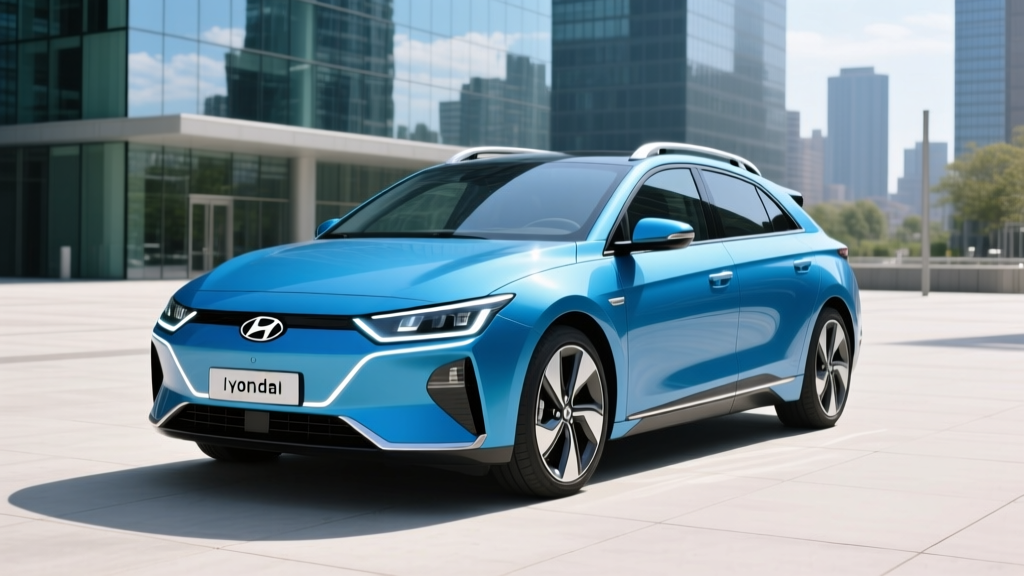
The compact electric crossover segment is about to get a new contender. The Hyundai Ioniq 3 — a subcompact-to-compact battery-electric SUV positioned below the Ioniq 5 — has been confirmed for global markets, and US buyers are watching closely. If you've been searching for information on the Hyundai Ioniq 3 USA availability, you're not alone: this model targets one of the most competitive price points in the EV market, aiming to undercut the Ioniq 5 while delivering competitive range and Hyundai's proven E-GMP platform technology.
As of early 2026, Hyundai has not yet opened US order books for the Ioniq 3. What follows is a comprehensive preview based on confirmed international specifications, Hyundai's North American product roadmap statements, and E-GMP platform data. All specs marked as projected or estimated are subject to change when the US-spec model is officially announced.
What Is the Hyundai Ioniq 3?
The Ioniq 3 slots into Hyundai's Ioniq EV sub-brand as the entry-level electric crossover, sitting below the mid-size Ioniq 5 and the larger Ioniq 7 (three-row SUV). It rides on a version of Hyundai Motor Group's E-GMP (Electric Global Modular Platform), the same skateboard architecture underpinning the Ioniq 5, Ioniq 6, Kia EV6, and Genesis GV60.
Where the Ioniq 5 targets the Tesla Model Y and Ford Mustang Mach-E, the Ioniq 3 aims squarely at the growing subcompact EV crossover space — think Volvo EX30, Kia EV3, and potentially a future Tesla Model 2 competitor. Hyundai's goal: deliver 250+ miles of range, DC fast charging, and a modern tech suite at a starting price that undercuts the Ioniq 5 by several thousand dollars.
For the US market, the Ioniq 3 would likely be imported initially (from Hyundai's Ulsan plant in South Korea), though Hyundai's new Metaplant America facility in Georgia could eventually produce it stateside — a critical factor for federal tax credit eligibility under current battery-sourcing rules.
Projected Range, Battery, and Efficiency
Based on confirmed international specs and the E-GMP platform's scalable battery options, the US-spec Hyundai Ioniq 3 is expected to offer a single long-range battery configuration:
| Specification | Projected Figure |
|---|---|
| Battery Chemistry | NMC (Nickel Manganese Cobalt) — high energy density variant |
| Usable Battery Capacity | ~58–65 kWh (estimated) |
| EPA Estimated Range | ~250–280 miles (projected, not EPA-certified) |
| Efficiency | ~120–130 MPGe combined (estimated) |
| Energy Consumption | ~26–28 kWh/100 mi (estimated) |
- Highway-only (70–75 mph): ~210–240 miles (aerodynamic drag reduces efficiency at sustained speed)
- City/mixed driving: ~250–280 miles (regenerative braking recovers energy in stop-and-go traffic)
- Cold weather (below 32°F / 0°C): ~180–220 miles (battery chemistry slows, cabin heating draws power; a heat pump — expected as standard — mitigates some loss)
Hyundai is expected to equip the Ioniq 3 with a heat pump as standard or widely available equipment — a critical feature for cold-climate buyers that preserves range by efficiently heating the cabin without relying solely on resistive electric heaters. The Ioniq 5's heat pump has proven effective in real-world winter testing, and the Ioniq 3 should benefit from the same thermal management system.
Charging Speed: DC Fast Charge and Home Level 2
Charging speed is where the E-GMP platform has consistently impressed, and the Ioniq 3 should inherit its 800-volt architecture — a significant advantage in a segment where most competitors still use 400-volt systems.
| Charging Level | Power / Rate | Time / Speed |
|---|---|---|
| DC Fast Charge (Peak) | ~150 kW (projected, 800V architecture) | 10–80% in ~18–22 minutes (estimated) |
| DC Fast Charge (Sustained Avg) | ~100–120 kW average to 80% | Charge curve tapers above 60% SoC |
| Level 2 Home (240V) | ~10.9 kW (onboard charger) | ~30–35 miles of range per hour; full charge in ~6–7 hours |
| Level 1 (120V) | ~1.4 kW | ~3–4 miles of range per hour (emergency/trickle only) |
Understanding the charge curve: The peak 150 kW rate is achieved at low state of charge (roughly 10–40% SoC) when the battery is preconditioned. As the battery fills, the charge rate tapers to protect cell longevity — this is normal for all lithium-ion EVs and not unique to Hyundai. The 800V architecture means the Ioniq 3 can sustain higher charge rates for longer than 400V competitors, which is why the 10–80% time is competitive despite a lower peak kW figure than some larger-battery EVs.
Connector: The US-spec Ioniq 3 is expected to ship with a NACS (North American Charging Standard) port, consistent with Hyundai's 2025+ transition to Tesla's connector format for North American models. This grants access to Tesla Supercharger stations via native plug — a major public-charging network advantage. For legacy CCS stations, Hyundai is expected to provide or offer a CCS-to-NACS adapter.
Home charging reality: Most Ioniq 3 owners will charge primarily at home on a Level 2 (240V) circuit. At ~10.9 kW, a full overnight charge from 20% to 100% takes roughly 7 hours — easily achievable with a standard 48-amp hardwired home charger on a 60-amp circuit. Budget $500–$1,500 for a quality Level 2 home charger and professional installation (assuming your electrical panel has capacity; a panel upgrade can add $1,000–$3,000).
Performance and Drivetrain
| Metric | RWD (Base) | AWD (Projected) |
|---|---|---|
| Drivetrain | Rear-Wheel Drive, single motor | Dual-Motor AWD |
| Horsepower | ~168–201 hp | ~300+ hp (estimated) |
| 0–60 mph | ~7.5–8.0 seconds | ~5.0–5.5 seconds |
| Top Speed | ~115 mph (electronically limited) | ~120 mph |
| Towing Capacity | Not yet confirmed (likely ~1,500–2,200 lbs if rated) | TBD |
The RWD single-motor variant will be the volume seller and range-maximizer, prioritizing efficiency over performance. The AWD dual-motor option (if offered in the US — Hyundai may limit it to certain trims) will provide all-weather traction and significantly quicker acceleration at the cost of ~15–20 miles of range.
Hyundai's E-GMP platform delivers a low center of gravity (battery pack mounted under the floor) and near-50/50 weight distribution in RWD form. Expect composed, confidence-inspiring handling rather than sports-car dynamics — this is a family-oriented crossover, not a performance EV.
Interior Space, Cargo, and Technology
The Ioniq 3 is smaller than the Ioniq 5, but Hyundai's E-GMP platform maximizes interior volume thanks to a flat floor and short overhangs. Projected dimensions based on global-spec data:
- Wheelbase: ~104–106 inches
- Overall Length: ~172–178 inches (subcompact-to-compact footprint)
- Rear Legroom: ~37–39 inches (estimated — competitive for the segment)
- Cargo Volume (behind rear seats): ~18–22 cu ft
- Cargo Volume (rear seats folded): ~45–52 cu ft
- Frunk (Front Trunk): Small storage compartment expected (~0.8–1.5 cu ft) — useful for charging cables
Infotainment: Expect Hyundai's latest ccNC (Connected Car Navigation Cockpit) system with a 12.3-inch touchscreen, wireless Apple CarPlay and Android Auto, over-the-air (OTA) software updates, and Hyundai's Digital Key 2 (phone-as-key via NFC/UWB).
Driver Assistance (ADAS): The Ioniq 3 should come equipped with Hyundai SmartSense, including:
- Forward Collision-Avoidance Assist with pedestrian/cyclist detection
- Blind-Spot Collision-Avoidance Assist
- Rear Cross-Traffic Collision-Avoidance Assist
- Lane Keeping Assist and Lane Following Assist
- Highway Driving Assist (HDA) — SAE Level 2 driver assistance (requires driver engagement at all times; this is not self-driving)
- Navigation-based Smart Cruise Control (if equipped with navigation)
Notable Drawbacks to Watch For:
- Rear visibility may be compromised by thick C-pillars (common in modern crossover design — a rear camera mitigates this)
- Entry-level trims may use cloth upholstery and manual seat adjustments to hit price targets
- No third row — families needing 6+ seats should look at the Ioniq 7 or Kia EV9
- Towing capacity, if offered, will be modest — not a heavy-haul vehicle
Pricing, Trims, and Federal Tax Credit Eligibility
Hyundai has not announced US pricing for the Ioniq 3. However, based on its positioning below the Ioniq 5 (which starts around $42,000 for 2026) and competitive pressure from the Volvo EX30, Kia EV3, and upcoming affordable EVs, we project:
| Trim Level | Projected MSRP | Key Features |
|---|---|---|
| SE (Base) | ~$30,000–$33,000 | RWD, ~250 mi range, SmartSense ADAS, 12.3" touchscreen |
| SEL (Mid) | ~$34,000–$37,000 | Adds heated seats, power liftgate, HDA, wireless charging pad |
| Limited (Top) | ~$38,000–$42,000 | Leather, ventilated seats, HUD, premium audio, AWD option |
Federal EV Tax Credit (§30D) — Critical Considerations
Whether the Ioniq 3 qualifies for the federal EV tax credit (up to $7,500) under IRS §30D depends on several factors that are still in flux for this model:
- MSRP Cap: SUVs/crossovers must have an MSRP at or below $80,000 — the Ioniq 3 easily clears this threshold.
- Buyer Income Cap: Adjusted gross income must not exceed $150,000 (single), $225,000 (head of household), or $300,000 (joint filers).
- Battery Sourcing Requirements: This is the critical variable. As of 2026, the credit is split into two halves ($3,750 each):
- $3,750 for critical minerals sourced from the US or FTA partners
- $3,750 for battery components manufactured in North America
- Point-of-Sale Transfer: Under current rules, eligible buyers can transfer the credit to the dealer at purchase, reducing the purchase price immediately rather than waiting for a tax refund.
For the most current eligibility details, consult the IRS clean vehicle credits page and confirm with a tax professional before purchasing. Hyundai will also publish eligibility information when the US-spec model is finalized.
Warranty and Ownership Costs
Hyundai offers one of the strongest warranty packages in the industry, and the Ioniq 3 should inherit the brand's EV-specific coverage:
- Battery Warranty: 8 years / 100,000 miles (whichever comes first), covering defects and capacity loss below a specified threshold (typically 70% state of health)
- Powertrain Warranty: 10 years / 100,000 miles — covers electric motor, reduction gear, and related components
- New Vehicle Limited Warranty: 5 years / 60,000 miles bumper-to-bumper
- Roadside Assistance: 5 years / unlimited miles
- Complimentary Maintenance: 3 years / 36,000 miles (oil changes aren't needed, but tire rotations, cabin filter replacements, and inspections are covered)
Total Cost of Ownership (TCO) Outlook: EVs typically cost less to fuel and maintain than gasoline equivalents, but insurance premiums can be 15–25% higher for EVs due to repair costs. The Ioniq 3's lower MSRP should keep insurance more affordable than pricier EVs. Electricity costs vary by region, but at a national average of ~$0.16/kWh, charging the Ioniq 3 at home would cost roughly $0.04–$0.05 per mile — compared to ~$0.12–$0.15/mile for a 30 MPG gasoline crossover at $3.50/gallon.
How the Ioniq 3 Compares to Key Rivals
| Vehicle | Est. Range (EPA) | Max DC Charge | Starting MSRP | Platform Voltage |
|---|---|---|---|---|
| Hyundai Ioniq 3 | ~250–280 mi | ~150 kW | ~$30,000–$33,000 | 800V |
| Volvo EX30 | ~265 mi | 153 kW | ~$36,000 | 400V |
| Kia EV3 | ~270 mi (est.) | ~150 kW | ~$30,000–$33,000 | 400V/800V TBD |
| Hyundai Ioniq 5 | ~303 mi (Long Range) | ~240 kW | ~$42,000 | 800V |
The Ioniq 3's 800-volt architecture is its potential differentiator: faster sustained DC charging compared to 400V rivals, which often see charge rates drop more sharply as the battery fills. However, the Ioniq 5 offers more range, more space, and faster peak charging for ~$10,000 more — buyers should weigh whether the savings justify the trade-offs.
Who Should Buy the Hyundai Ioniq 3?
- Want an affordable new EV under $35,000 (before credits) for commuting and daily driving
- Prioritize fast DC charging for occasional road trips
- Need a compact footprint for urban parking but reasonable cargo space
- Value Hyundai's industry-leading warranty coverage
- Want NACS access to Tesla Superchargers without an adapter hassle
- Need 300+ miles of EPA range for frequent long-distance travel (consider Ioniq 5 or Ioniq 6)
- Require three rows of seating (wait for the Ioniq 7 or look at the Kia EV9)
- Need serious towing capacity (EV trucks like the F-150 Lightning or Rivian R1T are better suited)
- Want a performance-oriented EV with sub-4-second 0–60 times
Frequently Asked Questions
When will the Hyundai Ioniq 3 be available in the USA?
Hyundai has not announced an exact US launch date. Based on the global reveal timeline and typical US-market certification processes, a late 2026 or early 2027 on-sale date is plausible. Hyundai Motor America will confirm timing closer to launch.
What is the real-world range of the Hyundai Ioniq 3?
Based on projected specs, expect ~250–280 miles EPA combined. In real-world highway driving at 70+ mph, plan for ~210–240 miles. In cold weather (below freezing), expect ~180–220 miles. These figures will be confirmed once the EPA certifies the US-spec model.
Does the Hyundai Ioniq 3 qualify for the $7,500 federal EV tax credit?
Eligibility depends on battery-sourcing requirements under IRS §30D. If the Ioniq 3 is imported from South Korea with Korean-sourced battery cells, it may qualify for only $3,750 (partial credit) or no credit at all. If Hyundai sources battery components from North America (potentially through its Georgia Metaplant), the full $7,500 becomes possible. Confirm eligibility at the time of purchase via the IRS clean vehicle credits page.
How fast does the Ioniq 3 charge at home?
On a Level 2 (240V) home charger at ~10.9 kW, the Ioniq 3 should add roughly 30–35 miles of range per hour, with a full charge from empty taking approximately 6–7 hours. Most owners will charge overnight and wake up to a full battery every morning.
Is the Ioniq 3 worth waiting for vs. buying an Ioniq 5 now?
If you need an EV immediately and want more range, space, and faster charging, the Ioniq 5 is a proven, available option starting around $42,000. If your budget is tighter (~$30,000–$35,000) and you can wait for the Ioniq 3's US launch, it promises excellent value with the same E-GMP platform DNA. The decision comes down to budget, timing, and how much range/space you need.
Will the Ioniq 3 have a NACS charging port?
Yes — Hyundai has committed to the NACS connector for all new North American EVs starting in 2025+. The Ioniq 3 is expected to ship with a native NACS port, granting direct access to Tesla Supercharger stations.
This article will be updated with final EPA-certified specifications, confirmed MSRP, and tax credit eligibility once Hyundai Motor America officially announces the US-spec Ioniq 3. Last updated: early 2026.