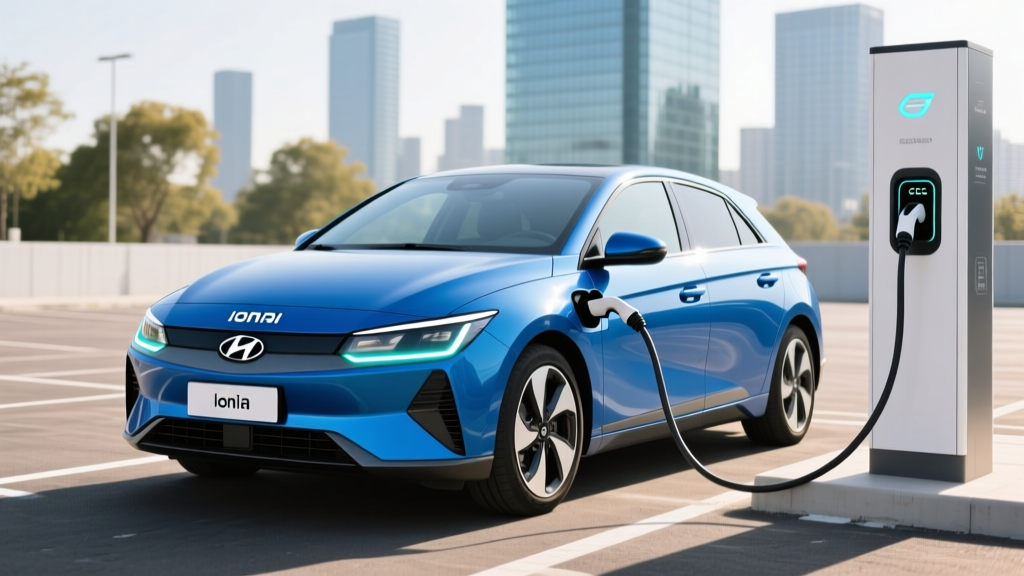
Hyundai's Ioniq sub-brand has delivered two massive hits—the Ioniq 5 crossover and the Ioniq 6 sedan—and now the automaker is preparing to fill the most lucrative gap in its EV lineup: a compact, sub-$35,000 electric SUV aimed squarely at the Tesla Model Y and the upcoming Chevrolet Equinox EV. Internally known as the Ioniq 3, this model is slated to become Hyundai's volume electric vehicle in North America. But as of early 2026, the Ioniq 3 has not yet gone on sale in the United States. Here is a data-driven breakdown of every confirmed and projected specification, the realistic timeline for American buyers, and whether it will qualify for the federal EV tax credit.
What Is the Hyundai Ioniq 3?
The Ioniq 3 is a compact electric crossover built on a shortened version of Hyundai Motor Group's E-GMP (Electric Global Modular Platform)—the same architecture underpinning the Ioniq 5, Ioniq 6, and Kia EV6. Where the Ioniq 5 targets mid-size crossover buyers with its 189-inch footprint, the Ioniq 3 is expected to slot in at roughly 175-178 inches long, making it a true compact SUV competitor to the Tesla Model Y, Volvo EX40, and the BMW iX1.
Hyundai has signaled that the Ioniq 3 will prioritize interior packaging efficiency, leveraging the E-GMP's flat floor and short overhangs to deliver near-mid-size cabin space in a smaller exterior envelope. The design language borrows the Parametric Pixel LED lighting from the Ioniq 5 but adopts a more upright, SUV-oriented silhouette closer to the Ioniq 6's smoothed aerodynamic approach.
Projected Battery, Range, and Efficiency
Based on international homologation filings and Hyundai's confirmed powertrain strategy, the US-market Ioniq 3 is expected to offer two battery configurations:
| Spec | Standard Range | Long Range |
|---|---|---|
| Battery Capacity (usable) | ~58 kWh | ~77.4 kWh |
| Chemistry | NMC (Nickel Manganese Cobalt) | NMC 811 |
| EPA Est. Range (projected) | ~230-250 mi | ~290-320 mi |
| Efficiency (projected) | ~27-29 kWh/100 mi | ~26-28 kWh/100 mi |
| Drivetrain | RWD (single motor) | RWD or AWD (dual motor) |
The EPA sticker for the Long Range Ioniq 3 may read up to 320 miles, but real-world results will vary significantly based on conditions:
- Highway driving at 70-75 mph: Expect ~250-275 miles (Long Range AWD). Aerodynamic drag cuts efficiency by 15-20% vs. city driving.
- Cold weather (below 32°F): Range loss of 20-30% is typical for NMC batteries without consistent preconditioning. A 310-mile EPA rating could drop to ~215-250 miles in winter.
- City/commuter driving with regen: You may actually exceed the EPA estimate in mild-weather stop-and-go traffic, where regenerative braking recaptures energy.
Hyundai's heat pump (expected as standard or available on US trims) will help mitigate cold-weather losses compared to resistive heating systems.
Charging Speed: DC Fast Charging and Home Level 2
Charging speed is where the E-GMP platform has consistently excelled, and the Ioniq 3 should inherit the architecture's 800-volt electrical system—a rarity in the compact SUV segment where most competitors still use 400V systems.
| Charging Level | Power / Rate | Time / Speed |
|---|---|---|
| Level 1 (120V household) | ~1.4 kW | ~3-4 miles per hour |
| Level 2 (240V home charger) | ~10.9 kW (48A) | ~30-35 miles per hour; full charge in ~7-8 hours |
| DC Fast Charge (peak) | ~175-200 kW (800V system) | 10-80% in ~18-22 minutes (projected) |
| DC Fast Charge (sustained avg) | ~120-140 kW average to 80% | Charge curve tapers sharply above 80% |
Charging curve reality check: Like the Ioniq 5 before it, the Ioniq 3's 800V architecture will allow it to accept peak charge rates at relatively low states of charge. However, the 10-80% time is the meaningful metric—charging from 80% to 100% can take nearly as long as 10-80% due to the battery management system tapering current to protect cell longevity. Plan your road-trip stops around the 10-80% window for optimal time efficiency.
The US-market Ioniq 3 will ship with the NACS (North American Charging Standard) connector natively, following Hyundai's confirmed transition away from CCS1 for all new models sold in America starting in late 2024. This means direct access to Tesla's Supercharger network (now open to non-Tesla EVs via NACS) without an adapter—a significant practical advantage over CCS-equipped competitors.
Performance and Drivetrain
| Spec | Standard Range RWD | Long Range RWD | Long Range AWD |
|---|---|---|---|
| Horsepower | ~168 hp | ~225 hp | ~320 hp |
| Torque | ~258 lb-ft | ~258 lb-ft | ~446 lb-ft |
| 0-60 mph (est.) | ~7.5 sec | ~6.8 sec | ~5.0 sec |
| Top Speed | ~115 mph | ~115 mph | ~120 mph |
The AWD dual-motor variant will be the performance-oriented choice, offering the kind of instant electric torque that makes merging and passing effortless. However, the RWD Long Range model is likely the sweet spot for most buyers—adequate acceleration, maximum range, and lower pricing.
Interior Space, Cargo, and Technology
Hyundai's E-GMP platform is designed around a long wheelbase relative to overall vehicle length, which translates directly to cabin room. The Ioniq 3 is projected to deliver:
- Front legroom: ~41-42 inches
- Rear legroom: ~37-39 inches (competitive with the Model Y's ~37 inches)
- Cargo volume (rear seats up): ~24-27 cu ft
- Cargo volume (rear seats folded): ~55-60 cu ft
- Front trunk (frunk): ~0.8-1.0 cu ft (small, for charging cables and essentials)
Tech highlights expected on US trims:
- 12.3-inch dual panoramic displays (instrument cluster + infotainment)
- Wireless Apple CarPlay and Android Auto
- Hyundai Digital Key 2 (phone-as-key via NFC/UWB)
- Over-the-air (OTA) software updates for powertrain, infotainment, and ADAS
- Vehicle-to-Load (V2L) capability—power external devices at up to 3.6 kW using the traction battery
- Highway Driving Assist 2 (HDA2) with lane-centering, adaptive cruise, and lane-change assist — an SAE Level 2 driver-assistance system requiring continuous driver engagement
Hyundai's Highway Driving Assist 2 and any available advanced cruise features are SAE Level 2 systems. They are not self-driving. The driver must keep hands on the wheel (or demonstrate attentiveness via capacitive sensing or driver monitoring camera) and eyes on the road at all times. These systems assist with steering, acceleration, and braking on divided highways but cannot handle construction zones, unmapped roads, or complex urban intersections autonomously.
Pricing, Trims, and Federal Tax Credit Eligibility
Hyundai has positioned the Ioniq brand as value-forward within the EV space, and the Ioniq 3 will be critical to that strategy. Based on global pricing announcements and US market positioning, here are the projected MSRP figures:
| Trim | Est. Base MSRP | Est. After §30D Credit* |
|---|---|---|
| SE Standard Range | ~$32,000-$34,000 | ~$24,500-$26,500 |
| SEL Long Range | ~$37,000-$39,000 | ~$29,500-$31,500 |
| Limited AWD | ~$43,000-$46,000 | ~$35,500-$38,500 |
*Tax credit estimates assume full $7,500 eligibility under IRS §30D. Actual eligibility depends on buyer income, vehicle MSRP, battery component sourcing, and critical minerals requirements. See checklist below.
Federal EV Tax Credit (§30D) Eligibility Checklist
- MSRP Cap: Vehicle base MSRP must not exceed $80,000 for SUVs/pickups or $55,000 for sedans. The Ioniq 3 (classified as an SUV) should clear this threshold on all trims.
- Buyer Income Cap: Modified Adjusted Gross Income (MAGI) must not exceed $150,000 (single), $225,000 (head of household), or $300,000 (joint filers).
- Battery Sourcing: A percentage of critical minerals and battery components must be sourced from the US or free-trade-agreement countries. Hyundai has been actively reshoring battery supply via its Georgia Meta Plant, but final credit qualification depends on the specific model year's supply chain. The credit may phase in as $3,750 (minerals only) or $7,500 (minerals + components).
- Point-of-Sale Transfer: As of 2024, buyers can transfer the credit to the dealer at purchase, reducing the out-of-pocket price immediately rather than waiting for a tax refund.
- Final Assembly: Vehicle must undergo final assembly in North America. Hyundai's Ellabell, Georgia EV plant (Meta Plant) is expected to produce the Ioniq 3 for the US market.
Key uncertainty: Battery-sourcing rules tighten annually. Whether the Ioniq 3 qualifies for the full $7,500 or the partial $3,750 at launch will depend on Hyundai's supply chain at the time of production. Consult a tax professional and check the latest fueleconomy.gov listings before purchasing.
Warranty Coverage
Hyundai's EV warranty is among the strongest in the industry, and the Ioniq 3 is expected to carry the same coverage:
- Battery: 10 years / 100,000 miles (capacity retention threshold: ~70% of original capacity)
- Electric Powertrain: 10 years / 100,000 miles
- New Vehicle Limited: 5 years / 60,000 miles
- Roadside Assistance: 5 years / unlimited miles
- Complimentary Maintenance: 3 years / 36,000 miles
The 10-year battery warranty is a significant differentiator versus Tesla (8 years/100,000-120,000 miles depending on model) and most legacy competitors offering 8 years/100,000 miles.
How the Ioniq 3 Stacks Up Against Competitors
| Vehicle | Est. EPA Range | DC Fast Charge (10-80%) | Est. Starting MSRP | Connector |
|---|---|---|---|---|
| Hyundai Ioniq 3 LR | ~290-320 mi | ~18-22 min (800V) | ~$37,000 | NACS |
| Tesla Model Y (refreshed) | ~310-330 mi | ~25-30 min | ~$40,000 | NACS |
| Chevrolet Equinox EV | ~315 mi | ~20-25 min | ~$33,000 | NACS |
| Volvo EX40 | ~293 mi | ~28-32 min | ~$53,000 | NACS (adapter) |
✅ Projected Pros
- 800V architecture enables class-leading DC fast-charging speeds
- Native NACS connector — no adapter needed at Tesla Superchargers
- Projected sub-$35,000 starting price undercuts Model Y
- 10-year/100,000-mile battery warranty (best in class)
- V2L capability for camping, tailgating, or emergency power
- Spacious cabin on a compact footprint (E-GMP packaging)
- Expected full §30D tax credit eligibility (GA assembly)
❌ Projected Cons
- Not yet on sale — actual US availability likely late 2026 or 2027 model year
- Standard Range battery may feel limited for road-trip-heavy buyers (~230 mi)
- NMC chemistry requires 20-80% daily charging discipline (vs. LFP's 100% tolerance)
- Compact cargo area vs. the larger Ioniq 5 or Model Y
- Frunk is small — don't expect meaningful front storage
- Final tax credit amount depends on battery-sourcing rules at time of production
Who Should Wait for the Hyundai Ioniq 3?
- Want a compact electric SUV priced under $40,000 (before incentives) with premium features
- Prioritize fast DC charging for road trips — the 800V system is a genuine advantage
- Need NACS-native Supercharger access without adapters
- Commute 30-60 miles daily and want to charge at home overnight on Level 2
- Value a long powertrain warranty for peace of mind on battery longevity
- Need a vehicle now — the Ioniq 3 is not yet available in the US
- Regularly tow — this segment isn't designed for heavy towing (expect ~1,500-2,000 lb max if rated)
- Want three rows of seating — look at the Ioniq 5 (future 3-row variant) or Kia EV9
- Prefer LFP battery chemistry for daily 100% charging convenience — consider the base Tesla Model Y RWD
Frequently Asked Questions
When will the Hyundai Ioniq 3 be available in the USA?
Hyundai has not confirmed an exact US on-sale date. Based on the global reveal timeline and the ramp-up of the Ellabell, Georgia EV plant, the most realistic expectation is late 2026 as a 2027 model year vehicle. Pre-orders may open in mid-to-late 2026.
What is the real-world range of the Hyundai Ioniq 3?
The Long Range variant is projected at ~290-320 miles EPA. In real-world highway driving at 70+ mph, expect ~250-275 miles. In cold weather (below freezing), range can drop 20-30%, putting winter highway range around 215-250 miles for the Long Range AWD model.
How fast does the Ioniq 3 charge at home and on the road?
At home on a 240V Level 2 charger (~10.9 kW), the Long Range battery should add ~30-35 miles of range per hour, with a full charge taking about 7-8 hours. On a DC fast charger, the 800V system enables 10-80% charging in approximately 18-22 minutes, assuming a 350 kW-capable station.
Does the Hyundai Ioniq 3 qualify for the $7,500 federal EV tax credit?
It is expected to qualify, but final eligibility depends on battery-sourcing compliance at the time of production. The Ioniq 3 will be assembled in Georgia (meeting North American final assembly requirements), and its MSRP will fall well under the $80,000 SUV cap. Buyers must also meet IRS income limits. The credit may be $3,750 or $7,500 depending on critical mineral and battery component sourcing percentages.
Is the Ioniq 3 worth waiting for vs. buying a Model Y or Equinox EV now?
If you can wait 6-12 months and want the combination of 800V fast charging, native NACS, and Hyundai's 10-year warranty at a competitive price, the Ioniq 3 is worth monitoring. If you need a vehicle immediately, the Tesla Model Y and Chevrolet Equinox EV are proven, available alternatives with established charging networks and real-world track records.
Will the Ioniq 3 have a frunk (front trunk)?
Yes, but expect it to be small—approximately 0.8-1.0 cubic feet, suitable for storing charging cables, a small bag, or emergency supplies. It will not replace meaningful cargo space.
Editorial Note: This article is based on the best available information as of early 2026. Specifications, pricing, and tax credit eligibility are subject to change as Hyundai finalizes the US-market Ioniq 3. We will update this page with confirmed EPA figures and MSRP when they become available. For the latest official data, consult Hyundai News and the EPA's fueleconomy.gov database.