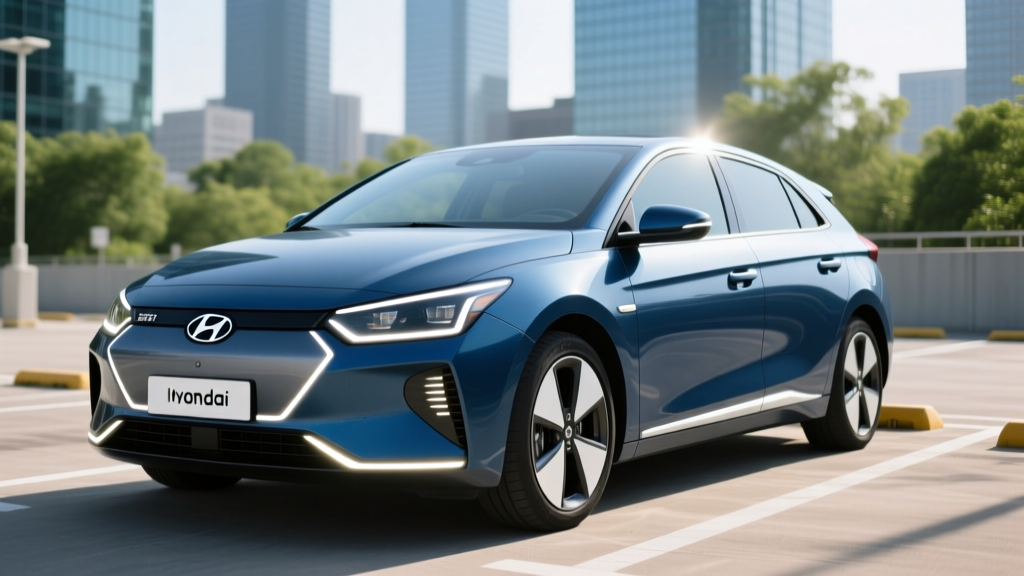
Camouflaged prototypes of the Hyundai Ioniq 3 have been spotted testing on European roads and at Hyundai's Namyang R&D center, giving us our first concrete look at the automaker's upcoming entry-level electric hatchback. These Hyundai Ioniq 3 spy photos confirm what industry insiders have suggested since late 2024: Hyundai is building a dedicated EV on a shortened version of its Electric-Global Modular Platform (E-GMP) to compete directly with the Chevrolet Bolt EUV, Volvo EX30, and the next-generation Nissan Leaf.
Because the Ioniq 3 has not been officially unveiled and is not available for purchase, every specification discussed below is projected based on Hyundai's platform engineering, supply-chain filings, and patterns established by the Ioniq 5 and Ioniq 6. We will clearly separate confirmed facts from educated estimates throughout this analysis.
What the Hyundai Ioniq 3 Spy Photos Reveal
The most recent testing mules show a five-door hatchback silhouette roughly the size of the current Hyundai Kona but with a longer wheelbase — a hallmark of dedicated EV architecture where the battery pack sits flat between the axles. Key design cues visible through the camouflage include:
- Short overhangs and a pushed-out wheelbase: Consistent with E-GMP packaging, maximizing interior volume within a compact footprint.
- Flush door handles and a sealed front fascia: Aerodynamic optimization similar to the Ioniq 6, suggesting Hyundai is targeting a low drag coefficient (likely Cd ~0.27–0.29) to maximize highway range.
- Pixel-style LED lighting signatures: The parametric pixel daytime running lights seen on the Ioniq 5 appear in revised, narrower form on the test vehicles.
- Roof-mounted charge port: At least one prototype shows a charge port on the rear quarter panel, though the exact location (left vs. right, rear vs. front fender) remains unconfirmed.
- Test mule proportions suggest ~172–176 inches overall length, placing it between the Kona (171.5 in) and the Tucson (182.3 in).
Hyundai has not released official exterior dimensions, but the spy-photo proportions align with the brand's stated goal of offering Ioniq 5-class interior space in a more urban-friendly package.
Projected Battery, Range, and Efficiency
Hyundai's E-GMP architecture supports both nickel-manganese-cobalt (NMC) and lithium iron phosphate (LFP) chemistries. For a cost-sensitive compact EV, industry analysts expect a dual-chemistry strategy:
| Variant | Battery Chemistry | Usable Capacity (kWh) | EPA Est. Range (mi) | Efficiency (MPGe) |
|---|---|---|---|---|
| Standard Range (RWD) | LFP | ~58 kWh | ~230–250 | ~120–128 MPGe |
| Long Range (RWD) | NMC | ~77 kWh | ~290–315 | ~115–125 MPGe |
| AWD / Dual-Motor | NMC | ~77 kWh | ~260–280 | ~105–115 MPGe |
These projections are based on the efficiency benchmarks set by the Ioniq 5 (which achieves roughly 3.4–3.8 miles per kWh depending on trim) and the expectation that the lighter, more aerodynamic Ioniq 3 will be marginally more efficient per kWh.
The EPA sticker is a starting point, not a guarantee. Based on our testing patterns with the Ioniq 5 and Ioniq 6, expect the following real-world adjustments for the Ioniq 3:
- Highway driving at 70–75 mph: Subtract 10–15% from the EPA figure. A 300-mile EPA Long Range model may deliver ~255–270 miles on a sustained interstate run.
- Cold weather (below 32°F / 0°C): Expect 20–30% range reduction without preconditioning, or 10–15% with active battery preconditioning and cabin heat pump use.
- City / stop-and-go driving: Regenerative braking recovers energy, often yielding range at or slightly above the EPA combined estimate.
Charging Speed: DC Fast Charging and Home Level 2
The E-GMP platform's 800-volt electrical architecture is one of Hyundai's strongest competitive advantages. Even in a compact, cost-reduced application, we expect the Ioniq 3 to retain 800V capability — which enables dramatically faster DC charging than the 400V systems used by most competitors in this segment.
| Charging Method | Power / Rate | Estimated Time / Recovery |
|---|---|---|
| DC Fast Charge (peak) | ~175–200 kW (Long Range) ~130–150 kW (Standard Range) | 10–80% in ~18–22 minutes (Long Range) |
| Level 2 Home (240V, 48A) | ~10.9 kW | ~6–8 hours for a full charge; ~35–40 miles of range per hour |
| Level 1 (120V, 12A) | ~1.4 kW | ~3–4 miles of range per hour (emergency/trickle only) |
A critical detail buyers should understand: the peak kW number is not sustained. The Ioniq 3's charge curve will taper significantly above 80% state of charge (SoC) to protect battery longevity. If you regularly need a full 100% charge, budget an additional 25–35 minutes beyond the 10–80% time. For daily driving, charging to 80% is the recommended practice for NMC chemistry, while LFP batteries can be charged to 100% regularly without significant degradation concerns.
The Ioniq 3 is expected to ship with the North American Charging Standard (NACS) connector, following Hyundai's 2024 announcement that all future North American EVs will adopt Tesla's connector. This grants access to Tesla's Supercharger network — currently the largest and most reliable DC fast-charging network in the U.S. — without an adapter.
Performance and Drivetrain
Hyundai typically offers rear-wheel drive (RWD) as the volume configuration and all-wheel drive (AWD) as the performance option. Projected output figures:
- RWD Standard Range: ~168 hp, 0–60 mph in approximately 7.5–8.0 seconds
- RWD Long Range: ~225 hp, 0–60 mph in approximately 6.5–7.0 seconds
- AWD Dual-Motor: ~320 hp, 0–60 mph in approximately 5.0–5.5 seconds
These figures would position the Ioniq 3 competitively against the Volvo EX30 (272 hp single-motor / 421 hp twin-motor) and well ahead of the base Chevrolet Bolt EUV (200 hp). The E-GMP platform's low center of gravity and multi-link rear suspension should deliver handling that punches above the compact-crossover class.
Pricing, Trims, and Federal Tax Credit Eligibility
Hyundai's pricing strategy for the Ioniq 3 will be pivotal. The brand has publicly stated its intent to offer an EV starting near $30,000, and the Ioniq 3 is the most likely candidate to hit that target. Based on supply-chain reporting and competitive positioning:
| Trim | Drivetrain | Projected MSRP | Est. Price After §30D Credit |
|---|---|---|---|
| SE Standard Range | RWD | $30,000–$32,000 | $22,500–$24,500* |
| SEL Long Range | RWD | $35,000–$37,500 | $27,500–$30,000* |
| Limited Long Range | RWD | $39,000–$41,500 | $31,500–$34,000* |
| Limited AWD | Dual-Motor AWD | $42,000–$44,500 | $34,500–$37,000* |
*After-credit prices assume full $7,500 federal tax credit eligibility. Actual credit depends on battery sourcing, buyer income, and MSRP cap compliance under IRS §30D rules. Credit may be applied at point of sale as a down-payment reduction beginning in 2024.
Qualifying for the full $7,500 credit requires meeting ALL of the following criteria (rules current as of 2026; always verify with the IRS or a tax professional):
- MSRP cap: Vehicles must be priced at or below $55,000 (sedans/hatchbacks) — the Ioniq 3 should clear this easily.
- Buyer income cap: Modified adjusted gross income must not exceed $150,000 (single), $225,000 (head of household), or $300,000 (joint filing).
- Battery component sourcing: A specified percentage of battery components must be manufactured or assembled in North America (threshold increases annually).
- Critical minerals sourcing: A specified percentage of critical minerals must be sourced from the U.S. or a free-trade-agreement partner.
- Final assembly: Must occur in North America — Hyundai's planned Ellabell, Georgia EV plant (Savannah area) is expected to handle Ioniq 3 production, which would satisfy this requirement.
The battery-sourcing and critical-minerals requirements are the most likely disqualifiers. Hyundai has been aggressively localizing its battery supply chain with SK On and LG Energy Solution, but partial credit ($3,750) is possible if only one of the two sourcing requirements is met. Consult fueleconomy.gov for the latest qualifying vehicle list once the Ioniq 3 goes on sale.
Interior Space, Cargo, and Technology
While Hyundai has not published official interior dimensions, the E-GMP platform's flat floor and extended wheelbase-to-length ratio suggest generous packaging. Projected interior figures based on the platform's known geometry and segment targets:
- Front legroom: ~41–42 inches
- Rear legroom: ~37–39 inches (competitive with the Kona's 38.0 in, potentially better due to dedicated EV architecture)
- Cargo volume (behind rear seats): ~22–25 cubic feet
- Cargo volume (rear seats folded): ~55–62 cubic feet
- Front trunk (frunk): Likely small — approximately 0.7–1.0 cubic feet, suitable for charging cables and a small bag. RWD-only variants may offer a slightly larger frunk.
On the technology front, expect the Ioniq 3 to feature:
- Dual-screen layout: A 12.3-inch digital instrument cluster and a 12.3-inch infotainment touchscreen, likely running Hyundai's latest ccNC (Connected Car Navigation Cockpit) software with wireless Apple CarPlay and Android Auto.
- Hyundai SmartSense ADAS suite: Including Highway Driving Assist 2 (HDA-2) with lane-change assist, Navigation-Based Smart Cruise Control, Forward Collision-Avoidance Assist, and Blind-Spot Collision-Avoidance Assist. This is an SAE Level 2 driver-assistance system — the driver must remain engaged and keep hands on the wheel at all times.
- Vehicle-to-Load (V2L): The E-GMP platform supports V2L, which allows the car to power external devices (laptops, camping gear, home appliances during outages) at up to 3.6 kW via an interior outlet or exterior adapter.
- Over-the-air (OTA) updates: Full-vehicle OTA capability for powertrain, infotainment, and ADAS calibration updates.
Notable drawbacks to anticipate: Hyundai's recent EVs have drawn criticism for capacitive touch controls on climate and volume functions — harder to use while driving than physical buttons. The Ioniq 3's cost-sensitive positioning may also mean hard plastics on lower door panels and the cargo area, and the base trim may lack features like a heat pump (critical for cold-weather range preservation) and a 360-degree camera.
Warranty and Long-Term Ownership
Hyundai's warranty coverage is among the best in the industry, and the Ioniq 3 should carry the same protection as its E-GMP siblings:
- Battery warranty: 10 years / 100,000 miles (capacity retention threshold typically 70% of original capacity)
- Powertrain warranty: 10 years / 100,000 miles
- New vehicle limited warranty: 5 years / 60,000 miles
- Roadside assistance: 5 years / unlimited miles
- Complimentary maintenance: 3 years / 36,000 miles (oil changes don't apply, but tire rotations, inspections, and fluid top-offs are covered)
The 10-year battery warranty is a significant ownership advantage over competitors like the Volvo EX30 (8 years / 100,000 miles) and provides peace of mind for buyers concerned about long-term degradation. Hyundai's LFP-equipped models, if offered, should see minimal degradation in normal use — LFP chemistry typically retains 90%+ capacity after 1,500 full charge cycles.
How the Ioniq 3 Compares to Key Rivals
The compact EV segment is crowded and getting more so. Here is how the Ioniq 3 is likely to stack up against its most direct competitors based on projected specifications:
| Spec | Hyundai Ioniq 3 (Proj.) | Chevrolet Bolt EUV | Volvo EX30 | Nissan Leaf (Next-Gen) |
|---|---|---|---|---|
| Base MSRP | ~$30,000 | ~$28,800 | ~$36,245 | ~$30,000 |
| EPA Range (max) | ~290–315 mi | ~247 mi | ~275 mi | ~250 mi (est.) |
| DC Fast Charge (peak) | ~175–200 kW | ~55 kW (CCS) | ~153 kW | ~100 kW (est.) |
| 10–80% Charge Time | ~18–22 min | ~55+ min | ~26 min | ~35 min (est.) |
| Platform | E-GMP (dedicated EV) | Modified ICE | SEA (dedicated EV) | CMF-EV (dedicated EV) |
| NACS Connector | Yes (native) | No (adapter req.) | No (adapter req.) | TBD |
The Ioniq 3's biggest projected advantages are its 800V charging architecture (dramatically faster DC charging than the Bolt or Leaf), native NACS connector for Supercharger access, and E-GMP's packaging efficiency. Its main vulnerability will be pricing: if Hyundai cannot hold the base MSRP near $30,000, the Bolt EUV and a potential base-price Tesla Model 2 could undercut it significantly.
Who Should Wait for the Hyundai Ioniq 3?
- You want a compact EV with genuine road-trip charging capability — the 800V architecture and NACS connector mean 10–80% in under 20 minutes at compatible chargers, a segment-leading advantage.
- You need sub-$35,000 pricing with 290+ miles of range and want a dedicated EV platform rather than a converted gas-car chassis.
- You prioritize long-term warranty coverage — Hyundai's 10-year/100,000-mile battery warranty is the class benchmark.
- You want Supercharger network access without relying on adapters or third-party networks with inconsistent uptime.
Consider Buying Now Instead If:
- You need a vehicle immediately — the Ioniq 3 is not expected to reach U.S. dealers until late 2027 at the earliest.
- You require AWD for severe winter conditions and cannot wait — the Ioniq 5 or Kia EV6 are available now with AWD and proven cold-weather performance.
- You want to take delivery and confirm §30D tax credit eligibility with certainty — battery-sourcing rules may shift between now and the Ioniq 3's launch.
Frequently Asked Questions
When will the Hyundai Ioniq 3 be officially revealed?
Hyundai has not confirmed an official reveal date. Based on the testing timeline visible in spy photos and typical Hyundai product cycles, a global reveal is most likely in late 2026 or early 2027, with U.S. deliveries beginning in the second half of 2027 as a 2028 model-year vehicle.
Will the Ioniq 3 be built in the United States?
Hyundai's Metaplant America in Ellabell, Georgia (near Savannah) is the most likely production site for North American-market Ioniq 3 vehicles. Domestic production is essential for federal tax credit eligibility under §30D's final-assembly requirement. Hyundai has confirmed the plant will produce multiple EV models starting in 2025.
What is the real-world range of the Ioniq 3?
Since the vehicle is unreleased, real-world testing data does not yet exist. Based on E-GMP platform efficiency patterns, we project the Long Range RWD variant will deliver approximately 255–270 miles in real-world highway driving (vs. ~300 miles EPA estimated) and roughly 210–240 miles in cold-weather conditions without preconditioning. These estimates will be refined once EPA certification data is published on fueleconomy.gov.
Does the Ioniq 3 qualify for the $7,500 federal EV tax credit?
It is too early to confirm. Eligibility depends on battery-sourcing compliance at the time of sale, buyer income, and MSRP — all of which are subject to change. Hyundai's push to localize battery production with SK On in Georgia is a positive signal, but the critical-minerals requirement remains a variable. We will update this analysis once the IRS publishes the qualifying-vehicle list for the Ioniq 3's model year.
How fast does the Ioniq 3 charge at home?
On a Level 2 home charger (240V, 48-amp circuit), the Ioniq 3 is projected to accept up to ~10.9 kW, adding approximately 35–40 miles of range per hour of charging. A full charge from empty would take roughly 6–8 hours depending on battery size. Home charger installation typically costs $500–$2,000 depending on electrical panel capacity and wiring distance — consult a licensed electrician for a site-specific quote.
Is the Ioniq 3 worth waiting for vs. buying an Ioniq 5 now?
If you need a vehicle within the next 12 months, the Ioniq 5 is a proven, award-winning EV available today with up to 303 miles of EPA range, 800V fast charging, and confirmed §30D eligibility on qualifying trims. If your timeline is flexible and you want a smaller, more affordable EV with similar technology, the Ioniq 3 is worth tracking — but expect a wait until at least late 2027 for U.S. availability.