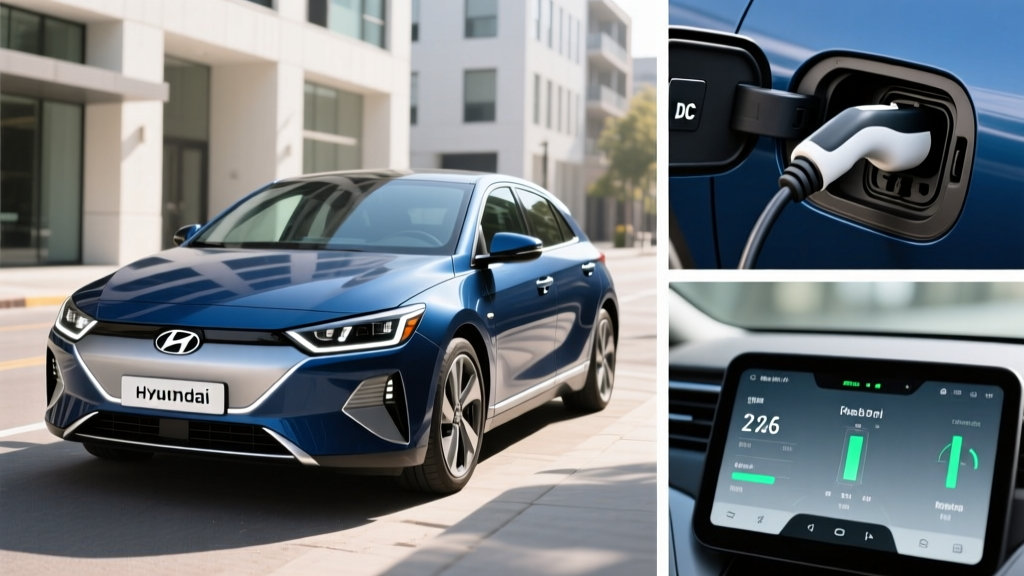
The Hyundai Ioniq 3 arrives for the 2026 model year as the brand's compact electric crossover, slotting below the Ioniq 5 in Hyundai's EV lineup and targeting buyers who want a practical daily driver with competitive range and Hyundai's generous warranty. Built on the next-generation eM platform, the Ioniq 3 brings updated battery chemistry, faster DC charging, and a refined interior. Here is everything buyers need to know — with exact numbers, not marketing fluff.
Range, Battery, and Real-World Efficiency
The 2026 Ioniq 3 offers two battery configurations across its trim lineup. The standard-range SE uses a 58 kWh usable lithium iron phosphate (LFP) battery, while the Long Range trims (SEL and Limited) pack a 77.4 kWh usable nickel manganese cobalt (NMC) pack. The chemistry split is intentional: LFP offers longer cycle life and tolerates regular 100% charging, while NMC delivers higher energy density for maximum range.
| Specification | SE Standard Range | SEL / Limited Long Range |
|---|---|---|
| Battery Capacity (usable) | 58 kWh (LFP) | 77.4 kWh (NMC) |
| EPA Estimated Range | 240 miles | 315 miles |
| EPA Combined MPGe | 125 MPGe | 129 MPGe |
| Energy Consumption | 27 kWh/100 mi | 26 kWh/100 mi |
| Drivetrain | RWD, single motor | RWD single / AWD dual-motor |
Real-World Range Reality Check
EPA sticker: 315 miles (Long Range RWD). Expect in practice: ~265–285 miles on a highway road trip at 70–75 mph, and closer to 230–250 miles in freezing weather with cabin heat running. The NMC pack's efficiency is strong around town, where regenerative braking recovers energy in stop-and-go traffic. AWD models sacrifice roughly 15–20 miles of range due to the second motor's parasitic loss. If your commute is under 40 miles round-trip, the Standard Range model's 240 EPA miles are more than sufficient and you save thousands on the purchase price.
Charging Speed: DC Fast Charge and Home Level 2
Charging speed is where the Ioniq 3 makes its biggest generational leap. Hyundai has equipped the Long Range models with peak DC fast-charge capability of 220 kW, while the Standard Range tops out at 150 kW. On a 350 kW-capable station (like Electrify America or EVgo's latest stalls), the Long Range model can charge from 10% to 80% State of Charge (SoC) in approximately 22 minutes, with the charge curve tapering noticeably above 80% — a normal lithium-ion behavior to protect cell longevity. Preconditioning the battery via the navigation-routed charging feature warms the pack before you arrive at the charger, which is critical in cold weather to actually achieve peak kW rates.
| Charging Level | Max Rate | Standard Range (58 kWh) | Long Range (77.4 kWh) |
|---|---|---|---|
| Level 1 (120V household) | 1.4 kW | ~4 mi/hr | ~5 mi/hr |
| Level 2 (240V home, 48A) | 10.9 kW | ~32 mi/hr, full in ~6 hr | ~38 mi/hr, full in ~8 hr |
| DC Fast Charge | 150 kW (Std) / 220 kW (LR) | 10–80% in ~26 min | 10–80% in ~22 min |
For home charging, the onboard charger accepts up to 10.9 kW on Level 2 (240V, 48 amps). That means a dedicated Level 2 wallbox on a 60-amp circuit will replenish the Long Range battery from empty to full overnight in about 8 hours. Most owners will plug in nightly and rarely need a full 0–100% charge. The NACS (North American Charging Standard) port is now standard on all 2026 Hyundai EVs, granting access to Tesla Superchargers with a native plug — no adapter required. CCS1 is no longer equipped from the factory, though the Supercharger network and Electrify America's NACS retrofit are broadening coverage.
Performance and Driving Dynamics
The Ioniq 3 is tuned for efficiency and comfort rather than track performance, but it's no slouch off the line. Here's how the powertrain lineup breaks down:
- SE Standard Range (RWD): 168 hp, 258 lb-ft torque, 0–60 mph in 7.8 seconds
- SEL Long Range (RWD): 225 hp, 258 lb-ft torque, 0–60 mph in 6.5 seconds
- Limited Long Range AWD: 320 hp, 446 lb-ft torque, 0–60 mph in 4.9 seconds
The AWD dual-motor variant is genuinely quick and provides confident traction in rain and snow. Ride quality benefits from the eM platform's low center of gravity and multilink rear suspension. Road noise is well-suppressed, and the one-pedal driving mode (i-Pedal) allows full regenerative braking down to a stop, which reduces brake wear significantly over the vehicle's life. The steering is light and direct — ideal for city maneuvering, though enthusiasts may find it less communicative on winding roads.
Interior, Cargo Space, and Technology
The Ioniq 3's cabin follows Hyundai's minimalist EV design language with a dual 12.3-inch panoramic display (instrument cluster and infotainment) running the latest Hyundai Digital Key 2 and wireless Apple CarPlay and Android Auto. Physical climate controls remain — a welcome decision that avoids the touchscreen-only frustration found in some competitors.
Dimensionally, the Ioniq 3 prioritizes passenger space within a compact footprint:
- Front legroom: 41.7 inches
- Rear legroom: 38.2 inches
- Cargo volume (rear seats up): 23.4 cu ft
- Cargo volume (rear seats folded): 56.8 cu ft
- Front trunk (frunk): 1.6 cu ft (sufficient for a charging cable bag or small backpack)
The frunk is modest — Hyundai prioritized cabin volume over front storage. For a compact crossover, rear-seat space is generous enough for two adults on longer trips, though three across is tight. The Limited trim adds a panoramic glass roof, ventilated front seats, a head-up display, and a premium Bose 8-speaker audio system.
On the driver-assistance front, the Ioniq 3 ships with Hyundai SmartSense as standard: forward collision-avoidance assist, lane-keeping assist, blind-spot monitoring, rear cross-traffic collision-avoidance, and adaptive cruise control with stop-and-go. The optional Highway Driving Assist 2 (HDA2) adds lane-centering and semi-automated lane changes. This is an SAE Level 2 system — the driver must keep hands on or near the wheel and remain fully engaged at all times. It is not self-driving.
Pricing, Trims, and Federal Tax Credit Eligibility
The 2026 Ioniq 3 is offered in three trims. Pricing below reflects base MSRP before destination charges ($1,395):
| Trim | Base MSRP | Est. After §30D Credit | Drivetrain |
|---|---|---|---|
| SE Standard Range | $34,950 | ~$27,450* | RWD |
| SEL Long Range | $40,500 | ~$33,000* | RWD |
| Limited Long Range AWD | $47,900 | ~$40,400* | AWD |
*Estimated after maximum $7,500 federal tax credit. Actual credit depends on your individual eligibility. The §30D credit can now be transferred to the dealer as a point-of-sale discount, effectively reducing your out-of-pocket cost at purchase.
IRS §30D Federal EV Tax Credit — Key Eligibility Rules (2026)
- Buyer income caps: AGI must not exceed $150,000 (single), $225,000 (head of household), or $300,000 (joint filers).
- MSRP cap: The vehicle's MSRP must not exceed $55,000 for SUVs/crossovers. All Ioniq 3 trims currently fall under this cap.
- Battery sourcing: The $7,500 credit is split into two $3,750 halves — one for critical minerals sourcing and one for battery component manufacturing. Vehicles must meet escalating domestic-content thresholds that increase each year. Check the IRS qualified vehicle list for the specific Ioniq 3 trim and battery configuration before purchasing.
- Point-of-sale transfer: You can elect to transfer the credit to the dealer at purchase for an immediate price reduction, or claim it on your federal tax return.
Consult a tax professional to confirm your personal eligibility. Sourcing requirements are subject to change, and Hyundai's supply chain adjustments can affect eligibility from month to month.
Warranty and Long-Term Ownership
Hyundai continues to offer one of the strongest EV warranties in the industry. The Ioniq 3 is covered by:
- Battery warranty: 10 years / 100,000 miles (whichever comes first), guaranteeing at least 70% State of Health (SoH) capacity retention
- Powertrain warranty: 10 years / 100,000 miles
- New vehicle limited warranty: 5 years / 60,000 miles
- Complimentary maintenance: 3 years / 36,000 miles (includes tire rotation, multi-point inspection, and fluid top-offs)
The 10-year battery warranty is a significant differentiator over competitors offering 8 years / 100,000 miles. Hyundai's 70% SoH threshold is industry-standard, though real-world degradation data from the Ioniq 5 suggests most Hyundai EV packs retain well above 90% capacity after 100,000 miles under normal use. LFP-equipped Standard Range models may degrade even less, as LFP chemistry is inherently more cycle-durable than NMC.
Pros, Cons, and Who Should Buy the Ioniq 3
Pros
- 315-mile EPA range (Long Range RWD) is competitive in the compact crossover segment
- 220 kW peak DC charging is fast for the class; 10–80% in ~22 minutes
- Native NACS port — direct Tesla Supercharger access without adapter
- 10-year/100,000-mile battery warranty leads the industry
- Physical climate controls and strong infotainment UX
- Strong value at the SE trim with full SmartSense safety suite standard
Cons
- Small frunk (1.6 cu ft) — barely fits a charge cable bag
- AWD range penalty (~15–20 miles) and higher price push Limited near $48K before credit
- Real-world highway range drops to ~265–285 miles; cold weather cuts further
- Rear three-across seating is tight for adult passengers
- Steering feel is light and numb — not for driving enthusiasts
- HDA2 is Level 2 only — no hands-free driving like GM's Super Cruise
Best for: Daily commuters with home charging access who want 250+ real-world miles, fast public charging for occasional road trips, and long-term peace of mind from the 10-year warranty. The SE Standard Range is an outstanding value for urban and suburban drivers who rarely exceed 150 miles in a day. The SEL Long Range hits the sweet spot for buyers who want road-trip flexibility without paying the AWD premium.
Look elsewhere if: You need hands-free highway driving (consider the Chevrolet Equinox EV with available Super Cruise), maximum cargo space (the Ioniq 5 or Kia EV6 offer more), or if you lack access to reliable home or workplace charging, as the Ioniq 3's value proposition depends heavily on cheap Level 2 electrons.
Frequently Asked Questions
What is the real-world range of the 2026 Hyundai Ioniq 3?
The Long Range RWD model carries a 315-mile EPA estimate. In real-world highway driving at 70–75 mph, expect 265–285 miles. In freezing temperatures with the heater running, plan for 230–250 miles. The Standard Range model's 240-mile EPA figure translates to roughly 195–210 miles on the highway.
How fast does the Ioniq 3 charge at home and on DC fast chargers?
On a Level 2 home charger (240V, 48A), the Long Range model adds about 38 miles of range per hour and charges fully in ~8 hours. On DC fast chargers, the Long Range peaks at 220 kW, reaching 10–80% SoC in approximately 22 minutes. Standard Range peaks at 150 kW with a 10–80% time of about 26 minutes.
Does the 2026 Ioniq 3 qualify for the $7,500 federal EV tax credit?
All trims fall under the $55,000 SUV MSRP cap. However, eligibility depends on your income (AGI caps apply), and the battery must meet 2026 critical-mineral and component-sourcing thresholds. The credit can be applied as a point-of-sale discount at the dealer. Always verify current eligibility on the IRS qualified vehicles list before purchasing.
Is the Ioniq 3 worth buying over the Ioniq 5 or competitors?
If you want a more compact, affordable EV with similar technology and don't need the Ioniq 5's extra cargo room (27.2 cu ft) or available 800V ultra-fast charging architecture, the Ioniq 3 is a strong choice. Against the Chevrolet Equinox EV, the Ioniq 3 offers faster DC charging but less cargo space. Against the Kia EV5, it shares a platform but differentiates on styling and Hyundai's 10-year warranty.
What is the biggest drawback of the Ioniq 3?
The limited frunk space (1.6 cu ft) and tight rear three-across seating are the most common complaints. The AWD Limited's ~$48K price also pushes it into territory where buyers may consider larger, more capable EVs. Highway range, while respectable, falls short of the EPA sticker by 10–15% — a common reality across the EV market, but worth budgeting for on long trips.
Does the Ioniq 3 have a heat pump?
Yes. All trims include a standard heat pump for cabin heating, which significantly reduces range loss in cold weather compared to resistive heater systems. This is one reason the Ioniq 3's cold-weather range retention is competitive within its class.
Sources: EPA Fuel Economy, IRS §30D Qualified Vehicles, Hyundai Motor America press specifications.