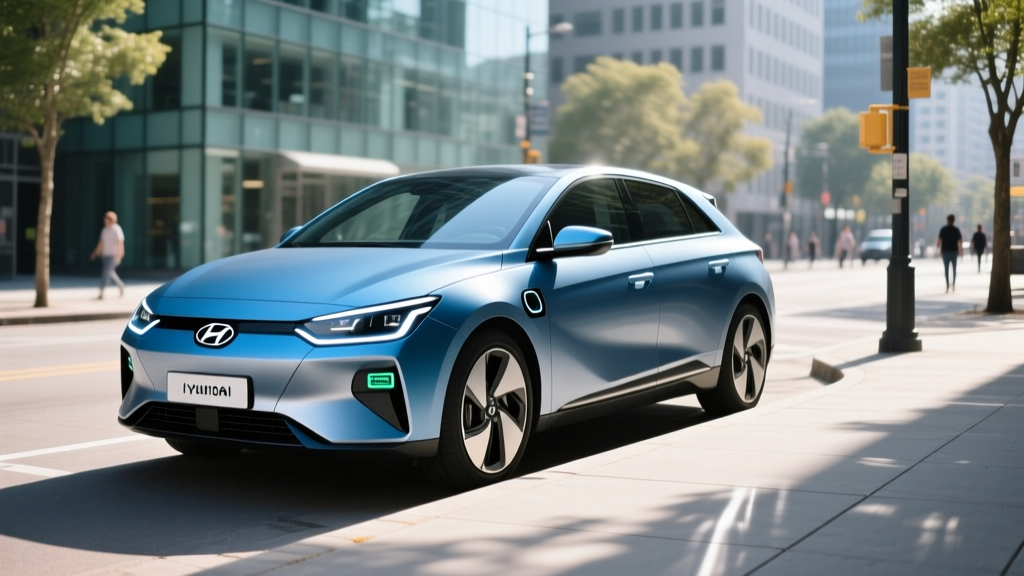
The compact electric crossover segment is about to get a serious new contender. A recent Hyundai Ioniq 3 public sighting — with camouflage-clad prototypes spotted testing across Europe and South Korea throughout late 2025 and early 2026 — has given us our clearest look yet at the brand's upcoming entry-level Ioniq model. Positioned below the Ioniq 5 and targeting buyers who want Hyundai's 800V E-GMP architecture in a smaller, more affordable package, the Ioniq 3 is shaping up to be one of the most important EV launches of the 2026 model year.
But spotted prototypes aren't a production car. Below, we break down everything we can reasonably confirm or estimate from the sightings, Hyundai's official teasers, and the brand's existing platform data — while being explicit about what remains preliminary until the production Ioniq 3 goes on sale.
What the Hyundai Ioniq 3 Public Sightings Tell Us
Since mid-2025, automotive photographers and industry watchers have captured the Ioniq 3 prototype in multiple configurations. The most informative sightings occurred at Hyundai's Namyang R&D Center testing grounds and on public roads in southern Germany, where the brand conducts high-speed validation. Key observations from these sightings:
- Form factor: A compact crossover roughly the size of a Hyundai Kona, with a slightly longer wheelbase thanks to the dedicated EV platform — expect approximately 178-182 inches in overall length.
- Design language: Heavily influenced by the Ioniq 5's "Parametric Pixel" aesthetic, though with softer surfacing and a more conventional roofline to maximize rear headroom.
- Charging port location: Rear-quarter panel placement (driver's side), consistent with Hyundai's E-GMP vehicles and confirming 800V architecture compatibility.
- Wheel options: Prototypes spotted with both 18-inch aero wheels and 19-inch sport variants, suggesting at least two trim tiers at launch.
- Sensor suite: Roof-mounted lidar bump not observed, but forward radar and camera housings indicate Hyundai's latest Highway Driving Assist 2 (HDA2) system will be standard or widely available.
Hyundai has not released a formal production date, but industry timelines point to a global reveal in mid-2026 with U.S. deliveries beginning late 2026 or early 2027 as a 2027 model-year vehicle.
Estimated Range, Battery, and Efficiency
The Ioniq 3 is expected to ride on a shortened variant of Hyundai's Electric Global Modular Platform (E-GMP), the same 800V architecture underpinning the Ioniq 5, Ioniq 6, and Kia EV6. For a vehicle of this size, battery chemistry and capacity choices directly determine range, charging speed, and long-term degradation behavior.
| Spec | Standard Range (Est.) | Long Range (Est.) |
|---|---|---|
| Battery Capacity (usable) | ~58 kWh | ~77 kWh |
| Chemistry | NMC (Nickel Manganese Cobalt) | NMC |
| EPA Est. Range | ~220 miles | ~290 miles |
| Efficiency (Est.) | ~120 MPGe / 28 kWh/100mi | ~115 MPGe / 29 kWh/100mi |
| Drivetrain | RWD (single motor) | RWD or AWD (dual motor) |
| Horsepower | ~168 hp | ~225 hp (RWD) / ~320 hp (AWD) |
| 0-60 mph (Est.) | ~7.8 sec | ~6.5 sec (RWD) / ~5.0 sec (AWD) |
Hyundai has historically used NMC (nickel manganese cobalt) chemistry across its E-GMP lineup for its high energy density, which is critical in a compact vehicle where physical battery space is limited. An LFP (lithium iron phosphate) variant is possible for a future base trim — LFP offers superior cycle life and lower cost but sacrifices roughly 15-20% energy density, which would reduce range in this form factor. Watch for Hyundai's battery sourcing announcements as production approaches.
Charging Speed: DC Fast Charging and Home Level 2
The Ioniq 3's biggest potential advantage over rivals like the Chevrolet Equinox EV and Volvo EX30 is its expected 800V electrical architecture. This is the same system that allows the Ioniq 5 to charge from 10-80% in roughly 18 minutes at a compatible 350 kW DC fast charger — a class-leading capability that could make the Ioniq 3 the fastest-charging compact EV on the market.
| Charging Level | Power / Rate | Speed / Time |
|---|---|---|
| Level 1 (120V household) | ~1.4 kW | ~4-5 miles per hour |
| Level 2 (240V home) | ~10.9 kW (48A) | ~35 miles per hour / 0-100% in ~8-9 hours |
| DC Fast Charge (peak) | ~220-240 kW (800V) | 10-80% in ~18-20 min (350 kW station) |
| DC Fast Charge (50 kW station) | ~50 kW | 10-80% in ~65-75 min |
Charging curve reality check: As with all EVs, the Ioniq 3's peak charge rate of ~220-240 kW will not be sustained across the entire session. The 800V architecture excels in the 10-50% state-of-charge (SoC) window, where thermal management keeps battery temps in the optimal range. Above 80% SoC, charging power tapers significantly to protect cell longevity — expect the final 80-100% to add 20+ minutes. For daily driving, charging to 80% at home on Level 2 is the recommended practice for NMC batteries to maximize long-term state of health (SoH).
The Ioniq 3 is expected to ship with the NACS (North American Charging Standard) connector, following Hyundai's commitment to adopting Tesla's charging standard across its U.S. lineup starting with 2025-2026 models. This grants access to Tesla Supercharger stations — a significant public-charging network advantage.
Interior Space, Tech, and Driver Assistance
Compact EVs live and die by how well they package interior volume within a small footprint. The E-GMP platform's flat floor and short overhangs give the Ioniq 3 a structural advantage over converted-ICE competitors.
Expected Interior Dimensions
- Rear legroom: ~38.0-39.5 inches (comparable to Kona, exceeding most subcompact crossovers)
- Cargo volume (behind rear seats): ~22-25 cu ft
- Cargo volume (rear seats folded): ~55-60 cu ft
- Front trunk (frunk): ~0.8-1.5 cu ft (small, suitable for charging cables)
On the technology front, expect Hyundai's latest ccNC (Connected Car Navigation Cockpit) infotainment system with a 12.3-inch integrated display, over-the-air (OTA) updates, wireless Apple CarPlay and Android Auto, and Hyundai's Digital Key 2 (NFC/UWB phone-as-key). Higher trims will likely include a head-up display with augmented-reality navigation prompts, a feature currently reserved for Ioniq 5 Limited and above.
Driver Assistance (SAE Level 2)
Expected ADAS features include forward collision-avoidance assist with pedestrian/cyclist detection, blind-spot collision-avoidance, rear cross-traffic alert, safe exit assist, and lane-keeping assist. Highway Driving Assist 2, which combines adaptive cruise control with lane-centering and navigation-based speed adjustment, is likely standard on SEL and above.
Pricing, Trims, and Federal Tax Credit Eligibility
Pricing is the Ioniq 3's make-or-break proposition. Hyundai needs this vehicle to undercut the Ioniq 5 (which starts around $42,000 for 2026) while remaining profitable and — crucially — qualifying for the federal §30D clean vehicle tax credit.
| Trim | Est. Base MSRP | Est. After Max §30D Credit |
|---|---|---|
| SE Standard Range | ~$32,000 | ~$24,500 |
| SEL Long Range | ~$37,000 | ~$29,500 |
| Limited AWD | ~$43,000 | ~$35,500 |
Tax credit reality check: The §30D credit offers up to $7,500, but eligibility is not automatic. Buyers must meet all of the following criteria, which are subject to change:
- MSRP cap: SUVs/crossovers must have an MSRP at or below $80,000 (the Ioniq 3 clears this easily)
- Buyer income cap: Modified adjusted gross income (MAGI) must not exceed $150,000 (single), $225,000 (head of household), or $300,000 (joint filers)
- Battery sourcing: A portion of the credit depends on critical minerals and battery components being sourced from the U.S. or free-trade-agreement countries — Hyundai's supply chain compliance will determine the exact credit amount ($3,750 or $7,500)
- Point-of-sale transfer: As of 2024, buyers can transfer the credit to the dealer at purchase, reducing the out-of-pocket price immediately rather than waiting for a tax refund
Hyundai's Georgia-based Metaplant America factory, which builds the Ioniq 5 for the U.S. market, is expected to also produce the Ioniq 3 — improving the likelihood of full §30D eligibility by meeting domestic assembly and battery-sourcing requirements. Always verify current-year eligibility on IRS.gov and consult a tax professional before relying on the credit in your purchase decision.
How the Ioniq 3 Stacks Up Against Competitors
The compact electric crossover segment is heating up. Here's how the Ioniq 3 is likely to compare against its most direct rivals:
| Vehicle | EPA Range | DC Fast Charge | Est. Starting Price |
|---|---|---|---|
| Hyundai Ioniq 3 (LR est.) | ~290 mi | ~220-240 kW (800V) | ~$37,000 |
| Chevrolet Equinox EV | 315 mi | ~150 kW | ~$33,000 |
| Volvo EX30 | 265 mi | ~153 kW | ~$36,000 |
| Kia EV3 (if U.S. bound) | ~280 mi (est.) | ~180 kW (est.) | ~$34,000 (est.) |
The Ioniq 3's differentiator is clear: 800V charging architecture. No competitor in this segment currently matches the 18-20 minute 10-80% DC fast-charge time that 800V enables at a 350 kW station. The Equinox EV offers slightly more range at a lower price, but its ~150 kW peak charge rate means 10-80% takes closer to 30 minutes. For buyers who road-trip regularly, this charging-speed advantage is substantial.
Warranty and Long-Term Ownership
Hyundai offers one of the strongest warranty packages in the industry, and the Ioniq 3 is expected to continue this tradition:
- Battery warranty: 10 years / 100,000 miles (capacity retention threshold expected at 70% — consistent with Hyundai's current EV warranty terms)
- Powertrain warranty: 10 years / 100,000 miles
- New vehicle limited warranty: 5 years / 60,000 miles
- Roadside assistance: 5 years / unlimited miles
- Complimentary maintenance: 3 years / 36,000 miles (expected)
The 10-year battery warranty is a significant confidence signal. Based on data from Ioniq 5 owners and Hyundai's E-GMP thermal management system — which actively heats and cools the battery pack to keep cells in the optimal temperature range — degradation has been minimal in real-world use. Most Ioniq 5 owners report 95%+ state of health (SoH) after 30,000-40,000 miles. Expect similar behavior from the Ioniq 3.
Who Should Wait for the Ioniq 3?
- Want 800V fast-charging capability in a compact, affordable crossover
- Commute 30-60 miles daily and want to charge almost exclusively at home on Level 2
- Need a practical second car for a two-EV household
- Value Hyundai's 10-year battery/powertrain warranty
- Want NACS Supercharger access without an adapter
- Need three rows of seating or maximum cargo volume (look at Ioniq 5 or Kia EV9)
- Require a vehicle now — the Ioniq 3 won't be available until late 2026 or early 2027
- Want a long-range road-tripper above 320 miles (the Ioniq 6 or Tesla Model 3 Long Range may be better)
- Prefer LFP chemistry for maximum cycle life and daily 100% charging (watch for a potential future LFP trim)
Frequently Asked Questions
What is the real-world range of the Hyundai Ioniq 3?
Based on estimated specs and platform data, the Long Range Ioniq 3 should deliver approximately 290 miles EPA. Real-world highway driving at 70-75 mph will likely yield 250-270 miles, while cold-weather operation (below 30°F) could reduce range to 200-220 miles without preconditioning. City driving with regenerative braking may exceed the EPA estimate in mild temperatures.
How fast does the Ioniq 3 charge at home and on DC fast chargers?
At home on a 240V Level 2 charger (10.9 kW), expect approximately 35 miles of range added per hour, with a full charge taking 8-9 hours. On a 350 kW DC fast charger, the 800V architecture should enable 10-80% charging in approximately 18-20 minutes — among the fastest in the compact EV segment.
Does the Hyundai Ioniq 3 qualify for the federal EV tax credit?
Likely yes, for the full or partial $7,500 §30D credit — assuming Hyundai's Georgia-built Ioniq 3 meets battery-sourcing and critical-mineral requirements. Buyer income caps ($150K single / $300K joint) and the $80,000 MSRP cap for SUVs also apply. Always verify eligibility on IRS.gov for the purchase year.
Is the Ioniq 3 worth waiting for vs. buying an Ioniq 5 or Equinox EV now?
If you need a vehicle immediately, the Ioniq 5 and Equinox EV are excellent, proven choices available today. If you can wait 12-18 months and want a smaller, more affordable EV with 800V charging and the latest Hyundai tech, the Ioniq 3 is worth monitoring. The trade-off is waiting for an unproven new model versus buying a known quantity now.
What are the biggest pros and cons of the Ioniq 3?
Pros (estimated): Class-leading 800V charging speed, strong warranty coverage, NACS/Supercharger compatibility, spacious interior for its size, competitive pricing with tax credit. Cons: Not yet available, range falls short of some rivals, smaller cargo area than Ioniq 5, final pricing and credit eligibility unconfirmed.
This article will be updated with official specifications, pricing, and availability when Hyundai formally unveils the production Ioniq 3. Check back or follow our coverage for the latest developments.