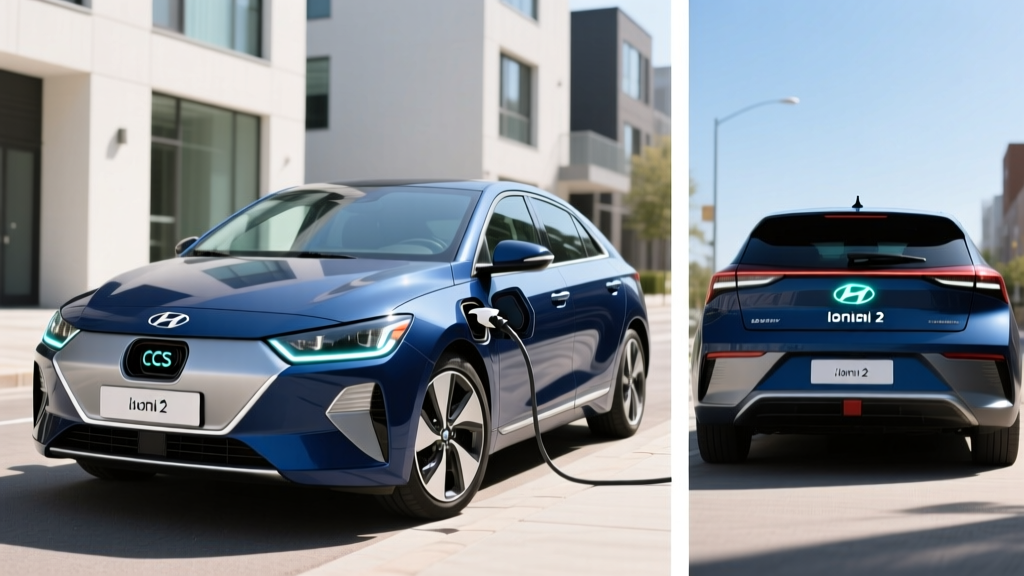
Quick Verdict: The 2026 Hyundai Ioniq 2 is Hyundai's entry-level electric subcompact, slotted below the Ioniq 5 and Ioniq 6 on the E-GMP platform. It targets urban commuters and budget-conscious EV buyers who want Hyundai's proven battery thermal management, 800V-class fast charging, and a sub-$35,000 starting price. If the final specs hold near Hyundai's announced targets, the Ioniq 2 could become the most accessible long-range EV in its segment — but cargo space and rear-seat room will demand compromises.
Range, Battery & Efficiency
The Ioniq 2 is expected to share a scaled-down version of Hyundai's E-GMP architecture with a lithium-ion NMC (nickel manganese cobalt) battery pack. Hyundai has targeted a usable battery capacity in the 58–65 kWh range for the standard model, with a possible Long Range variant pushing toward 72–77 kWh.
| Attribute | Standard Range (Est.) | Long Range (Est.) |
|---|---|---|
| Battery Chemistry | NMC | NMC |
| Usable Capacity | ~60 kWh | ~74 kWh |
| EPA Range (Target) | ~230–250 mi | ~290–310 mi |
| Efficiency (Target) | ~26–28 kWh/100 mi | ~25–27 kWh/100 mi |
| MPGe (Est. Combined) | ~120–128 MPGe | ~125–135 MPGe |
- Highway driving (70–75 mph): Expect ~15–20% below EPA. A 250-mile EPA Standard Range model may deliver ~200–215 miles at sustained highway speeds.
- Cold weather (below 32°F): Plan for 20–30% range reduction without preconditioning. Hyundai's heat pump (expected standard) helps mitigate this versus resistive heating.
- City / mixed driving: EPA figures are most achievable in stop-and-go traffic where regenerative braking recovers energy.
Charging Speed & Infrastructure
Hyundai's E-GMP platform supports 800V architecture, enabling exceptionally fast DC charging when paired with compatible 350 kW chargers. The Ioniq 2 is expected to inherit this capability, though peak charge rates will be lower than the larger Ioniq 5 due to the smaller battery.
| Charging Level | Power / Rate | Time / Speed |
|---|---|---|
| Level 1 (120V household) | ~1.4 kW | ~3–4 mi/hr added |
| Level 2 (240V home, 48A) | ~10.9 kW | ~35–40 mi/hr; full charge ~6–7 hrs |
| DC Fast Charge (peak) | ~150–175 kW (est.) | 10–80% in ~18–22 min |
| DC Fast Charge (350 kW station) | Burst up to ~175 kW | Tapers significantly above 80% SoC |
Charging-curve reality check: Peak kW figures are only sustained for a narrow window (typically 10–40% SoC). Above 80%, the charge rate drops sharply to protect battery longevity. Plan DC fast stops around the 10–80% window for optimal time efficiency — charging from 80–100% on DC can take nearly as long as 10–80%.
Connector: The Ioniq 2 is expected to ship with the NACS (North American Charging Standard) port, aligning with Hyundai's commitment to adopt Tesla's connector for all new U.S. EVs beginning with 2025+ models. This grants access to Tesla Superchargers via native plug, plus Electrify America, EVgo, and other networks using NACS adapters or native cables.
Performance & Drivetrain
The Ioniq 2 is positioned as a practical commuter, not a performance EV. Expect a single-motor rear-wheel-drive (RWD) layout as standard, with a possible dual-motor all-wheel-drive (AWD) option on higher trims.
| Spec | RWD (Est.) | AWD (Est.) |
|---|---|---|
| Horsepower | ~168–200 hp | ~250–300 hp |
| 0–60 mph | ~7.5–8.5 sec | ~5.5–6.5 sec |
| Drivetrain | Rear-Wheel Drive | Dual-Motor AWD |
| Towing Capacity | Not rated (est. 1,500 lb max) | Not rated |
The RWD variant will be the volume seller, offering adequate acceleration for merging and city driving. Instant electric torque gives the Ioniq 2 a responsiveness advantage over similarly priced gas subcompacts, even with modest horsepower. The AWD variant, if offered, would appeal to snow-belt buyers but will reduce range by roughly 10–15 miles EPA.
Interior, Cargo & Technology
As a subcompact, the Ioniq 2 faces the same packaging constraints as the Chevrolet Bolt EV or Nissan Leaf. Hyundai's E-GMP skateboard platform helps by pushing wheels to the corners and eliminating a transmission tunnel, maximizing interior volume relative to the exterior footprint.
- Seating: 5 passengers (4 adults comfortably; rear middle seat best for short trips)
- Rear legroom (est.): ~35–37 inches — adequate for adults under 6'0"
- Cargo behind rear seats (est.): ~18–22 cu ft
- Cargo with rear seats folded (est.): ~45–52 cu ft
- Frunk (front trunk): Expected, ~0.8–1.2 cu ft — useful for charging cables
Infotainment: Expect a 10.25-inch or 12.3-inch touchscreen with wireless Apple CarPlay and Android Auto, over-the-air (OTA) update capability, Hyundai's Bluelink connected services, and a digital key feature. Higher trims may include a head-up display and Bose premium audio.
Driver Assistance (ADAS): The Ioniq 2 will ship with Hyundai SmartSense, including:
- Forward Collision-Avoidance Assist with pedestrian/cyclist detection
- Lane Keeping Assist and Lane Following Assist
- Blind-Spot Collision-Avoidance Assist
- Rear Cross-Traffic Collision-Avoidance Assist
- Highway Driving Assist (HDA) with stop-and-go — SAE Level 2 (driver must remain engaged at all times)
Pricing, Trims & Federal Tax Credit
Hyundai has signaled an aggressive entry price to compete with the Chevrolet Bolt EV/EUV successors, Nissan Leaf, and entry-level trims of the Tesla Model 3 and Volvo EX30.
| Trim | Est. Base MSRP | Est. After §30D Credit* |
|---|---|---|
| SE Standard Range | ~$30,000–$32,000 | ~$22,500–$24,500 |
| SEL Long Range | ~$35,000–$37,000 | ~$27,500–$29,500 |
| Limited AWD | ~$40,000–$42,000 | ~$32,500–$34,500 |
*Federal tax credit estimates assume full $7,500 eligibility under IRS §30D. Actual credit depends on buyer income, battery sourcing, and MSRP caps. See checklist below.
- ✅ MSRP cap: Vehicle must be priced under $55,000 (sedans/hatchbacks) — Ioniq 2 expected to qualify on all trims.
- ✅ Buyer income cap: Modified AGI ≤ $150,000 (single), $225,000 (head of household), $300,000 (joint).
- ⚠️ Battery sourcing: Increasing percentages of critical minerals and battery components must be sourced from U.S. or FTA partners. Hyundai's supply chain compliance for Ioniq 2 is not yet confirmed — check the IRS's eligible vehicle list at time of purchase.
- ✅ Point-of-sale transfer: Under the Inflation Reduction Act, buyers can transfer the credit to the dealer at purchase, reducing the upfront price rather than waiting for a tax refund.
- ⚠️ Final assembly: Must occur in North America. Hyundai's Savannah, GA, Metaplant is expected to produce the Ioniq 2 for the U.S. market.
Source: IRS §30D Clean Vehicle Credit. Consult a tax professional before relying on credit eligibility.
Warranty & Long-Term Ownership
Hyundai's warranty coverage is among the best in the industry, and the Ioniq 2 should inherit the brand's standard EV protections:
- Battery & Powertrain: 10 years / 100,000 miles (whichever comes first)
- Battery capacity retention: Hyundai typically warrants that the high-voltage battery will retain at least 70% of original capacity during the warranty period
- New Vehicle Limited: 5 years / 60,000 miles
- Roadside Assistance: 5 years / unlimited miles
- Complimentary Maintenance: 3 years / 36,000 miles (oil changes irrelevant for EV, but covers tire rotations, inspections)
Degradation outlook: Based on E-GMP platform data from the Ioniq 5 (which launched in 2022), Hyundai's liquid-cooled NMC packs have shown strong State of Health (SoH) retention — typically 92–95% after 3 years / 45,000 miles in moderate climates. The 10-year/100,000-mile battery warranty is one of the longest in the segment and should ease long-term ownership anxiety.
How the Ioniq 2 Stacks Up Against Competitors
The subcompact EV segment in 2026 is increasingly competitive. Here's how the Ioniq 2's targets compare:
| Model | Est. EPA Range | Est. Base MSRP | DC Fast Charge | Battery Warranty |
|---|---|---|---|---|
| Hyundai Ioniq 2 (LR) | ~300 mi | ~$35,000 | ~175 kW / 18–22 min | 10 yr / 100k mi |
| Chevrolet Bolt EUV (next-gen) | ~260 mi | ~$30,000 | ~115 kW / 30 min | 8 yr / 100k mi |
| Nissan Leaf (next-gen) | ~250 mi | ~$32,000 | ~100 kW / 35 min | 8 yr / 100k mi |
| Volvo EX30 | ~275 mi | ~$36,000 | ~153 kW / 25 min | 8 yr / 100k mi |
| Tesla Model 3 (base) | ~272 mi | ~$38,000 | ~170 kW / 25 min | 8 yr / 100k mi |
Key differentiator: Hyundai's 800V architecture gives the Ioniq 2 a meaningful charging-speed advantage over competitors still on 400V systems (Bolt, Leaf). On a 350 kW Electrify America station, the Ioniq 2 could add ~100 miles of range in under 10 minutes — a segment-leading capability if the specs hold.
Pros, Cons & Who Should Buy
✅ Pros
- 800V fast-charging architecture (10–80% in ~18–22 min)
- Class-leading 10-year/100,000-mile battery warranty
- Aggressive entry price with full §30D tax credit eligibility (if sourcing rules met)
- NACS connector = native Tesla Supercharger access
- Hyundai SmartSense ADAS standard across trims
- Heat pump for cold-weather efficiency
- OTA updates and digital key capability
❌ Cons
- Subcompact cargo space (~18–22 cu ft) limits family/utility use
- Rear seat tight for tall adults on long trips
- No towing rating — not suitable for trailers
- NMC chemistry may degrade faster than LFP in hot climates over 10+ years
- AWD variant (if offered) will cost more and reduce range
- Final EPA and pricing not yet confirmed — early reservation risk
- Urban commuters with home Level 2 charging who need 200–300 miles of daily range buffer
- Budget-first EV buyers who want a new vehicle under $30,000 after tax credits
- Second-car households that need an efficient runabout for errands and commuting
- Snow-belt buyers (if AWD is offered) who want EV efficiency with all-weather traction
Frequently Asked Questions
What is the real-world range of the 2026 Hyundai Ioniq 2?
Hyundai targets ~230–250 miles EPA for the Standard Range and ~290–310 miles for the Long Range. In real-world highway driving at 70+ mph, expect ~15–20% less than EPA. In cold weather (below freezing), plan for 20–30% reduction unless you precondition the battery while plugged in. City driving with regenerative braking will be closest to the EPA sticker.
How fast does the Ioniq 2 charge at home and on DC fast chargers?
At home on a 240V Level 2 charger (48A), expect ~35–40 miles of range added per hour, or a full charge in 6–7 hours. On a 350 kW DC fast charger, Hyundai targets a 10–80% charge in ~18–22 minutes, peaking around 150–175 kW. Above 80% SoC, charging slows dramatically — plan your stops around the 10–80% window.
How much does the Ioniq 2 cost after federal tax credits?
If the Ioniq 2 qualifies for the full $7,500 §30D credit (pending battery sourcing confirmation), the base Standard Range model could start as low as ~$22,500–$24,500 after the point-of-sale credit transfer. The Long Range SEL trim would land around ~$27,500–$29,500. Eligibility depends on your income (≤$150k single / $300k joint), the vehicle's MSRP (must be under $55k), and battery component/critical mineral sourcing rules. Always verify on the IRS eligible vehicle list before purchasing.
Does the Ioniq 2 qualify for the federal EV tax credit?
It is expected to qualify, but final eligibility depends on three factors: (1) North American final assembly (likely at Hyundai's Georgia Metaplant), (2) battery component and critical mineral sourcing thresholds that tighten annually under the IRA, and (3) your personal income falling under the §30D caps. Hyundai has been proactive in localizing supply chains, but the IRS must list the specific model year and trim. Check fueleconomy.gov and the IRS list at time of purchase.
Is the Ioniq 2 worth buying vs. the Bolt EUV, Leaf, or Model 3?
The Ioniq 2's main advantage is its 800V fast-charging architecture and 10-year battery warranty — both segment-leading features. If fast DC charging matters to you (road trips, apartment dwellers without home charging), the Ioniq 2 is a strong pick. If you prioritize the lowest absolute price, the next-gen Bolt EUV may undercut it. If you want Supercharger network access without adapters and don't mind a slightly higher price, the Model 3 remains compelling. The Ioniq 2 sits in a sweet spot of price, charging speed, and warranty that should appeal to pragmatic buyers.
When will the Ioniq 2 be available to buy?
Hyundai has announced the Ioniq 2 as part of its expanded EV lineup, with production expected to begin at the Hyundai Motor Group Metaplant America in Savannah, Georgia. U.S. dealer deliveries are anticipated in late 2026 or early 2027. Reservations may open before EPA certification is finalized — early reservists should be prepared for possible spec adjustments between announcement and delivery.
Sources: Hyundai Motor Group Press, U.S. DOE / EPA fueleconomy.gov, IRS §30D Clean Vehicle Credit.