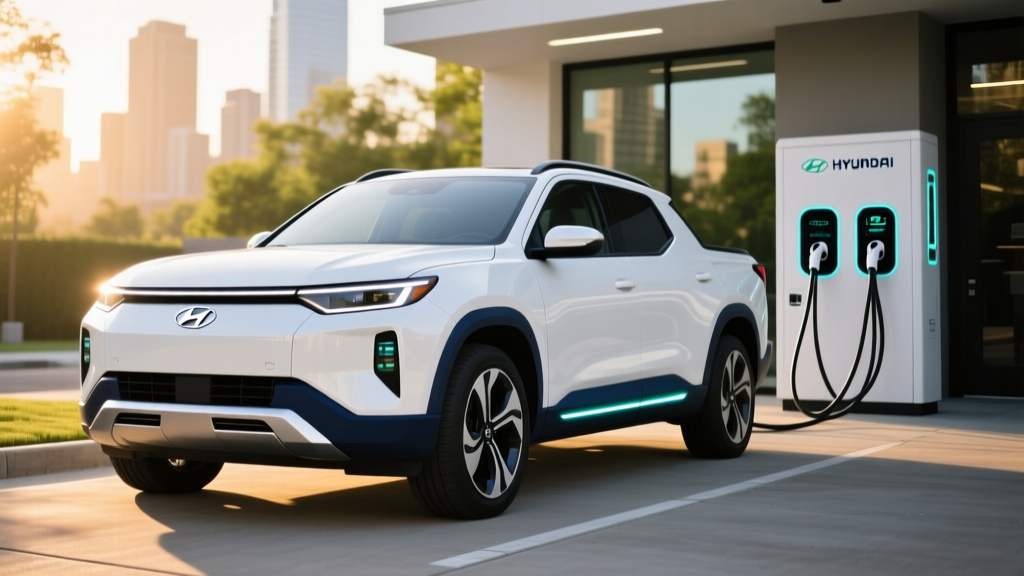
Quick Answer: As of early 2026, Hyundai does not yet sell a fully electric pickup truck in the U.S. The gasoline-powered Hyundai Santa Cruz (compact unibody truck) remains the only truck in Hyundai's lineup, starting around $28,250 MSRP. Hyundai has confirmed an electric pickup concept is in development for the North American market, but no production model, pricing, or EPA range figures have been officially released. If you need a Hyundai truck today, the Santa Cruz gas model is your option; if you want an electric truck now, you'll need to look at the Ford F-150 Lightning, Rivian R1T, or Chevrolet Silverado EV.
Where Hyundai Stands on Electric Trucks in 2026
Hyundai has been vocal about expanding its Ioniq EV sub-brand and electrifying its utility lineup, but a production Hyundai EV truck has not yet reached U.S. showrooms. The company has referenced an electric pickup in strategic roadmaps and showcased design studies, yet concrete specifications — battery capacity in kWh, EPA-estimated range, peak DC fast-charge rate in kW, or towing capacity — remain unannounced for a truck-specific model.
What Hyundai does offer right now is the Santa Cruz, a compact unibody pickup with a choice of a 2.5L naturally aspirated four-cylinder (191 hp) or a 2.5L turbocharged four-cylinder (281 hp). It's a gas-only vehicle with no hybrid or plug-in hybrid variant available for the 2026 model year.
For buyers specifically searching for a Hyundai EV truck, the honest reality is a waiting game. Here's what you need to know to make a smart decision today versus holding out.
The Santa Cruz Today: Gas Truck Specs and Costs
Before projecting what a Hyundai electric truck might cost or deliver, it's useful to anchor expectations in the Santa Cruz that's actually on sale. These numbers come from fueleconomy.gov and Hyundai's official U.S. specifications.
| Spec | 2.5L NA | 2.5L Turbo AWD |
|---|---|---|
| Horsepower | 191 hp | 281 hp |
| EPA Combined MPG | 23 MPG | 22 MPG |
| EPA City / Highway | 21 / 25 MPG | 19 / 27 MPG |
| Max Towing Capacity | 3,500 lbs | 5,000 lbs |
| Bed Length | 52.1 in | 52.1 in |
| Starting MSRP | ~$28,250 | ~$35,000 |
| Powertrain Warranty | 10 years / 100,000 miles | |
The Santa Cruz occupies a niche: it's smaller and more car-like than a Ford Maverick or Toyota Tacoma, with a short bed suited to weekend hauling rather than worksite duty. Fuel economy is modest — expect real-world highway figures around 24–26 MPG in the turbo AWD model, dropping to 18–20 MPG in city stop-and-go or when loaded near max payload.
What a Hyundai Electric Truck Could Look Like (Projected)
While Hyundai has not released official specs, we can project reasonable parameters based on the company's existing EV architecture (E-GMP platform used in the Ioniq 5 and Ioniq 6) and competitive benchmarks in the electric truck segment. All figures below are estimates, not confirmed specifications.
| Parameter | Estimated Range | Competitive Benchmark |
|---|---|---|
| Battery Capacity | 85–110 kWh (NMC) | Ford F-150 Lightning: 98–131 kWh |
| EPA Range | 250–320 miles | Rivian R1T Dual-Motor: ~330 mi |
| Peak DC Charge Rate | 250–350 kW | Silverado EV: 350 kW peak |
| 10–80% Charge Time | ~18–25 minutes | Ioniq 5: ~18 min at 240 kW |
| Horsepower | 300–580 hp (dual motor) | F-150 Lightning: 452–580 hp |
| Towing Capacity | 5,000–7,500 lbs | Rivian R1T: up to 11,000 lbs |
| Estimated Starting MSRP | $50,000–$60,000 | F-150 Lightning: ~$52,995 |
Hyundai's E-GMP platform supports 800V architecture, which means a future Hyundai EV truck could realistically achieve very fast DC charging speeds — a significant advantage for truck buyers who tow or road-trip. The trade-off is that towing at highway speeds in an electric truck typically cuts real-world range by 30–50%, a pattern consistent across the F-150 Lightning and Rivian R1T. A Hyundai EV truck would not be immune to this physics reality.
Cost Comparison: Gas Santa Cruz vs. Electric Truck Ownership
Whether you're cross-shopping the current Santa Cruz against an existing electric truck or waiting for Hyundai's future EV pickup, the total cost of ownership (TCO) math is what matters. Below is a 5-year / 75,000-mile comparison using national averages.
| Cost Category | Santa Cruz Turbo AWD (Gas) | Typical Electric Truck (e.g., F-150 Lightning) |
|---|---|---|
| Purchase Price (MSRP) | $38,000 | $55,000 |
| Federal Tax Credit (§30D) | $0 | Up to $7,500 (eligibility varies) |
| Fuel / Electricity | $8,900 (gas at $3.50/gal, 22 MPG) | $3,200 (home L2 at $0.14/kWh, 2.0 kWh/mi) |
| Maintenance | $3,500 | $1,500 |
| Insurance (avg) | $7,500 | $9,000 |
| Estimated Depreciation | $14,000 | $20,000 |
| Total 5-Year Cost | ~$71,900 | ~$81,200 |
Key takeaways from this comparison:
- Upfront gap: Even after a potential $7,500 federal tax credit, the electric truck costs roughly $9,500 more at purchase. The §30D credit has income caps ($150K single / $300K joint), MSRP caps ($80,000 for trucks), and battery sourcing requirements that change annually — always verify current-year rules at irs.gov.
- Fuel savings are real: Over 75,000 miles, the EV saves approximately $5,700 in energy costs when charging primarily at home. Public DC fast charging at $0.35–$0.50/kWh narrows this gap significantly.
- Maintenance favors EV: No oil changes, no transmission fluid, fewer brake replacements (thanks to regenerative braking). Expect roughly $2,000 less in scheduled maintenance over 5 years.
- Insurance is higher for EVs: Electric trucks typically carry 15–25% higher premiums due to higher repair costs and battery replacement risk. Get quotes before committing.
- Depreciation uncertainty: EV depreciation has been volatile. Early electric trucks have seen steeper drops than gas counterparts in some model years, though this is stabilizing as the market matures.
Real-World Ownership: What First-Time EV Truck Buyers Must Know
If you're considering any electric truck — whether waiting for Hyundai or buying a Ford, Rivian, or Chevy today — these practical realities separate informed buyers from disappointed ones.
Home Charging Is Non-Negotiable for Most Owners
Electric trucks have large batteries (100+ kWh). Charging on a standard 120V outlet (Level 1) adds roughly 3–4 miles of range per hour — that's 36–48 miles overnight, which won't replenish a depleted truck battery for days. A Level 2 home charger (240V, 40–48 amps) adds 25–35 miles per hour and can fully recharge overnight.
Installation costs for a Level 2 home charger typically run $500–$2,500 depending on your electrical panel. If your home has a 100-amp panel and the charger requires a 200-amp upgrade, costs can reach $3,000–$5,000. Always get a licensed electrician's assessment before purchasing equipment. Renters and condo dwellers without dedicated parking face a significant barrier.
Cold Weather Cuts Range 20–35%
Lithium-ion batteries lose efficiency in cold temperatures, and cabin heating draws substantial energy. In sustained sub-30°F conditions, expect an electric truck rated at 300 miles EPA to deliver 195–240 miles of real-world range. Hyundai's current EVs (Ioniq 5, Ioniq 6) use heat pump systems that mitigate this somewhat — a future Hyundai EV truck would likely include one — but the physics cannot be eliminated entirely.
Towing and Payload Slash Range
This is the biggest real-world shock for electric truck owners. Towing a 5,000-lb trailer at 65 mph can reduce range by 40–50%. A truck rated for 300 miles unladen may deliver just 150–180 miles while towing. For anyone who tows frequently or over long distances, route planning around DC fast chargers becomes essential — and not all charging stations accommodate trucks with trailers (you may need to unhitch).
Charging Speed: Peak kW vs. Sustained Reality
When manufacturers advertise "350 kW charging," that's a peak rate sustained only briefly at a low state of charge. The actual charge curve tapers significantly above 80% state of charge to protect battery health. A realistic 10–80% charge session on a modern electric truck takes 18–30 minutes at a capable DC fast charger. Charging from 80–100% can add another 20–40 minutes. Plan road trips around the 10–80% window for efficiency.
| Myth | Fact |
|---|---|
| "Hyundai already sells an electric truck." | As of 2026, Hyundai only sells the gas-powered Santa Cruz. No production EV truck is available. |
| "An electric truck can tow just as far as a gas truck." | Towing cuts EV range by 30–50%. A gas truck with a 25-gallon tank still has a towing range advantage. |
| "I'll save $7,500 no matter what." | The §30D credit has income, MSRP, and battery-sourcing requirements. Not every buyer or vehicle qualifies. |
| "EV batteries need replacing every few years." | Modern NMC and LFP batteries are warrantied for 8–10 years / 100,000–150,000 miles. Most retain 85–90%+ capacity at 100K miles based on current degradation data. |
| "Charging is always cheaper than gas." | Home charging is cheaper. Public DC fast charging at $0.40+/kWh can equal or exceed gas cost per mile in some regions. |
Decision Framework: Should You Wait or Buy Now?
Choose to buy the gas Hyundai Santa Cruz now if:
- You need a compact truck immediately and prefer Hyundai's warranty (10-year/100K-mile powertrain)
- You tow regularly and can't accommodate EV range loss while towing
- You don't have access to home Level 2 charging
- Your budget is under $40,000 and you want to avoid EV price premiums
- You drive in extreme cold frequently and prioritize predictable range
Choose to buy an existing electric truck (F-150 Lightning, Rivian R1T, Silverado EV) now if:
- You want an electric truck today and can't wait for an unannounced Hyundai product
- You have home Level 2 charging access and a daily commute under 150 miles
- You qualify for the §30D federal tax credit and want to reduce effective purchase price
- You value instant torque, quiet operation, and a front trunk (frunk) for gear storage
- You want V2L (vehicle-to-load) capability for job-site power or camping
Choose to wait for a Hyundai EV truck if:
- You're loyal to the Hyundai brand and its dealer/warranty network
- You want to see if Hyundai's 800V E-GMP platform delivers class-leading charge speeds in a truck format
- Your current vehicle serves you fine and you're 18–36 months from a purchase
- You want to see how the EV truck market matures on pricing, battery chemistry (LFP vs. NMC), and charging infrastructure
Federal Tax Credit: What Applies to Electric Trucks in 2026
If you're considering any electric truck purchase, the IRS §30D Clean Vehicle Credit is a significant factor — but it's not a guaranteed $7,500 for every buyer. Here's what governs eligibility in 2026:
- MSRP cap: Trucks (including pickups) must have an MSRP at or below $80,000.
- Buyer income cap: Adjusted gross income must not exceed $150,000 (single), $225,000 (head of household), or $300,000 (joint filers).
- Battery sourcing: Increasing percentages of battery critical minerals and components must be sourced from the U.S. or free-trade-agreement partners. Vehicles that don't meet thresholds may qualify for a partial credit ($3,750) or none at all.
- Point-of-sale transfer: Buyers can transfer the credit to the dealer at purchase, reducing the sale price directly rather than waiting to claim it on a tax return.
- Assembly requirement: Final assembly must occur in North America.
Always confirm a specific vehicle's eligibility at fueleconomy.gov before signing a purchase agreement. Rules have tightened annually since the Inflation Reduction Act took effect, and some previously eligible models have lost partial or full credit eligibility.
Alternatives: Electric Trucks You Can Buy Right Now
If the search for a Hyundai EV truck leads you to explore the current electric truck market, here are the main contenders with key data points (2026 model year where available, 2025 otherwise):
| Model | EPA Range | Battery (kWh) | Peak DC Charge | Starting MSRP |
|---|---|---|---|---|
| Ford F-150 Lightning | 240–320 mi | 98 / 131 kWh | ~150 kW | ~$52,995 |
| Rivian R1T (Dual Motor) | 270–410 mi | 95 / 149 kWh | ~220 kW | ~$69,900 |
| Chevrolet Silverado EV | 340–440 mi | ~200 kWh (max) | 350 kW | ~$52,900 |
| GMC Sierra EV | 340–440 mi | ~200 kWh (max) | 350 kW | ~$59,900 |
| Tesla Cybertruck | 320–340 mi | ~123 kWh | ~250 kW | ~$79,990 |
Notable: Hyundai's own Ioniq 5 SUV (not a truck) demonstrates the company's EV capabilities — 800V charging, ~303-mile EPA range in Long Range AWD trim, and a starting price around $42,000. A truck built on similar architecture would be compelling, but it simply doesn't exist yet.
Frequently Asked Questions
Does Hyundai currently make an electric truck?
No. As of 2026, Hyundai's only truck offering in the U.S. is the gasoline-powered Santa Cruz compact pickup. Hyundai has indicated plans for an electric pickup, but no production model, specs, or release date have been officially confirmed.
How much would a Hyundai EV truck cost?
There is no official pricing. Based on competitive electric trucks and Hyundai's EV pricing strategy, a reasonable estimate puts a future Hyundai EV truck in the $50,000–$65,000 starting range. The gas Santa Cruz starts at roughly $28,250 for comparison.
Can I get a federal tax credit on a Hyundai Santa Cruz?
No. The §30D Clean Vehicle Credit applies only to new plug-in electric vehicles (BEVs and qualifying PHEVs). The Santa Cruz is a conventional gasoline vehicle with no electrified powertrain option.
Is an electric truck practical for towing?
Electric trucks can tow — the F-150 Lightning is rated up to 10,000 lbs and the Rivian R1T up to 11,000 lbs. However, towing at highway speeds typically reduces real-world range by 30–50%. For frequent long-distance towing, a gas or diesel truck still has a practical range advantage.
What's the best electric truck to buy while waiting for Hyundai?
It depends on your needs. The Ford F-150 Lightning offers the best value proposition for a full-size electric work truck. The Rivian R1T excels in adventure/off-road capability and range options. The Chevrolet Silverado EV provides the longest range and fastest charging in the segment. Test-drive each and compare against your specific use case — payload needs, towing frequency, daily commute distance, and home charging access.
Will a Hyundai EV truck use NACS or CCS for charging?
Hyundai has committed to adopting the NACS (Tesla-style) connector for future EVs sold in North America, beginning with models released in the 2025–2026 timeframe. A future Hyundai EV truck would very likely ship with a NACS port, granting native access to Tesla Supercharger stations in addition to third-party networks like Electrify America and EVgo (which are adding NACS cables).