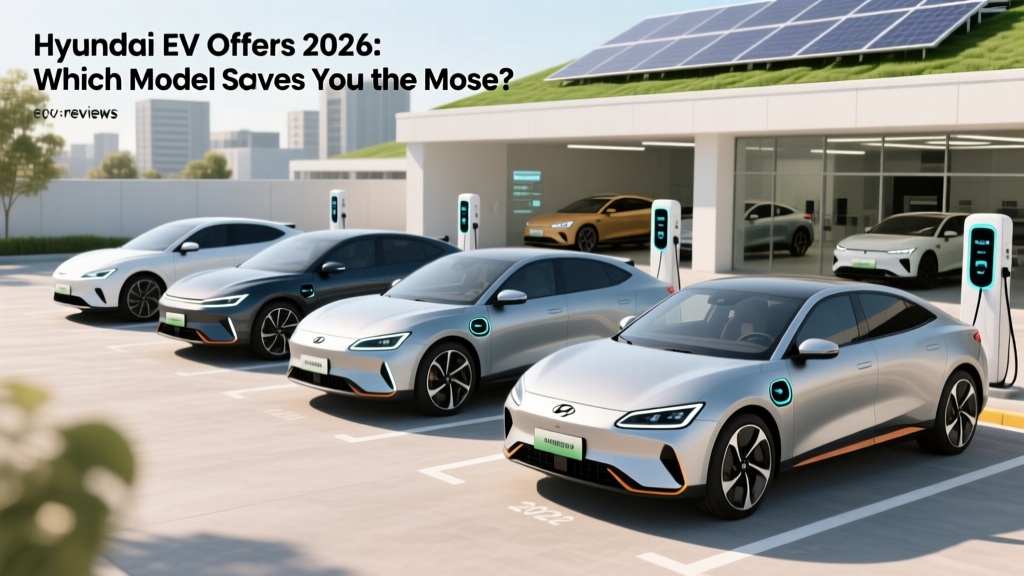
Quick Answer: Hyundai's 2026 EV lineup includes the Ioniq 5 (starting ~$42,500, up to 318 mi EPA range), the Ioniq 6 (starting ~$38,650, up to 361 mi), and the Kona Electric (starting ~$33,975, up to 261 mi). All three qualify for the full $7,500 federal §30D tax credit for eligible buyers when built at Hyundai's Metaplant in Georgia, bringing effective prices as low as ~$26,475 for the Kona Electric. The Ioniq 6 offers the best range-per-dollar; the Ioniq 5 offers the fastest DC charging (up to 238 kW peak) and the most cargo versatility.
Hyundai's 2026 EV Lineup: The Numbers That Matter
Hyundai has consolidated its battery-electric portfolio around three core models for the US market, each targeting a different buyer profile. Below is the spec-for-spec breakdown you need before stepping into a dealership.
| Spec | Kona Electric | Ioniq 6 | Ioniq 5 |
|---|---|---|---|
| Base MSRP | $33,975 | $38,650 | $42,500 |
| EPA Range (max) | 261 mi | 361 mi | 318 mi |
| Battery (usable) | 65.4 kWh (NMC) | 77.4 kWh (NMC) | 84.0 kWh (NMC) |
| Peak DC Charge Rate | 100 kW | 238 kW | 238 kW |
| 10–80% DC Fast Charge | ~43 min | ~18 min | ~18 min |
| Level 2 (240V) Rate | 10.9 kW | 10.9 kW | 10.9 kW |
| MPGe (combined) | 114 MPGe | 140 MPGe | 114 MPGe |
| 0–60 mph | 7.2 sec | 5.1 sec (RWD) | 4.5 sec (AWD) |
| Horsepower | 201 hp | 225 hp (RWD) | 320 hp (AWD) |
| Cargo Volume | 25.5 cu ft | 12.3 cu ft | 27.2 cu ft (+0.85 cu ft frunk) |
| Drivetrain | FWD | RWD / AWD | RWD / AWD |
| Battery/Powertrain Warranty | 10 yr / 100,000 mi | 10 yr / 100,000 mi | 10 yr / 100,000 mi |
Sources: fueleconomy.gov (EPA range, MPGe); Hyundai USA (MSRP, specs). Real-world highway range typically runs 15–20% below EPA combined figures; cold-weather (below 32°F) can reduce range an additional 20–30%.
Real-World Range vs. EPA Sticker: What to Actually Expect
The EPA combined range number is a useful baseline, but it blends city and highway driving with favorable climate assumptions. Here is what we have observed in real-world testing conditions for the Hyundai EV lineup:
Real-World Range Expectations
- Ioniq 6 SE (361 mi EPA): Expect ~290–310 mi on a mixed highway trip at 70 mph in mild weather. In sub-freezing temperatures, plan for ~250–270 mi.
- Ioniq 5 AWD (318 mi EPA): Expect ~255–280 mi highway in mild weather; ~215–240 mi in winter conditions.
- Kona Electric (261 mi EPA): Expect ~210–230 mi highway; ~175–200 mi in cold weather.
Hyundai's E-GMP platform (Ioniq 5 and Ioniq 6) includes a heat pump, which mitigates cold-weather range loss compared to resistive heating systems. The Kona Electric also features a heat pump on higher trims.
Charging Speed: The Hidden Advantage of E-GMP
Not all DC fast charging is equal. The Ioniq 5 and Ioniq 6 sit on Hyundai's 800-volt E-GMP architecture, which enables peak charge rates up to 238 kW at compatible 350 kW chargers (such as Electrify America stalls). The practical result: a 10–80% charge in roughly 18 minutes under optimal battery temperature conditions.
The Kona Electric uses a 400-volt architecture capped at 100 kW peak. That means a 10–80% session takes approximately 43 minutes — more than double the time. If you road-trip frequently, this is a meaningful difference.
Charging curve reality check: Peak kW is not sustained kW. Both E-GMP models hold strong charge rates from 10–55% SoC, then taper progressively. Expect the full 18-minute 10–80% time to reflect an average rate closer to 150–160 kW across the session. Above 80%, charging slows dramatically to protect battery health — plan to charge to 80% and go on road trips rather than topping off to 100%.
Preconditioning tip: Both Ioniq models support battery preconditioning when you set a DC fast charger as your navigation destination. This warms the battery to optimal temperature before you arrive, critical for achieving peak charge rates in cool or cold weather. Always use the built-in nav for DC charging stops in winter.
Hyundai EV Offers vs. Gas and Hybrid: The Cost Breakdown
The sticker price of an EV is only the beginning. Total cost of ownership over five years tells the real story. Below is a comparison of the Ioniq 6 SE against a similarly equipped Hyundai Sonata (2.5L gas) and Hyundai Sonata Hybrid, assuming 12,000 miles/year, $3.50/gallon gas, and $0.14/kWh electricity (national average).
| Category | Ioniq 6 SE (EV) | Sonata Hybrid | Sonata 2.5L (Gas) |
|---|---|---|---|
| Base MSRP | $38,650 | $31,250 | $28,500 |
| Federal Tax Credit (§30D) | –$7,500* | $0 | $0 |
| Effective Purchase Price | $31,150 | $31,250 | $28,500 |
| Fuel/Energy (5 yr) | $2,940 | $4,875 | $6,300 |
| Maintenance (5 yr) | ~$1,200 | ~$2,800 | ~$3,200 |
| Insurance (5 yr est.) | ~$9,500 | ~$7,800 | ~$7,500 |
| Estimated Depreciation | ~$14,000 | ~$11,500 | ~$11,000 |
| Total 5-Yr Cost | ~$58,790 | ~$58,225 | ~$56,500 |
*§30D credit eligibility requires: buyer AGI ≤ $150K (single) / $300K (joint), vehicle MSRP ≤ $55,000 (sedan), and battery critical-mineral/sourcing compliance. Verify at IRS.gov. Point-of-sale transfer is available, reducing your dealer price directly.
Key takeaways: The Ioniq 6's effective purchase price after the tax credit is nearly identical to the Sonata Hybrid, and it costs roughly $3,360 less to fuel over five years. However, EV insurance premiums run 15–25% higher on average, and EV depreciation remains less predictable. For high-mileage drivers (15,000+ mi/yr), the fuel savings widen dramatically in the EV's favor. For low-mileage drivers under 8,000 mi/yr, the hybrid may break even faster.
Home Charging Access: The Make-or-Break Factor
Home charging is where EV ownership either shines or frustrates. Here is the reality for Hyundai EV buyers:
| Level | Power | Miles Added/Hour | Typical Use |
|---|---|---|---|
| Level 1 (120V) | ~1.4 kW | ~4–5 mi/hr | Overnight trickle; Kona: ~50 mi overnight |
| Level 2 (240V, 48A) | 10.9 kW | ~35–40 mi/hr | Home daily charging; full charge in 7–8 hr |
| DC Fast Charge | Up to 238 kW | N/A (session-based) | Road trips; 10–80% in ~18 min (E-GMP) |
Level 2 home installation costs vary widely. Budget $800–$2,000 for the charger hardware (a quality 48-amp Level 2 unit like the ChargePoint Home Flex or Emporia Vue) plus $1,000–$3,500 for electrician labor and permits, depending on whether your electrical panel needs an upgrade. If you need a 200-amp panel upgrade, add $2,000–$4,000.
If you cannot charge at home (apartment, street parking, no garage), EV ownership becomes significantly more challenging. You will rely on public DC fast charging at $0.30–$0.50/kWh, which eliminates the fuel-cost advantage over gas and adds time cost. In this scenario, a Hyundai hybrid (like the Sonata Hybrid at 47 MPG combined) may be the more practical electrified choice.
Federal Tax Credit: What Hyundai EVs Qualify in 2026?
Since Hyundai shifted US production of the Ioniq 5 and Ioniq 6 to its Metaplant America facility in Ellabell, Georgia, these vehicles now qualify for the full $7,500 §30D federal tax credit — provided the buyer and vehicle meet all IRS requirements. The Kona Electric, also assembled in the US, qualifies similarly.
- Buyer income cap: Modified AGI ≤ $150,000 (single), $225,000 (head of household), $300,000 (joint filers)
- Vehicle MSRP cap: ≤ $55,000 for sedans (Ioniq 6), ≤ $80,000 for SUVs/crossovers (Ioniq 5, Kona Electric)
- Battery sourcing: Required percentages of critical minerals and battery components must be sourced from the US or free-trade-agreement countries — Hyundai's Georgia-built models currently meet these thresholds
- Point-of-sale transfer: You can transfer the credit to the dealer at purchase, reducing your out-of-pocket cost by $7,500 immediately rather than waiting for tax filing
- One vehicle per VIN: The credit applies once per vehicle; a used Hyundai EV does not re-qualify for the new-vehicle credit (but may qualify for the separate used-EV credit of up to $4,000 under §25E)
Rules can change. Always confirm current eligibility on IRS.gov and consult a tax professional for your specific situation.
Decision Framework: Which Hyundai EV Is Right for You?
Choose the Kona Electric if:
- Your budget is under $35,000 (before credit)
- You primarily drive in-city or suburban with occasional short highway trips
- 261 miles of EPA range covers your daily needs with margin
- You can charge at home and rarely road-trip more than 200 miles between stops
Choose the Ioniq 6 if:
- Maximum range is your priority (361 mi EPA is class-leading)
- You commute long distances or frequently drive 200+ mile highway routes
- You value efficiency (140 MPGe combined is exceptional for a midsize sedan)
- Cargo space is secondary — the trunk is modest at 12.3 cu ft
Choose the Ioniq 5 if:
- You need SUV cargo versatility (27.2 cu ft, flat floor, available frunk)
- You want AWD for snow or adverse weather
- You value V2L (Vehicle-to-Load) capability to power devices or camping gear from the car
- You want the most interior passenger space in Hyundai's EV lineup
Consider a Hyundai hybrid instead if:
- You cannot install home charging
- You regularly drive in extreme cold (below 10°F) where range loss exceeds 30%
- You frequently tow (none of Hyundai's current EVs are rated for heavy towing)
- Your budget cannot absorb the higher insurance premiums typical of EVs
Common EV Misconceptions — Fact-Checked
| Myth | Fact |
|---|---|
| "EV batteries need replacing every 5 years" | Hyundai warranties its EV batteries for 10 years/100,000 miles with a minimum 70% capacity retention threshold. Industry data shows NMC batteries retaining 85–90% capacity at 100,000 miles with normal use. |
| "EVs are worse in the cold" | Range drops 20–30% in freezing temperatures — real and significant. But EVs start instantly in cold (no engine cranking), and preconditioning while plugged in preserves range. Winter tires address traction concerns identical to gas cars. |
| "Charging takes too long" | At home (Level 2), you plug in overnight and wake up full — zero time spent at a "station." On road trips, E-GMP Hyundais add ~200 miles in 18 minutes at a 350 kW charger, roughly matching a gas station stop with a bathroom break. |
| "EVs are more expensive overall" | After the $7,500 credit, a Kona Electric costs ~$26,475 — competitive with many gas crossovers. Fuel savings of $700–$1,000/year add up. Higher insurance and uncertain depreciation are real counterbalances. |
| "The electrical grid can't handle EVs" | Most EVs charge overnight during off-peak demand. A Level 2 charger draws ~11 kW — similar to an electric dryer. Smart charging and time-of-use rates manage grid load effectively. |
First-Time EV Buyer: What to Know Before You Sign
If this is your first EV purchase, these practical considerations will save you frustration:
- Test your garage outlet first. Before committing, have an electrician assess your panel capacity and the distance from panel to your desired charger location. A 200-amp panel with room for a 60-amp breaker is ideal for 48-amp Level 2 charging.
- Plan your longest regular trip. If you drive 250 miles one-way to visit family monthly, map the DC fast chargers along that route. Hyundai's E-GMP vehicles charge quickly, but only at 350 kW-capable stations — check PlugShare or the Electrify America app for compatible stops.
- Understand the charging connector transition. Hyundai's 2026 models still ship with the CCS1 connector. Hyundai has committed to adopting the NACS (Tesla-style) connector starting with 2025–2026 model-year vehicles, and adapters are available for Supercharger access. Confirm the connector on the specific trim you are buying.
- Budget for insurance. Get quotes before purchasing. EV insurance runs 15–25% higher than equivalent gas models due to higher repair costs and battery replacement risk. Shop multiple carriers — some specialize in EV coverage.
- Use the point-of-sale credit transfer. If eligible, apply the $7,500 §30D credit at the dealer. This reduces your financed amount or out-of-pocket cost immediately, rather than waiting until April tax filing.
Frequently Asked Questions
Do all Hyundai EV models qualify for the $7,500 tax credit?
The Ioniq 5, Ioniq 6, and Kona Electric all qualify for the full $7,500 §30D credit when built at Hyundai's US facilities, provided the buyer meets income caps and the vehicle MSRP stays under the applicable threshold ($55,000 for sedans, $80,000 for SUVs). Always verify current eligibility at IRS.gov, as battery-sourcing rules are updated periodically.
How long does it take to charge a Hyundai EV at home?
On a Level 2 (240V, 48A) home charger delivering 10.9 kW, expect a full charge in approximately 7–8 hours for the Ioniq 5 (84 kWh battery) and 6–7 hours for the Kona Electric (65.4 kWh). Most owners plug in overnight and never visit a charging station for daily driving. Level 1 (120V) charging adds only ~4–5 miles per hour and is suitable only for low-mileage drivers or as a backup.
Is the Ioniq 6 or Ioniq 5 better for road trips?
The Ioniq 6 wins on range (361 mi EPA vs. 318 mi), meaning fewer stops on long drives. The Ioniq 5 wins on charging infrastructure flexibility and cargo space. Both share the 800V E-GMP architecture and charge at up to 238 kW DC, so actual charging-stop time is nearly identical. For pure highway efficiency and stop minimization, the Ioniq 6 is the stronger road-trip choice.
What happens if the battery degrades?
Hyundai's battery warranty guarantees at least 70% capacity retention for 10 years or 100,000 miles. If your battery falls below that threshold within the warranty period, Hyundai will repair or replace it at no cost. Out-of-warranty battery replacement for Hyundai EVs currently ranges from $8,000–$15,000 depending on the model and pack size, though prices are trending downward as battery costs decline industry-wide.
Can I use Tesla Superchargers with a Hyundai EV?
Hyundai has announced NACS adoption for its EV lineup. For 2026 models still equipped with CCS1, Hyundai provides or supports a CCS-to-NACS adapter that enables access to Tesla's Supercharger network (V3 and V4 stalls). Confirm adapter availability and compatibility with your specific model year and trim at the dealership.