The Short Answer on Hyundai EVs
Hyundai currently sells three battery-electric vehicles in the U.S.: the Ioniq 5 (crossover, EPA 318 mi max), the Ioniq 6 (sedan, EPA 361 mi max), and the Kona Electric (subcompact, EPA 261 mi). Base MSRPs range from roughly $32,975 (Kona) to $42,600 (Ioniq 5 SE Standard Range). All three use an 800-volt architecture capable of 10–80% DC fast charging in approximately 18 minutes at a 350 kW station, though the Kona Electric tops out at ~100 kW. Federal §30D tax-credit eligibility depends on your income, the vehicle's MSRP, and battery-component/critical-mineral sourcing — verify current-year rules at IRS.gov before purchasing.
Hyundai's 2026 EV Lineup at a Glance
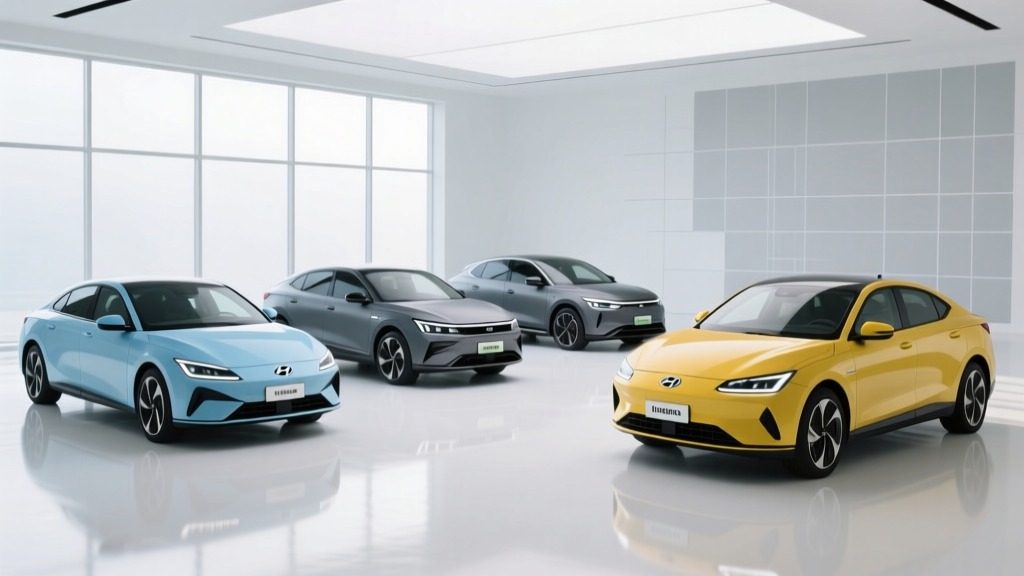
Hyundai's electric portfolio has matured significantly since the Kona Electric debuted. The E-GMP (Electric Global Modular Platform) underpins the Ioniq 5 and Ioniq 6, giving both models a flat floor, long wheelbase, and the 800V electrical architecture that enables ultra-fast DC charging. The refreshed Kona Electric, while built on a conventional platform, delivers strong value for urban-focused buyers.
| Spec | Kona Electric | Ioniq 5 | Ioniq 6 |
|---|---|---|---|
| Body Style | Subcompact CUV | Midsize Crossover | Sedan |
| Battery (usable, kWh) | 64.8 kWh (NMC) | 63.0 / 84.0 kWh (NMC) | 77.4 kWh (NMC) |
| EPA Range (max config) | 261 mi | 318 mi (LR RWD) | 361 mi (SE LR RWD) |
| Combined MPGe | 116 MPGe | 114 MPGe (LR AWD) | 140 MPGe (SE LR RWD) |
| Peak DC Charge Rate | ~100 kW | ~240 kW (84 kWh) | ~250 kW |
| 10–80% DC Time (ideal) | ~43 min | ~18 min | ~18 min |
| Level 2 Charge Rate | 11 kW | 10.9 kW | 10.9 kW |
| Horsepower (max) | 201 hp | 320 hp (AWD) | 320 hp (AWD) |
| 0–60 mph | ~7.0 sec | ~4.5 sec (AWD) | ~4.5 sec (AWD) |
| Base MSRP | $32,975 | $42,600 (SE Std Rng) | $42,450 (SE) |
| Battery Warranty | 10 yr / 100,000 mi | 10 yr / 100,000 mi | 10 yr / 100,000 mi |
Source: EPA fueleconomy.gov, Hyundai Motor America. Specs reflect 2025/2026 model-year configurations as published. Verify trim-level specs before purchase.
Real-World Range: What the EPA Sticker Doesn't Tell You
EPA estimates are useful baselines, but real-world range varies with speed, temperature, and terrain. Here's what to actually expect from Hyundai's EVs on the road:
Range Reality Check
Ioniq 6 SE Long Range RWD: EPA 361 mi → Expect ~290–310 mi on highway trips at 70–75 mph; ~240–260 mi in sub-30°F winter driving.
Ioniq 5 Long Range AWD: EPA 290 mi → Expect ~240–260 mi highway; ~200–220 mi in cold weather.
Kona Electric: EPA 261 mi → Expect ~215–235 mi highway; ~175–195 mi in cold weather.
Cold weather reduces range 20–35% due to battery heating demands and cabin HVAC use. Hyundai's available heat pump (standard on most Ioniq trims, optional or unavailable on Kona depending on trim) helps mitigate this loss by 5–10 percentage points compared to resistive heating.
The Ioniq 6's class-leading efficiency (140 MPGe combined) stems from its 0.21 drag coefficient — one of the lowest of any production car. At highway speeds where aerodynamic drag dominates, this translates directly into extra miles. The boxier Ioniq 5 sacrifices some efficiency for cargo space and upright seating.
Charging Speed & Infrastructure: The 800V Advantage
The Ioniq 5 and Ioniq 6 share Hyundai's 800V electrical architecture, which allows them to accept significantly higher DC fast-charging power than most competitors running 400V systems. Here's how the charge curve actually behaves:
| Charging Level | Power (kW) | Miles Added per Hour | Best For |
|---|---|---|---|
| Level 1 (120V household) | ~1.4 kW | ~4–5 mi/hr | Overnight top-ups, emergencies |
| Level 2 (240V home/public) | 7.7–11 kW | ~25–38 mi/hr | Daily home charging |
| DC Fast (Ioniq 5/6 at 350 kW station) | Peak ~240–250 kW | ~150+ mi in 10 min | Road trips |
| DC Fast (Kona Electric) | Peak ~100 kW | ~50–60 mi in 10 min | Occasional road trips |
Understanding kW vs kWh: kW (kilowatts) measures the rate of energy flow — like water pressure from a hose. kWh (kilowatt-hours) measures total energy stored — like the size of the bucket. A 240 kW charge rate fills an 84 kWh battery fast, but only if the station can deliver that power and the battery is preconditioned.
The 10–80% charge time of ~18 minutes applies under ideal conditions: a functioning 350 kW CCS/NACS charger, battery preconditioned to optimal temperature (the car does this automatically when you navigate to a charger), and a state of charge starting at or below 10%. Above 80%, the charge rate tapers sharply to protect battery chemistry — expect 80–100% to take an additional 15–20 minutes. For road trips, plan stops around the 10–80% window for maximum efficiency.
Hyundai has been transitioning to the NACS (Tesla-style) connector. Some 2025–2026 models ship with NACS ports; others include a CCS-to-NACS adapter for Supercharger access. Confirm connector type with your dealer before purchase, as it affects which public networks you can use natively.
Cost of Ownership: Hyundai EV vs. Gas Equivalent
The purchase price of an EV is higher, but operating costs tilt the equation over time. Here's a five-year comparison between the Ioniq 5 SEL AWD (~$47,500 MSRP) and a comparably equipped Hyundai Tucson gas AWD (~$35,000 MSRP):
| Cost Category (5 Years) | Ioniq 5 SEL AWD | Tucson AWD (Gas) |
|---|---|---|
| Purchase Price (MSRP) | $47,500 | $35,000 |
| Est. Federal Tax Credit (§30D) | Up to $7,500* | $0 |
| Effective Purchase Price | ~$40,000 | $35,000 |
| Fuel/Energy (75,000 mi) | ~$3,900 (home L2 avg) | ~$9,400 (28 MPG, $3.50/gal) |
| Maintenance | ~$1,200 | ~$3,500 |
| Insurance (avg) | ~$10,500 | ~$8,200 |
| 5-Year Total (excl. depreciation) | ~$55,600 | ~$56,100 |
*§30D credit eligibility requires meeting income caps ($150K single / $300K joint), MSRP caps ($80K SUV / $55K sedan), and battery sourcing requirements. Confirm at IRS.gov and with your tax professional. Point-of-sale transfer available at participating dealers.
The Ioniq 5 reaches near cost-parity within five years when the federal credit applies, and the gap widens further in years 6–10 as fuel and maintenance savings compound. EVs eliminate oil changes, transmission fluid, spark plugs, and exhaust system repairs. Brake pad life extends significantly due to regenerative braking — many EV owners report original pads at 80,000+ miles.
Insurance note: EV insurance premiums run 15–25% higher than gas equivalents due to higher repair costs and specialized parts. Get quotes before purchasing to budget accurately.
Federal Tax Credit & Incentive Eligibility
The §30D clean vehicle credit can reduce your effective cost by up to $7,500, but eligibility involves several moving parts:
- Income caps: Modified AGI ≤ $300,000 (joint) / $225,000 (head of household) / $150,000 (single)
- MSRP caps: ≤ $80,000 for SUVs/crossovers (Ioniq 5, Kona) / ≤ $55,000 for sedans (Ioniq 6)
- Battery sourcing: Must meet escalating critical-mineral and battery-component requirements — percentages increase annually
- Point-of-sale transfer: You can transfer the credit to the dealer at purchase, reducing your out-of-pocket cost immediately (rather than waiting for a tax refund)
- Assembly: Vehicle must undergo final assembly in North America — all three Hyundai EVs qualify
Beyond federal credits, many states and utilities offer additional rebates for EV purchases and home charger installation. Check your state energy office and local utility for specifics, as these vary widely by jurisdiction.
Myths vs. Facts: What First-Time Buyers Get Wrong
| Myth | Fact |
|---|---|
| "The battery will need replacing in 5 years" | Hyundai warranties the battery for 10 years / 100,000 miles with a 70% capacity retention threshold. NMC chemistry in these models typically degrades ~1–2% per year under normal use. |
| "EVs don't work in cold climates" | Range drops 20–35% in freezing temps, but preconditioning (warming the battery while plugged in) and heat-pump HVAC recover significant efficiency. Thousands of EV owners in Minnesota, Norway, and Alaska drive daily year-round. |
| "Charging takes too long" | Home Level 2 charging adds ~30 mi/hr overnight — most owners start every day with a full battery. Road-trip DC charging adds ~150 mi in 10–12 minutes on the Ioniq 5/6. |
| "There aren't enough chargers" | The U.S. has over 70,000 public charging ports. Hyundai's NACS adapter opens 20,000+ Tesla Superchargers. Rural gaps exist — plan road trips with apps like PlugShare or A Better Routeplanner. |
| "EVs are worse for the environment" | Even on a coal-heavy grid, lifecycle emissions for EVs are lower than gas cars within 1–2 years of driving. On cleaner grids, the advantage is immediate. Source: Union of Concerned Scientists analysis. |
Decision Framework: Which Hyundai EV Fits You?
Choose Based on Your Actual Needs
Choose the Kona Electric if: You drive under 200 miles daily, want the lowest entry price (~$33K before incentives), mostly commute in-city, and don't need ultra-fast road-trip charging.
Choose the Ioniq 5 if: You need crossover cargo space (27.2 cu ft behind rear seats), want AWD availability, value the fastest DC charging (18-min 10–80%), and want a family-sized EV with strong tech features.
Choose the Ioniq 6 if: Maximum range is your priority (361 mi EPA), you prefer a sedan's driving dynamics, you take frequent highway trips where aerodynamic efficiency pays dividends, and you don't need a tall roofline.
Consider a Hyundai hybrid (Tucson Hybrid/PHEV) instead if: You lack reliable home charging access, regularly drive in remote areas with sparse charging infrastructure, or need to tow heavy loads (the Ioniq 5 max towing is 2,300 lbs vs. Tucson Hybrid's 2,000 lbs — neither is a heavy hauler).
Home Charging Setup: What You'll Actually Need
Most Hyundai EV owners charge at home 85–90% of the time. Here's the practical breakdown:
| Item | Typical Cost Range |
|---|---|
| Level 2 EVSE hardware (40–48A, hardwired) | $400–$750 |
| Electrician labor (240V circuit install) | $800–$2,500 |
| Permit & inspection | $100–$300 |
| Electrical panel upgrade (if needed, 200A) | $1,500–$4,000 |
| Total (standard install, no panel upgrade) | $1,300–$3,550 |
You'll need a 240V circuit rated for at least 40 amps (50-amp breaker) to achieve the full 10.9–11 kW Level 2 rate. A licensed electrician should evaluate your panel capacity — many older homes with 100-amp service need an upgrade before adding a dedicated EV circuit. Factor this into your purchase budget.
Without home charging, EV ownership is significantly less convenient and more expensive (public DC charging costs $0.30–$0.60/kWh vs. ~$0.13–$0.18/kWh for residential electricity). If you can't install a Level 2 charger at home, a PHEV or hybrid may be the more practical choice until your situation changes.
Frequently Asked Questions
Does the Hyundai Ioniq 5 qualify for the $7,500 federal tax credit?
It can, but eligibility depends on the specific model year's battery sourcing compliance, your income, and the vehicle's MSRP. The Ioniq 5 is assembled in Georgia (Metaplant America), satisfying the North American assembly requirement. Check the current qualified vehicle list at fueleconomy.gov and consult a tax professional.
How long does it take to charge a Hyundai EV at home?
On a Level 2 home charger (10.9 kW), the Ioniq 5's 84 kWh battery charges from 0–100% in roughly 8 hours. The Kona Electric's 64.8 kWh battery takes about 6 hours. Most owners charge overnight and wake to a full battery every morning.
What happens if the battery degrades?
Hyundai's battery warranty guarantees at least 70% capacity retention for 10 years or 100,000 miles. If degradation exceeds that threshold within the warranty period, Hyundai will repair or replace the battery. Real-world data from high-mileage Hyundai EVs suggests NMC batteries typically retain 85–90% capacity at 100,000 miles under normal use.
Can I use Tesla Superchargers with a Hyundai EV?
Newer Hyundai models are shipping with NACS ports or include a CCS-to-NACS adapter. With the adapter (or native NACS), you can access Tesla Supercharger stations. Verify the included connector hardware with your dealer before purchase.
Is Hyundai's driver-assist system self-driving?
No. Hyundai's Highway Driving Assist 2 (HDA2) is an SAE Level 2 system — it can manage steering, acceleration, and braking on highways, but the driver must remain fully attentive with hands on or near the wheel at all times. It is not autonomous driving.