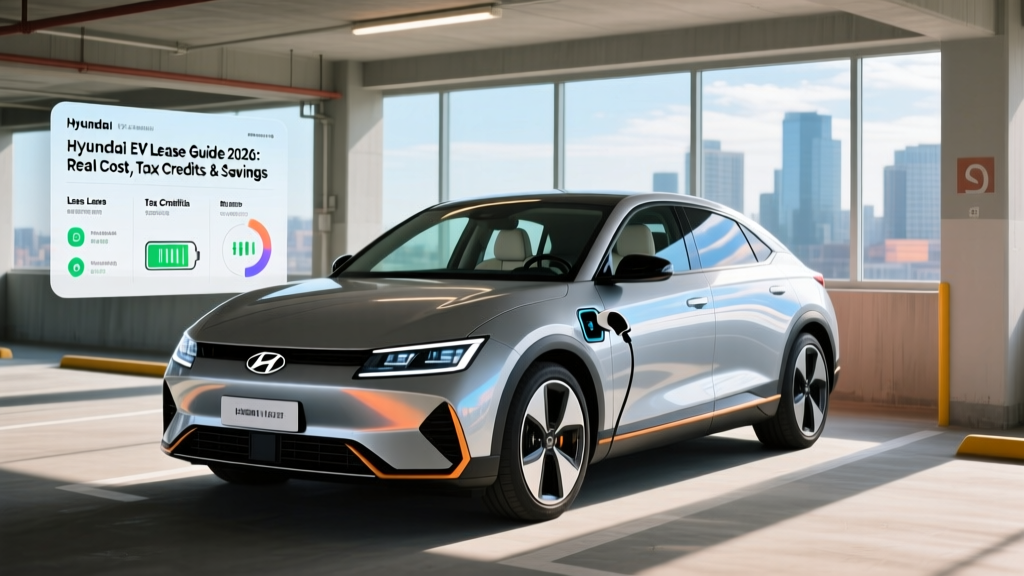
Hyundai's electric lineup has expanded dramatically, but the math behind buying versus leasing an Ioniq 5, Ioniq 6, or Kona Electric isn't always straightforward. A Hyundai EV lease can unlock savings that a purchase can't — particularly when it comes to federal tax credits on models that wouldn't otherwise qualify. But leases also come with mileage limits, no equity buildup, and their own cost traps.
This guide walks through the real five-year cost picture of leasing versus buying a Hyundai EV in 2026, including the exact IRS rules that determine whether you'll see $7,500 off your deal, what you'll actually spend on charging versus gas, and why insurance premiums might sting more than you expect.
The Hyundai EV Lineup: What You Can Lease in 2026
Hyundai currently offers three mainstream battery-electric vehicles in the U.S., each with distinct range, pricing, and charging profiles:
| Model | EPA Range | Battery (usable kWh) | Peak DC Charge | 10–80% Time | 0–60 mph | Base MSRP |
|---|---|---|---|---|---|---|
| Kona Electric SEL | 261 mi | 64.8 kWh (NMC) | 100 kW | ~43 min | 7.8 sec | $34,975 |
| Ioniq 5 SE Std Range | 245 mi | 63.0 kWh (NMC) | 150 kW | ~30 min | 7.4 sec | $42,600 |
| Ioniq 5 SEL (LR AWD) | 290 mi | 84.0 kWh (NMC) | 240 kW | ~18 min | 5.1 sec | $50,250 |
| Ioniq 6 SE (LR RWD) | 361 mi | 77.4 kWh (NMC) | 240 kW | ~18 min | 6.9 sec | $42,750 |
All four trims use nickel-manganese-cobalt (NMC) lithium-ion chemistry, which delivers higher energy density than LFP but benefits from staying between 20–80% state of charge for daily use to maximize long-term battery health.
Why a Hyundai EV Lease Can Beat a Purchase on Price
The single biggest reason shoppers search for a Hyundai EV lease is the commercial clean vehicle credit loophole. Under IRC §45W, vehicles leased through a dealership's captive finance arm (Hyundai Motor Finance) are classified as commercial fleet vehicles. That means the $7,500 federal credit flows to Hyundai as the lessor — and Hyundai typically passes it through as a "lease cash" incentive applied to your capitalized cost.
Here's why that matters: if you purchase a Hyundai Ioniq 5, the vehicle likely fails the §30D battery-sourcing and critical-mineral requirements because Hyundai sources cells primarily from SK On and LG Energy Solution, with supply chains that don't yet fully meet U.S.-free-trade-agreement thresholds. Purchased, the Ioniq 5 may qualify for $0 or $3,750 of the $7,500 credit depending on the model year's specific sourcing compliance.
Leased? You bypass those rules entirely. The full $7,500 typically applies as lease cash.
§30D Purchase Credit Checklist (If You Buy Instead of Lease)
- MSRP cap: SUVs/pickups/vans ≤ $80,000; sedans/other ≤ $55,000 (IRS §30D rules)
- Buyer income cap (MAGI): $150K single / $225K head of household / $300K joint
- Battery sourcing: Critical minerals must be extracted/processed in U.S. or FTA partner; battery components must be manufactured/assembled in North America (phasing thresholds tighten annually through 2029)
- FEOC exclusion: No battery components from "foreign entities of concern" (China, Russia, etc.) — this is where many Hyundai/Kia models stumble on purchase
- Point-of-sale transfer: You can elect to transfer the credit to the dealer at purchase for an immediate price reduction, rather than claiming it on your tax return
Rules are current for tax year 2026 and subject to legislative change. Consult a tax professional before relying on credit eligibility.
Five-Year Total Cost of Ownership: Lease vs. Buy vs. Gas
To compare apples to apples, let's model a 2026 Hyundai Ioniq 5 SEL (LR AWD, $50,250 MSRP) leased for 36 months then either returned or re-leased, versus purchasing the same vehicle, versus a comparable gas crossover (2026 Toyota RAV4 AWD, ~$35,000 MSRP, 30 MPG combined).
| Cost Category | Ioniq 5 Lease (2× 36-mo, overlap 5 yr) | Ioniq 5 Purchase | Gas Crossover (RAV4 AWD) |
|---|---|---|---|
| Vehicle acquisition (down + payments or purchase price net of credit) | $22,800 (est. $380/mo × 60 mo, incl. $7,500 lease cash applied) | $42,750 ($50,250 − $7,500 §30D if eligible) | $35,000 |
| Fuel / electricity (60K mi) | $4,320 (home L2 @ $0.14/kWh, 3.0 mi/kWh) | $4,320 | $10,000 ($3.50/gal ÷ 30 MPG × 60K) |
| Maintenance | $900 | $1,200 | $3,500 |
| Insurance (5 yr) | $11,400 ($190/mo avg) | $11,400 | $8,400 ($140/mo avg) |
| Depreciation / equity | $0 (returned, no equity) | −$18,000 (est. resale ~60% of net price at 60K mi) | −$14,000 (est. resale ~60% at 60K mi) |
| Total 5-year net cost | $39,420 | $41,670 | $42,900 |
Assumes $0.14/kWh home electricity (national avg), $3.50/gal gas, 12K mi/yr. Insurance varies significantly by ZIP, age, and driving record. Depreciation estimates based on industry resale data. Actual lease payments vary by dealer, money factor, and residual.
Charging vs. Gas: The Real $/Mile Math
The fuel-cost advantage of an EV depends entirely on where you charge. Here's the breakdown for the Ioniq 5 LR AWD, which achieves roughly 3.0 miles per kWh (112 MPGe combined per fueleconomy.gov):
| Scenario | $/kWh or $/gal | $/mile (Ioniq 5) | $/mile (30 MPG gas) |
|---|---|---|---|
| Home Level 2 (national avg) | $0.14/kWh | $0.047 | $0.117 |
| Home Level 2 (CA/high-cost) | $0.28/kWh | $0.093 | $0.150 |
| Public DCFC (Electrify America avg) | $0.48/kWh | $0.160 | $0.117 |
| Tesla Supercharger (NACS adapter, avg) | $0.30/kWh | $0.100 | $0.117 |
Key insight: If you charge primarily at home on a standard utility rate, the Ioniq 5 costs roughly $0.05/mile — a 60% savings over gas. But if you rely on public DC fast chargers at $0.48/kWh, you're actually spending more per mile than a 30 MPG gas car. Home charging access is the single biggest variable in EV economics.
Level 2 home charging adds roughly 30–35 miles of range per hour for the Ioniq 5 on an 11.5 kW onboard charger. A full overnight charge from 20–80% SoC takes about 4 hours — plenty for daily driving.
Maintenance Savings: Where EVs Quietly Win
EVs have roughly 20 moving parts in their drivetrain versus 2,000+ in an internal combustion engine. That translates to real savings:
| Service Item | Ioniq 5 EV | Gas Crossover |
|---|---|---|
| Oil changes (every 5K–7.5K mi) | $0 | $600–$900 |
| Brake pads (regen extends life 2–3×) | $0–$200 (often still original at 60K) | $600–$1,200 |
| Cabin air filter | $150 | $150 |
| Tire rotation/replacement | $800 (EVs wear tires ~15% faster due to torque + weight) | $700 |
| Coolant / transmission fluid | $100 (reduction gear fluid check) | $400 (transmission, engine coolant) |
| Spark plugs, belts, emissions | $0 | $500–$800 |
| Total (est.) | $1,050–$1,250 | $2,950–$4,150 |
Hyundai's EV battery and drive unit warranty covers 10 years / 100,000 miles, with a capacity-retention threshold of 70%. If the battery degrades below that, Hyundai replaces or refurbishes it at no cost — a meaningful backstop given that out-of-warranty NMC battery replacement currently runs $12,000–$18,000 depending on pack size.
The Insurance Reality: Why EVs Cost More to Insure
Here's the line item that catches most new EV owners off guard. According to industry data, EV insurance premiums run 15–25% higher than comparable gas vehicles. For the Ioniq 5, expect $170–$210/month for full coverage depending on your profile, versus $130–$160 for a RAV4.
The reasons are structural:
- Higher repair costs: EV battery packs and power electronics are expensive to replace after collision damage. Even minor rear-end impacts can total an EV if the battery enclosure is compromised.
- Specialized labor: High-voltage system repairs require certified technicians, and fewer shops have that certification.
- Higher vehicle cost: The Ioniq 5's $50K MSRP simply costs more to insure than a $35K gas crossover.
- Parts availability: Hyundai EV parts supply chains are still maturing, leading to longer rental-car reimbursements during repairs.
Before signing any lease or purchase, get a quote from your insurer specifically for the EV trim you're considering. The difference can erase $1,500–$3,000 of your fuel savings over five years.
Depreciation: How Well Does a Hyundai EV Hold Value?
EV depreciation has been volatile. Between 2023 and 2025, aggressive price cuts by Tesla, new model launches, and shifting federal credit rules caused used EV values to drop faster than gas cars — some models lost 40–50% of value in the first two years.
Hyundai EVs have fared slightly better than average thanks to strong reviews, the 800V fast-charging architecture (rare at this price point), and Hyundai's reputation for reliability. Expect a 2026 Ioniq 5 to retain roughly 55–65% of its net acquisition cost at 60,000 miles and five years, assuming no major market disruptions.
This is where leasing gains an edge: you transfer depreciation risk to Hyundai Motor Finance. If the EV market softens further or a breakthrough in solid-state batteries tanks used-NMC values, that's the lessor's problem, not yours. If values hold strong, you walk away without capturing the upside — but you also never took the downside risk.
State, Local & Utility Incentives (Vary by Region)
Beyond the federal credit, many buyers can stack additional savings:
- California (CVRP): Up to $2,000 rebate for income-qualified buyers on new EVs; additional $1,000 for low-income applicants
- Colorado: $5,000 state tax credit for new EVs under $80,000 MSRP (stackable with federal)
- New York (Drive Clean Rebate): Up to $2,000 point-of-sale rebate
- Utility rebates: Many utilities (PG&E, ConEd, Xcel Energy) offer $500–$1,500 for home Level 2 charger installation or off-peak charging credits
- HOV lane access: California, Virginia, and other states offer single-occupant HOV stickers for EVs — a non-monetary perk worth real commute time
These programs change frequently and have income/application requirements. Check your state energy office and local utility for current availability. The AFDC state incentive database maintains a current list.
Lease vs. Buy Decision Framework
Choose a Hyundai EV Lease If:
- You want the full $7,500 incentive on a model that may not qualify under §30D purchase rules
- You drive fewer than 12,000–15,000 miles per year (lease limits typically 10K–15K mi/yr; overage fees ~$0.20–$0.25/mi)
- You want to upgrade every 3 years as battery tech and charging infrastructure evolve
- You don't want to absorb depreciation risk in a volatile used-EV market
- Your state offers lease-equivalent tax treatment (most states tax the monthly payment, not the full vehicle price)
Choose to Purchase If:
- Your specific Hyundai model and trim qualifies for the full $7,500 §30D credit at purchase (check fueleconomy.gov for current eligibility by VIN)
- You drive more than 15,000 miles per year
- You plan to keep the vehicle 6+ years and want equity buildup
- You want to modify the vehicle (wraps, wheels, suspension) without lease restrictions
- Your state taxes the full lease value upfront rather than monthly payments (rare, but applies in some jurisdictions)
Frequently Asked Questions
How much does it really cost to own a Hyundai EV over 5 years?
Based on our modeling, a leased Ioniq 5 LR AWD costs roughly $39,000–$42,000 over five years including payments, electricity, insurance, and maintenance — comparable to or slightly less than a gas crossover when the $7,500 lease cash incentive applies. Purchasing costs roughly $40,000–$45,000 net of depreciation, depending on whether the §30D credit applies at purchase and how well the vehicle holds value.
Do I qualify for the federal EV tax credit on a Hyundai?
If you purchase, eligibility depends on your MAGI (≤$150K single / $300K joint), the vehicle's MSRP (≤$55K for sedans like the Ioniq 6, ≤$80K for SUVs like the Ioniq 5), and battery sourcing compliance. Many Hyundai models struggle with the FEOC and critical-mineral sourcing requirements at purchase. If you lease, the commercial vehicle credit (§45W) typically provides the full $7,500 as lease cash regardless of sourcing rules or buyer income.
How much do I save on fuel and maintenance with a Hyundai EV?
Fuel savings average $4,000–$6,000 over five years if you charge primarily at home ($0.14/kWh), versus a 30 MPG gas crossover at $3.50/gallon. Maintenance savings add another $1,500–$3,000 from eliminated oil changes, reduced brake wear (regenerative braking handles most deceleration), and fewer scheduled service items. Combined, that's $5,500–$9,000 in operational savings.
Are Hyundai EVs more expensive to insure?
Yes — typically 15–25% higher premiums than comparable gas vehicles. For the Ioniq 5, budget $170–$210/month for full coverage versus $130–$160 for a gas crossover. The higher cost reflects expensive battery components, specialized repair requirements, and higher vehicle MSRP. Always get a specific quote before committing.
How well do Hyundai EVs hold their value?
Hyundai EVs have retained value better than some competitors thanks to strong reviews and the 800V charging platform, but EV depreciation remains volatile. Expect 55–65% value retention at five years / 60,000 miles. Leasing transfers this risk to the lessor. If you buy and plan to sell within 3–4 years, depreciation is your single largest cost — often exceeding fuel and maintenance combined.
What happens if I exceed the mileage limit on a Hyundai EV lease?
Hyundai Motor Finance leases typically offer 10,000, 12,000, or 15,000 miles per year. Overage fees range from $0.20–$0.25 per mile. If you expect to drive 18,000+ miles annually, the overage cost ($1,500–$2,000/year) can erase your fuel savings — making purchase the better option.
Can I buy out my Hyundai EV lease at the end?
Hyundai Motor Finance lease agreements typically include a purchase option at the residual value stated in your contract. If used EV values have dropped below the residual, you walk away. If they've risen above it, buying out the lease can be a smart way to capture equity. Note that the §30D tax credit is generally not available on lease buyouts, as the original "sale" was to the leasing company.