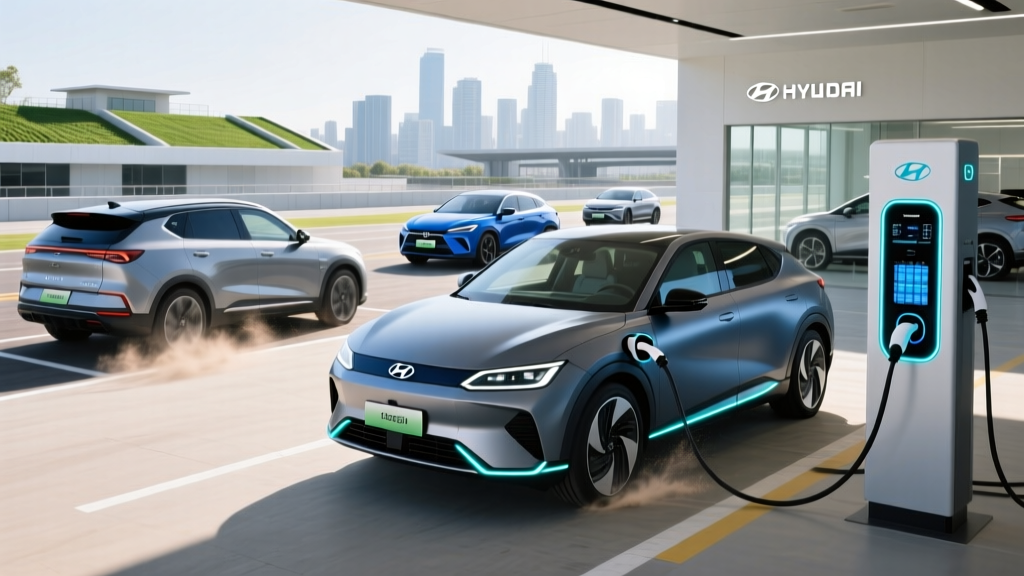
Quick Answer: Hyundai's 2026 EV lineup includes the Ioniq 5 crossover (up to 318 miles EPA, starting ~$42,500), the Ioniq 6 sedan (up to 361 miles EPA, ~$38,500), and the Kona Electric compact crossover (up to 261 miles EPA, ~$33,000). All use 800V architecture enabling 10–80% DC fast charges in roughly 18 minutes at 250+ kW chargers. Federal tax credit eligibility varies by model, trim, battery sourcing, and buyer income under IRS §30D rules — check current status before purchasing.
Hyundai's 2026 EV Lineup at a Glance
If you're researching Hyundai EV cars, the brand currently sells three battery-electric models in the U.S., all built on the Hyundai Motor Group's Electric-Global Modular Platform (E-GMP). The Ioniq 5 and Ioniq 6 share the same 800V architecture with NMC (nickel-manganese-cobalt) battery chemistry, while the Kona Electric uses a 400V system with a smaller battery aimed at budget-conscious buyers and urban commuters.
| Spec | Ioniq 5 (Long Range RWD) | Ioniq 6 (SE Long Range RWD) | Kona Electric (SEL) |
|---|---|---|---|
| EPA Range | 318 mi | 361 mi | 261 mi |
| Battery (usable) | 84 kWh, NMC | 84 kWh, NMC | 65 kWh, NMC |
| MPGe (combined) | 114 MPGe | 140 MPGe | 105 MPGe |
| Peak DC Charge Rate | ~240 kW | ~250 kW | ~100 kW |
| 10–80% DC Charge | ~18 min | ~18 min | ~43 min |
| Level 2 Rate (7.2 kW) | ~7 hrs (10–100%) | ~7 hrs (10–100%) | ~6.5 hrs (10–100%) |
| Horsepower | 225 hp (RWD) | 225 hp (RWD) | 201 hp |
| 0–60 mph | 7.2 sec | 7.0 sec | 7.5 sec |
| Base MSRP | ~$42,500 | ~$38,500 | ~$33,000 |
| Battery Warranty | 10 yr / 100,000 mi | 10 yr / 100,000 mi | 10 yr / 100,000 mi |
Source: fueleconomy.gov and Hyundai Newsroom. Specs reflect the most recent published data for current model-year trims; always confirm exact figures with your dealer.
Real-World Range: What the EPA Sticker Doesn't Tell You
EPA range estimates are measured under controlled laboratory conditions. In real-world driving, your results will vary — sometimes significantly — based on speed, temperature, terrain, and climate-control usage.
Ioniq 5 (318 mi EPA): Expect roughly 260–285 miles on a highway-heavy road trip at 70–75 mph. In freezing temperatures (below 32°F), range can drop to 200–230 miles due to battery chemistry limitations and cabin heating demands. The Ioniq 5 does include a standard heat pump, which mitigates some cold-weather loss compared to resistive heating.
Ioniq 6 (361 mi EPA): Its slippery 0.21 Cd drag coefficient makes it one of the most efficient EVs sold. Real-world highway range typically lands around 300–320 miles; cold weather drops it to 240–270 miles.
Kona Electric (261 mi EPA): Best suited for commuting and city driving. Expect 210–230 miles mixed, and 160–190 miles in sustained freezing weather. No heat pump is standard on base trims.
The key takeaway: if your daily commute is under 80 miles round-trip and you can charge at home, any of these models will work. If you regularly drive 250+ miles between charges in cold climates, the Ioniq 6 is the strongest choice, and you'll want to plan charging stops regardless.
Charging Speed: Hyundai's 800V Advantage Explained
The Ioniq 5 and Ioniq 6 use an 800V battery architecture, which is a genuine competitive advantage. Here's why it matters:
kW vs. kWh — the critical distinction. kW (kilowatts) measures power — how fast energy flows into the battery. kWh (kilowatt-hours) measures energy — how much the battery holds. A 240 kW peak charge rate on an 84 kWh battery is like filling a 20-gallon tank through a fire hose versus a garden hose.
Most competing EVs in this price range use 400V systems that peak between 130–170 kW. Hyundai's 800V system sustains higher charge rates longer on the curve, meaning you actually spend less time plugged in — not just on paper, but at real chargers. At a 350 kW Electrify America or Tesla Supercharger (via the NACS adapter Hyundai now supports), the Ioniq 5 and 6 hold above 180 kW through roughly 60% state of charge before tapering.
The Kona Electric's 400V system tops out around 100 kW, which is adequate for overnight Level 2 charging but noticeably slower on road trips. Plan for roughly 43 minutes from 10–80% at a fast charger, versus 18 minutes for the Ioniq models.
Charging connector note: Hyundai has adopted the NACS (North American Charging Standard) connector for newer production runs, granting access to Tesla's Supercharger network. Older CCS1-equipped models can use a Hyundai-provided NACS adapter. Confirm your vehicle's connector type at purchase.
Hyundai EV Cars vs. Gas and Hybrid: The Cost Reality
The purchase decision usually comes down to total cost of ownership (TCO), not just sticker price. Here's a 5-year comparison using the Ioniq 5 SEL (~$45,000) versus a comparably equipped Hyundai Tucson gas crossover (~$34,000) and a Tucson Hybrid (~$38,000).
| Cost Category | Ioniq 5 SEL (EV) | Tucson Hybrid | Tucson Gas (AWD) |
|---|---|---|---|
| Purchase Price (MSRP) | $45,000 | $38,000 | $34,000 |
| Est. Federal Tax Credit (§30D) | –$3,750 to –$7,500* | $0 | $0 |
| Fuel / Electricity (75k mi) | $2,800** | $6,200 | $8,500 |
| Maintenance (5 yr) | $1,200 | $2,800 | $3,500 |
| Insurance (5 yr avg) | $9,500 | $7,800 | $7,200 |
| Est. Depreciation | $18,000 | $14,000 | $13,500 |
| Total 5-Yr Cost (approx.) | $55,250–$59,000 | $68,800 | $73,700 |
* §30D credit eligibility depends on buyer income caps ($150k single / $300k joint), vehicle MSRP caps ($55k for sedans, $80k for SUVs/vans), and battery critical-mineral/component sourcing rules. Confirm at IRS.gov before purchase. Credit can be transferred to the dealer at point of sale as a purchase-price reduction.
** Electricity cost based on $0.14/kWh national average and 70% home / 30% public charging mix. Public DC fast charging costs significantly more ($0.35–$0.55/kWh).
The EV wins on fuel and maintenance savings — no oil changes, fewer brake replacements thanks to regenerative braking, and roughly one-third the per-mile energy cost when charging at home. But insurance premiums run 15–30% higher for EVs, and depreciation remains steeper than gas equivalents, though this gap is narrowing as the used EV market matures.
First-Time EV Buyer: What You Actually Need to Know
Before you sign for any Hyundai EV, work through these practical ownership considerations:
Home Charging Access Is the Make-or-Break Factor
If you can install a Level 2 (240V) home charger, an EV becomes dramatically more convenient — you start every morning with a full charge, and home electricity costs a fraction of public charging. A typical Level 2 installation (40-amp circuit, hardwired ChargePoint or Emporia charger) runs $800–$2,200 including the electrician, permit, and equipment. If your electrical panel needs an upgrade to 200 amps, add $1,500–$3,500.
If you cannot charge at home (apartment, street parking, no garage), you'll rely on public charging and workplace chargers. This is feasible but more expensive and less convenient. In that scenario, a PHEV like the Hyundai Tucson Plug-In Hybrid (33 miles electric-only, then gas) may be a smarter bridge.
Climate and Driving Patterns Matter
Living in a cold-weather state (Minnesota, Colorado, New England) means accepting 20–35% range reduction in winter. Hyundai's heat pump helps, but physics is physics — lithium-ion batteries charge slower and hold less energy when cold. Preconditioning the battery while plugged in (a feature the Ioniq 5 and 6 support) mitigates this.
For warm-climate, mostly-city drivers, the Kona Electric's 261 miles is more than adequate and offers the lowest entry price.
The §30D Tax Credit Is Not Guaranteed
Many buyers assume every EV qualifies for the full $7,500. That's incorrect. The credit phases based on where the battery minerals and components are sourced, and it can change mid-year as supply chains shift. Some Hyundai EVs qualify for the full amount, some for $3,750, and some for $0 depending on the current sourcing determination. Always verify on the IRS clean vehicle credit page and ask the dealer for the IRS-issued credit transfer confirmation before closing the deal.
Decision Framework: Which Hyundai EV Is Right for You?
Choose the Ioniq 6 if:
- You prioritize maximum range (361 mi EPA) and efficiency (140 MPGe)
- You take frequent road trips and want fewer charging stops
- You prefer a sedan form factor and don't need tall cargo clearance
Choose the Ioniq 5 if:
- You want crossover utility (cargo space, ride height, available AWD)
- You need the fastest DC charging for road trips
- You want V2L (vehicle-to-load) capability to power devices or a campsite from your car's battery
Choose the Kona Electric if:
- Your budget is under $35,000 before incentives
- You commute under 80 miles daily and charge at home
- You want the lowest entry price into Hyundai's EV ecosystem
Consider a Hyundai PHEV instead if:
- You lack reliable home charging access
- You regularly drive 300+ miles in rural areas with sparse charging infrastructure
- You want electric-only commuting (30-ish miles) with gas flexibility for longer trips
Common Hyundai EV Myths — Addressed with Data
| Myth | Fact |
|---|---|
| "The battery will need replacing in 5 years." | Hyundai warranties the battery for 10 years / 100,000 miles against capacity loss below 70%. Real-world degradation data from similar NMC packs shows ~8–12% capacity loss at 100,000 miles — meaning you'd still have 280+ miles from an Ioniq 6. |
| "EVs cost more to own overall." | Over 5 years and 75,000 miles, an Ioniq 5 typically costs $10,000–$18,000 less than a comparable gas crossover when the tax credit applies and you charge primarily at home. Without the credit or with 100% public fast charging, the gap narrows or flips. |
| "Charging takes too long on road trips." | At a 250+ kW charger, the Ioniq 5/6 adds roughly 200 miles of range in 18 minutes. Combined with a rest stop, food, and a bathroom break, it's comparable to a gas fill-up stop in total time. |
| "You can't drive an EV in winter." | You can, but expect 20–35% range loss. Preconditioning, a heat pump, and planning charging stops accordingly make it manageable. Millions of EVs operate in Norway, Canada, and the northern U.S. year-round. |
| "Hyundais don't have good charging networks." | With NACS adoption, Hyundai EVs now access Tesla's Supercharger network (17,000+ stalls in North America) plus Electrify America, EVgo, and ChargePoint. The Ioniq 5/6's 800V architecture also charges faster than most competitors at any network. |
Frequently Asked Questions
Do Hyundai EV cars qualify for the $7,500 federal tax credit?
Eligibility varies by model, trim, battery sourcing, and buyer income. Under IRS §30D, the buyer must fall under income caps ($150,000 single / $225,000 head of household / $300,000 joint), the vehicle MSRP must be under $55,000 (sedans like Ioniq 6) or $80,000 (SUVs/crossovers like Ioniq 5), and the battery must meet critical-mineral and component-sourcing thresholds. Some trims may qualify for $3,750 rather than the full $7,500. The credit can be applied as a point-of-sale price reduction through the dealer. Always verify current eligibility at IRS.gov before purchasing.
How much does it cost to charge a Hyundai EV at home?
At the U.S. average residential electricity rate of ~$0.14/kWh, fully charging an Ioniq 5's 84 kWh battery costs roughly $11.75 — yielding 318 miles of EPA range, or about $0.037 per mile. Compare that to a gas car at 28 MPG and $3.30/gallon: $0.118 per mile. Home charging saves roughly $0.08 per mile. Over 15,000 miles annually, that's about $1,200 in fuel savings.
Can I use Tesla Superchargers with a Hyundai EV?
Yes. Hyundai has adopted the NACS connector for new production, and existing CCS-equipped models can use a Hyundai-provided NACS adapter to access Tesla's Supercharger network. Confirm adapter availability and compatibility with your specific model year and trim at your dealer.
What happens if the battery degrades significantly?
Hyundai's battery warranty covers capacity loss below 70% of original capacity for 10 years or 100,000 miles. If your battery falls below that threshold within the warranty period, Hyundai will repair or replace it at no cost. Out-of-warranty battery replacement for the Ioniq 5/6 currently runs $12,000–$18,000 depending on the pack — a significant cost, but one that very few owners face based on current degradation data.
Is Hyundai's highway driving assist (HDA2) self-driving?
No. HDA2 is an SAE Level 2 driver-assistance system. It combines adaptive cruise control with lane-centering and can assist on highways, but the driver must remain attentive, keep hands on the wheel (or demonstrate engagement), and be ready to take over at any moment. It is not autonomous driving. Only Level 4 systems like Waymo's robotaxi service operate without a human driver.