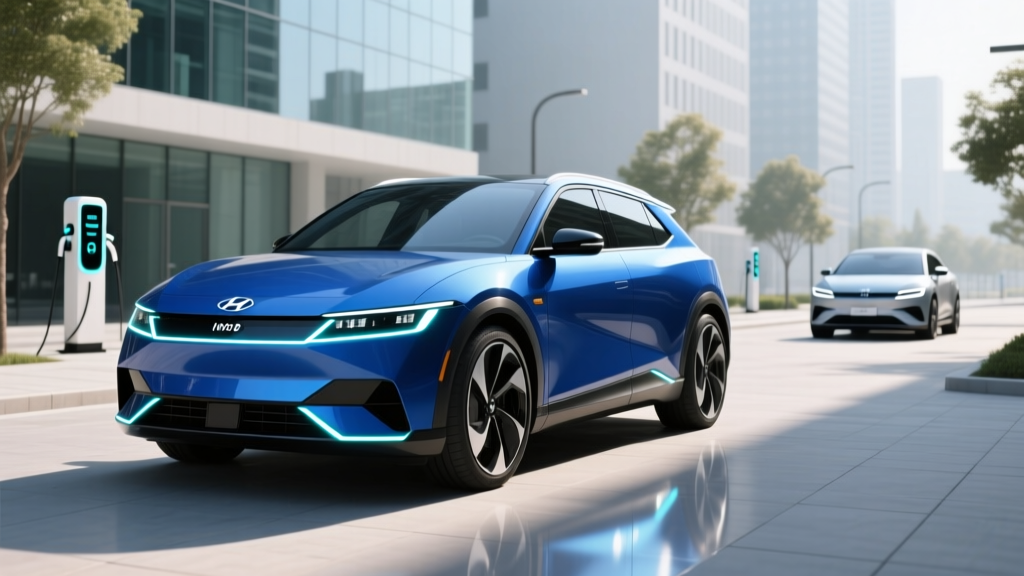
If you've seen a Hyundai electric SUV spotted in your neighborhood or on social media, you're likely looking at one of two vehicles: the compact Ioniq 5 or the three-row Ioniq 9. Both ride on Hyundai's E-GMP platform with 800V architecture, meaning they can charge from 10% to 80% in roughly 18–20 minutes at a compatible 350 kW DC fast charger. The Ioniq 5 starts around $42,600 (2026 MSRP), while the Ioniq 9 begins near $56,000. Both may qualify for the federal §30D tax credit of up to $7,500, but eligibility depends on your income, the vehicle's MSRP cap, and battery-sourcing requirements that shift yearly — always verify current rules at IRS.gov before purchasing.
Ioniq 5 vs Ioniq 9: Which Hyundai Electric SUV Did You Spot?
Hyundai's electric SUV lineup has expanded significantly. The angular, retro-futuristic crossover you've seen is likely the Ioniq 5. The larger, more conventional-looking three-row SUV is the Ioniq 9, which arrived for the 2025 model year and is now well-established in 2026. Here's how they compare on paper and in practice:
| Spec | Ioniq 5 (Long Range AWD) | Ioniq 9 (Long Range AWD) |
|---|---|---|
| EPA Range | 290 mi (SE/SEL), 258 mi (Limited) | 311 mi (SEL), 275 mi (Limited) |
| Battery (usable) | 77.4 kWh, NMC | 110.3 kWh, NMC |
| Peak DC Fast Charge | ~240 kW (800V) | ~240 kW (800V) |
| 10–80% DCFC Time | ~18 min (at 350 kW station) | ~20 min (at 350 kW station) |
| Level 2 Charge Rate | 10.9 kW | 11 kW |
| Horsepower | 320 hp (AWD) | 338 hp (AWD) |
| 0–60 mph | 4.5 sec | 4.9 sec |
| Cargo (behind 2nd row) | 27.2 cu ft | ~35 cu ft |
| Starting MSRP (2026) | ~$42,600 | ~$56,000 |
| Battery/Powertrain Warranty | 10 yr / 100,000 mi | 10 yr / 100,000 mi |
EV vs Gas vs Hybrid: What Does Ownership Actually Cost?
The Hyundai electric SUV you spotted might look like a leap into the unknown, but the math is increasingly straightforward. Let's compare the Ioniq 5 AWD against its closest internal-combustion sibling, the Tucson Hybrid AWD, over five years and 75,000 miles:
| Category | Ioniq 5 SEL AWD | Tucson Hybrid SEL AWD |
|---|---|---|
| Base MSRP | ~$45,000 | ~$36,500 |
| Fed. Tax Credit (§30D est.) | Up to $7,500 (if eligible) | N/A |
| Effective Purchase Price | ~$37,500 | ~$36,500 |
| Fuel/Energy (75k mi) | ~$2,800 (home L2 @ $0.14/kWh) | ~$7,200 (38 MPG @ $3.65/gal) |
| Maintenance (5 yr) | ~$1,200 | ~$3,100 |
| Insurance (est. avg) | ~$9,500 | ~$7,800 |
| 5-Year Total | ~$51,000 | ~$54,600 |
The Ioniq 5 pulls ahead primarily through fuel and maintenance savings — EVs have no oil changes, no transmission fluid, and regenerative braking extends pad life significantly. However, EV insurance premiums run 15–25% higher on average due to costlier collision repairs. According to fueleconomy.gov, the Ioniq 5 AWD achieves 110 MPGe combined, translating to roughly 3.5 miles per kWh.
Key caveat: If you charge primarily on public DC fast chargers at $0.40–$0.60/kWh, your energy cost jumps to $4,500–$6,700 over 75,000 miles — still below gasoline but eroding the advantage. Home charging access is the single biggest variable in EV economics.
Real-World Ownership: What First-Time EV Buyers Must Know
Buying the Hyundai electric SUV you spotted isn't just about the sticker price. Here are the practical ownership factors that separate satisfied EV owners from frustrated ones:
Home Charging Is Non-Negotiable for Most Buyers
Level 1 charging (120V household outlet) adds roughly 3–5 miles of range per hour — adequate only if you drive under 30 miles daily and can leave the car plugged in overnight. Most EV owners install a Level 2 home charger (240V), which adds 30–40 miles per hour at 10.9 kW. Expect to pay $600–$1,200 for a quality Level 2 unit (like the ChargePoint Home Flex or Emporia Vue) plus $500–$2,000 for electrician installation, depending on whether your panel needs an upgrade to 200A. If you live in an apartment or lack off-street parking, map out reliable public Level 2 or DCFC options within a 10-minute detour of your routine before buying.
The 800V Charging Advantage Is Real — But Conditional
Hyundai's E-GMP platform supports 800V DC fast charging, meaning at a 350 kW station (like Electrify America's latest stalls), the Ioniq 5 can accept up to ~240 kW peak. However, charge speed follows a curve: it peaks between roughly 10–55% State of Charge, then tapers progressively. The advertised 18-minute 10–80% time assumes ideal conditions — a preconditioned battery, a 350 kW stall, and ambient temperatures above 60°F. At a 150 kW station or in cold weather, expect 25–35 minutes for the same 10–80% session. Per Hyundai's official specs, preconditioning the battery via navigation-routed charging is critical for achieving peak speeds.
Connector Transition: NACS vs CCS
For 2026, Hyundai has transitioned new EVs to the NACS (Tesla-style) connector in North America. This means the Ioniq 5 and Ioniq 9 can natively access Tesla Supercharger stalls (now open to non-Tesla EVs via the NACS standard) without an adapter. If you're buying a 2024–2025 model with CCS1, a Hyundai-provided NACS adapter is available. Always confirm the connector type on the specific vehicle you're evaluating.
Common Misconceptions About Hyundai's Electric SUVs
| Myth | Fact |
|---|---|
| "The battery will need replacing in 5 years." | Hyundai warranties the battery for 10 years/100,000 miles against capacity loss below 70%. Real-world degradation data from Ioniq 5 owners shows roughly 5–8% loss after 60,000 miles. A full replacement (rare) costs $12,000–$18,000 out of warranty. |
| "EVs don't work in cold climates." | Range drops 20–30% in sub-freezing temps, but the Ioniq 5's heat pump and battery preconditioning mitigate this. Owners in Minnesota and Maine routinely drive them year-round — just plan for reduced range and precondition while plugged in. |
| "Everyone gets the $7,500 tax credit." | The §30D credit has income caps ($150K single / $300K joint), MSRP caps ($80K for SUVs), and critical-mineral/battery-sourcing requirements that change annually. Some Hyundai EVs qualify for the full $7,500; others may get $3,750 or none. Check the latest at IRS.gov and consult a tax professional. |
| "It charges at 350 kW the whole time." | Peak rate is ~240 kW and only between ~10–55% SoC. Above 80%, speed drops dramatically to protect the battery — a 70–100% session can take 25+ minutes. Plan road-trip stops around 10–80% charges for best efficiency. |
| "Highway driving kills range completely." | At a steady 70 mph in 65°F weather, the Ioniq 5 AWD delivers roughly 255–270 miles — about 15% below EPA. At 80 mph or in headwinds, expect closer to 230–245 miles. This is manageable with DCFC stations spaced every 150–180 miles on major corridors. |
Decision Framework: Is a Hyundai Electric SUV Right for You?
Choose the Ioniq 5 if:
- You have Level 2 home charging (or can install it)
- Your daily driving is under 200 miles round-trip
- You want a compact SUV with strong acceleration (4.5 sec 0–60) and distinctive styling
- You value the 10-year/100,000-mile battery warranty
- You qualify for the §30D credit, bringing effective price near $35K–$40K
Choose the Ioniq 9 if:
- You need three rows of seating for family hauling
- You want maximum range in the Hyundai EV lineup (311 mi EPA)
- You're willing to pay $56K+ for a larger, more premium cabin
- You take occasional road trips and want the 110.3 kWh battery buffer
Choose the Tucson Hybrid or PHEV instead if:
- You lack reliable home or workplace charging
- You regularly drive 400+ miles between stops in rural areas with sparse DCFC coverage
- You tow frequently (the Ioniq 5 is rated for only 1,650 lbs; Tucson Hybrid manages similar)
- You live in an extreme cold climate and can't precondition while plugged in
- Your budget is firm below $35K and you don't qualify for the federal credit
Charging Speeds at a Glance: What to Expect
| Level | Power (kW) | Miles Added per Hour | Typical Use Case |
|---|---|---|---|
| Level 1 (120V) | ~1.4 kW | 3–5 mi/hr | Overnight top-up, low-mileage drivers |
| Level 2 (240V, 48A) | ~10.9 kW | 32–38 mi/hr | Home charging, full overnight recharge |
| DC Fast (150 kW station) | ~130 kW avg | ~250 mi in 30 min | Road trips, public charging |
| DC Fast (350 kW station) | ~240 kW peak | ~200 mi in 18 min (10–80%) | Optimal road-trip charging |
kW vs kWh reminder: kW (kilowatts) measures power — how fast energy flows into the car, like water pressure from a hose. kWh (kilowatt-hours) measures energy capacity — the total amount stored in the battery, like the size of a bucket. The Ioniq 5 has a 77.4 kWh battery and can accept up to ~240 kW of charging power.
Frequently Asked Questions
Which Hyundai electric SUV was spotted most often in 2026?
The Ioniq 5 remains Hyundai's highest-volume electric SUV in the US, with well over 100,000 units on American roads. The Ioniq 9, launched for 2025, is rapidly gaining visibility as a three-row family EV. The smaller Kona Electric (EPA 261 mi, ~$33K) is also common but is a subcompact crossover rather than a midsize SUV.
Does the Hyundai Ioniq 5 qualify for the $7,500 federal tax credit in 2026?
Eligibility depends on the specific model year, trim, battery-sourcing compliance, your adjusted gross income, and the vehicle's MSRP relative to the $80,000 SUV cap. Hyundai has worked to shift battery sourcing to qualify, but rules tighten annually under the Inflation Reduction Act. The credit can now be transferred to the dealer at point of sale as an immediate price reduction. Always confirm current eligibility at IRS.gov before finalizing a purchase.
How long does the Ioniq 5 battery last before replacement?
Based on fleet data and owner reports, Hyundai's NMC batteries in the E-GMP platform retain approximately 92–95% capacity after 60,000 miles and 3+ years. The warranty guarantees at least 70% retention over 10 years / 100,000 miles. Full battery replacement is rare and costs $12,000–$18,000 out of pocket, but most owners will never need one within typical ownership periods.
Can I use Tesla Superchargers with a Hyundai electric SUV?
Yes. For 2026, Hyundai builds new Ioniq 5 and Ioniq 9 models with the native NACS connector, granting direct access to Tesla's Supercharger network. For 2022–2025 models originally equipped with CCS1, Hyundai offers a NACS adapter. Tesla's network remains the most reliable and widely distributed DC fast-charging infrastructure in the US, with over 25,000 stalls nationally.
Is Hyundai's Highway Driving Assist (HDA) self-driving?
No. Hyundai's HDA and HDA 2 are SAE Level 2 driver-assistance systems — they provide adaptive cruise control and lane centering, but you must keep your hands on the wheel and eyes on the road at all times. This is not autonomous driving. Only Level 4 services like Waymo operate without a human driver, and those are limited to specific geofenced urban areas.
What's the real cost to charge a Hyundai Ioniq 5 at home?
At the US average residential electricity rate of ~$0.16/kWh (varies widely by state), fully recharging the 77.4 kWh battery from 10% to 100% costs roughly $11.15. That translates to about $0.045 per mile — compared to roughly $0.10–$0.13 per mile for a 30 MPG gas car at $3.50/gallon. Over 15,000 annual miles, home-charged Ioniq 5 energy costs run approximately $675 per year versus $1,750 for gasoline.