Quick Answer: Which Hyundai Electric Vehicle Should You Buy?
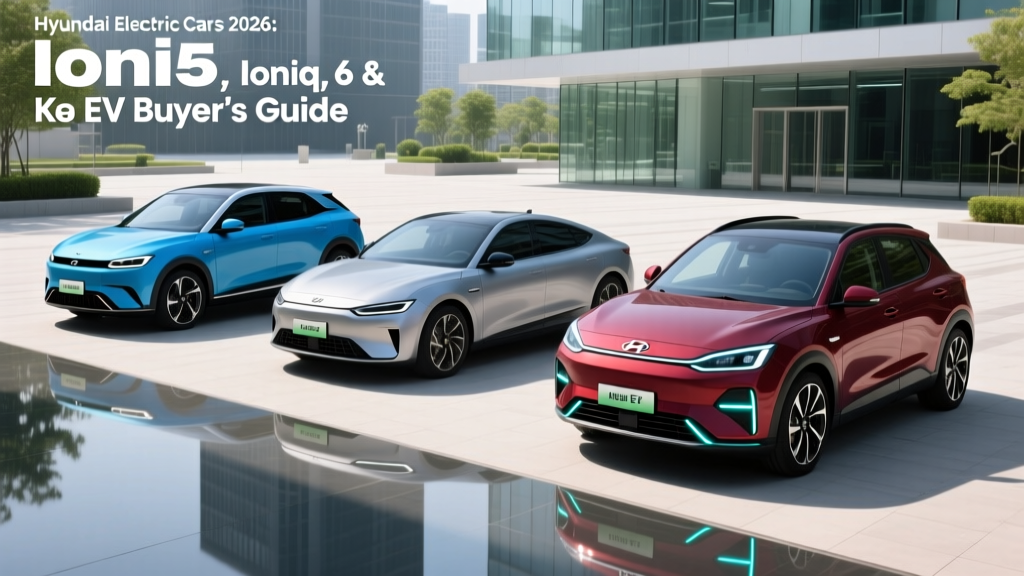
Hyundai's 2026 electric lineup covers three distinct buyer profiles. The Kona Electric (starting ~$32,975, EPA 261 mi) is the budget-friendly compact crossover for city commuters. The Ioniq 5 (starting ~$42,900, EPA up to 303 mi) is the best all-around family EV with 800V ultra-fast charging and NACS compatibility. The Ioniq 6 (starting ~$38,650, EPA up to 361 mi) delivers the longest range and lowest running costs for highway-heavy drivers. All three qualify for varying levels of the federal §30D tax credit depending on battery sourcing, your income, and point-of-sale transfer rules.
Hyundai's 2026 Electric Lineup at a Glance
Hyundai has invested more heavily in dedicated EV platforms than most legacy automakers. The Ioniq 5 and Ioniq 6 ride on the E-GMP (Electric-Global Modular Platform), which gives them 800-volt electrical architecture — a feature that directly translates to faster DC charging than competitors still on 400V systems. The Kona Electric uses a modified version of Hyundai's ICE platform adapted for battery electric duty, which keeps costs down but sacrifices some charging speed.
| Spec | 2026 Kona Electric | 2026 Ioniq 5 | 2026 Ioniq 6 |
|---|---|---|---|
| Base MSRP | $32,975 | $42,900 | $38,650 |
| EPA Range (max config) | 261 mi | 303 mi | 361 mi |
| Battery (usable) | 64.8 kWh (NMC) | 84.0 kWh (NMC) | 77.4 kWh (NMC) |
| Peak DC Charge Rate | 100 kW | 240 kW | 240 kW |
| 10–80% DC Fast Charge | ~43 min | ~18 min | ~18 min |
| Level 2 Charge Rate | 10.9 kW | 10.9 kW | 10.9 kW |
| Horsepower | 201 hp | 168–320 hp | 149–320 hp |
| 0–60 mph | 7.4 sec | 5.1–7.4 sec | 5.1–8.3 sec |
| Combined MPGe | 103 MPGe | 110–114 MPGe | 140 MPGe |
| Connector (2026) | NACS | NACS (native) | NACS (native) |
| Battery/Powertrain Warranty | 10 yr / 100,000 mi | 10 yr / 100,000 mi | 10 yr / 100,000 mi |
Source: fueleconomy.gov and Hyundai Motor America. Specs reflect 2026 model-year data where published; some trims carry over from late-2025 updates. EPA range varies by trim and drivetrain (RWD vs AWD).
Real-World Range vs. EPA Sticker
The EPA numbers above assume mixed driving at moderate temperatures. In real-world ownership:
- Highway driving at 75 mph: Expect 85–90% of EPA range. The Ioniq 6 SE Long Range may deliver ~305–320 mi; the Ioniq 5 ~255–270 mi.
- Cold weather (below 30°F): Plan for 20–30% range reduction without preconditioning. A 303-mi Ioniq 5 in a Minnesota January may see 210–240 mi of usable range.
- Preconditioning matters: Both Ioniq models let you precondition the battery via the app or nav-routed charging. This warms the pack for faster DC charging and recovers some cold-weather range.
How Hyundai Electric Vehicles Compare to Gas and Hybrid Alternatives
The most common question from first-time EV buyers: does the math actually work versus a gas Tucson or a Tucson Hybrid? Let's compare using the Ioniq 5 against its closest internal-combustion siblings.
| Metric | 2026 Ioniq 5 SEL (EV) | 2026 Tucson Hybrid (AWD) | 2026 Tucson SEL (Gas AWD) |
|---|---|---|---|
| MSRP (before credit) | $46,400 | $35,500 | $31,250 |
| Est. Federal Tax Credit | Up to $7,500* | $0 | $0 |
| Effective Price | ~$38,900 | $35,500 | $31,250 |
| Annual Fuel/Energy Cost | ~$600 | ~$1,450 | ~$1,900 |
| Annual Maintenance | ~$150 | ~$500 | ~$600 |
| 5-Year Total Fuel + Maint. | ~$3,750 | ~$9,750 | ~$12,500 |
| 5-Year Net Cost (price + running) | ~$42,650 | ~$45,250 | ~$43,750 |
*Federal §30D credit eligibility depends on your taxable income (≤$150K single / ≤$300K joint), the vehicle's MSRP cap ($80K for SUVs), and battery critical-mineral and component sourcing requirements per IRS rules. Point-of-sale transfer is available — confirm eligibility with your dealer and tax professional.
The Ioniq 5's higher sticker price is substantially offset by the tax credit and dramatically lower running costs. Over five years of ownership, the Ioniq 5 can come out ahead of the Tucson Hybrid — and well ahead of the gas Tucson — especially if you charge primarily at home on residential electricity rates.
Real Ownership Costs: What You'll Actually Spend
EV ownership economics go beyond the purchase price. Here's a detailed five-year cost breakdown for the Ioniq 5, assuming 12,000 miles/year and a national-average electricity rate of $0.16/kWh.
| Cost Category | Ioniq 5 SEL (5-Year) | Notes |
|---|---|---|
| Purchase Price (after credit) | $38,900 | Assumes full $7,500 §30D credit |
| Home Charger Install (Level 2) | $800–$2,000 | 240V/48A circuit; panel upgrade adds $1,500–$3,000 if needed |
| Electricity (home charging) | $2,400 | ~3.3 kWh/mi × 60,000 mi × $0.16/kWh |
| Public DC Fast Charging | $600 | ~10% of miles on road trips at $0.40/kWh avg |
| Insurance | $8,500–$10,000 | EV premiums run 10–20% higher than ICE equivalents |
| Maintenance | $750 | Tire rotation, cabin filter, wiper fluid — no oil changes |
| Tires (replacement at ~40K mi) | $800–$1,200 | EVs wear tires faster due to weight and instant torque |
| Est. Depreciation (5 yr) | $14,000–$17,000 | EV depreciation has improved but still lags Toyota/Honda ICE |
| Estimated 5-Year Total | $56,750–$62,850 | Varies significantly by local electricity rates and credit eligibility |
The Home Charging Reality Check
Hyundai's EVs deliver their best economics when you charge at home. A Level 2 home charger (10.9 kW onboard charger) adds roughly 30–35 miles of range per hour of charging — enough to fully replenish an Ioniq 5 overnight. But not every buyer has access:
- Single-family home with garage/driveway: Ideal. Budget $800–$2,000 for a licensed electrician to install a 240V NEMA 14-50 outlet or hardwired Level 2 unit. If your electrical panel is at capacity, a 200-amp upgrade adds $1,500–$3,000.
- Apartment/condo without charging: You'll rely on public Level 2 and DC fast charging. This raises your per-mile energy cost by 2–4× and adds time inconvenience. Hyundai's 800V architecture helps — 18-minute DC sessions are viable for road trips, but daily reliance on public chargers gets expensive and unpredictable.
- Workplace charging available: A strong middle ground. Many employers offer free or subsidized Level 2 charging, which can offset the lack of home charging.
Charging Speed: Hyundai's 800V Advantage Explained
This is where Hyundai's E-GMP platform genuinely differentiates itself. Most EVs in this price range — including the Ford Mustang Mach-E, Volkswagen ID.4, and Toyota bZ4X — use 400-volt electrical systems that cap DC fast charging around 135–150 kW. The Ioniq 5 and Ioniq 6 use 800V architecture, enabling peak charge rates of 240 kW at compatible DC fast chargers.
What this means in practice:
- 10–80% in ~18 minutes at a 250+ kW charger (Electrify America, Tesla Supercharger with NACS adapter or native NACS on 2026 models)
- 10–80% in ~26 minutes at a 150 kW charger (the peak is capped by the station, not the car)
- Charging curve taper: Like all EVs, charge speed peaks at low SoC and drops significantly above 80%. Charging from 80–100% on DC can take as long as 10–80%. For battery health and time efficiency, plan road-trip stops around 10–80% increments.
The Kona Electric, on its 400V platform, tops out at 100 kW — adequate for its smaller 64.8 kWh battery, but noticeably slower on road trips. A 10–80% session takes roughly 43 minutes.
All 2026 Hyundai EVs sold in the U.S. now feature the NACS (North American Charging Standard) connector natively, granting access to Tesla's Supercharger network without an adapter — a major expansion of available charging infrastructure, particularly on highway corridors.
Federal Tax Credit and Incentive Eligibility
The §30D federal clean vehicle credit remains a significant factor in Hyundai EV purchase decisions, but eligibility is not automatic. Here's what you need to verify:
- Income caps: Modified adjusted gross income ≤$150,000 (single), ≤$225,000 (head of household), ≤$300,000 (married filing jointly)
- MSRP caps: ≤$55,000 for sedans (Ioniq 6); ≤$80,000 for SUVs/crossovers (Ioniq 5, Kona Electric)
- Battery sourcing: Critical minerals and battery components must meet phased-in percentages sourced from the U.S. or FTA partners. Hyundai has shifted significant battery production to the Georgia Metaplant, improving eligibility — but specific trim/battery-pack combinations may vary.
- Point-of-sale transfer: You can transfer the credit to the dealer at purchase, reducing your out-of-pocket cost immediately rather than waiting for tax filing.
- One vehicle per taxpayer per year — and the vehicle must be for personal use, primarily in the U.S.
Always confirm current eligibility at irs.gov and with your tax professional before relying on the credit in your purchase decision. State and local incentives (utility rebates, HOV lane access, reduced registration fees) vary by jurisdiction — check afdc.energy.gov for your area.
Common EV Misconceptions — Addressed with Data
| Myth | Fact |
|---|---|
| "EV batteries need replacing every few years" | Hyundai warrants its EV batteries for 10 years / 100,000 miles with a minimum 70% capacity retention threshold. Real-world data from Hyundai/Kia E-GMP vehicles shows typical degradation of 5–8% over 100K miles — meaning most packs retain 92%+ of original capacity well past the warranty period. |
| "You'll be stranded — charging takes too long" | An Ioniq 5 adds roughly 180 miles of range in 18 minutes at a 250 kW charger. Most road-trip charging stops align with rest breaks. Home charging means you start every day with a full "tank." |
| "EVs are worse in winter" | Cold reduces range 20–30% — this is real. But preconditioning (warming the battery and cabin while plugged in) recovers much of this loss. EVs also start reliably in cold weather with no engine cranking concerns, and regenerative braking works on icy roads. |
| "EVs cost more to insure" | Partly true. EV insurance premiums run 10–20% higher due to higher repair costs and battery replacement expense. Shop quotes from multiple insurers — some now offer EV-specific policies with better rates. |
| "The electric grid can't handle EVs" | Most EV charging happens overnight during off-peak hours when grid demand is low. A single EV using a Level 2 charger draws about the same power as an electric clothes dryer. |
Decision Framework: Which Hyundai EV Fits You?
Choose the Kona Electric if:
- Your budget is under $35K (before credit) and you want the lowest entry price
- Your daily commute is under 50 miles round-trip
- You primarily drive in-city and rarely road-trip more than 200 miles
- You want a compact crossover footprint for tight parking
Choose the Ioniq 5 if:
- You need a family-sized crossover with 300+ mi range and cargo versatility
- Fast road-trip charging is a priority (18-min 10–80% sessions)
- You want V2L (Vehicle-to-Load) capability to power devices/camping gear
- You value the latest driver-assist tech (Highway Driving Assist 2, Level 2 ADAS)
Choose the Ioniq 6 if:
- Maximum range and efficiency are your top priorities (361 mi / 140 MPGe)
- You drive highway-heavy commutes and want the lowest per-mile energy cost
- You prefer a sedan's driving dynamics and aerodynamic efficiency
- You're willing to trade some cargo space and rear headroom for range
What First-Time Hyundai EV Buyers Should Know
Before You Buy
- Audit your charging access. Can you install a Level 2 charger at home? Does your electrical panel have capacity for a 48-amp circuit? Get a quote from a licensed electrician before committing.
- Test your road-trip routes. Use PlugShare or the Hyundai app to map DC fast chargers along your most common long drives. The NACS connector opens Tesla Supercharger access — a significant infrastructure boost.
- Verify tax credit eligibility. Don't assume you qualify. Check IRS sourcing requirements for the specific model year and trim you're buying.
- Get insurance quotes early. EV insurance varies widely by carrier. Get at least three quotes before signing a purchase agreement.
After You Take Delivery
- Charge to 80% daily, 100% only for road trips. NMC batteries (used in all Hyundai EVs) last longest when not held at 100% SoC for extended periods. Set your charge limit in the infotainment system.
- Use preconditioning. Schedule departure times in the Hyundai app so the car warms or cools the cabin and battery while still plugged in — this uses grid power instead of battery power.
- Learn one-pedal driving. Hyundai's i-Pedal mode maximizes regenerative braking, reducing brake wear and recapturing energy in stop-and-go traffic.
- Monitor battery health. The Hyundai app displays State of Health (SoH). If it drops below 70% within the warranty period, you're entitled to a repair or replacement under the 10-year/100,000-mile coverage.
Does the Hyundai Ioniq 5 qualify for the full $7,500 federal tax credit?
Eligibility depends on current-year IRS rules regarding battery critical-mineral sourcing and component manufacturing, your income level, and the vehicle's MSRP. Hyundai's Georgia Metaplant production has improved domestic sourcing compliance, but specific eligibility can change. Verify at irs.gov and confirm with your dealer and tax professional before purchase.
How long does the Hyundai EV battery last?
Hyundai warranties its EV batteries for 10 years or 100,000 miles with a minimum 70% capacity retention. Real-world NMC degradation data from E-GMP vehicles suggests typical capacity loss of 5–8% over 100,000 miles. With proper charging habits (daily 80% limit, avoiding prolonged 100% SoC), most packs should last well beyond the warranty period.
Can I charge a Hyundai EV at Tesla Superchargers?
Yes. 2026 Hyundai EVs come with native NACS connectors, granting direct access to Tesla's Supercharger network without an adapter. This significantly expands your public fast-charging options, especially on highway corridors where Supercharger stations are dense and reliable.
Is the Hyundai Ioniq 6 better than the Ioniq 5?
It depends on your priorities. The Ioniq 6 delivers superior range (361 vs 303 mi) and efficiency (140 vs 110 MPGe) thanks to its aerodynamic sedan shape. The Ioniq 5 offers more cargo space, a more upright seating position, and V2L capability. For families needing versatility, the Ioniq 5 wins. For highway commuters prioritizing range, the Ioniq 6 is the better pick.
What happens if I can't charge at home?
Public-only charging is viable but more expensive and time-consuming. Expect to pay $0.30–$0.50/kWh at DC fast chargers (2–3× home electricity rates) and spend 20–40 minutes per session. If you lack home charging, strongly consider whether a PHEV like the Hyundai Tucson Plug-in Hybrid (33 mi electric-only range, then gas) better fits your situation until home or workplace charging becomes available.