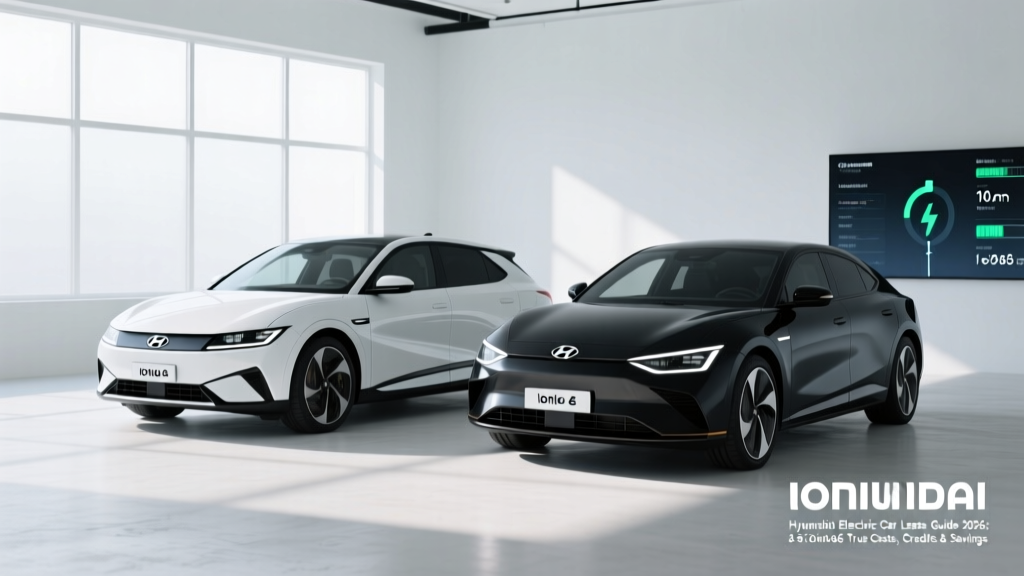
If you've been eyeing the Hyundai Ioniq 5 or Ioniq 6 but aren't ready to commit to a full purchase, a Hyundai electric car lease can be the most financially efficient way to get behind the wheel of a modern EV. Leasing sidesteps the steepest part of EV depreciation, lowers your monthly cash outlay, and — critically — lets Hyundai pass through the $7,500 federal EV credit as a lease incentive even if you wouldn't qualify for the credit on a purchase. But the math only works if you understand the real numbers: what you'll actually spend on electricity, insurance, maintenance, and tires over three years. This guide walks through the true cost of leasing a Hyundai EV in 2026, with hard figures instead of marketing promises.
Why Lease a Hyundai EV in 2026?
Hyundai's current EV lineup eligible for leasing centers on two models: the Ioniq 5 (a crossover with up to 318 miles EPA range on the Long Range RWD trim) and the Ioniq 6 (a sleek sedan reaching up to 361 miles EPA on the SEL RWD). Both ride on Hyundai's E-GMP platform with 800V architecture, meaning DC fast charging peaks around 240 kW on the Ioniq 5 and 239 kW on the Ioniq 6 — translating to a 10–80% charge in roughly 18 minutes under ideal conditions at a 350 kW station.
| Spec | Ioniq 5 SEL AWD | Ioniq 6 SEL RWD |
|---|---|---|
| EPA Range | 290 mi | 361 mi |
| Battery (usable) | 84 kWh, NMC | 77.4 kWh, NMC |
| Peak DC Charge Rate | ~240 kW | ~239 kW |
| 10–80% DC Time | ~18 min | ~18 min |
| Level 2 Rate (10.9 kW) | ~7 hr 20 min (full) | ~6 hr 50 min (full) |
| 0–60 mph | 4.5 sec (AWD) | 5.1 sec (RWD) |
| Horsepower | 320 hp | 225 hp |
| MPGe (combined) | 101 MPGe | 140 MPGe |
| Base MSRP | $47,750 | $39,250 |
| Battery Warranty | 10 yr / 100,000 mi | 10 yr / 100,000 mi |
Real-world range note: The EPA 318-mile figure on the Ioniq 5 Long Range RWD assumes mixed driving at moderate temperatures. Expect roughly 250–275 miles on sustained highway driving at 70+ mph, and a 20–30% reduction in freezing weather. The Ioniq 6's superior aerodynamics (0.21 Cd) help it hold highway range better than most crossovers.
The lease advantage is structural: under IRS rules, the $7,500 federal EV credit on a lease goes to the lessor (Hyundai Motor Finance), which can — and typically does — apply it as a capitalized cost reduction. This "lease loophole" works regardless of your personal income or the vehicle's battery-sourcing compliance, because it's technically a commercial credit under §45W passed through to you. On a purchase, by contrast, you must meet modified adjusted gross income caps ($150K single / $300K joint), MSRP caps ($55K for sedans like the Ioniq 6, $80K for SUVs/vans like the Ioniq 5), and strict battery-critical-minerals and component-sourcing requirements that shift annually. Always verify current eligibility on IRS.gov's §30D page.
The Lease Loophole: How the $7,500 Credit Works on a Hyundai Lease
When you buy an EV outright, the federal tax credit is a nonrefundable credit against your income tax — meaning you need sufficient tax liability, the vehicle must be assembled in North America with compliant battery sourcing, and you must fall under the income and MSRP caps. Hyundai's Ioniq 5 and Ioniq 6 are built in Ellabell, Georgia (since late 2024), so domestic assembly is satisfied. But battery sourcing rules tighten every year under the Inflation Reduction Act, and whether a specific trim qualifies for the full $7,500 vs. $3,750 vs. $0 on a purchase can shift mid-year.
Leasing changes the equation entirely. Under the commercial clean vehicle credit (§45W), Hyundai Motor Finance claims the credit as the vehicle's owner and typically reduces your lease cost by the equivalent amount. This has been a consistent Hyundai practice since 2023. The result:
§30D Purchase Credit Checklist (if buying instead of leasing):
- MSRP cap: ≤$55,000 for sedans (Ioniq 6); ≤$80,000 for SUVs (Ioniq 5)
- Income cap: MAGI ≤$150,000 (single), $225,000 (HOH), $300,000 (joint)
- Battery critical minerals must meet annual % thresholds from IRA-compliant trade partners
- Battery components must meet annual % manufactured/assembled in North America
- Vehicle must undergo final assembly in North America (both Ioniq 5 and 6 qualify)
- Credit is nonrefundable — you must owe enough in federal taxes to use it
- Point-of-sale transfer available: dealer applies credit as down payment reduction at purchase
Source: IRS §30D. Rules are current for 2026 and subject to legislative change. Consult a tax professional for your specific situation.
On a lease, you can typically skip most of that checklist. The $7,500 is baked into the lease economics regardless of your income or the specific battery-sourcing mix in your vehicle. That said, always confirm with your Hyundai dealer that the lease incentive is being applied — it should appear as a capitalized cost reduction on your lease agreement.
5-Year Total Cost of Ownership: Hyundai Ioniq 5 vs. Gas Crossover Baseline
To understand whether a Hyundai electric car lease makes financial sense, you need a full picture of what ownership costs look like — not just the monthly payment. Below is a 5-year TCO estimate comparing the Ioniq 5 SEL AWD against a comparably priced gas crossover (think a mid-trim Hyundai Tucson or Toyota RAV4 AWD at ~$38,000 MSRP). We assume 15,000 miles/year, $0.16/kWh average home electricity, $3.50/gallon regular unleaded, and 27 MPG combined for the gas baseline.
| Category | Ioniq 5 SEL AWD (EV) | Gas Crossover AWD |
|---|---|---|
| Purchase / Lease Net Cost* | $28,500 (lease + buyout est.) | $38,000 (purchase) |
| Fuel / Electricity | $3,600 (75k mi ÷ 3.1 mi/kWh × $0.16) | $9,722 (75k mi ÷ 27 MPG × $3.50) |
| Maintenance | $1,800 (cabin filter, wipers, brake fluid, tire rotations) | $4,500 (oil changes, filters, spark plugs, brake pads, transmission fluid) |
| Tires | $2,400 (EV-specific tires wear faster due to torque + weight) | $1,600 |
| Insurance (5 yr) | $12,500 (~$2,500/yr avg) | $9,000 (~$1,800/yr avg) |
| Depreciation (estimated) | $14,200 (~50% over 5 yr) | $15,200 (~40% over 5 yr) |
| Federal Tax Credit | −$7,500 (via lease incentive) | $0 |
| Total 5-Year Cost | ~$55,500 | ~$62,822 |
*Lease + buyout estimate assumes a 36-month lease with $7,500 cap cost reduction, ~$399/mo payment, then purchasing at residual. Actual figures vary by dealer, region, and credit tier. Source: author estimates based on Hyundai lease programs, fueleconomy.gov, and AAA Your Driving Costs 2025.
The EV comes out roughly $7,300 ahead over five years in this scenario. But the margin is heavily dependent on three things: (1) the $7,500 lease incentive actually being applied, (2) your ability to charge primarily at home at residential electricity rates, and (3) insurance costs not spiraling above the estimate. If you rely on public DC fast charging at $0.40–$0.55/kWh, your fuel cost doubles or triples, narrowing the gap significantly.
Charging vs. Gas: The Per-Mile Cost Reality
Let's break down the actual cost-per-mile math, because "EVs are cheaper to fuel" is only true under specific conditions. The Ioniq 5 SEL AWD achieves roughly 3.1 miles per kWh in mixed driving (101 MPGe equivalent). Here's what that translates to at different electricity sources:
| Charging Source | Cost per kWh / Gallon | Cost Per Mile (EV) | Cost Per Mile (Gas) |
|---|---|---|---|
| Home (national avg) | $0.16/kWh | $0.052 | $0.130 |
| Home (off-peak TOU rate) | $0.09/kWh | $0.029 | $0.130 |
| Home (high-cost state, e.g. CA avg) | $0.28/kWh | $0.090 | $0.130 |
| Public Level 2 (ChargePoint, etc.) | $0.30/kWh | $0.097 | $0.130 |
| Public DC Fast (Electrify America) | $0.48/kWh | $0.155 | $0.130 |
| Tesla Supercharger (NACS adapter) | $0.35/kWh | $0.113 | $0.130 |
The takeaway: home charging is where the economics work decisively. At $0.16/kWh, you're paying roughly 5 cents per mile versus 13 cents for gas — a 60% savings. But if you're exclusively using DC fast chargers at $0.48/kWh, you're actually paying more per mile than the gas crossover. This is why a Hyundai electric car lease makes the most sense for drivers with reliable home or workplace Level 2 charging access. Hyundai includes 2 years of complimentary 30-minute DC fast charging sessions at Electrify America with new Ioniq purchases and leases, which helps on road trips but doesn't replace daily home charging.
Both the Ioniq 5 and Ioniq 6 now come equipped with the NACS (Tesla) charging port as standard for the 2026 model year, giving you direct access to Tesla's Supercharger network — currently the most reliable public fast-charging infrastructure in the U.S. This is a significant practical advantage over the CCS-only era.
Maintenance Savings: What You'll Actually Spend
EVs have far fewer moving parts than internal combustion vehicles, and the maintenance savings are real — but not zero. Here's a realistic breakdown:
| Service Item | Ioniq 5 (EV) | Gas Crossover |
|---|---|---|
| Oil Changes | $0 | $900 (6 changes @ $150) |
| Cabin Air Filter | $200 (4 replacements) | $200 |
| Brake Pads | $0 (regen braking preserves pads; expect 80,000+ mi life) | $600 (1–2 replacements) |
| Brake Fluid Flush | $200 (every 2 yr) | $200 |
| Transmission Fluid | $0 (single-speed reduction gear, sealed) | $300 |
| Coolant Service | $150 (battery thermal management loop) | $200 |
| Spark Plugs | $0 | $400 |
| Engine Air Filter | $0 | $150 |
| Tire Rotations | $350 (7 rotations @ $50) | $350 |
| Wiper Blades / Misc. | $200 | $200 |
| Tire Replacement | $2,400 (EV-rated tires, ~30,000 mi life) | $1,600 (~45,000 mi life) |
| Total | ~$3,500 | ~$5,100 |
Net savings on maintenance: roughly $1,600 over five years. The biggest surprise for first-time EV owners is tire cost. The Ioniq 5's instant torque and 4,400+ lb curb weight eat through tires faster than a gas crossover. Budget for EV-specific tires (like the Hankook iON evo or Michelin Pilot Sport EV) which cost $250–$350 per corner and may last only 25,000–35,000 miles. Rotating every 5,000–7,500 miles is non-negotiable to maximize tire life.
One cost advantage often overlooked: Hyundai's 10-year/100,000-mile battery and powertrain warranty covers you well beyond a typical lease term. If you buy out the lease, you retain the balance of that warranty — a meaningful backstop against the $12,000–$18,000 battery replacement cost that looms for out-of-warranty EVs.
Insurance Costs: The EV Premium You Should Expect
Here's where the EV ownership story gets less rosy. Insurance for the Ioniq 5 and Ioniq 6 typically runs 25–45% higher than for a comparably priced gas crossover. Based on aggregated quote data, expect:
- Ioniq 5 SEL AWD: $2,200–$2,800/year (national average, good-driving-record profile)
- Ioniq 6 SEL RWD: $2,000–$2,600/year
- Gas crossover baseline: $1,600–$2,000/year
Why the premium? Three reasons: (1) EVs have higher repair costs after collisions — specialized high-voltage safety procedures, expensive sensor recalibration, and battery-pack damage protocols drive up claims; (2) EVs have higher total-loss rates because even minor battery enclosure damage can trigger a total-write-off by insurers; (3) the Ioniq 5's 320-hp AWD performance puts it in a sportier insurance class than a 187-hp Tucson.
Mitigation strategies: shop at least four insurers (Geico, Progressive, State Farm, and Liberty Mutual all price EVs differently), bundle home/auto, and ask about EV-specific discounts. Some carriers offer up to 10% off for garaging an EV. The insurance gap is narrowing as adjusters gain experience and as Hyundai's Georgia-built vehicles become more common in collision-repair networks.
Depreciation and Resale: What Your Ioniq Will Be Worth
EV depreciation has been volatile since 2022, when Tesla's aggressive price cuts cascaded through the used-EV market. Current data from iSeeCars and Kelley Blue Book show that mainstream EVs depreciate roughly 45–55% over five years, compared to 35–45% for comparable gas vehicles. The Ioniq 5 has held value somewhat better than average for the EV segment — around 48–52% depreciation over 5 years — thanks to its strong range, fast charging, and Hyundai's reputation.
Key depreciation factors to watch:
- Battery health: Hyundai's NMC cells have shown ~5–8% degradation over 100,000 miles in fleet data. The 10-year warranty and strong real-world SoH retention support resale.
- Charging standard: The 2026 Ioniq 5/6's native NACS port is a resale positive — CCS-only vehicles from 2022–2024 are depreciating faster as the industry standardizes on Tesla's connector.
- New-vehicle pricing: If Hyundai cuts MSRPs or offers aggressive incentives on new models, used values compress. This is the biggest wild card.
- Tax-credit policy: Changes to §30D eligibility or amounts can shift new-vs-used demand dynamics rapidly.
This is precisely why leasing can be the smartest play: you transfer the depreciation risk to Hyundai Motor Finance. If the EV market softens further, it's their problem at lease-end, not yours. If values hold or rise, you can exercise the purchase option at the predetermined residual.
State, Local, and Utility Incentives: Stack Your Savings
Important: State and local incentives vary dramatically by jurisdiction and change frequently. Always verify current programs through your state energy office, utility provider, and the DOE's Alternative Fuels Data Center. The examples below are illustrative, not exhaustive.
Beyond the federal credit, many Hyundai EV lessees can stack additional incentives:
- California: Up to $7,000 via the Clean Fuel Reward (point-of-sale) and potential CVRP rebate for income-qualified buyers. Plus HOV lane access stickers.
- Colorado: State EV tax credit of up to $5,000 (subject to legislative renewal).
- New York: Drive Clean Rebate up to $2,000 at point of sale.
- Utility rebates: Many utilities (e.g., PG&E, ConEdison, Xcel Energy) offer $500–$1,500 rebates for installing a Level 2 home charger, plus off-peak time-of-use rates that slash charging costs.
- Home charger tax credits: The federal Alternative Fuel Vehicle Refueling Property Credit (§30C) offers up to $1,000 (30% of cost, capped) for home charging equipment installed in eligible census tracts.
Combined with the $7,500 lease incentive, a buyer in California with a utility rebate could see effective incentives exceeding $15,000 — making the effective lease cost remarkably low. Check your specific ZIP code on the AFDC database for a complete list.
Is a Hyundai Electric Car Lease Right for You? A Decision Framework
Lease the Ioniq 5 or Ioniq 6 if:
- You have reliable home or workplace Level 2 charging
- Your income exceeds the §30D purchase caps, making the lease loophole your best path to the $7,500 incentive
- You drive 10,000–15,000 miles/year (typical lease limits are 10K/12K/15K — overage penalties are $0.20–$0.30/mile)
- You want to hedge against EV depreciation uncertainty and battery-tech obsolescence
- You plan to upgrade to the next generation of Hyundai EVs (e.g., solid-state or updated Ioniq 7 SUV) in 3 years
Buy instead of leasing if:
- You drive over 15,000 miles/year (lease overage penalties erode savings fast)
- You qualify for the full $7,500 purchase credit (income under caps, vehicle meets sourcing requirements) and prefer to own
- You want to keep the vehicle 7+ years and ride out the depreciation curve
- You want to modify the vehicle (wraps, wheels, suspension — leases prohibit this)
Frequently Asked Questions
How much does it really cost to own a Hyundai Ioniq 5 over 5 years?
Based on our analysis, approximately $55,500 over 5 years / 75,000 miles when factoring in the lease incentive, electricity, insurance, maintenance, tires, and depreciation. That's roughly $7,300 less than a comparably priced gas crossover under the same assumptions — but the savings depend heavily on home-charging access and the $7,500 lease incentive being applied.
Do I qualify for the federal EV tax credit if I lease?
On a lease, the $7,500 credit goes to Hyundai Motor Finance under §45W (commercial credit), and they pass it through as a cap cost reduction. Your personal income, the vehicle's battery sourcing, and MSRP caps do not apply the same way they would on a purchase. Confirm with your dealer that the incentive is reflected in your lease terms.
How much do I save on fuel and maintenance with a Hyundai EV?
Fuel savings range from $4,000–$6,000 over 5 years if you charge primarily at home at $0.10–$0.16/kWh. Maintenance savings are approximately $1,600 over 5 years, offset partly by higher tire costs ($800 more than a gas crossover). Net combined savings: $5,000–$7,000 depending on your electricity rate and driving patterns.
Are Hyundai Ioniq EVs more expensive to insure?
Yes — typically 25–45% more than a comparable gas crossover, or roughly $500–$800/year extra. This is driven by higher collision repair costs, battery-damage total-loss protocols, and the Ioniq 5 AWD's performance classification. Shop multiple insurers and ask about EV-specific discounts.
How well does the Ioniq 5 hold its value?
The Ioniq 5 depreciates approximately 48–52% over 5 years, which is better than the EV segment average (~50–55%) but slightly worse than gas crossovers (~35–45%). The native NACS port on 2026 models is a resale positive. Leasing transfers depreciation risk to the lessor.
Can I charge the 2026 Ioniq 5 at Tesla Superchargers?
Yes. The 2026 Ioniq 5 and Ioniq 6 come with a native NACS port, giving you direct access to Tesla's Supercharger network without an adapter. This significantly improves public charging reliability and road-trip convenience.
What happens if I exceed my lease mileage?
Hyundai Motor Finance typically charges $0.20–$0.30 per mile over your contracted limit at lease-end. If you anticipate driving 18,000+ miles/year, a high-mileage lease (if available) or outright purchase is more economical.