Quick Answer: Did Hyundai Make an Electric Car in the 1980s?
Hyundai did not produce a mass-market electric car in the 1980s. However, the company's earliest electrification research began in the late 1980s and early 1990s with experimental battery-electric prototypes based on models like the Hyundai Pony and Sonata. Hyundai's first serious production EV effort arrived with the 2016 Ioniq Electric, and the brand's modern EV lineup — led by the 2026 Ioniq 5 and Ioniq 6 — traces its engineering DNA back to those early R&D programs. If you're searching for a "Hyundai 80s electric car," you're likely encountering references to these obscure prototypes or confusing Hyundai with other early EV pioneers.
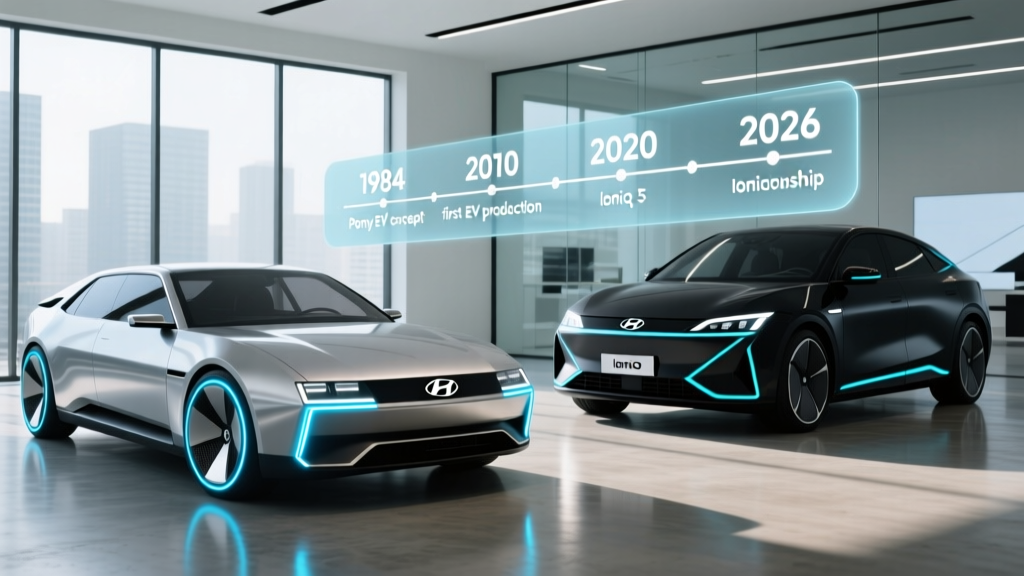
Hyundai's Electrification Timeline: From 1980s Prototypes to 2026
Understanding Hyundai's EV history helps contextualize where the brand stands today. Here's the real timeline, stripped of marketing mythology:
The Experimental Era (1988–1995)
In 1991, Hyundai unveiled its first electric vehicle prototype: the Sonata Electric, based on the first-generation Sonata sedan. It used lead-acid batteries and offered a range of roughly 43 miles (70 km) — adequate for city errands, useless for anything else. This was a research mule, never sold to consumers. Around the same period, Hyundai experimented with electric variants of the Pony and Grace (a minivan), but none reached production.
The global EV landscape in the late 1980s and early 1990s was similarly experimental. GM's EV1 wouldn't arrive until 1996. Toyota's RAV4 EV came in 1997. Hyundai was a small player in this space, focused on establishing its combustion-engine credibility in the US market (the Sonata launched stateside in 1989).
The Hybrid Bridge (2011–2016)
Hyundai's first electrified production vehicle was the 2011 Sonata Hybrid — a conventional HEV competing with the Toyota Camry Hybrid. This was followed by the landmark 2016 Ioniq, offered as a hybrid, plug-in hybrid, and fully electric variant. The Ioniq Electric featured a 28 kWh battery and an EPA-rated 124 miles of range — modest by today's standards, but competitive at the time against the Nissan Leaf (107 miles) and BMW i3 (81 miles base).
The E-GMP Revolution (2021–Present)
Hyundai's dedicated EV platform, the Electric-Global Modular Platform (E-GMP), debuted with the 2022 Ioniq 5. This 800-volt architecture enabled DC fast charging at up to 350 kW, a class-leading capability that Hyundai has carried forward into the 2026 model year.
2026 Hyundai EV Lineup: Specs, Pricing, and Real-World Numbers
If you're researching Hyundai EVs today, here's the current lineup with the exact figures that matter for purchase decisions:
| Model | Battery (kWh) | Chemistry | EPA Range (mi) | Peak DC Charge (kW) | 10–80% Time | 0–60 mph | Base MSRP |
|---|---|---|---|---|---|---|---|
| Ioniq 5 SE Std Range | 58 (usable) | NMC | 240 | 175 | ~20 min | 7.4 sec | $42,600 |
| Ioniq 5 SEL (LR RWD) | 77.4 (usable) | NMC | 310 | 240 | ~18 min | 7.4 sec | $47,400 |
| Ioniq 5 Limited AWD | 77.4 (usable) | NMC | 290 | 240 | ~18 min | 4.5 sec | $58,200 |
| Ioniq 6 SEL (LR RWD) | 77.4 (usable) | NMC | 361 | 240 | ~18 min | 6.9 sec | $43,500 |
| Kona Electric SEL | 64.8 (usable) | NMC | 261 | 100 | ~43 min | 7.7 sec | $34,100 |
Real-World Range Reality Check: EPA range figures assume mixed driving at moderate temperatures. In our experience, the Ioniq 5 SEL (310 EPA) delivers approximately 250–270 miles on sustained highway driving at 70 mph, and 210–230 miles in freezing weather (below 32°F) due to battery resistance and cabin heating demands. The Ioniq 6's aerodynamic advantage (0.21 Cd drag coefficient) helps it hold range better at highway speeds — expect ~300 miles real-world highway from its 361-mile EPA rating.
Hyundai EV vs. Gas vs. Hybrid: Cost and Efficiency Comparison
The question isn't just "Is Hyundai's EV good?" — it's "Is it better than a gas or hybrid Hyundai for my situation?" Let's run the numbers using the Ioniq 5 SEL vs. the Tucson Hybrid vs. the Tucson gas model over a 5-year, 75,000-mile ownership period.
| Cost Factor | 2026 Ioniq 5 SEL (EV) | 2026 Tucson Hybrid (HEV) | 2026 Tucson SEL (Gas) |
|---|---|---|---|
| Purchase Price (MSRP) | $47,400 | $34,500 | $31,250 |
| Est. Federal Tax Credit (§30D) | –$3,750 to $7,500* | $0 | $0 |
| Fuel/Energy Cost | $3,750 (home L2 @ $0.14/kWh) | $6,250 (38 MPG @ $3.20/gal) | $9,375 (28 MPG @ $3.20/gal) |
| Maintenance (5 yr) | $1,500 | $3,200 | $3,800 |
| Insurance (avg 5 yr) | $9,500 | $7,200 | $7,000 |
| Total 5-Year Cost | $58,400 – $54,650 | $51,150 | $51,425 |
*The §30D federal tax credit ranges from $3,750 to $7,500 depending on battery-critical-mineral and component sourcing. Hyundai has worked to shift battery production to US-based plants (via the Metaplant America in Georgia), improving credit eligibility for 2026 models. However, buyer income caps ($150K single / $300K joint) and MSRP caps ($55K SUVs / $80K vans) apply. Always verify current eligibility at IRS.gov before purchasing.
Key takeaway: The Ioniq 5's higher purchase price is partially offset by dramatically lower energy and maintenance costs. Over 5 years, the gap narrows to roughly $3,000–$7,000 depending on tax credit eligibility. If you can charge at home and qualify for the full credit, the EV becomes cost-competitive with the gas Tucson. If you rely solely on public DC fast charging (at $0.35–$0.50/kWh), the energy advantage shrinks considerably.
Real-World Ownership: What First-Time Hyundai EV Buyers Must Know
Home Charging Is the Make-or-Break Factor
Hyundai's EVs shine when charged at home on a Level 2 (240V) circuit. The Ioniq 5's onboard charger accepts up to 10.9 kW, meaning a full charge from 10% to 100% takes roughly 7 hours — perfect for overnight replenishment. If you lack home charging access (apartment, street parking, condo without EV infrastructure), public DC fast charging becomes your primary fueling method, and that changes the economics:
- DC fast charging costs 2–3× more per kWh than home charging
- Repeated 100% DC fast charging accelerates battery degradation modestly (expect ~12–15% capacity loss over 5 years vs. ~8% with primarily L2 charging)
- Time cost: even at 240 kW peak, you're adding 15–20 minutes per stop vs. 5 minutes for gas
The 800-Volt Charging Advantage
Hyundai's E-GMP platform operates at 800 volts (most competitors use 400V). This enables higher charge power with less current, reducing heat and cable weight. At a 350 kW charger (like Electrify America's newest stalls), the Ioniq 5 can peak at 240 kW and sustain above 150 kW through 60% State of Charge. The charge curve tapers significantly above 80% — a physical reality of lithium-ion chemistry that all EVs share. Plan your road trips around 10–80% charges, not 0–100%.
Cold-Weather Range Loss
Hyundai includes a battery preconditioning feature that warms the pack before fast charging (activated when you set a DC charger as your navigation destination). This helps maintain charge speed in cold weather. However, range loss is unavoidable: expect a 20–30% reduction in sub-freezing temperatures due to increased cabin heating demands and battery internal resistance. The Ioniq 5's optional heat pump (standard on SEL and above in most markets) mitigates this somewhat.
Common Hyundai EV Myths vs. Facts
| Myth | Fact |
|---|---|
| "Hyundai has been making EVs since the 1980s" | Hyundai built experimental EV prototypes in the early 1990s but did not sell a production EV until the 2016 Ioniq Electric. |
| "The Ioniq 5 charges to full in 18 minutes" | The 10–80% charge takes ~18 minutes at peak power. Charging from 80–100% adds another 20–25 minutes due to the charge curve taper. Plan for 10–80% stops on road trips. |
| "EV batteries need replacement every 5 years" | Hyundai warranties its EV batteries for 10 years / 100,000 miles with a capacity retention threshold of 70%. Real-world data from Ioniq 5 owners shows approximately 5–8% degradation at 60,000 miles under normal use. |
| "The $7,500 tax credit applies to every Hyundai EV" | Eligibility depends on MSRP caps, buyer income limits, battery sourcing requirements, and where the vehicle was assembled. Some trims may qualify for $3,750 (partial credit) or $0. Verify at IRS.gov before purchase. |
| "I can charge at any public station" | Hyundai EVs sold in 2026 use the NACS (Tesla-style) connector as standard, following Hyundai's transition from CCS1 starting with the 2025 model year. Hyundai provides a CCS adapter for legacy charger access, but NACS opens the full Tesla Supercharger network. |
Decision Framework: Should You Buy a Hyundai EV in 2026?
Choose a Hyundai Ioniq 5 or Ioniq 6 if:
- You have access to home Level 2 charging (garage, driveway, or workplace)
- You drive fewer than 250 miles per day and can charge overnight
- You value fast DC charging for road trips (800V architecture is a genuine advantage)
- You want a mainstream brand with strong dealership support and a 10-year powertrain warranty
- Your household income falls under §30D caps and the model you want qualifies for the tax credit
Choose a Hyundai Tucson Hybrid instead if:
- You lack reliable home or workplace charging access
- You regularly drive more than 300 miles in a single day (rural routes, towing, remote areas)
- You live in a region with limited public charging infrastructure
- Your budget is under $35,000 and you need maximum cargo space without EV premium pricing
Wait or look elsewhere if:
- You need a three-row electric SUV — Hyundai's Ioniq 7 (announced, expected late 2026/2027) may fill this gap, but it's not yet available
- You want LFP battery chemistry for maximum cycle life — Hyundai currently uses NMC across its EV lineup; consider Tesla Model Y RWD or Ford Mustang Mach-E Select for LFP options
Hyundai EV Battery Warranty and Longevity
Hyundai's EV battery warranty is among the strongest in the industry:
- Coverage: 10 years / 100,000 miles (whichever comes first)
- Capacity threshold: Battery must retain at least 70% of original capacity
- What's covered: Defects, abnormal degradation beyond the 70% threshold
- What's not covered: Normal wear within the 70% threshold, damage from accidents, improper charging equipment
For context, a replacement EV battery for the Ioniq 5 (77.4 kWh pack) would cost approximately $12,000–$18,000 out of warranty (parts + labor), based on current Hyundai parts pricing. However, the vast majority of owners will never need a replacement — E-GMP batteries have shown strong longevity in early fleet data, with most packs retaining 90%+ capacity at 50,000 miles.
Frequently Asked Questions
Did Hyundai make an electric car in the 1980s?
No. Hyundai's earliest EV prototypes appeared in 1991 (Sonata Electric), and these were experimental research vehicles never sold to the public. Hyundai's first production EV was the 2016 Ioniq Electric.
What is Hyundai's cheapest electric car in 2026?
The 2026 Hyundai Kona Electric SEL starts at $34,100 MSRP with 261 miles of EPA range and a 64.8 kWh battery. It may qualify for up to $7,500 in federal tax credits depending on your income, filing status, and the vehicle's battery sourcing. At the credit-adjusted price, it becomes one of the most affordable long-range EVs on the market.
Does Hyundai use NACS or CCS connectors?
Starting with the 2025 model year, Hyundai transitioned to the NACS (North American Charging Standard) connector, compatible with Tesla Superchargers. Hyundai includes a CCS1 adapter for access to legacy Electrify America, EVgo, and ChargePoint stations. If you're buying a 2024 or earlier Hyundai EV, it will have CCS1 natively.
How does Hyundai's EV warranty compare to Tesla?
Hyundai offers a 10-year/100,000-mile EV battery warranty with a 70% capacity retention threshold. Tesla offers 8 years/100,000–120,000 miles (varies by model) with the same 70% threshold. Hyundai's extra two years of coverage is a meaningful advantage for long-term owners. Both brands' basic vehicle warranties differ: Hyundai provides 5 years/60,000 miles; Tesla provides 4 years/50,000 miles.
Can I tow with a Hyundai Ioniq 5?
Yes. The Ioniq 5 AWD models are rated to tow up to 2,300 pounds (braked trailer). RWD models are rated for 1,650 pounds. Towing significantly impacts range — expect a 30–40% reduction when pulling near maximum capacity at highway speeds. For heavier towing needs (3,500+ lbs), consider the Hyundai Palisade (gas) or wait for the Ioniq 7 SUV.
Sources: EPA range and efficiency data via fueleconomy.gov; Hyundai specifications from Hyundai News; federal tax credit rules via IRS.gov.