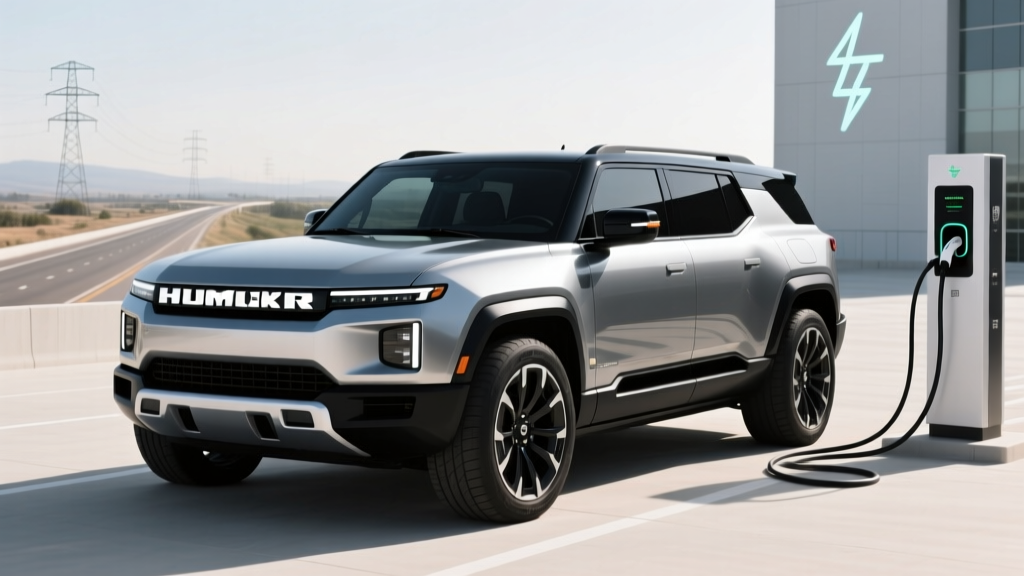
The short answer: The 2026 GMC Hummer EV Pickup weighs approximately 9,046 lbs (4,103 kg) in its heaviest Edition 1 / 3X trim with the 24-module Ultium battery pack. The SUV variant lands around 9,000 lbs. That makes it the heaviest production passenger vehicle sold in the U.S. — roughly 2,000 lbs heavier than a Ford F-150 Lightning and nearly double a Tesla Model Y. This extreme mass directly affects efficiency (47 MPGe combined), tire wear, braking distances, and home-charging requirements.
Why the Hummer EV Weights Over 9,000 Pounds
Three engineering realities push the Hummer EV past the 4-ton mark:
- Battery mass: The 24-module, double-stacked Ultium pack (NMC chemistry) holds roughly 212.7 kWh of usable energy. The battery alone accounts for an estimated 2,900 lbs — nearly the entire curb weight of a base Nissan Leaf.
- Truck architecture: A reinforced body-on-frame-style skateboard chassis, steel and aluminum body panels, and heavy-duty suspension components designed for off-road abuse (including Extract Mode, which lifts the suspension 6 inches) add substantial mass.
- Performance hardware: The tri-motor 3X powertrain produces up to 1,000 hp and 12,000 lb-ft of wheel torque, requiring heavy motors, inverters, and half-shafts.
For comparison, the smaller 20-module battery pack used in the 2X trim drops total weight to approximately 8,600 lbs, still enormous by any standard.
Hummer EV Weight vs. Other Electric Trucks and SUVs
| Vehicle | Curb Weight (lbs) | Battery (kWh) | EPA Range | Efficiency (MPGe) |
|---|---|---|---|---|
| GMC Hummer EV Pickup 3X | ~9,046 | 212.7 | 314 mi | 47 |
| GMC Hummer EV SUV 3X | ~9,000 | 212.7 | 314 mi | 47 |
| Ford F-150 Lightning Ext. Range | ~6,829 | 131 | 320 mi | 66 |
| Rivian R1T Dual-Motor Max | ~7,100 | 149 | 352 mi | 70 |
| Chevrolet Silverado EV 4WT | ~8,800 | 200+ | 440 mi | 54 |
| Tesla Cybertruck AWD | ~6,650 | 123 | 340 mi | 72 |
| Gas GMC Hummer H3 (2010) | ~5,300 | N/A | ~370 mi | 14 MPG |
The Hummer EV Pickup carries roughly 2,200 lbs more than the F-150 Lightning Extended Range despite offering slightly less EPA range. That's a direct consequence of moving more mass with every mile — physics that no amount of battery capacity fully offsets.
How Extreme Mass Affects Range, Efficiency, and Charging
Real-World Range Reconciliation
EPA Sticker: 314 miles (Pickup and SUV, 3X trim with 24-module pack)
Real-World Expectations:
- Highway (70 mph, 75°F): ~250–270 miles — heavy vehicles lose proportionally more energy to aerodynamic drag and rolling resistance at speed
- Cold weather (30°F, mixed driving): ~200–230 miles — expect 25–35% reduction; the massive pack takes longer to precondition
- Towing (estimated 7,500-lb trailer): ~150–175 miles — weight compounds dramatically when pulling loads
The Hummer EV's efficiency rating of 47 MPGe (roughly 72 kWh/100 mi) is the lowest of any current production EV. That means you're burning through a lot of electricity per mile — which matters both at home and on road trips.
Charging: The Weight Penalty at the Plug
The 212.7 kWh pack supports DC fast charging at up to 350 kW on 800V-capable infrastructure, though sustained rates taper significantly. Expect:
- 10–80% DC fast charge: ~35–40 minutes on a 350 kW charger (real-world curve tapers heavily past 60%)
- Level 2 home charging (11.5 kW / 48A): roughly 18–20 hours from 0–100%
- Level 2 home charging (19.2 kW / 80A): roughly 11–12 hours from 0–100%
Because the pack is so large, even a full overnight session on a standard 11.5 kW Level 2 won't replenish the entire battery from empty. Most owners will charge incrementally (20–80% daily), which is fine for battery longevity but means you need a reliable home charging setup.
Ownership Costs: What 9,000 Pounds Really Costs You
| Cost Factor | Hummer EV 3X | F-150 Lightning Lariat | Gas GMC Sierra 1500 Denali |
|---|---|---|---|
| Base MSRP (2026) | ~$104,500 | ~$72,000 | ~$68,000 |
| Federal §30D Tax Credit | Likely $0 (MSRP cap $80k for trucks) | Up to $7,500 (if sourcing rules met) | $0 |
| Annual Electricity/Fuel (15k mi) | ~$1,800 (at $0.16/kWh) | ~$1,100 | ~$3,000 (at $3.50/gal, 16 MPG) |
| Tire Replacement (set of 4) | $2,000–$2,800 (37" OE) | $1,000–$1,500 | $1,200–$1,600 |
| Tire Lifespan (estimated) | 20,000–30,000 mi | 35,000–50,000 mi | 40,000–55,000 mi |
| Annual Insurance (est.) | $3,200–$4,000 | $2,000–$2,600 | $1,800–$2,400 |
| Brake Pad Life (regen-assisted) | 80,000–100,000+ mi | 80,000–100,000+ mi | 30,000–50,000 mi |
| 5-Year Maintenance (est.) | $1,500–$2,500 | $1,200–$2,000 | $3,500–$5,000 |
The Tire Cost Reality
This is where Hummer EV weight hits owners hardest. The factory 37-inch Goodyear Territory MT tires carry a load rating engineered for 9,000+ lbs, and the combination of extreme mass and instant electric torque accelerates tread wear significantly. Budget-conscious owners report replacing tires every 20,000–30,000 miles — roughly twice the cost and half the lifespan of a typical truck tire. Factor in $2,000–$2,800 per set, and tires become a major line item over 5 years of ownership.
Tax Credit Limitations
Under current IRS §30D rules, the Hummer EV Pickup and SUV are classified as trucks/SUVs with an MSRP cap of $80,000. Since every Hummer EV trim exceeds that cap, no trim qualifies for the federal $7,500 credit. State incentives may still apply — check your local energy office — but the federal incentive is off the table.
Weight-Related Considerations for First-Time EV Buyers
Common Misconceptions
| Myth | Fact |
|---|---|
| "Heavy EVs are unsafe because of their weight" | Higher mass actually improves crash outcomes for occupants (Newton's second law). The Hummer EV's structure and battery placement provide a very low center of gravity. However, heavier vehicles pose greater risk to other road users in multi-vehicle collisions. |
| "The battery will degrade quickly from all that weight" | Battery degradation is driven by charge cycles, temperature, and SoC habits — not vehicle mass. GM's Ultium warranty covers 8 years/100,000 miles against capacity loss below 70%. |
| "I can charge it on any standard outlet" | Level 1 (120V) charging adds roughly 2–3 miles per hour on a 212.7 kWh pack. A full charge would take over 70 hours. A dedicated Level 2 circuit is essentially mandatory. |
| "Any home garage can support it" | At 9,046 lbs, the Hummer EV exceeds the rated load capacity of some older residential garage slabs (typically rated 4,000–6,000 lbs for passenger vehicles). Consult a structural engineer if your garage is pre-1990s construction. |
Home Charging Infrastructure
You'll need a 240V circuit with at least 60A capacity (for an 11.5 kW charger) or ideally an 80–100A circuit (for a 19.2 kW charger) to make daily charging practical. Installation costs typically run:
- 60A circuit + Level 2 charger: $1,200–$2,500 (if panel is nearby and has capacity)
- 100A circuit + high-power charger: $2,000–$4,500 (may require a panel upgrade to 200A+ service)
- Electrical panel upgrade (if needed): $2,500–$5,000 additional
Given the pack size, investing in a 19.2 kW charger (like the ChargePoint Home Flex or Tesla Wall Connector at 80A) is strongly recommended. Always have a licensed electrician assess your panel capacity before committing to equipment.
Driving Dynamics You Should Expect
The Hummer EV's mass manifests in several ways behind the wheel:
- Braking distances: Heavier vehicles require more distance to stop. Expect 130–140 feet from 60 mph — roughly 10–20 feet longer than lighter EV trucks.
- Cornering: Body roll is noticeable despite the low center of gravity. This is a straight-line and off-road performer, not a canyon carver.
- Watts to Cruise: At steady 70 mph highway speeds, the Hummer EV consumes approximately 70–80 kWh/100 mi — roughly double a Tesla Model Y's consumption.
- Off-road advantage: The weight actually helps in certain off-road scenarios (rock crawling, deep sand) by improving traction and stability.
Decision Framework: Is the Hummer EV's Weight a Dealbreaker?
Choose the Hummer EV if:
- You want a statement vehicle with unmatched presence, 1,000 hp, and genuine off-road capability (Extract Mode, crab steering, adaptive air suspension)
- You have home charging access with a 240V/60A+ circuit (or can install one)
- Your daily driving is under 200 miles round-trip, so range isn't a daily stressor
- You accept higher tire, insurance, and electricity costs as the price of performance and size
- You don't need the $7,500 federal tax credit (your budget accommodates the full MSRP)
Look elsewhere if:
- Efficiency is a priority — the F-150 Lightning (66 MPGe) or Rivian R1T (70 MPGe) deliver far more miles per kWh
- You regularly drive 300+ miles between charging stops — the Hummer EV's real-world highway range of ~250 miles will require frequent stops
- You live in an apartment or lack home charging — public-charging a 212.7 kWh pack is expensive and time-consuming
- Tire replacement costs concern you — budget $4,000–$6,000 over 5 years just for rubber
- You want federal tax credit eligibility — every Hummer EV trim exceeds the $80,000 MSRP cap
Frequently Asked Questions
Does the Hummer EV's weight affect bridge and road restrictions?
At ~9,046 lbs, the Hummer EV stays under the 10,000-lb GVWR threshold that triggers commercial-vehicle road restrictions in most states. However, some weight-restricted bridges posted at 5 or 6 tons (10,000–12,000 lbs) are worth noting. The Hummer EV is legal on virtually all public roads, but always observe posted weight-limit signage.
How does the Hummer EV's weight compare to the original gas Hummer?
The 2006 Hummer H2 weighed approximately 6,400 lbs, while the H3 was around 5,300 lbs. The EV version is roughly 40–70% heavier than its gas predecessors, primarily due to the battery pack. However, the EV's instant torque (12,000 lb-ft at the wheels) gives it vastly superior acceleration — 0–60 mph in approximately 3.0 seconds vs. 9+ seconds for the H2.
Will the weight cause excessive wear on my driveway or garage floor?
Most modern concrete driveways and garage slabs (poured after 2000) are rated to handle the Hummer EV's weight without issue. Older or thin-pour slabs may develop stress cracks over time. The point-load on each tire is significant — consider reinforcing your garage floor if it's original to a pre-1990s home.
Does regenerative braking help offset the weight penalty?
Yes, partially. One-pedal driving and regenerative braking recapture energy during deceleration, which helps in stop-and-go city driving. The Hummer EV's regen system is strong enough to bring the vehicle to a complete stop without touching the brake pedal. This also dramatically extends brake pad life — many owners report 80,000+ miles on original pads. However, regen doesn't recover the energy spent accelerating 9,000 lbs from a stop, which is where the efficiency penalty really lives.
What's the battery warranty, and does weight affect it?
GM covers the Ultium battery for 8 years or 100,000 miles, guaranteeing it will retain at least 70% of original capacity. Vehicle weight does not factor into battery degradation — charge habits (avoiding sustained 100% SoC, minimizing DC fast charging, preconditioning) are the primary drivers of long-term battery health. According to GMC's official specifications, the battery management system includes active thermal management to protect the pack during heavy-load driving.
Sources: fueleconomy.gov (EPA range and efficiency data), IRS §30D Clean Vehicle Credit rules, GMC Hummer EV official specifications.