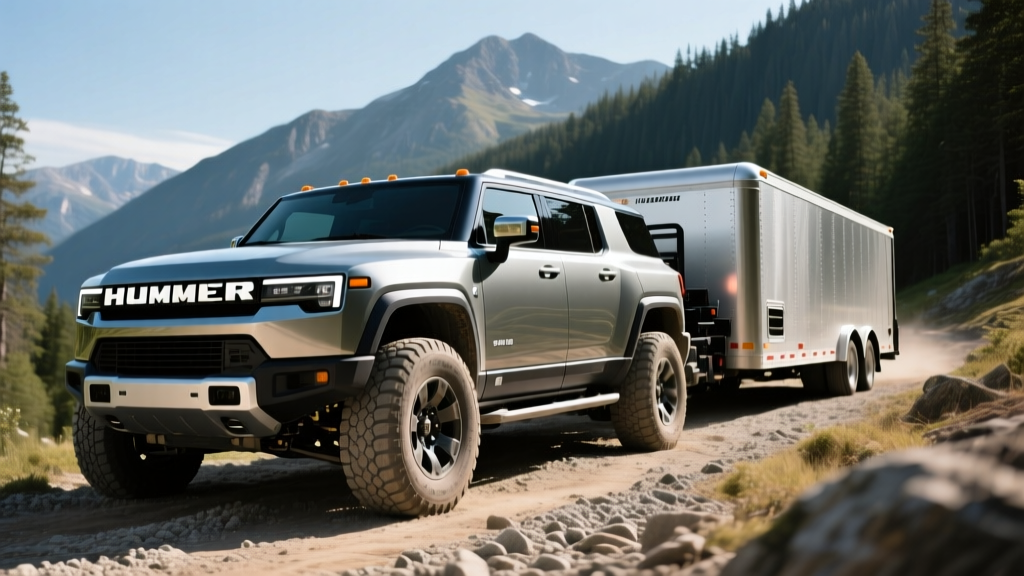
The GMC Hummer EV doesn't apologize for its excess. At nearly 9,500 pounds curb weight and producing up to 1,200 horsepower, it's the automotive equivalent of a sledgehammer — and when buyers search for Hummer EV towing capacity, they're asking whether that sledgehammer can actually pull its weight. The short answer: yes, up to 10,000 pounds when properly equipped. But towing with an electric truck this massive reshapes everything you thought you knew about EV range, charging logistics, and ownership cost.
After spending time with both the Pickup and SUV variants across multiple model years, we've compiled the data that GMC's marketing won't lead with — what happens to your range when you hook up a 7,000-pound trailer, how long you'll actually wait at DC fast chargers, and whether the federal tax credit applies to a six-figure electric supertruck.
Hummer EV Towing Capacity: By the Numbers
The Hummer EV Pickup carries a maximum tow rating of 10,000 pounds (4,536 kg) across the 2X and 3X trims when equipped with the factory tow package. The SUV variant is rated slightly lower at 7,500 pounds due to its shorter wheelbase and reduced payload capacity. These figures place the Hummer EV in legitimate heavy-duty truck territory, though notably below the Ford F-150 Lightning's 10,000-pound max and well short of the Rivian R1T's updated 11,000-pound rating for 2025+ models.
| Specification | Pickup 2X/3X | SUV 2X/3X |
|---|---|---|
| Max Towing Capacity | 10,000 lbs | 7,500 lbs |
| Max Payload | 1,300 lbs | 1,100 lbs |
| Curb Weight | ~9,046 lbs | ~9,000 lbs |
| GCWR (Gross Combined) | ~18,500 lbs | ~16,000 lbs |
| Tow Package Required | Yes (factory) | Yes (factory) |
| Integrated Trailer Brake | Standard w/ pkg | Standard w/ pkg |
| Trailer Camera Assist | Available | Available |
The critical detail here is the Gross Combined Weight Rating (GCWR). When you're towing near the 10,000-pound maximum, your combined vehicle-plus-trailer weight approaches 19,000 pounds. That mass has enormous implications for energy consumption, braking distances, and — most painfully — range.
Range Reality Check: EPA vs. Real-World vs. Towing
EPA Estimated: 329 miles (Pickup 3X, 24-module pack)
Real-World Highway (no trailer): ~260-280 miles at 70 mph
Real-World Towing (7,000 lb trailer): ~140-170 miles
Cold Weather (32°F, no trailer): ~230-250 miles
Combined Mixed Driving: ~270-290 miles
The Hummer EV's EPA range of 329 miles applies to the Pickup 3X trim with the full 24-module Ultium battery pack. The 2X trim with the smaller pack achieves around 292 miles EPA. The SUV variant, despite sharing the platform, posts slightly lower figures due to different aerodynamic profiles and gearing.
According to fueleconomy.gov, the Hummer EV Pickup posts a combined efficiency rating of 47 MPGe, which translates to roughly 72 kWh per 100 miles in mixed driving. That's the worst efficiency of any mainstream EV on the market — a direct consequence of pushing nearly 5 tons of vehicle through the air. For context, the Ford F-150 Lightning achieves 66 MPGe combined, and the Rivian R1T lands at 70 MPGe.
Where efficiency becomes genuinely alarming is under tow. Independent testing and owner reports consistently show energy consumption roughly doubling when pulling a 7,000-8,000 pound trailer at highway speeds. At 72 kWh/100mi baseline, expect 130-150 kWh/100mi under load. With approximately 200 kWh of usable battery capacity, your practical towing range drops to 130-170 miles depending on terrain, speed, and wind conditions. Plan your fuel stops accordingly — and yes, "fuel stops" means 45+ minute charging sessions with a trailer still hitched.
Battery, Powertrain & Performance Specs
| Spec | 2X Trim | 3X Trim |
|---|---|---|
| Battery Usable Capacity | ~170 kWh (est.) | ~200 kWh (24-module) |
| Battery Chemistry | NCMA (Nickel Cobalt Manganese Aluminum) | NCMA |
| Motor Configuration | Dual-Motor AWD | Tri-Motor AWD (Watts to Freedom) |
| Horsepower | 625 hp | 830-1,000 hp (WTF mode) |
| Torque | 7,400 lb-ft (wheel) | 12,000 lb-ft (wheel, WTF) |
| 0-60 mph | ~5.0 seconds | ~3.0 seconds (WTF mode) |
| Drivetrain | AWD w/ torque vectoring | AWD w/ rear torque vectoring |
| EPA Range | ~292 miles | ~329 miles (Pickup) |
| Efficiency (Combined) | ~47 MPGe / 72 kWh/100mi | ~47 MPGe / 72 kWh/100mi |
GMC's Ultium platform uses NCMA chemistry — a variant of NMC that adds aluminum for improved thermal stability. This is not an LFP battery; it prioritizes energy density and performance over cycle-life longevity. The 24-module pack in the 3X is one of the largest battery packs ever fitted to a production vehicle, and its weight (the battery alone is estimated at over 2,900 pounds) is the primary reason the Hummer EV tips the scales where it does.
The tri-motor 3X with Watts to Freedom (WTF) mode is genuinely absurd: a 9,000-pound truck that hits 60 mph in roughly 3 seconds. It's a party trick that drains the battery at an alarming rate, but it demonstrates the torque-vectoring capability that also benefits off-road traction and low-speed trailer maneuvering.
Charging Speed: DC Fast Charge & Home Level 2
The Hummer EV supports a maximum DC fast-charge rate of 350 kW on 800V-capable infrastructure — among the fastest peak rates of any production EV. However, as with every EV, peak rate is not sustained rate. The charge curve tapers significantly above 50% state of charge, and the massive battery means even "fast" charging involves substantial time.
| Charging Method | Power / Rate | Time / Range Added |
|---|---|---|
| Level 1 (120V / 12A) | ~1.4 kW | ~2 miles per hour |
| Level 2 (240V / 48A) | ~11.5 kW | ~16 miles per hour (~18 hrs, 10-100%) |
| Level 2 (240V / 80A) | ~19.2 kW | ~26 miles per hour (~10 hrs, 10-100%) |
| DC Fast Charge (peak) | Up to 350 kW | 10-80% in ~35-40 minutes |
| DC Fast Charge (sustained avg.) | ~180-220 kW avg. | ~200 miles added in 30 min |
Home charging is where the Hummer EV's enormous battery creates real logistical friction. On a standard 48-amp Level 2 home charger (the most common residential installation), a full charge from near-empty takes approximately 18 hours. Even upgrading to an 80-amp circuit — which requires a 100-amp dedicated breaker and likely a panel upgrade in older homes — only cuts that to about 10 hours.
For daily driving, this isn't a crisis: most owners will plug in each evening and never deplete below 30-40%, meaning a nightly top-up of 8-12 hours covers typical use. But if you're towing and arrive home with 20% remaining after a long haul, expect a full day of downtime before the truck is ready again.
At public DC fast chargers, the 350 kW peak is achievable at Electrify America and select Tesla Supercharger stations (via the NACS adapter GM now provides). Expect real-world 10-80% sessions to take 35-40 minutes under ideal conditions — longer in cold weather, as the battery must precondition. GMC recommends enabling the navigation-based preconditioning feature, which warms the battery en route to a planned charging stop.
Pricing, Trims & Federal Tax Credit Eligibility
The Hummer EV is not an affordable truck, and the 2025-2026 pricing reflects its positioning as a luxury-performance flagship:
| Trim | Body Style | Base MSRP | §30D Tax Credit |
|---|---|---|---|
| 2X | Pickup | ~$99,995 | Not eligible (MSRP cap: $80,000 for trucks) |
| 3X | Pickup | ~$119,995 | Not eligible (exceeds MSRP cap) |
| 2X | SUV | ~$106,495 | Not eligible (MSRP cap: $80,000 for SUVs) |
| 3X | SUV | ~$126,495 | Not eligible (exceeds MSRP cap) |
Here's the hard truth for tax-credit shoppers: the Hummer EV does not qualify for the $7,500 federal EV tax credit under IRS §30D rules. The credit imposes MSRP caps — $80,000 for vans, SUVs, and pickup trucks — and every Hummer EV trim exceeds this threshold by $20,000 or more. Buyer income limits ($300,000 joint / $225,000 head of household / $150,000 individual) are a secondary barrier that becomes irrelevant once the MSRP cap is breached.
Additionally, the point-of-sale transfer option — which allows qualifying buyers to apply the credit as an immediate discount at the dealership — is unavailable for the same reason. If a dealer tells you otherwise, ask them to show the MSRP line on the Monroney sticker against the IRS threshold.
Some state-level incentives may still apply (Colorado's innovative motor vehicle credit, for example, has different thresholds), but these vary by jurisdiction. Check your state's energy office or department of revenue for current programs.
Cargo, Passenger Space & Everyday Practicality
The Hummer EV Pickup offers a 5-foot bed (shorter than the typical 5.5-6.5 foot beds on midsize trucks) with approximately 37 cubic feet of cargo volume. The SUV provides 35.9 cu ft behind the second row and up to 81.8 cu ft with seats folded. Both variants include a front trunk ("e-trunk" or "frunk") that adds meaningful weatherproof storage — GMC quotes roughly 8.9 cu ft up front.
Interior space is generous but not class-leading given the vehicle's exterior footprint:
- Front legroom: ~45.6 inches
- Rear legroom (Pickup): ~38.9 inches
- Rear legroom (SUV): ~37.0 inches
- Front headroom: ~42.5 inches (varies with roof option)
The infinity roof — removable transparent panels stored in the frunk — is a standout feature that transforms the cabin experience in good weather. The 13.4-inch diagonal infotainment screen runs Google Built-In with native Google Maps, Assistant, and Play Store apps. A 12.3-inch driver display handles instrumentation, and available UltraVision camera systems provide up to 18 camera views including underbody and trailer-hitch angles.
Warranty Coverage & Battery Longevity
GMC backs the Hummer EV with its standard EV warranty package:
- Battery & Propulsion: 8 years / 100,000 miles (whichever comes first), with a minimum 70% capacity retention threshold
- Bumper-to-Bumper: 3 years / 36,000 miles
- Powertrain (non-battery): 5 years / 60,000 miles
- Corrosion: 6 years / 100,000 miles
- Roadside Assistance: 5 years / 60,000 miles
The 70% capacity retention threshold is industry-standard but worth noting: GMC will only replace or repair the battery if it degrades below 70% of original capacity within the warranty window. Given the NCMA chemistry and the battery's enormous size (which means less depth-of-discharge stress for typical daily driving cycles), most owners should expect well over 200,000 miles before approaching that threshold under normal use. However, frequent DC fast charging to 100% and regular towing at maximum capacity will accelerate degradation.
For long-term ownership peace of mind, GMC's Ultium platform is modular — individual battery modules can be replaced rather than the entire pack, which should keep out-of-warranty replacement costs lower than early-generation EVs. Current estimates for full pack replacement exceed $30,000-$40,000 at today's pricing, though module-level repairs would be substantially less.
Driver Assistance & Smart Features
GMC's Super Cruise and the available Ultra Cruise are SAE Level 2 driver-assistance systems. They do not make the Hummer EV self-driving. You must keep your eyes on the road and hands available to take over at any time. Only Level 4 services like Waymo operate without a human driver in the loop.
The Hummer EV offers GMC's Super Cruise on over 750,000 miles of mapped roads in North America, enabling hands-free driving on compatible highways with driver attention monitoring via a steering-column camera. The available Ultra Cruise extends this capability to virtually all roads (not just highways) in a supervised capacity, using a more advanced sensor suite including LiDAR.
For towing, the ProGrade trailering system includes trailer light-sequence testing, tire-pressure monitoring for compatible trailers, and trailer-length blind-spot monitoring that extends the alert zone to account for your combined vehicle-plus-trailer length. The available trailer camera system lets you view a camera mounted on the back of your trailer directly on the infotainment screen — invaluable when backing into a campsite or boat slip.
Other notable technology includes:
- CrabWalk: Four-wheel steering allows diagonal movement at low speeds — genuinely useful for tight trail obstacles and aligning to a trailer hitch
- Extract Mode: Adaptive air suspension raises the vehicle up to 14.9 inches of ground clearance for extreme off-road situations
- One-Pedal Driving: Aggressive regenerative braking allows near-complete stops without the friction brake — recovers meaningful energy in stop-and-go traffic
- V2L (Vehicle to Load): The Pro Power outlet system can run tools, camp equipment, or tailgate setups directly from the battery
Pros, Cons & Who Should Buy
- 10,000-lb towing capacity (Pickup) rivals heavy-duty ICE trucks
- 350 kW DC fast-charge capability — best-in-class peak rate
- Tri-motor WTF mode: 0-60 in ~3 sec is supercar territory
- CrabWalk and Extract Mode are genuinely useful off-road tools
- Super Cruise / Ultra Cruise among the best L2 systems available
- Removable infinity roof panels create an open-air experience
- Massive battery means less daily depth-of-discharge stress
- ~47 MPGe / 72 kWh/100mi is the worst efficiency in the EV market
- Towing range drops to 130-170 miles — severely limits trip planning
- 18+ hour Level 2 home charge on a standard 48A circuit
- No federal tax credit — MSRP exceeds §30D caps by $20K+
- 5-foot bed is short for a full-size truck
- 9,500-lb curb weight increases tire wear and limits bridge/parking access
- $100K+ entry price puts it in luxury territory without luxury refinement
Buy it if: You need serious towing capacity AND want an EV, you have reliable home charging with a 60A+ circuit, you value performance and technology over efficiency, and the $100K+ price tag doesn't cause hesitation.
Look elsewhere if: Your primary concern is range efficiency, you regularly tow long distances (>200 miles between charging), you need the federal tax credit, or you want a full-size bed for work use. The Ford F-150 Lightning or Rivian R1T may serve you better in those scenarios.
Frequently Asked Questions
What is the real-world range of the Hummer EV when towing?
With a 7,000-pound trailer at highway speeds, expect approximately 140-170 miles of range from the 3X's 200 kWh usable battery. Energy consumption roughly doubles under tow, from ~72 kWh/100mi to 130-150 kWh/100mi. Terrain, wind, and speed are major variables — mountain passes and 75+ mph speeds will push you toward the lower end of that range.
How fast does the Hummer EV charge at home and on the road?
On a 48-amp Level 2 home charger, expect ~16 miles of range per hour and a full 10-100% charge in approximately 18 hours. An 80-amp circuit improves this to ~26 miles/hour and ~10 hours total. At a 350 kW DC fast charger, the 10-80% session takes approximately 35-40 minutes under ideal conditions, though cold weather and high state-of-charge can extend this.
Does the Hummer EV qualify for the $7,500 federal EV tax credit?
No. Under current IRS §30D rules, the federal tax credit caps eligible pickup trucks and SUVs at $80,000 MSRP. Every Hummer EV trim starts well above $99,000, making it ineligible regardless of buyer income or battery sourcing. The point-of-sale transfer option is also unavailable for the same reason.
Is the Hummer EV worth buying vs. the Ford F-150 Lightning or Rivian R1T?
It depends on your priorities. The Hummer EV wins on raw performance (830-1,000 hp in 3X), peak charging speed (350 kW vs. ~230 kW for the Lightning), and off-road capability (CrabWalk, Extract Mode). The F-150 Lightning wins on efficiency (~66 MPGe vs. 47), practicality (5.5-foot bed, more rear-seat room), pricing ($55K-$97K range), and tax-credit eligibility on lower trims. The Rivian R1T offers the best balance of range, towing (11,000 lbs on updated models), efficiency, and technology, starting around $75K. If towing capacity and performance spectacle are your top priorities and budget is flexible, the Hummer EV delivers. If efficiency and daily practicality matter more, the Lightning or R1T are stronger choices.
How does the Hummer EV's CrabWalk feature help with towing?
CrabWalk uses four-wheel steering to move the vehicle diagonally at low speeds. When aligning to a trailer hitch in a tight space — a narrow campsite, a crowded boat ramp, or a garage — you can inch sideways into position rather than performing multi-point turns. It's a genuine practical advantage, not just a novelty.
What home electrical upgrades are needed for Hummer EV charging?
For optimal Level 2 charging (80-amp circuit, ~19.2 kW), you'll need a dedicated 100-amp breaker, which may require upgrading a standard 200-amp home electrical panel to 300 or 400 amps. Panel upgrades typically cost $2,000-$5,000, on top of $500-$1,500 for the charger hardware and $800-$2,500 for electrician labor and permits. Always consult a licensed electrician for your specific installation — older homes with 100-amp or 150-amp service will almost certainly need an upgrade to support the Hummer EV's charging demands alongside normal household loads.