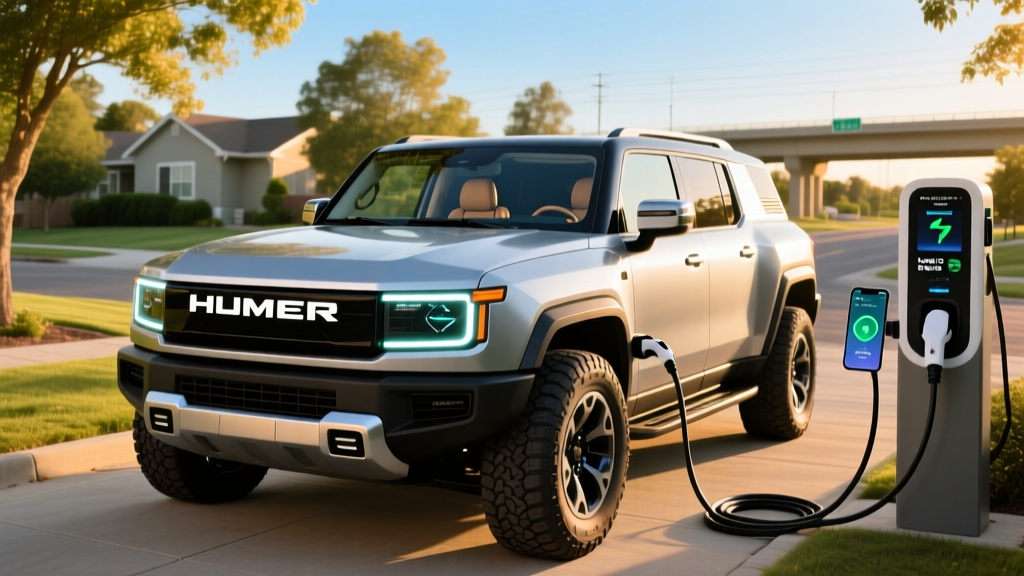
If you've been eyeing the GMC Hummer EV SUV — whether through a lease or purchase — you already know this isn't a budget-friendly electric vehicle. With a starting MSRP well above $90,000 and a curb weight north of 9,000 pounds, it's an electric supertruck-SUV that demands serious financial homework before you sign any paperwork. This guide breaks down exactly what owning or leasing a 2026 Hummer EV SUV costs over five years, including the federal tax credit reality, charging economics, insurance premiums, and what happens to its value when you're ready to move on.
2026 Hummer EV SUV: The Numbers That Matter
Before we get into the cost breakdown, here are the core specs that drive every ownership calculation. The 2026 Hummer EV SUV continues with GM's Ultium platform and dual-motor AWD configuration across most trims.
| Spec | 2X (Base AWD) | 3X (Tri-Motor) | |
|---|---|---|---|
| Base MSRP | ~$98,000 | ~$108,000 | |
| EPA Range | ~314 miles | ~298 miles | |
| Battery (usable) | ~212 kWh (NMC) | ~212 kWh (NMC) | |
| Horsepower | 625 hp | 830 hp (Watts to Freedom) | |
| 0-60 mph | ~4.5 sec | ~3.5 sec (WTF mode) | |
| Max DC Fast Charge | ~350 kW (peak) | ~350 kW (peak) | |
| 10-80% DC Charge | ~22 minutes (est.) | ~22 minutes (est.) | |
| Level 2 Charging | 11.5 kW / ~19 hrs full | 11.5 kW / ~19 hrs full | |
| Efficiency | ~47 MPGe | ~44 MPGe | |
| Battery/Powertrain Warranty | 8 yr / 100,000 mi | 8 yr / 100,000 mi |
Hummer EV SUV Lease: What You'll Actually Pay Monthly
Leasing a Hummer EV SUV in 2026 typically means negotiating a capitalized cost near MSRP (discounts on this model remain limited due to production volumes), with lease terms generally running 36 months at 10,000 or 12,000 miles per year. Based on current money factors and residual values set by GM Financial, here's what realistic monthly payments look like:
- 2X trim, $98,000 MSRP: ~$1,350-$1,550/month with approved credit (tier 1), assuming ~$8,000 due at signing (first month + security + cap cost reduction)
- 3X trim, $108,000 MSRP: ~$1,550-$1,800/month under similar terms
A critical lease consideration: the federal EV tax credit treatment differs in a lease versus a purchase. Under IRS §30D, the credit applies to the purchaser. In a lease, the leasing company (GM Financial) technically owns the vehicle and claims the credit. Some lessors pass this savings through as a "lease cash" incentive that reduces your capitalized cost; others absorb it. Always confirm with your dealer whether the $7,500 (or partial credit amount) is being applied to your lease deal — it's not automatic.
Federal Tax Credit Eligibility: The §30D Rules for 2026
The federal EV tax credit under IRS §30D can reduce your federal tax liability by up to $7,500, but qualifying for the full amount on a Hummer EV SUV purchase requires navigating several requirements that have tightened significantly since the Inflation Reduction Act reshaped the rules.
- MSRP Cap: SUVs/pickups must have an MSRP ≤ $80,000. The Hummer EV SUV starts at ~$98,000 — it exceeds the MSRP cap and does NOT qualify for the new-vehicle §30D credit on purchase.
- Buyer Income Limits: AGI must not exceed $150,000 (single), $225,000 (head of household), or $300,000 (joint filers).
- Battery Sourcing: Critical minerals and battery components must meet escalating domestic/free-trade-partner percentages (2026 thresholds are stricter than 2024-2025).
- Point-of-Sale Transfer: Eligible buyers can transfer the credit to the dealer at purchase for an immediate price reduction — but only if all other criteria are met.
- Lease Loophole (§45W): Commercial lessors may claim a separate credit under §45W, which some pass through as lease incentives. This is how some Hummer EV lessees still see a price reduction — but it's at the lessor's discretion.
Here's the uncomfortable truth: if you purchase a Hummer EV SUV outright, you almost certainly will NOT receive the $7,500 federal tax credit because its MSRP exceeds the $80,000 SUV cap. This is a deal-breaker for some buyers who factored the credit into their budget. However, leasing may still provide indirect savings if GM Financial applies a pass-through incentive. Always verify current incentive programs directly with GMC or your leasing company before committing.
5-Year Total Cost of Ownership Breakdown
Whether you lease (typically 3 years) or purchase and hold for five, here's what the total cost picture looks like for a Hummer EV SUV 2X. We're comparing against a similarly priced luxury gas SUV — the BMW X7 xDrive40i (~$82,000 MSRP, 22 MPG combined) — to contextualize the EV ownership economics.
| Cost Category | Hummer EV SUV 2X | BMW X7 xDrive40i |
|---|---|---|
| Purchase Price / Cap Cost | $98,000 | $82,000 |
| Federal Tax Credit | $0 (exceeds MSRP cap) | $0 |
| Estimated Depreciation (5 yr) | -$49,000 (50%) | -$38,500 (47%) |
| Fuel / Charging (75,000 mi) | $5,850 | $13,125 |
| Insurance (5 yr avg) | $18,500 | $13,000 |
| Maintenance (5 yr) | $2,200 | $6,800 |
| Estimated Repairs (out of warranty) | $500 | $1,500 |
| Total 5-Year Cost | ~$75,050 | ~$76,425 |
A few critical notes on this table: The Hummer EV's depreciation is steeper in dollar terms because the starting price is higher and heavy luxury EVs have shown aggressive depreciation curves (more on this below). The fuel savings are substantial but don't fully offset the higher purchase price, insurance, and depreciation. The 5-year totals end up remarkably close — meaning the Hummer EV SUV isn't a money-saving play versus a gas luxury SUV; it's a lifestyle and performance choice that roughly breaks even on cost.
Charging Cost vs. Gas: The Per-Mile Math
The Hummer EV SUV's efficiency is its weakest economic argument. At roughly 47 MPGe (2X) or about 2.1 kWh per mile, it's one of the least efficient EVs on the market. That massive battery and 9,000-lb curb weight demand a lot of electrons. Here's how the charging costs break down under different scenarios, assuming 15,000 miles driven annually:
| Charging Scenario | Rate ($/kWh) | kWh per Mile | Annual Cost (15k mi) | Cost per Mile |
|---|---|---|---|---|
| Home Level 2 (national avg) | $0.16 | 2.1 | $5,040 | $0.34 |
| Home Level 2 (cheap utility, e.g., $0.10) | $0.10 | 2.1 | $3,150 | $0.21 |
| Home Level 2 (expensive, e.g., CA $0.30) | $0.30 | 2.1 | $9,450 | $0.63 |
| DC Fast Charging (avg $0.48/kWh) | $0.48 | 2.1 | $15,120 | $1.01 |
| Gas SUV equivalent (22 MPG, $3.50/gal) | — | — | $2,386 | $0.16 |
Let that last row sink in: a conventional gas luxury SUV at 22 MPG actually costs less per mile to fuel than the Hummer EV SUV on expensive electricity or DC fast charging. At the national average home rate of $0.16/kWh, the Hummer EV costs roughly $0.34/mile to "fuel" — about double the gas equivalent. This is the consequence of 2.1 kWh/mile efficiency. If you have cheap home solar or a low utility rate, the math improves significantly. If you rely heavily on public DC fast chargers, the Hummer EV becomes one of the most expensive vehicles to energy-feed, period.
The 212 kWh battery also means Level 2 home charging is slow relative to capacity. Even at 11.5 kW, a full charge takes roughly 19 hours. Most owners will charge from 20-80% overnight (about 12-13 hours), which is manageable with daily routine but means you can't quickly "top off" the massive pack on a standard home charger.
Maintenance Savings: Where the EV Advantage Is Real
This is where the Hummer EV SUV — like all EVs — genuinely saves money. Without an internal combustion engine, there are no oil changes, no spark plugs, no transmission fluid services, no timing belts, and no exhaust system repairs. Regenerative braking also significantly reduces brake pad wear.
| Maintenance Item | Hummer EV SUV | Gas Luxury SUV |
|---|---|---|
| Oil Changes | $0 | $1,200 (10 changes × $120) |
| Brake Pads (front + rear) | $0-$400 (regen extends life) | $1,800 (2 sets × $900) |
| Transmission Service | $0 | $400 |
| Coolant / Fluid Services | $300 | $800 |
| Tire Rotation/Replacement | $1,500 (heavy EV = faster tire wear) | $1,200 |
| Cabin Air Filter / Wipers / Misc | $400 | $400 |
| 5-Year Total | ~$2,200 | ~$5,800 |
The net savings over five years is roughly $3,600 in maintenance. However, note the tire cost: the Hummer EV's 9,000+ lb weight and instant torque are brutal on tires. Expect to replace tires more frequently than on a lighter vehicle — potentially every 25,000-30,000 miles on the OEM 35-inch all-terrains. That's a real cost that partially offsets the EV maintenance advantage.
Insurance Costs: The Premium You'll Pay
EV insurance is almost always more expensive than equivalent gas vehicles, and the Hummer EV SUV sits at the high end of this spectrum. Several factors drive this:
- High repair costs: The Ultium battery pack, specialized suspension (including available 4-wheel steer and adaptive air ride), and extensive sensor suites mean collision repairs are expensive.
- Vehicle weight: At 9,000+ lbs, the Hummer EV causes more damage in a collision, raising liability premiums.
- High MSRP: Comprehensive and collision coverage scale with vehicle value.
- Limited repair network: Not all body shops are certified for high-voltage Ultium platform work, limiting competition.
Based on 2026 national averages for a driver with a clean record, expect annual premiums of $3,500-$4,200 for the Hummer EV SUV — roughly 35-50% higher than a comparable gas luxury SUV. Over five years, that's an additional $5,000-$6,500 in insurance costs compared to the gas alternative. Get quotes from multiple carriers before purchasing; some insurers (like GEICO and Progressive) have narrowed the EV insurance gap, while others still penalize heavily.
Depreciation and Resale Value: The Elephant in the Room
Luxury EV depreciation has been one of the most painful ownership realities of the 2023-2025 period, and the Hummer EV has not been immune. According to industry data from sources like iSeeCars and Kelley Blue Book, large luxury EVs have seen 5-year depreciation rates of 45-60%, compared to 35-45% for comparable gas luxury SUVs.
For the Hummer EV SUV specifically, expect:
- Year 1: 15-20% depreciation off MSRP (common for luxury vehicles once driven off the lot)
- Year 3: 35-45% cumulative depreciation (lease-end residual values typically set around 55-60% of MSRP)
- Year 5: 45-55% cumulative depreciation, meaning a $98,000 2X could be worth $44,000-$54,000
Several factors accelerate Hummer EV depreciation: the niche market for a $100K electric supertruck-SUV, rapid EV technology advancement making older models feel dated, battery health uncertainty for second owners, and the fact that the used-EV tax credit (§25E, up to $4,000) actually helps used buyers, which paradoxically puts downward pressure on used prices by making lower-priced used EVs more competitive.
If you lease, depreciation is the lessor's problem — you're only paying for the depreciation during the lease term (which is baked into your monthly payment). If you purchase, depreciation is your single largest ownership cost by far.
State, Local, and Utility Incentives
Beyond the federal credit, many states, municipalities, and utility companies offer additional EV incentives. These can include:
- State rebates: Some states offer $1,000-$5,000 rebates for new EV purchases (income-dependent). However, many state programs also have MSRP caps that exclude the Hummer EV.
- Utility rebates: Programs like PG&E, SCE, and ConEdison offer $500-$1,500 rebates for home Level 2 charger installation. Check with your local utility.
- HOV lane access: Several states grant EVs access to carpool lanes regardless of occupant count — a significant non-monetary benefit in congested metros.
- Property tax exemptions: Some jurisdictions exempt EVs from annual personal property tax.
Always verify current incentive availability with your state's energy office and local utility, as programs change annually and funds can be exhausted. Refer to the Alternative Fuels Data Center for a state-by-state incentive database.
Lease vs. Buy Decision Framework
- You want to avoid the steep depreciation risk on a $100K luxury EV
- You prefer lower monthly payments vs. financing the full purchase price
- The lessor passes through a §45W commercial credit as lease cash
- You plan to upgrade to newer EV tech in 3 years
- You drive under 12,000 miles/year (lease mileage limits)
- You drive high annual mileage (15,000+ mi/yr) and would exceed lease limits
- You plan to keep the vehicle 7+ years and ride out the depreciation curve
- You want to modify the vehicle (lift kits, wraps, aftermarket wheels — all prohibited under lease)
- You qualify for substantial state incentives that offset the purchase price
- You want the flexibility to sell privately if the used market strengthens
Frequently Asked Questions
How much does it really cost to own a Hummer EV SUV over 5 years?
Based on our analysis, the 5-year total cost of ownership for a Hummer EV SUV 2X (purchased at MSRP) is approximately $75,000, factoring in depreciation (~$49,000), charging (~$5,850 at national average home rates), insurance (~$18,500), and maintenance (~$2,200). This is roughly comparable to a gas luxury SUV like the BMW X7 over the same period, with the EV's fuel and maintenance savings offset by higher insurance, purchase price, and depreciation.
Do I qualify for the $7,500 federal tax credit on the Hummer EV SUV?
Almost certainly not on a purchase. The Hummer EV SUV's MSRP (~$98,000+) exceeds the §30D cap of $80,000 for SUVs and trucks. Even if you meet income requirements and battery-sourcing rules, the MSRP cap disqualifies it. On a lease, the lessor may claim a §45W commercial credit and pass savings through — but this is not guaranteed and varies by leasing company and current GM incentive programs.
How much do I save on fuel and maintenance vs. a gas SUV?
At national average electricity rates ($0.16/kWh), the Hummer EV costs about $0.34/mile to charge vs. $0.16/mile for a 22 MPG gas SUV at $3.50/gallon — meaning you actually spend more on energy unless you have very cheap electricity (under $0.10/kWh) or solar. Maintenance savings are more reliable: approximately $3,600 over 5 years from eliminated oil changes, reduced brake wear, and fewer fluid services. However, tire costs are higher due to the vehicle's extreme weight.
Are EVs more expensive to insure than gas cars?
Yes, typically 20-50% more expensive, depending on the model and insurer. The Hummer EV SUV is at the high end due to its $100K MSRP, 9,000+ lb weight, expensive Ultium battery, and specialized repair requirements. Expect $3,500-$4,200 annually with a clean driving record. Always get quotes before committing.
How well does the Hummer EV SUV hold its value?
Not as well as comparable gas luxury SUVs. Expect 45-55% depreciation over 5 years, meaning a $98,000 purchase could be worth $44,000-$54,000 at year five. Luxury EV depreciation has been accelerated by rapid technology advancement, battery health uncertainty for used buyers, and a softening used EV market. Leasing transfers this depreciation risk to the lessor.
Is the Hummer EV SUV a good financial decision?
From a purely financial standpoint, the Hummer EV SUV is not a cost-saving vehicle. It's a premium lifestyle and performance choice that roughly breaks even with a gas luxury SUV over five years. The buyers who are best served are those who value its unique capabilities (350 kW charging, CrabWalk, Extract Mode, 830 hp in 3X), have access to cheap home charging, and either lease to avoid depreciation risk or plan to hold the vehicle long-term.