Quick Verdict: A 9,000-Pound Luxury Statement
The GMC Hummer EV SUV is less a conventional electric utility vehicle and more a rolling demonstration of what happens when you give engineers a 246 kWh battery and tell them to build without compromise. For 2026, the SUV variant continues to pair a genuinely upscale, tech-laden cabin with supertruck performance and a footprint that demands a three-car garage. If you're researching the Hummer EV SUV interior — its materials, screen real estate, cargo flexibility, and passenger comfort — this review covers every dimension, spec, and ownership reality you need before signing a six-figure purchase order.
The short version: the cabin is spacious, screen-heavy, and well-insulated, but the vehicle's sheer mass limits real-world range and makes public charging infrastructure a planning exercise. Let's break down exactly what you're getting.
Hummer EV SUV Interior: Dimensions, Materials & Tech
Step inside the Hummer EV SUV and the first impression is width. At 86.6 inches wide (excluding mirrors), the cabin offers genuine three-across shoulder room that most full-size SUVs can't match. GMC positions this as a premium adventure vehicle, and the interior execution largely backs that up — with some caveats appropriate to its price bracket.
Front Row & Cockpit
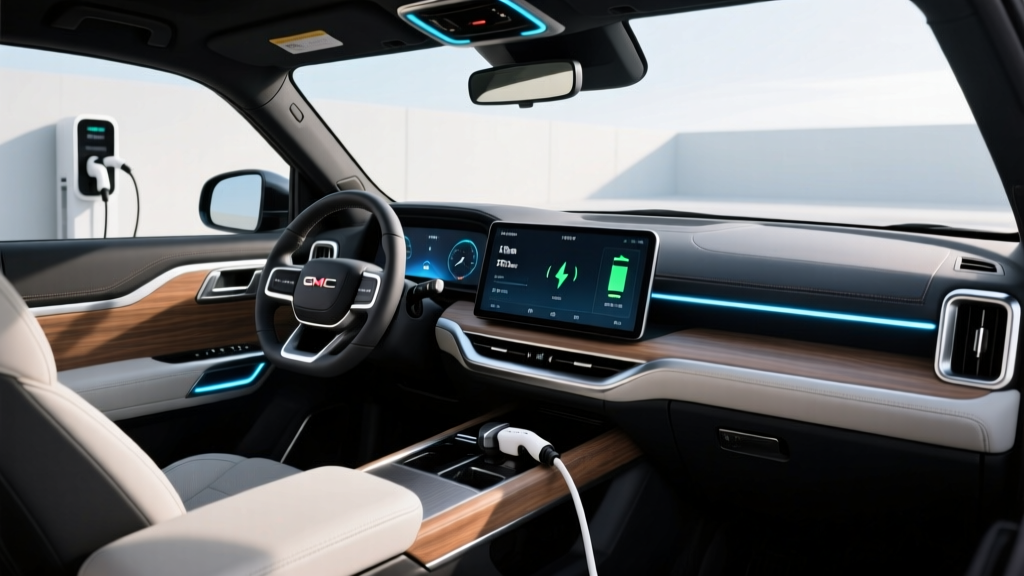
The dashboard is dominated by a 13.4-inch diagonal infotainment touchscreen running GM's latest Ultifi software platform, paired with a 12.3-inch digital instrument cluster behind the steering wheel. The center stack is angled toward the driver, with physical knobs for climate and drive-mode selection — a welcome choice given the vehicle's off-road mission. Available 18-way power front seats include heating, ventilation, and massage on the 3X and Edition 1 trims, upholstered in standard perforated leather or available synthetic suede.
Second Row & Passenger Space
Rear-seat passengers enjoy approximately 38.9 inches of legroom and 40.1 inches of headroom (without the available Infinity Roof panels installed). The rear bench is a three-place seat with a 60/40 split-fold function. Outboard seats are heated on upper trims. A rear-seat entertainment package with dual 12.6-inch screens is available on 3X and standard on Edition 1.
Cargo Volume & the Infinity Roof
Behind the second row, the Hummer EV SUV offers 35.9 cubic feet of cargo space. Fold the rear seats and that expands to 81.8 cubic feet — competitive with large three-row SUVs despite the Hummer's two-row configuration. The signature Infinity Roof features removable panels that store in the front trunk (frunk), which itself adds 11.3 cubic feet of lockable storage. The frunk is a practical differentiator versus body-on-frame competitors that lack front cargo space.
Infotainment & Driver Assistance
GM's Super Cruise — a Level 2 hands-free driver-assistance system — is standard on 2X and above trims, enabled on over 750,000 miles of mapped highways in the US and Canada. This is not autonomous driving; the system uses a driver-attention camera and requires you to remain alert and ready to take over. Also standard: a 14-camera UltraView system (useful for trail navigation and parking a vehicle this wide), wireless Apple CarPlay/Android Auto, and a 14-speaker Bose audio system (upgraded to 16 speakers on Edition 1).
Super Cruise is a hands-free driver-assistance system, not self-driving. You must remain attentive, keep your eyes on the road, and be prepared to steer or brake at all times. The system will disengage and alert you if the attention camera detects prolonged distraction.
Range, Battery & Efficiency: The Physics of 9,000 Pounds
The Hummer EV SUV's battery pack is an engineering marvel and an efficiency liability in equal measure. The 2X and 3X trims use a massive 246 kWh (total) / approximately 212 kWh (usable) Ultium lithium-ion battery with NMC (nickel manganese cobalt) chemistry. This is the largest battery pack in any production passenger vehicle sold in the US, and it's the reason the Hummer can achieve its EPA range despite weighing over 9,000 pounds.
Real-World Expectation: Expect approximately 260–280 miles in mixed highway driving at 70–75 mph. In cold weather (below 32°F), range can drop to 210–240 miles due to battery heating demands and cabin climate load. City driving with regenerative braking may approach or slightly exceed the EPA figure. The 3X trim with larger 22-inch wheels sees an EPA reduction to approximately 298 miles.
Efficiency is the Hummer's weakest metric on paper. The 2X achieves an EPA-rated 47 MPGe combined, which translates to roughly 72 kWh per 100 miles. For comparison, a Tesla Model X uses about 33 kWh per 100 miles. That energy consumption is the direct cost of moving 9,046 pounds with the aerodynamic profile of a fortified bunker. If you charge exclusively at home on off-peak electricity rates ($0.12–$0.16/kWh), a full charge costs approximately $25–$34. On DC fast chargers at $0.35–$0.48/kWh, that same charge runs $74–$102.
| Spec | 2X Trim | 3X Trim |
|---|---|---|
| EPA Range | 314 mi | 298 mi |
| Battery (Total / Usable) | 246 kWh / ~212 kWh | 246 kWh / ~212 kWh |
| Chemistry | NMC (Ultium) | NMC (Ultium) |
| Horsepower | 625 hp | 830 hp (w/ Watts to Freedom) |
| Torque | 7,400 lb-ft (wheel) | 11,500 lb-ft (wheel, WTF mode) |
| 0–60 mph | ~4.5 sec | ~3.5 sec |
| Drivetrain | Dual-motor AWD | Tri-motor AWD (e4WD) |
| MPGe (Combined) | 47 MPGe | 43 MPGe |
| Cargo (behind 2nd row) | 35.9 cu ft | 35.9 cu ft |
| Max Cargo (seats folded) | 81.8 cu ft | 81.8 cu ft |
| Frunk | 11.3 cu ft | 11.3 cu ft |
| Towing Capacity | 7,500 lb | 7,500 lb |
| Curb Weight | ~9,046 lb | ~9,063 lb |
| Base MSRP | $99,995 | $119,995 |
Charging Speed: 800-Volt Architecture, Real-World Curves
The Hummer EV SUV's 800-volt Ultium architecture enables DC fast charging at up to 350 kW on compatible stations. However, the enormous battery pack means the charge curve is a marathon, not a sprint. Here's what to expect at each charging level:
| Level | Power / Voltage | Rate | Time |
|---|---|---|---|
| Level 1 (120V) | 1.4 kW | ~3 mi/hr | Impractical for full charge (~72 hr) |
| Level 2 (240V, 48A) | 11.5 kW | ~23 mi/hr | ~13–14 hr (10–100%) |
| Level 2 (240V, 80A) | 19.2 kW | ~38 mi/hr | ~8–9 hr (10–100%) |
| DC Fast (350 kW peak) | Up to 350 kW | ~200 mi in ~22 min (10–50%) | 10–80% in ~40–45 min |
A critical note on the DC fast-charge curve: while the Hummer EV can peak near 350 kW at low state-of-charge (below 30%), the rate tapers significantly as the pack fills. Sustained average power from 10–80% is closer to 180–220 kW. This is physics — pushing high current into a 246 kWh pack at 350 kW continuously would generate excessive heat. Plan road-trip stops around 40–45 minutes at a 350 kW-capable station, and always precondition the battery via the navigation system before arrival.
For home charging, the 19.2 kW onboard charger (available with the dual-level charge cord and a 100-amp dedicated circuit) is the practical sweet spot. Overnight charging easily replenishes a full day's driving. However, installing a 100-amp circuit typically requires a 200-amp (or larger) electrical panel — budget $1,500–$3,500 for a licensed electrician to install the outlet and potentially upgrade your panel. Always confirm amperage requirements with a qualified electrician before purchasing equipment.
Performance: Watts to Freedom and Tri-Motor Muscle
The 3X trim's tri-motor powertrain (one front, two rear) produces 830 horsepower and, in the theatrical Watts to Freedom (WTF) launch mode, an estimated 11,500 lb-ft of wheel torque. GMC's claimed 0–60 mph time of approximately 3.5 seconds is extraordinary for a vehicle that outweighs many commercial trucks. The dual-motor 2X trim still delivers 625 hp and a ~4.5-second 0–60 — quicker than most sport sedans.
Beyond straight-line speed, the Hummer EV SUV offers genuine off-road capability: CrabWalk (four-wheel steering enabling diagonal movement at low speeds), Extract Mode (adaptive air suspension that lifts the vehicle 5.8 inches for obstacle clearance), underbody armor, and 35-inch all-terrain tires standard. Approach, departure, and breakover angles are competitive with purpose-built off-roaders. This isn't a soft-roader wearing adventure aesthetics.
Pricing, Trims & Federal Tax Credit Eligibility
The 2026 Hummer EV SUV lineup starts at $99,995 for the 2X trim and climbs to $119,995 for the 3X. The limited-production Edition 1 (based on 3X with exclusive interior trim and badging) was offered at initial launch and may appear in limited allocation. Destination charges add approximately $1,995.
| Trim | Base MSRP | As-Tested (typical) | §30D Credit Eligible? |
|---|---|---|---|
| 2X | $99,995 | $104,000–$112,000 | No (exceeds $80,000 SUV MSRP cap) |
| 3X | $119,995 | $125,000–$140,000 | No (exceeds $80,000 SUV MSRP cap) |
The IRS §30D Clean Vehicle Credit imposes an MSRP cap of $80,000 for SUVs. Every Hummer EV SUV trim exceeds this threshold, making it ineligible for the up-to-$7,500 federal tax credit regardless of buyer income, battery sourcing, or point-of-sale transfer rules. Consult IRS.gov §30D guidelines for the latest eligibility criteria. Some states offer separate EV incentives that may apply — check your state's energy or DMV office.
Warranty & Ownership Considerations
GMC backs the Hummer EV SUV with a competitive warranty package:
- Battery & Propulsion: 8 years / 100,000 miles (whichever comes first), with a capacity retention guarantee — GM warrants that the battery will retain at least 70% of its original capacity during the warranty period.
- Bumper-to-Bumper: 3 years / 36,000 miles
- Powertrain (non-electric components): 5 years / 60,000 miles
- Corrosion: 6 years / 100,000 miles
- Roadside Assistance: 5 years / 100,000 miles
Insurance premiums are a real ownership cost to model before purchase. Given the $100,000+ MSRP, high repair costs for the battery pack and aluminum-intensive body, and the vehicle's weight, expect annual premiums in the $3,500–$5,500 range depending on your profile and state. Get quotes before committing.
Pros, Cons & Who Should Buy
Pros
- Massive 246 kWh battery delivers 314-mile EPA range despite 9,000+ lb weight
- 350 kW DC fast-charge capability (800V architecture)
- Tri-motor 3X achieves supercar-rivaling 0–60 in ~3.5 seconds
- CrabWalk and Extract Mode offer genuine off-road differentiation
- Spacious, well-insulated cabin with premium materials on upper trims
- 11.3 cu ft frunk adds practical lockable storage
- Super Cruise hands-free driving on 750,000+ miles of mapped roads
- 7,500-lb towing capacity
Cons
- 47 MPGe / 72 kWh per 100 mi — highest energy consumption in its class
- 10–80% DC charge takes ~40–45 min even at 350 kW stations
- Over 9,000 lb curb weight accelerates tire wear and limits route options (some bridges/parking structures)
- $100,000+ starting price with no federal tax credit eligibility
- 86.6-inch width makes urban driving and tight parking challenging
- Real-world highway range drops to ~260–280 mi; cold weather further reduces to ~210–240 mi
- Insurance premiums are steep ($3,500–$5,500+/yr)
- Home charging requires 100A circuit and likely panel upgrade
Who This EV Suits Best
The Hummer EV SUV is the right choice if you need (or want) a statement vehicle that combines genuine off-road capability, supertruck acceleration, and a spacious luxury cabin — and you have the budget, garage space, and home electrical infrastructure to support it. It works well as a weekend adventure rig, a towing platform for boats or campers under 7,500 lb, and a daily driver if your commute is under 200 miles round-trip with reliable home charging. It is not the right choice if efficiency, low running costs, or urban maneuverability are priorities. Competitors like the Rivian R1S (EPA 352+ mi, ~$79,900 starting) or the Tesla Model X (EPA 348 mi, ~$79,990 starting) deliver more range, better efficiency, and federal tax-credit eligibility at lower price points, though neither matches the Hummer's sheer presence or off-road hardware.
Frequently Asked Questions
What is the real-world range of the Hummer EV SUV?
The EPA rates the 2X trim at 314 miles and the 3X at 298 miles. In real-world highway driving at 70–75 mph, expect 260–280 miles. In sustained cold weather (below 32°F), range drops to approximately 210–240 miles. These figures are consistent with the physics of propelling a 9,000-pound, boxy vehicle — the large battery compensates for poor efficiency, but can't overcome it entirely.
How fast does the Hummer EV SUV charge at home and on the road?
On a 350 kW DC fast charger, expect 10–80% in approximately 40–45 minutes (peak rate tapers significantly above 50% SoC). At home on a Level 2 charger at 19.2 kW (80A circuit), a full charge takes roughly 8–9 hours, adding about 38 miles per hour of charging. On a standard 48A Level 2 (11.5 kW), plan for 13–14 hours for a full charge.
Does the Hummer EV SUV qualify for the federal EV tax credit?
No. The IRS §30D Clean Vehicle Credit caps eligible SUVs at an MSRP of $80,000. Every Hummer EV SUV trim starts at $99,995 or above, disqualifying it regardless of your income, battery sourcing, or how you take delivery. State-level incentives may still apply — check with your state energy office or the IRS §30D page for details.
Is the Hummer EV SUV worth buying vs. the Rivian R1S or Tesla Model X?
It depends on your priorities. The Rivian R1S offers more range (up to 410 miles on Max Pack), better efficiency (~70 MPGe combined), a lower starting price (~$79,900), and federal tax-credit eligibility on qualifying trims. The Tesla Model X delivers 348 miles of range, access to the Supercharger network, and a lower starting price (~$79,990). The Hummer EV SUV wins on off-road capability (CrabWalk, Extract Mode, underbody armor), sheer presence, and the novelty of its 830-hp tri-motor powertrain. If you're buying for capability and statement value, the Hummer is unmatched. If you're buying for efficiency, range, and value, the R1S or Model X are stronger choices.
What battery chemistry does the Hummer EV SUV use?
The Hummer EV SUV uses GM's Ultium platform with NMC (nickel manganese cobalt) lithium-ion chemistry across all trims. NMC offers higher energy density than LFP (lithium iron phosphate), which is necessary to achieve 314 miles of range in such a heavy vehicle. The trade-off is that NMC cells are more sensitive to sustained high-state-of-charge storage — GM recommends daily charging to 80% and reserving 100% charges for road trips.
How much does it cost to charge a Hummer EV SUV?
With a usable battery capacity of approximately 212 kWh, a full charge from near-empty costs about $25–$34 at home (at $0.12–$0.16/kWh) and $74–$102 on public DC fast chargers (at $0.35–$0.48/kWh). At 72 kWh per 100 miles, the Hummer costs roughly $8.64–$11.52 per 100 miles to fuel at home — comparable to a gas vehicle getting 12–15 MPG at $3.50/gallon.
Sources: EPA Fueleconomy.gov, GMC Hummer EV Official Specifications, IRS §30D Clean Vehicle Credit Guidelines.