Why the Hummer EV's Dimensions Matter for Buyers
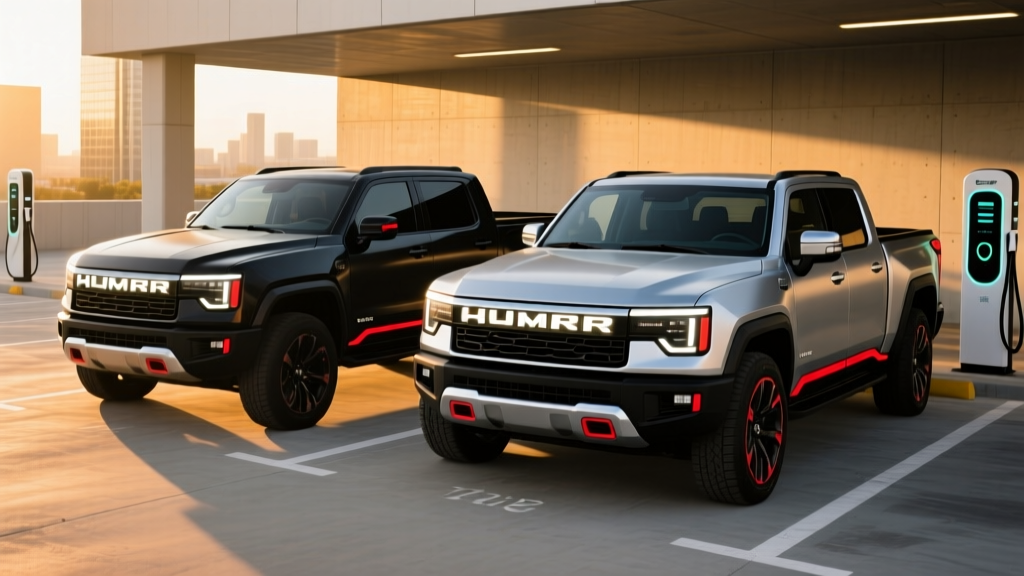
If you've searched for Hummer EV length, you're likely measuring your garage, your parking spot, or your tolerance for a full-size electric truck. The answer depends on which body style you choose. The GMC Hummer EV Pickup measures 216.8 inches bumper to bumper, while the Hummer EV SUV trims that down to 196.8 inches — still enormous by passenger-car standards, but a meaningful 20-inch difference when threading into a suburban driveway.
For 2026, GMC continues to offer both the Pickup and SUV on the Ultium platform with the 24-module double-stacked battery pack. The result is one of the heaviest, widest, and most capable electric vehicles on the road — and one that demands honest conversation about range, charging infrastructure, and real-world usability before you sign a six-figure purchase order.
Spec Snapshot: 2026 GMC Hummer EV Pickup (Edition 1 / 3X)
| Spec | Pickup 3X | SUV 3X |
|---|---|---|
| Overall Length | 216.8 in | 196.8 in |
| Wheelbase | 135.6 in | 126.7 in |
| Width (mirrors out) | 96.5 in | 96.5 in |
| Curb Weight | ~9,063 lb | ~8,600 lb |
| Battery (usable) | ~212.7 kWh, NMC | ~212.7 kWh, NMC |
| EPA Range | 329 mi | 314 mi |
| Peak DC Fast Charge | 350 kW (800V) | 350 kW (800V) |
| 10–80% Charge Time | ~34 min | ~34 min |
| Level 2 Home Rate | 11.5 kW (~25 mi/hr) | 11.5 kW (~25 mi/hr) |
| 0–60 mph | ~3.0 s (Watts to Freedom) | ~3.5 s |
| Horsepower | 830 hp | 830 hp |
| MPGe (combined) | 47 MPGe | 47 MPGe |
| Efficiency | ~72 kWh/100 mi | ~72 kWh/100 mi |
Real-World Range vs. the EPA Sticker
Real-world expectation: 250–280 miles at sustained 70–75 mph highway speeds; 220–250 miles in sub-freezing weather.
The Hummer EV's EPA range looks respectable for a 9,000-lb truck, but the physics of pushing that much mass and frontal area at highway speed is unforgiving. In mixed driving at 65 mph with mild weather, owners consistently report landing near 290–310 miles. Push the speed to 75–80 mph on an interstate run and efficiency drops into the 85–90 kWh/100 mi range, shrinking practical range toward 250 miles.
Cold weather compounds the penalty. The Ultium pack's active thermal management helps, but heating a cabin this large in 20°F weather without a heat pump (the Hummer EV uses resistive PTC heating) can cut range by 25–35%. Plan winter road trips around 200–220 mile legs to keep a safety margin.
For context, the EPA's fueleconomy.gov listing shows 47 MPGe combined — roughly 2.1 kWh per mile. That's nearly triple the consumption of a midsize EV like the Hyundai Ioniq 5, which is the tradeoff for 830 hp and 8,100-lb towing capacity.
Charging: 800V Architecture Done Right, With Caveats
| Level | Power | Rate | Notes |
|---|---|---|---|
| Level 1 (120V) | 1.4 kW | ~3 mi/hr | Effectively unusable for daily needs on a 212 kWh pack |
| Level 2 (240V, 48A) | 11.5 kW | ~25 mi/hr | Full charge in ~19 hours; overnight top-ups work fine |
| DC Fast (800V, peak) | 350 kW | ~100 mi in 12 min | Peak rate sustained to ~40% SoC; tapers hard above 80% |
The Hummer EV's 800-volt architecture is genuinely impressive at a 350 kW-capable station like an Electrify America or Tesla Supercharger (with NACS adapter). The charge curve holds near peak output through the low-to-mid state of charge, delivering roughly 100 miles of range in 12 minutes on a warm pack. But the enormous battery means even "fast" charging takes time — a 10–80% session runs about 34 minutes under ideal thermal conditions.
Preconditioning is essential. Use the navigation-based battery prep when routing to a DC fast charger; arriving with a cold pack can halve your peak charge rate. The 11.5 kW onboard charger is adequate for overnight home charging, but expect to install a 60A hardwired Level 2 circuit (or a NEMA 14-50 for 40A/9.6 kW) to make daily top-ups practical. Budget $800–$2,200 for professional installation depending on panel proximity.
One ownership note: the 212 kWh pack means you'll rarely charge from empty. Most owners plug in nightly at 40–60% SoC, adding 100–150 miles while they sleep. That's actually gentle on NMC chemistry and should support long-term State of Health.
Performance: 830 HP and the Watts to Freedom Paradox
The tri-motor 3X powertrain delivers 830 horsepower and 1,200 lb-ft of torque, propelling 9,000 pounds to 60 mph in roughly 3.0 seconds in Watts to Freedom mode. This is absurd in the best way — a vehicle that weighs as much as two Honda Civics accelerating like a Porsche Taycan. The Adaptive Air Ride suspension drops the body 2 inches in WTF mode, stiffens the dampers, and plays a haptic rumble through the seat.
Beyond the parlor trick, the dual-motor 2X trims (570 hp, ~4.5 sec 0–60) are the rational choice for most buyers. You still get air suspension, CrabWalk diagonal steering, Extract Mode (15.9 inches of ground clearance), and 8,100-lb max towing. The 3X's third motor adds ~300 lb of weight and meaningful cost without transforming daily drivability.
Ride quality in Comfort mode is genuinely plush, with the air suspension soaking up expansion joints better than most luxury SUVs. But the steering is vague on-center, and the 9,000-lb mass is obvious under hard braking — plan your stopping distances accordingly, especially when towing.
Interior, Cargo, and the Garage Problem
Inside, the Hummer EV uses a 13.4-inch infotainment touchscreen running GM's Ultifi software with Google Built-In, plus a 12.3-inch driver display. The UltraVision camera system (up to 18 views, including underbody) is invaluable for off-road navigation and trailer hitching. Super Cruise hands-free driving on mapped highways is a highlight on long road trips — but remember it's SAE Level 2, requiring active driver supervision, not autonomous driving.
Cargo space diverges sharply between body styles:
- Pickup: 5-foot bed (81.9 cu ft with tailgate up), plus a 5.7 cu ft eTrunk frunk
- SUV: 81.8 cu ft behind front seats (seats folded), 35.9 cu ft behind second row, no frunk on early models
Passenger space is generous — 42.5 inches of front legroom, 38.9 inches rear — but the cabin feels narrower than its exterior width suggests due to massive door panels and the center console. The Infinity Roof with removable transparent panels is a standout feature, though storage of the panels requires dedicated garage space.
And about that garage: the 96.5-inch width (with mirrors folded) and 216.8-inch length of the Pickup will not fit in a standard single-car bay. Measure twice. Many owners report needing to park at an angle in a two-car garage or simply use the driveway.
Pricing, Trims, and Federal Tax Credit Reality
| Trim | Base MSRP (2026) | §30D Credit Eligible? | Effective Price |
|---|---|---|---|
| Pickup 2X | ~$99,995 | No (over $80k MSRP cap) | ~$99,995 |
| Pickup 3X | ~$106,495 | No (over $80k MSRP cap) | ~$106,495 |
| Pickup Edition 1 | ~$112,495 | No (over $80k MSRP cap) | ~$112,495 |
| SUV 2X | ~$99,995 | No (over $80k MSRP cap) | ~$99,995 |
| SUV 3X | ~$106,495 | No (over $80k MSRP cap) | ~$106,495 |
The IRS §30D federal EV tax credit imposes an $80,000 MSRP cap for trucks and vans (and $55,000 for sedans). Every Hummer EV trim clears that ceiling by $20,000+, making the full $7,500 credit unavailable regardless of your income, battery sourcing, or point-of-sale transfer preference. This is a hard rule per IRS guidance on new clean vehicle credits.
Some buyers look to state-level incentives (Colorado, California, and others offer rebates that don't have MSRP caps) or commercial-vehicle lease loopholes under §45W. Consult a tax professional — rules are jurisdiction-specific and change annually. But plan your budget assuming full MSRP out-of-pocket.
Warranty and Long-Term Ownership
GMC covers the Hummer EV with a 3-year/36,000-mile bumper-to-bumper warranty and a 8-year/100,000-mile battery and powertrain warranty, guaranteeing at least 70% capacity retention over that period. Given the 212 kWh pack's size, even 10% degradation over a decade still leaves you with ~190 kWh usable — plenty for daily driving.
The NMC chemistry is proven in GM's Ultium family, though the Hummer's pack is the largest production application. Replacement cost, should you need it outside warranty, is estimated at $25,000–$35,000 for the full module set — another reason to maintain moderate charge habits (20–80% daily, 100% only for road trips).
Insurance premiums run 15–25% higher than a comparable gas-powered GMC Sierra 2500HD, reflecting the repair complexity of the Ultium platform and aluminum-intensive body. Get quotes before ordering.
Who the Hummer EV Suits — And Who Should Look Elsewhere
- You need 8,000+ lb towing with zero-emissions local driving
- Off-road capability (CrabWalk, Extract Mode, underbody armor) is a priority
- You have a 240V/48A+ home charging setup and a large garage or driveway
- You value presence, tech (UltraVision, Super Cruise), and WTF-mode theatrics
- Daily commuting efficiency matters (47 MPGe vs. 100+ MPGe for a Rivian R1S or Ioniq 5)
- You want federal tax credit eligibility
- Your garage is a standard single-car bay
- You road-trip frequently through areas with sparse 350 kW DC fast charging
The Rivian R1T and R1S are the most direct competitors — lighter, more efficient (~2.7 MPGe better), NACS-native, and starting $30,000+ lower. The Ford F-150 Lightning offers 78 MPGe, a lower MSRP floor, and broader charging compatibility, though with less off-road prowess. The Tesla Cybertruck undercuts on price and efficiency but lacks the Hummer's interior refinement and off-road hardware.
Pros
- 350 kW 800V charging — best-in-class for full-size trucks
- 830 hp / 3.0 sec 0–60 in WTF mode is unmatched
- Air suspension + Extract Mode = serious off-road clearance
- Super Cruise hands-free highway driving
- UltraVision camera system for trails and towing
Cons
- No federal §30D tax credit (over $80k MSRP cap)
- 47 MPGe — brutal efficiency for daily commuting
- Real-world highway range drops to ~250 mi
- Won't fit most standard garages (216.8 in length, 96.5 in width)
- Resistive cabin heating hurts cold-weather range
- Insurance premiums 15–25% above gas truck equivalents
Frequently Asked Questions
What is the real-world range of the Hummer EV?
EPA rates the 2026 Pickup at 329 miles and the SUV at 314 miles. Expect 250–280 miles at highway speeds in mild weather, and 200–220 miles in sub-freezing conditions due to the large cabin's heating demands and aero drag.
How fast does the Hummer EV charge at home and on the road?
At a 350 kW DC fast charger, 10–80% takes roughly 34 minutes with a preconditioned pack. At home on a 240V/48A Level 2, you'll add about 25 miles per hour — enough for overnight top-ups but not a full charge in a single night.
Does the Hummer EV qualify for the $7,500 federal EV tax credit?
No. All Hummer EV trims exceed the IRS §30D MSRP cap of $80,000 for trucks/vans. State incentives may apply depending on your jurisdiction; consult a tax professional.
How long is the Hummer EV, and will it fit in my garage?
The Pickup is 216.8 inches long and 96.5 inches wide (mirrors folded). The SUV is 196.8 inches long. Both exceed standard single-car garage dimensions; most owners use a two-car bay at an angle or park outdoors.
Is the Hummer EV worth buying over the Rivian R1T or F-150 Lightning?
If you need maximum off-road hardware (CrabWalk, Extract Mode, armor), 830 hp, and don't mind the efficiency and tax-credit penalties, yes. For daily-driving efficiency, lower price, and tax credit eligibility, the Rivian R1T or F-150 Lightning are more rational choices.
What is the battery warranty on the Hummer EV?
GMC provides an 8-year/100,000-mile battery and powertrain warranty with a guaranteed minimum of 70% capacity retention over that period.
Sources: EPA fueleconomy.gov, GMC Hummer EV official specs, IRS §30D clean vehicle credit rules.