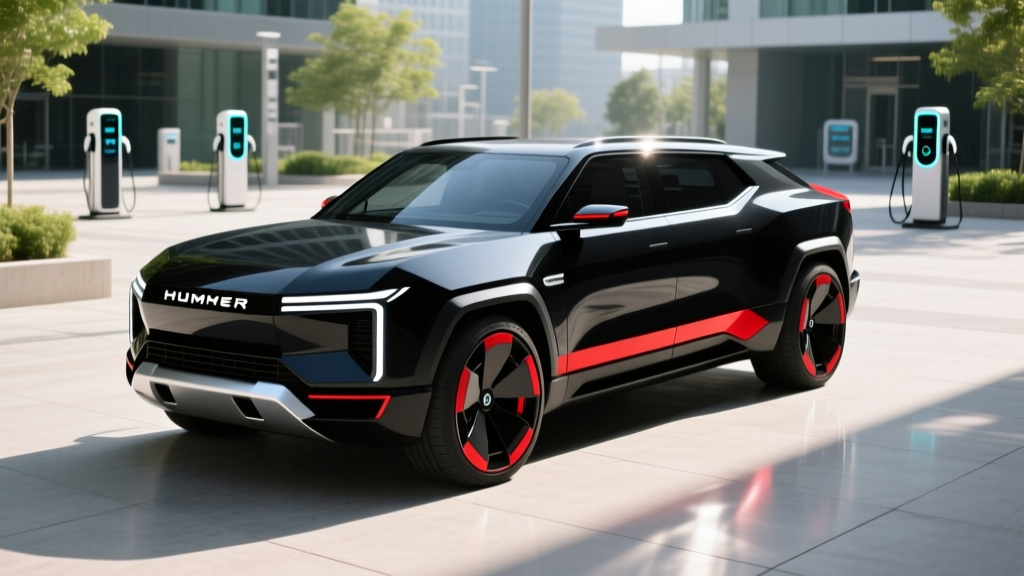
The GMC Hummer EV is a 9,000-pound, 1,000-horseproof electric supertruck that defies subtlety. But beneath the CrabWalk and Watts to Freedom launch mode lies a serious question for prospective lessees: what does it actually cost to live with one? A Hummer EV lease might look attractive on paper — especially with aggressive manufacturer incentives and the potential to capture the federal tax credit at the point of sale — but the real math involves charging costs, insurance premiums, maintenance savings, and depreciation that behaves very differently than a gas truck's.
This guide dissects the 2026 Hummer EV lease from a total-cost-of-ownership perspective, using real EPA data, current IRS §30D rules, and concrete per-mile calculations. No marketing fluff — just the numbers you need before signing.
2026 Hummer EV: The Lease Numbers at a Glance
Before we get to ownership costs, here's what you're working with on the vehicle itself. The 2026 GMC Hummer EV Pickup (2X and 3X trims) carries a massive Ultium battery pack and performance figures that rival supercars, all while achieving an EPA-estimated range that surprises most first-time buyers.
| Spec | 2X Trim | 3X Trim |
|---|---|---|
| Base MSRP | $98,845 | $106,245 |
| EPA Range (est.) | ~350 miles | ~329 miles |
| Battery (usable) | ~212 kWh, NMC (Ultium) | ~212 kWh, NMC (Ultium) |
| Horsepower | 625 hp | 830 hp (1,000 hp w/ WTF mode) |
| 0–60 mph | ~3.5 sec | ~3.0 sec |
| Max DC Fast Charge | 350 kW (peak) | 350 kW (peak) |
| 10–80% DC Charge | ~34 min | ~34 min |
| Level 2 Charge Rate | 19.2 kW | 19.2 kW |
| MPGe (combined, est.) | ~47 MPGe | ~45 MPGe |
| Battery/Powertrain Warranty | 8 yr / 100,000 mi | 8 yr / 100,000 mi |
Federal Tax Credit: Does the Hummer EV Qualify Under §30D?
This is where the lease math gets interesting — and complicated. The IRS §30D Clean Vehicle Credit offers up to $7,500 for qualifying new EVs, but eligibility hinges on multiple requirements that change periodically. Here's the 2026 checklist:
- ✓ MSRP Cap: Trucks, SUVs, and vans must have an MSRP ≤ $80,000. The Hummer EV starts at ~$98,845 — it exceeds the cap and does NOT qualify for the §30D purchase credit.
- ✓ Buyer Income Limits: AGI must not exceed $300,000 (married filing jointly), $225,000 (head of household), or $150,000 (individual).
- ✓ Battery Sourcing: Critical minerals and battery components must meet phased-in domestic/free-trade sourcing thresholds (tightening annually through 2029).
- ✓ Point-of-Sale Transfer: Qualifying buyers can transfer the credit to the dealer for an immediate price reduction — but only if the vehicle itself qualifies.
- ✓ North American Assembly: Final assembly must occur in North America (the Hummer EV is built in Detroit-Hamtramck — this requirement is met).
5-Year Total Cost of Ownership: Hummer EV vs. Gas Truck
To understand the true financial picture of a Hummer EV lease, we need to compare it against a realistic alternative — a similarly capable gas-powered heavy-duty truck. We'll use the 2026 GMC Sierra 2500HD Denali (MSRP ~$82,000, 15 MPG combined) as the baseline.
| Cost Category | Hummer EV 3X (Lease) | Sierra 2500HD Denali (Gas) |
|---|---|---|
| Effective Vehicle Cost (after credits) | ~$96,000* | ~$82,000 |
| Fuel / Charging (75,000 mi) | ~$5,625 | ~$17,500 |
| Maintenance (5 years) | ~$1,800 | ~$4,500 |
| Insurance (5 years) | ~$18,000 | ~$12,000 |
| Depreciation (est. 5-yr) | ~$48,000 | ~$36,000 |
| Total Estimated 5-Yr Cost | ~$169,425 | ~$152,000 |
*Assumes lessor passes through a portion of the §45W commercial credit. Actual lease cost depends on money factor, residual, and dealer terms. Source: Author estimates using fueleconomy.gov data, industry insurance averages, and Kelley Blue Book depreciation trends.
Charging vs. Gas: The Per-Mile Math That Matters
The Hummer EV's efficiency is roughly 2.1 kWh per mile (derived from its ~45 MPGe rating and 212 kWh battery). Here's what that translates to in real dollars:
| Scenario | Hummer EV ($/mile) | Sierra 2500HD ($/mile) |
|---|---|---|
| Home Level 2 charging ($0.14/kWh avg) vs. gas ($3.50/gal, 15 MPG) | $0.29 | $0.23 |
| Home charging with solar ($0.06/kWh effective) vs. gas | $0.13 | $0.23 |
| Public DC fast charging ($0.40/kWh avg) vs. gas | $0.84 | $0.23 |
| Time-of-use off-peak ($0.09/kWh) vs. gas | $0.19 | $0.23 |
The takeaway: home charging is essential to making the Hummer EV economical. At standard residential rates, the per-mile cost is competitive with a gas heavy-duty truck. With solar or off-peak rates, you save meaningfully. But relying on public DC fast charging — at $0.35–$0.50/kWh — makes the Hummer EV dramatically more expensive to "fuel" than its gas counterpart. This is a 2.1 kWh/mile vehicle; every cent per kWh matters at that consumption rate.
For a typical driver covering 15,000 miles per year with 80% home charging at $0.14/kWh and 20% public DC at $0.40/kWh:
- Annual charging cost: ~$1,575 (blended rate ~$0.35/mi weighted)
- Annual gas cost (Sierra 2500HD): ~$3,500
- Annual savings: ~$1,925 (assuming predominantly home charging)
Maintenance Savings: Where the EV Advantage Is Real
The Hummer EV eliminates many routine maintenance items that gas trucks require. Here's a side-by-side look at what you will and won't pay for over 5 years / 75,000 miles:
| Service Item | Hummer EV | Gas Truck (Sierra 2500HD) |
|---|---|---|
| Oil changes (every 7,500 mi) | $0 | ~$1,000 |
| Transmission fluid | $0 (no multi-speed trans) | ~$300 |
| Brake pads (regen braking extends life) | ~$0 (often 100k+ mi) | ~$800 |
| Coolant flush | ~$150 | ~$200 |
| Air filters (engine) | $0 (no engine) | ~$200 |
| Cabin air filter | ~$150 | ~$150 |
| Tire rotation & replacement | ~$1,200 (heavy vehicle = faster wear) | ~$900 |
| Wiper blades, misc. | ~$200 | ~$200 |
| Total Estimated | ~$1,700 | ~$3,750 |
The Hummer EV saves roughly $2,000–$2,700 in maintenance over 5 years. The biggest caveat: tires. At 9,000 lbs with instant torque, the Hummer EV wears through tires faster than a gas truck. Budget for premium 35-inch all-terrain replacements at ~$400 per tire. Regenerative braking, however, virtually eliminates brake pad wear in normal driving — many EV owners report original brake pads at 80,000+ miles.
Insurance Reality: The Cost Most Buyers Underestimate
EV insurance is typically 15–30% higher than comparable gas vehicles, and the Hummer EV sits at the extreme end. Here's why:
- Repair cost: The Ultium battery pack, specialized suspension (eCrabWalk components), and aluminum-intensive body mean higher repair bills after collisions. Fewer body shops are certified for high-voltage EV repair.
- Vehicle value: At $106,000+ MSRP, comprehensive and collision premiums scale accordingly.
- Performance risk: 830–1,000 hp and a 3.0-second 0–60 time place the Hummer EV in supercar performance territory from an actuarial standpoint.
- Parts availability: GMC's EV parts supply chain is still maturing, which can extend rental-car reimbursement periods after claims.
Expect annual premiums of $3,200–$4,200 for the Hummer EV 3X, depending on your driving record, location, and coverage level. That's $6,000+ more over 5 years than a gas Sierra Denali. Always get quotes from at least three insurers before signing a lease — some companies (like GEICO and Progressive) have become more competitive on EVs, while others still price them at a significant premium.
Depreciation & Resale: How Well Does a Hummer EV Hold Value?
EV depreciation has been volatile. According to Kelley Blue Book and iSeeCars data, mainstream EVs lost 45–55% of their value over 5 years as of 2025, compared to 35–40% for comparable gas trucks. The Hummer EV faces specific headwinds:
- Luxury/niche segment: Low-volume, high-price EVs typically depreciate faster than mass-market models.
- Battery technology pace: As solid-state batteries and faster-charging platforms arrive, early Ultium vehicles may feel dated sooner.
- Tax credit resets: When new buyers can get $7,500 off competing models, your used Hummer EV competes against discounted new inventory.
- Lease residuals: If you're leasing, depreciation is the lessor's problem — your monthly payment already bakes in the projected residual value. This can actually make leasing the smartest way to drive a Hummer EV, since you're insulated from resale risk.
Estimated 5-year depreciation for the Hummer EV 3X: 45–55% (~$48,000–$58,000 in dollar terms). For a gas Sierra 2500HD Denali: 40–48% (~$33,000–$39,000). The gap exists, but leasing shifts this risk to the lessor.
State, Local & Utility Incentives: Stacking the Savings
Federal credits are only part of the picture. Depending on where you live, additional incentives can meaningfully reduce your effective cost:
- California: CVRP rebate up to $2,000 for income-qualified buyers (note: MSRP caps may apply — check CARB for current rules).
- Colorado: State EV tax credit up to $5,000 for vehicles under $80,000 MSRP (Hummer EV likely excluded).
- New York: Drive Clean Rebate up to $2,000 (MSRP cap applies).
- Utility rebates: Many utilities (PG&E, ConEdison, Xcel Energy) offer $500–$1,500 rebates for home Level 2 charger installation. Some offer off-peak charging credits of $0.05–$0.10/kWh.
- HOV lane access: Several states grant solo HOV lane access to EVs regardless of occupant count — a significant time savings in metro areas.
Is a Hummer EV Lease Right for You? Decision Framework
Choose the Hummer EV Lease If:
- You have reliable home Level 2 charging (or can install a 19.2 kW charger on a 100A circuit)
- You want to insulate yourself from EV depreciation risk (leasing shifts this to the lessor)
- The lessor confirms passthrough of the §45W commercial credit into reduced payments
- You value performance (3.0s 0–60), novelty (CrabWalk, Extract Mode), and zero tailpipe emissions
- Your AGI exceeds the §30D income limits anyway, making the lease commercial-credit path your best option
Look Elsewhere If:
- You rely primarily on public DC fast charging (at $0.40/kWh, fueling costs exceed gas)
- Insurance quotes come in above $4,500/year and blow up your budget
- You need a truck for daily towing (range drops significantly under heavy trailer loads — expect ~180–220 miles with a 7,500-lb trailer)
- Total 5-year cost is your primary purchase driver (a gas truck or a less expensive EV like the Rivian R1T will cost less overall)
Frequently Asked Questions
How much does it really cost to own a Hummer EV over 5 years?
Based on our analysis, expect approximately $165,000–$175,000 in total 5-year cost (vehicle, charging, insurance, maintenance, and depreciation combined) for a Hummer EV 3X. This is roughly $15,000–$20,000 more than a gas Sierra 2500HD Denali over the same period. The fuel and maintenance savings offset part of the higher insurance and depreciation costs, but don't fully close the gap.
Do I qualify for the federal tax credit on a Hummer EV?
Under §30D (purchase credit), no — the Hummer EV's MSRP exceeds the $80,000 truck/SUV cap. However, leasing may allow the lessor to claim the §45W commercial credit, which has no MSRP cap for vehicles above 14,000 lbs GVWR. Whether this savings reaches you depends on the lessor's lease pricing. Always confirm with the dealer and consult a tax professional. Current rules are published at IRS.gov.
How much do I save on fuel and maintenance?
With predominantly home charging at $0.14/kWh, you'll save roughly $1,900–$2,400 per year on fuel compared to a 15 MPG gas truck at $3.50/gallon. Maintenance savings run approximately $400–$600 per year (no oil changes, minimal brake wear). Combined, that's $2,300–$3,000 in annual savings — but only if you charge at home. Public DC fast charging erases the fuel savings entirely.
Are EVs more expensive to insure?
Yes, typically 15–30% more, and the Hummer EV is at the high end of that range due to its $100K+ value, 1,000-hp performance, and specialized repair requirements. Expect $3,200–$4,200 annually. Get quotes before signing — the variance between insurers can be $1,000+ per year.
How well does the Hummer EV hold its value?
Expect 45–55% depreciation over 5 years, which is steeper than a gas heavy-duty truck (40–48%). However, when you lease, the residual value is the lessor's risk, not yours. This makes leasing arguably the most financially rational way to drive a Hummer EV, since you're protected if resale values drop further than projected.
What home electrical work do I need for the Hummer EV?
The Hummer EV supports up to 19.2 kW Level 2 charging, which requires a 100-amp dedicated circuit and a hardwired EVSE. Most homes will need a panel upgrade (to 200A or 400A service) plus professional installation. Budget $2,500–$5,000 for the complete setup (panel upgrade, wiring, EVSE, permits). Consult a licensed electrician for a site-specific quote — this is not a DIY project.