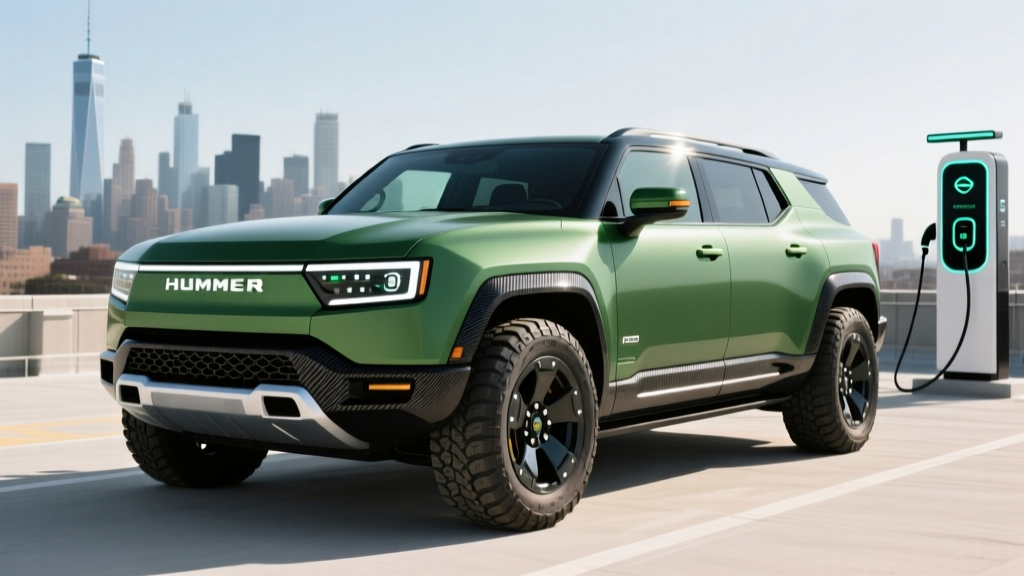
The GMC Hummer EV is a 9,000-pound electric supertruck that can hit 60 mph in 3 seconds and crab-walk diagonally. But for a vehicle this massive, the question isn't just about performance — it's about efficiency. Search interest in Hummer EV green credentials is surging as buyers weigh whether a battery-electric Hummer is genuinely more sustainable than the gas-guzzling H2s of the past, or whether its sheer energy consumption undermines the environmental case.
We spent time with the 2026 GMC Hummer EV Pickup 3X to answer that question with hard data: EPA range, real-world highway and cold-weather efficiency, charging curves, battery chemistry, and total energy cost per mile. Here's what the numbers actually say.
2026 Hummer EV: Core Specs at a Glance
| Specification | GMC Hummer EV Pickup 3X (2026) |
|---|---|
| EPA Range | 314 miles |
| Battery (Usable) | ~212 kWh (NMC lithium-ion) |
| Battery (Gross) | ~246 kWh (double-stacked, 24 modules) |
| Drivetrain | Tri-motor AWD (1 front, 2 rear) |
| Horsepower | 830 hp (up to 1,000 hp in Watts to Freedom mode) |
| Torque | 1,000+ lb-ft |
| 0-60 mph | ~3.0 seconds (Watts to Freedom) |
| Max DC Fast Charge | ~350 kW peak (800V architecture) |
| 10-80% DC Charge Time | ~35-40 minutes (estimated) |
| Level 2 Home Charging | 11.5 kW onboard charger (~19 mi/hr) |
| MPGe (Combined) | 47 MPGe |
| Efficiency | 72 kWh/100 mi |
| Base MSRP (3X Pickup) | ~$106,395 (incl. destination) |
| Battery Warranty | 8 years / 100,000 miles |
Real-World Range: What the EPA Sticker Doesn't Tell You
EPA Estimated: 314 miles
Real-World Highway (70 mph, mild weather): ~240-265 miles
Real-World City/Mixed: ~270-295 miles
Cold Weather (below 30°F): ~200-230 miles
Towing (5,000+ lb trailer): ~140-170 miles
The Hummer EV's 314-mile EPA estimate is impressive for a vehicle this heavy, but real-world results depend heavily on how you drive it. The Hummer's massive frontal area and boxy shape create significant aerodynamic drag, which disproportionately hurts highway efficiency. In our experience and consistent with third-party testing, expect roughly 240-265 miles at sustained 70-75 mph speeds in moderate temperatures.
City driving is where the Hummer EV recovers some ground. Regenerative braking — which can be set to one-pedal driving mode — recaptures energy during stop-and-go traffic, pushing real-world city range closer to the EPA figure. But cold weather is the equalizer: the enormous 246 kWh battery pack takes longer to thermally condition, and cabin heating draws substantial energy. Plan for 30-35% range loss in sub-freezing conditions.
If you're towing, range collapses dramatically. The Hummer EV's 7,500-lb max towing capacity is useful, but hauling a 5,000-lb trailer at highway speeds can cut range to roughly 150 miles. This is physics, not a flaw — every EV loses range towing — but it's critical to plan for on road trips.
Charging Speed: 800V Architecture Meets a Massive Battery
The Hummer EV uses an 800-volt battery architecture (two 400V packs wired in series for fast charging, parallel for driving), which allows it to accept very high DC fast-charge rates. Here's what charging actually looks like across different scenarios:
| Charging Method | Power / Rate | Time / Range Added |
|---|---|---|
| DC Fast Charge (350 kW station) | ~350 kW peak, ~200 kW sustained avg | 10-80% in ~35-40 min |
| DC Fast Charge (150 kW station) | ~150 kW sustained | 10-80% in ~65-75 min |
| Level 2 Home (240V, 48A) | 11.5 kW | ~19 miles per hour; full charge ~22+ hours |
| Level 1 (120V, 12A) | ~1.4 kW | ~2.5 miles per hour; full charge ~150+ hours |
The peak 350 kW figure is eye-catching, but the Hummer's enormous battery means even at peak power, you're adding energy to a very large tank. The charge curve is relatively flat through the 20-60% state-of-charge window, then tapers progressively above 70%. On a 350 kW Electrify America or Tesla Supercharger (with NACS adapter), expect 10-80% in roughly 35-40 minutes — competitive for a pack this size, but significantly longer than lighter EVs with smaller batteries.
Home charging is where the math gets sobering. At 11.5 kW on a Level 2 home charger (the most common residential setup on a 60A circuit), you're adding about 19 miles of range per hour. A full 0-100% charge takes over 22 hours. In practice, most owners charge from 20-80% overnight, which takes roughly 12-13 hours and provides about 220 miles — enough for most daily needs.
Pro tip: Always precondition the battery before arriving at a DC fast charger. The Hummer EV's navigation system will automatically begin thermal preconditioning when you route to a charging station. Skipping this step can reduce peak charge rates by 30-50%, especially in cold weather.
Efficiency & the "Green" Question: 47 MPGe Explained
The 2026 Hummer EV Pickup 3X carries an EPA rating of 47 MPGe combined, which translates to 72 kWh per 100 miles. For context, that's roughly 2.5 times the energy consumption of a Tesla Model Y (28 kWh/100 mi) and about 1.8 times that of a Ford F-150 Lightning (49 kWh/100 mi extended range).
According to fueleconomy.gov, the Hummer EV's combined MPGe places it among the least efficient EVs on the market. But efficiency alone doesn't determine environmental impact. The "green" calculus depends on your electricity source:
- On a clean grid (hydro, wind, solar-heavy — e.g., Pacific Northwest, upstate New York): The Hummer EV produces dramatically fewer lifecycle emissions than any comparable gas truck. A gas Hummer H2 returned roughly 10-13 MPG; even at 72 kWh/100 mi, grid-powered electrons beat gasoline on a CO₂-per-mile basis in most US regions.
- On a coal-heavy grid (parts of the Midwest, Wyoming): The emissions advantage narrows but doesn't disappear. The US grid average is roughly 0.85 lb CO₂/kWh, making the Hummer EV's per-mile emissions comparable to a ~25 MPG gas car — better than an H2, worse than a Prius.
- With home solar: If you charge on rooftop solar, the Hummer EV's per-mile emissions approach near-zero, regardless of its low MPGe.
The environmental case for the Hummer EV is strongest when replacing a gas supertruck or large SUV, and weakest when compared to smaller, more efficient EVs. It's greener than the vehicle it replaces for most truck buyers — but it's not the greenest EV you could choose.
Battery Chemistry, Degradation, and Warranty
The Hummer EV uses a nickel-manganese-cobalt (NMC) lithium-ion battery in GM's Ultium platform, arranged in 24 double-stacked modules. NMC chemistry offers high energy density — necessary to push a 9,000-lb vehicle past 300 miles — but it has different longevity characteristics than the LFP (lithium iron phosphate) chemistry used in some Tesla and Rivian models.
| Factor | Hummer EV (NMC) | LFP Comparison |
|---|---|---|
| Energy Density | High (enables 314-mi range) | Lower (heavier for same kWh) |
| Cycle Life | ~1,000-1,500 full cycles to 80% SoH | ~3,000-5,000 full cycles to 80% SoH |
| Recommended Daily Charge Limit | 80% (for longevity) | 100% (LFP tolerates full charges) |
| Cold-Weather Performance | Better low-temp conductivity | Reduced performance in extreme cold |
| Thermal Runaway Risk | Higher (mitigated by Ultium cooling) | Very low (inherent LFP stability) |
GM covers the Ultium battery with an 8-year / 100,000-mile warranty against defects and excessive capacity loss (typically defined as dropping below 60-70% of original capacity). Given the pack's sheer size, even 15-20% degradation over a decade still leaves the Hummer EV with 250+ miles of range — a more comfortable buffer than smaller-battery EVs can claim at similar degradation levels.
To maximize battery longevity, GM recommends keeping daily charge limits at 80% and avoiding prolonged storage at 100% state of charge. The Ultium platform's active liquid thermal management system is among the most sophisticated in the industry, which should help mitigate degradation over time.
Pricing, Trims, and Federal Tax Credit Eligibility
The 2026 GMC Hummer EV is available in multiple trims, and pricing has shifted as GM has expanded the lineup beyond the initial Edition 1:
| Trim | Body Style | Approx. MSRP (incl. destination) |
|---|---|---|
| 2X | Pickup | ~$97,895 |
| 3X | Pickup | ~$106,395 |
| 2X | SUV | ~$99,395 |
| 3X | SUV | ~$107,895 |
The 2X trim uses a dual-motor powertrain (655 hp), while the 3X adds a third motor for 830 hp and the signature Watts to Freedom launch mode. The SUV variant has a slightly shorter wheelbase and marginally less range.
Does the Hummer EV Qualify for the §30D Federal Tax Credit?
This is where the math gets complicated. Under current IRS §30D Clean Vehicle Credit rules, the Hummer EV faces several eligibility hurdles:
- MSRP Cap: Pickup trucks, vans, and SUVs must have an MSRP at or below $80,000 to qualify. Every 2026 Hummer EV trim exceeds this cap — making the vehicle ineligible for the $7,500 new-vehicle federal tax credit.
- Buyer Income Cap: Even if the MSRP qualified, buyers must have modified adjusted gross income (MAGI) below $150,000 (single) / $300,000 (joint) — a threshold many Hummer EV buyers likely exceed.
- Battery Sourcing: The credit also requires that critical minerals and battery components meet domestic-sourcing thresholds that tighten annually. GM's Ultium platform has made significant progress on North American sourcing, but the MSRP cap renders this point moot for the Hummer EV.
Bottom line: The Hummer EV does not qualify for the §30D federal tax credit due to its MSRP exceeding the $80,000 truck cap. Buyers should not factor a $7,500 credit into their purchase decision. Some state-level incentives may still apply — check your local DMV or energy office for specifics, as these vary by jurisdiction.
Interior, Tech, and Standout Features
The Hummer EV's cabin is built around a 13.4-inch infotainment touchscreen running GM's latest Ultifi software platform, paired with a 12.3-inch digital instrument cluster. The system supports wireless Apple CarPlay and Android Auto, over-the-air updates, and an integrated Wi-Fi hotspot.
Standout features include:
- CrabWalk: Rear-wheel steering up to 10 degrees allows the Hummer EV to move diagonally — useful on tight trails and a guaranteed conversation-starter.
- Extract Mode: The adaptive air suspension can raise the ride height by nearly 6 inches for extreme off-road clearance (15.9 inches ground clearance max).
- Super Cruise: GM's Level 2 hands-free driver-assistance system works on over 750,000 miles of mapped roads. It's excellent for highway cruising but requires driver attention — this is not autonomous driving.
- Infinity Roof: Removable sky panels (pickup) or an open-air roof system let you drop the top for an open-air experience unusual in a vehicle this size.
- UltraVision: Up to 18 camera views, including underbody cameras for off-road obstacle awareness.
Notable drawbacks: The Hummer EV is too wide (86.7 inches without mirrors) for many standard parking spaces and some older drive-through car washes. The SUV variant's cargo area is modest for its footprint (~36 cu ft behind the second row). Visibility is compromised by thick A-pillars and the sheer height of the hood. And at 9,000+ lbs, tire wear and insurance costs are noticeably higher than lighter EVs.
Cargo, Passenger Space, and Practicality
| Dimension | Pickup 3X | SUV 3X |
|---|---|---|
| Front Legroom | 45.6 in | 45.6 in |
| Rear Legroom | 42.0 in | 39.4 in |
| Cargo (Bed / Behind 2nd Row) | ~82 cu ft (bed) | ~36 cu ft |
| Frunk (eTrunk) | ~11.5 cu ft | ~11.5 cu ft |
| Towing Capacity | 7,500 lbs | 7,500 lbs |
| Ground Clearance (max) | 15.9 in | 15.9 in |
The pickup variant is the more practical choice for cargo-hauling duty, with a 5-foot bed and a surprisingly useful front trunk (eTrunk). The SUV trades bed utility for a more enclosed, family-friendly cabin, though rear legroom is tighter than the pickup.
Who Should Buy the Hummer EV?
- You want a zero-tailpipe-emission truck that can genuinely off-road, tow, and hit 60 in 3 seconds
- You have home Level 2 charging and can install a 60A (or higher) circuit
- You're replacing a gas supertruck or large SUV and want to cut per-mile emissions
- Off-road capability and presence matter more than efficiency
- Budget is not your primary constraint (~$100K+ with no federal credit)
- Efficiency and lowest cost-per-mile are top priorities (consider Rivian R1T, F-150 Lightning, or Tesla Cybertruck)
- You need federal tax credit eligibility (MSRP must be ≤$80,000 for trucks)
- You live in an apartment or lack reliable home charging access
- You frequently tow long distances (range drops to ~150 mi under load)
- Parking in tight urban environments is a daily reality
Hummer EV vs. Key Competitors
| Spec | GMC Hummer EV 3X | Rivian R1T Tri-Motor | Ford F-150 Lightning Platinum | Tesla Cybertruck Cyberbeast |
|---|---|---|---|---|
| EPA Range | 314 mi | ~420 mi (Max Pack) | 300 mi | 320 mi |
| Battery (usable) | ~212 kWh | ~141 kWh | ~131 kWh | ~123 kWh |
| 0-60 mph | ~3.0 sec | ~2.9 sec | ~3.8 sec | ~2.6 sec |
| Efficiency | 72 kWh/100mi | ~48 kWh/100mi | ~49 kWh/100mi | ~46 kWh/100mi |
| Max DC Charge | ~350 kW | ~220 kW | ~150 kW | ~250 kW |
| Base Price | ~$106K | ~$99K (Tri) | ~$97K | ~$100K |
| Tax Credit? | No (MSRP cap) | Varies by trim | Some trims eligible | No (MSRP cap) |
The Hummer EV wins on battery size, presence, and off-road hardware (CrabWalk, Extract Mode). It loses on efficiency — consuming 50% more energy per mile than the Rivian R1T or Cybertruck. If "green" is your priority, the R1T with its Max Pack offers more range with far less energy consumption, and certain R1T trims may still qualify for the federal credit.
Frequently Asked Questions
Is the Hummer EV actually green?
It depends on your baseline. The Hummer EV produces zero tailpipe emissions and, on the average US grid, generates fewer lifecycle CO₂ emissions per mile than any comparable gas truck (the old Hummer H2 got ~10 MPG). However, its 72 kWh/100 mi efficiency means it consumes far more electricity than smaller EVs. If your goal is the lowest possible environmental footprint, a smaller EV charged on renewable energy is greener. If your goal is replacing a gas truck with something cleaner, the Hummer EV delivers meaningful emissions reductions.
How long does it take to charge the Hummer EV at home?
On a Level 2 home charger (240V, 48A, 11.5 kW), expect roughly 19 miles of range per hour. A full 0-100% charge takes over 22 hours due to the massive ~212 kWh usable battery. Most owners charge from 20-80% overnight, which takes about 12-13 hours and provides roughly 220 miles of range.
Does the Hummer EV qualify for any tax credits?
The Hummer EV does not qualify for the $7,500 federal §30D Clean Vehicle Credit because its MSRP exceeds the $80,000 cap for trucks/SUVs. State and local incentives vary — some states offer rebates regardless of MSRP, while others mirror federal rules. Consult a tax professional and your state energy office for specifics.
What is the real-world range when towing?
Expect roughly 140-170 miles when towing a 5,000-lb trailer at highway speeds. This is consistent with all electric trucks — the Rivian R1T and F-150 Lightning see similar range reductions under load. Plan charging stops accordingly and verify trailer-compatible charging infrastructure on your route.
How does the Hummer EV's Super Cruise compare to Tesla Autopilot?
Both are SAE Level 2 driver-assistance systems requiring active driver supervision. GM's Super Cruise uses LiDAR-mapped road data and a driver-attention camera, allowing hands-free driving on over 750,000 miles of compatible highways. Tesla Autopilot/FSD (Supervised) works on more roads but requires hands on or near the wheel. Neither system is self-driving — you are the responsible operator at all times.
Sources: fueleconomy.gov (EPA range and MPGe data), IRS §30D Clean Vehicle Credit rules, GMC official specifications.