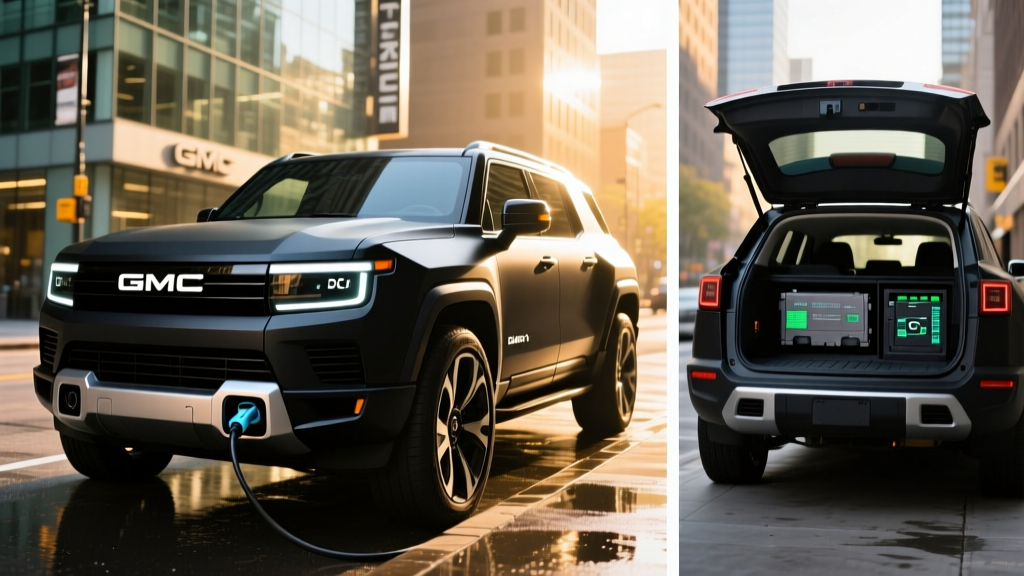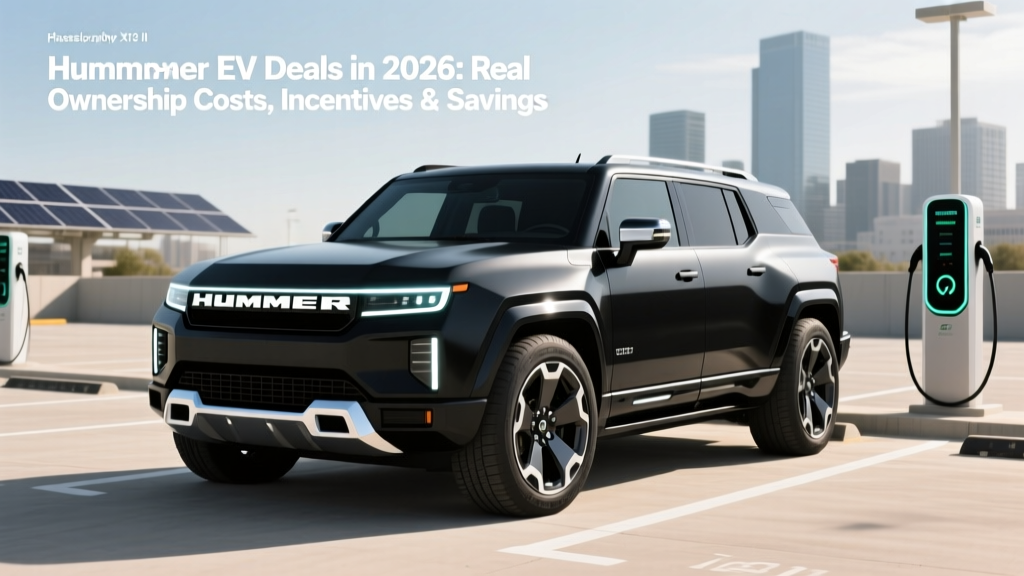
If you're researching Hummer EV deals in 2026, you're likely weighing the GMC Hummer EV's headline specs — 1,000+ horsepower, Watts to Freedom launch mode, and 300+ miles of range — against a six-figure starting price. The sticker shock is real, but so are the incentives, fuel savings, and maintenance reductions that reshape the true cost of ownership.
This guide dissects what it actually costs to buy, charge, insure, and maintain a GMC Hummer EV Pickup or SUV over five years. We'll run the numbers on federal tax credits, state rebates, electricity vs. gas costs, and the depreciation curve that matters when you eventually sell or trade in.
2026 GMC Hummer EV: Price, Trims, and Key Specs at a Glance
Before calculating ownership cost, here's what you're working with. The 2026 GMC Hummer EV continues in Pickup and SUV body styles, built on GM's Ultium platform with a dual-motor AWD or tri-motor AWD powertrain. Pricing has shifted slightly for the 2026 model year, and the federal tax credit landscape has tightened.
| Spec | 2X (Dual Motor) | 3X (Tri Motor) |
|---|---|---|
| Base MSRP (Pickup) | ~$99,995 | ~$119,995 |
| Base MSRP (SUV) | ~$101,995 | ~$121,995 |
| Battery (usable) | ~212 kWh (Ultium NMC) | ~212 kWh (Ultium NMC) |
| EPA Range (Pickup est.) | ~329 mi | ~285 mi |
| Real-World Range (highway/cold) | ~260–290 mi | ~230–255 mi |
| Peak DC Fast Charge | ~350 kW (800V architecture) | ~350 kW (800V architecture) |
| 10–80% DC Charge Time | ~22 min (peak conditions) | ~22 min (peak conditions) |
| Horsepower | ~625 hp | ~1,000 hp (WTF mode) |
| 0–60 mph | ~4.0 sec | ~3.0 sec |
| MPGe (combined) | ~47 MPGe | ~44 MPGe |
| Battery/Powertrain Warranty | 8 yr / 100,000 mi | 8 yr / 100,000 mi |
Federal Tax Credit: Does the Hummer EV Qualify for §30D in 2026?
The IRS §30D Clean Vehicle Credit offers up to $7,500 for qualifying new EVs. However, the Hummer EV faces significant eligibility hurdles in 2026. Here's the checklist:
- MSRP Cap: Pickup trucks, vans, and SUVs must have an MSRP at or below $80,000. The Hummer EV starts near $100,000 — it exceeds the cap and does not qualify for the new-vehicle §30D credit.
- Buyer Income Limits: Modified AGI must not exceed $300,000 (joint filers), $225,000 (head of household), or $150,000 (single). Even if the price qualified, high-income buyers would be excluded.
- Battery Sourcing & Critical Minerals: Battery components must be manufactured or assembled in North America (phase-in percentages increase yearly). Critical minerals must be sourced from the US or FTA partners. GM's Ultium battery sourcing has improved but must be verified per VIN at the time of purchase.
- Point-of-Sale Transfer: Eligible credits can now be transferred to the dealer at purchase, reducing your out-of-pocket cost immediately rather than waiting for tax filing. But this only applies if the vehicle itself qualifies.
5-Year Total Cost of Ownership: Hummer EV vs. Gas Truck
To evaluate Hummer EV deals fairly, we need to look beyond the purchase price. Below is a 5-year / 75,000-mile total cost of ownership (TCO) comparison between the Hummer EV 2X Pickup and a comparably equipped gas-powered heavy-duty truck (e.g., GMC Sierra 2500HD Denali, MSRP ~$75,000, 15 MPG combined).
| Cost Category | Hummer EV 2X | Gas HD Truck | Notes |
|---|---|---|---|
| Purchase Price (MSRP) | $99,995 | $75,000 | Before any incentives |
| Federal Tax Credit | $0 (MSRP exceeds cap) | $0 | Hummer EV ineligible under §30D |
| Fuel / Charging (5 yr) | ~$6,200 | ~$18,750 | See cost-per-mile math below |
| Maintenance (5 yr) | ~$1,800 | ~$5,500 | No oil, fewer brake replacements |
| Insurance (5 yr) | ~$18,000 | ~$12,000 | EV premiums typically 20–40% higher |
| Depreciation (5 yr) | ~$45,000 | ~$30,000 | EVs depreciate faster on average |
| Total 5-Year TCO | ~$171,000 | ~$141,250 | Hummer EV costs ~$30K more over 5 yr |
Charging Cost vs. Gas: The Per-Mile Math
The Hummer EV's efficiency is approximately 47 MPGe (combined), which translates to roughly 2.1 kWh per mile driven. Here's how that converts to real dollars:
| Scenario | Rate / Assumption | Cost Per Mile |
|---|---|---|
| Home Level 2 Charging | $0.14/kWh (national avg) | $0.29/mi |
| Home Charging (off-peak utility rate) | $0.08/kWh | $0.17/mi |
| Public DC Fast Charging | $0.40/kWh (avg network pricing) | $0.84/mi |
| Gas Truck (15 MPG combined) | $3.75/gallon | $0.25/mi |
At home on standard utility rates, the Hummer EV costs about $0.29 per mile to "fuel" — slightly more than a 15 MPG gas truck at $3.75/gallon. However, if you have access to off-peak or time-of-use rates (common in states like California, Texas, and the Pacific Northwest), charging drops to ~$0.17/mile, yielding meaningful savings. Public DC fast charging, at $0.40+/kWh, is significantly more expensive than gas — so the Hummer EV's cost advantage depends heavily on reliable home charging access.
Over 75,000 miles at the blended assumption (70% home, 30% public), expect total charging costs of approximately $6,200 vs. $18,750 for gas. That's a $12,550 fuel savings — but only if you charge at home most of the time.
Maintenance Savings: Where the Hummer EV Wins
Electric drivetrains have far fewer moving parts than internal combustion engines. Here's what Hummer EV owners skip entirely:
| Service Item | Hummer EV | Gas Truck | Estimated Gas Cost Saved |
|---|---|---|---|
| Oil Changes (every 5K–7.5K mi) | Not required | 10–15 changes | $800–$1,500 |
| Transmission Fluid | Not required (single-speed) | 1–2 services | $300–$600 |
| Brake Pads/Rotors | Greatly extended (regen braking) | 1–2 replacements | $800–$1,600 |
| Spark Plugs | Not required | 1 replacement | $200–$400 |
| Air Filters / Fuel Filters | Cabin filter only | Multiple replacements | $150–$300 |
| Exhaust / Emissions | None | Potential repairs | $0–$1,000+ |
| Total Estimated Maintenance | ~$1,800 | ~$5,500 | ~$3,700 saved |
The Hummer EV's regenerative braking system handles most deceleration, dramatically extending brake pad and rotor life. Many EV owners report original brake pads lasting 100,000+ miles. Tire wear, however, can be higher on the Hummer EV due to its 9,000+ lb curb weight and instant torque — budget for premium tire replacements every 25,000–35,000 miles.
Insurance Costs: The Hidden EV Premium
Insuring a Hummer EV is significantly more expensive than a comparable gas truck. Expect annual premiums of $3,200–$4,000 (vs. $2,000–$2,800 for a gas HD truck), depending on your state, driving record, and coverage level. Over five years, that's an additional $6,000+ in insurance costs.
Why the premium? Several factors drive higher EV insurance rates:
- Higher repair costs: EV battery packs, power electronics, and specialized aluminum body panels are expensive to replace after a collision.
- Specialized labor: Fewer body shops have high-voltage EV certification, limiting competition and raising repair invoices.
- Vehicle value: A $100,000+ vehicle simply carries higher comprehensive and collision premiums.
- Total-loss thresholds: Battery damage in even minor accidents can push an EV past the insurer's total-loss threshold.
Shop quotes from EV-friendly insurers (Geico, Progressive, State Farm, and specialty carriers like Hagerty for collectible EVs) before purchasing. Bundling home and auto, maintaining a clean record, and selecting higher deductibles can reduce premiums by 10–20%.
Depreciation and Resale Value: What to Expect
EVs have historically depreciated faster than comparable gas vehicles, though the gap has narrowed as the market matures. The Hummer EV, as a low-volume, high-price halo product, faces specific depreciation pressures:
- Typical 5-year EV depreciation: 45–55% of original MSRP (vs. 35–45% for gas trucks).
- Hummer EV specific factors: Limited production, niche appeal, and rapid EV technology advancement can accelerate value loss. Early 2022–2023 Hummer EVs with 10K–20K miles are listing at 40–50% below original MSRP in the used market.
- Battery health perception: Even with GM's 8-year/100,000-mile battery warranty (covering defects and capacity below 70%), used buyers remain cautious about long-term battery degradation on a 212 kWh pack.
- Technology obsolescence: As newer EVs offer faster charging, better range, and updated ADAS at lower prices, early Hummer EVs may feel dated more quickly than a traditional truck.
Estimated 5-year depreciation for a Hummer EV 2X: ~$45,000 (leaving a residual value of ~$55,000). For a gas HD truck at $75,000 MSRP: ~$30,000 depreciation (residual ~$45,000). The Hummer EV loses more in absolute dollars and as a percentage.
State, Local, and Utility Incentives for the Hummer EV
Potential incentive categories that may apply to Hummer EV buyers:
- State EV rebates: Some states (e.g., Colorado, California, Massachusetts) offer rebates that are not subject to federal MSRP caps. Colorado's Innovative Motor Vehicle Credit, for instance, can provide up to $5,000 for EVs regardless of price, though income phase-outs may apply.
- Utility charging rebates: Many electric utilities offer $250–$1,500 rebates for Level 2 home charger purchases and installation. Some (like PG&E, Con Edison, and Austin Energy) also offer discounted time-of-use rates for EV owners.
- HOV lane access: States like California, New York, and Virginia grant solo HOV lane access to EVs regardless of price — a significant non-monetary benefit for commuters.
- Registration fee waivers or reductions: A handful of states waive or reduce annual EV registration fees, though many now impose higher fees to offset lost gas tax revenue.
Check the AFDC state incentive database and your local utility's EV programs page for current offerings. These incentives rarely close the full $30K TCO gap but can offset $2,000–$7,000 depending on where you live.
Is the Hummer EV the Right Deal for You? A Decision Framework
Consider the Hummer EV if:
- You want a zero-tailpipe-emissions truck with supercar-level acceleration and serious off-road capability (Extract Mode, 4-Wheel Steer, adaptive air suspension).
- You have reliable home Level 2 charging and access to off-peak electricity rates to maximize fuel savings.
- You plan to keep the vehicle 7+ years, spreading the depreciation hit and maximizing the battery warranty coverage.
- The purchase price fits your budget without relying on the federal tax credit.
Look elsewhere if:
- You're optimizing purely for total cost of ownership — a gas truck or a less expensive EV (Ford F-150 Lightning, Rivian R1T) will cost significantly less over 5 years.
- You lack home charging access and would rely on public DC fast charging, which erases the per-mile cost advantage.
- You expect the federal $7,500 credit to apply — it doesn't at this MSRP.
- You plan to sell or trade within 3 years, when depreciation will be steepest.
Frequently Asked Questions
How much does it really cost to own a Hummer EV over 5 years?
Approximately $171,000 over 5 years and 75,000 miles, including purchase price, charging, insurance, maintenance, and depreciation. That's roughly $30,000 more than a comparably equipped gas heavy-duty truck, even after accounting for fuel and maintenance savings.
Does the Hummer EV qualify for the $7,500 federal tax credit?
No. Under current IRS §30D rules, trucks and SUVs must have an MSRP at or below $80,000 to qualify. The Hummer EV starts near $100,000, exceeding this cap. Always verify current rules on IRS.gov as regulations evolve.
How much do I save on fuel and maintenance with the Hummer EV?
Approximately $12,550 in fuel and $3,700 in maintenance over 5 years / 75,000 miles — totaling ~$16,250 in operational savings. Fuel savings depend heavily on home charging with favorable electricity rates; exclusive public fast-charging use significantly reduces or eliminates the cost advantage.
Are EVs more expensive to insure than gas vehicles?
Yes, typically 20–40% more expensive. For the Hummer EV, expect $3,200–$4,000 annually vs. $2,000–$2,800 for a gas truck. Higher repair costs, specialized labor, vehicle value, and battery replacement risk all contribute to elevated premiums.
How well does the Hummer EV hold its value?
The Hummer EV depreciates faster than gas trucks, losing an estimated 45–50% of its value over 5 years (~$45,000 on a $100,000 vehicle). Niche appeal, rapid EV tech advancement, and battery health perception all contribute. Long-term holders (7+ years) absorb this hit more gradually.
Can I charge the Hummer EV at home on a standard outlet?
Technically yes, via Level 1 (120V), but at ~1.4 kW, adding roughly 3–4 miles of range per hour. With a 212 kWh battery, a full Level 1 charge would take over 6 days. A Level 2 home charger (240V, 11.5–19.2 kW) is strongly recommended, adding 25–50 miles per hour and enabling overnight replenishment. Budget $1,000–$2,500 for professional Level 2 installation, including potential electrical panel upgrades.