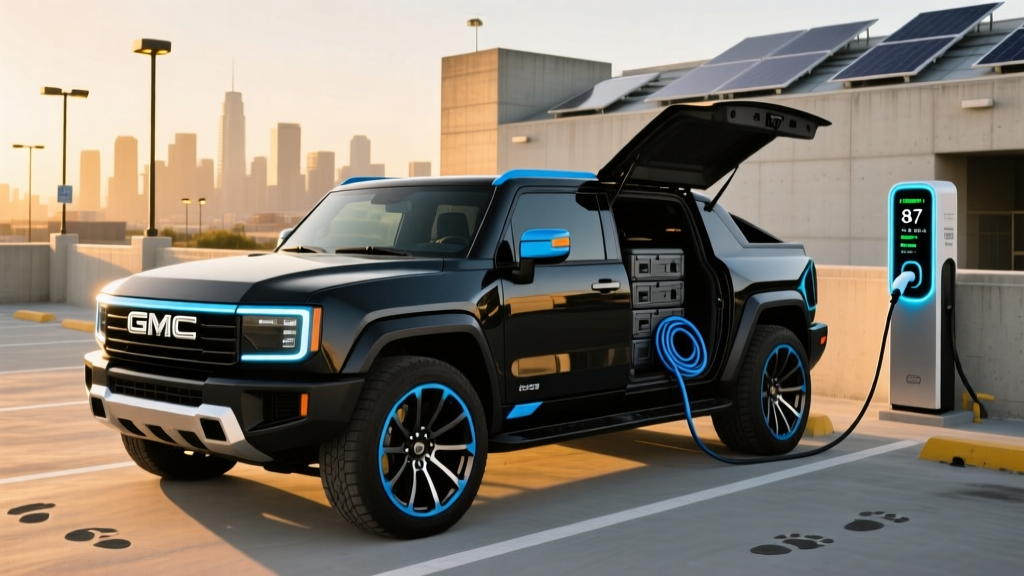
If you've been searching for a Hummer EV custom build that balances extreme off-road capability with daily-driver practicality, GMC's 2026 lineup offers more configuration flexibility than ever. From the 2X pickup with dual motors to the tri-motor 3X and the range-topping Edition 1, each Hummer EV variant caters to a distinct use case — whether that's towing a boat, tackling Moab trails, or simply making a statement in the school drop-off line.
But beneath the 9,000-pound curb weight and 1,000+ horsepower headlines lies a complex EV ownership proposition. The Ultium battery platform is genuinely impressive, yet real-world range falls notably short of EPA estimates under highway or cold-weather conditions. Charging speeds are class-leading when you can find a compatible 350 kW station, but those remain scarce outside major metro areas. And at a base price hovering near six figures, the Hummer EV demands careful financial consideration — especially regarding federal tax credit eligibility.
This review breaks down every 2026 Hummer EV custom configuration with exact specifications, real-world ownership data, and the practical realities that spec sheets don't advertise.
2026 Hummer EV Lineup: Trim Levels and Custom Configurations
GMC structures the 2026 Hummer EV around three primary powertrain tiers, each available in pickup or SUV body styles. The "custom" aspect comes from GMC's extensive option packages — the Extreme Off-Road Package, Infinity Roof with removable panels, and the available Adaptive Air Ride suspension with Extract Mode (which raises the vehicle 5.8 inches for obstacle clearance).
| Trim | Powertrain | HP / Torque | 0-60 mph | EPA Range | Base MSRP |
|---|---|---|---|---|---|
| 2X Pickup | Dual-Motor AWD | 625 hp / 7,400 lb-ft* | ~4.3 sec | 314 mi | $99,995 |
| 2X SUV | Dual-Motor AWD | 625 hp / 7,400 lb-ft* | ~4.5 sec | 298 mi | $101,495 |
| 3X Pickup | Tri-Motor AWD | 830 hp / 11,500 lb-ft* | ~3.0 sec | 329 mi | $119,995 |
| 3X SUV | Tri-Motor AWD | 830 hp / 11,500 lb-ft* | ~3.2 sec | 314 mi | $121,495 |
| Edition 1 (Pickup/SUV) | Tri-Motor AWD | 1,000 hp / 12,000 lb-ft* | ~2.8 sec | 329 mi (PU) / 314 mi (SUV) | $139,995+ |
*GMC publishes wheel torque figures, which are multiplied through the gear reduction — a marketing convention that inflates the number versus motor-output torque. Actual motor torque is approximately 1,200-1,600 lb-ft depending on configuration.
Real-World Range: What the EPA Sticker Doesn't Tell You
3X Pickup EPA: 329 miles
Real-world highway (70-75 mph): ~230-260 miles
Real-world cold weather (below 32°F): ~180-220 miles
Real-world mixed city/suburban: ~270-300 miles
The Hummer EV's 12,500-pound curb weight (3X) and aerodynamic profile of a brick wall mean highway efficiency suffers dramatically. Expect 1.8-2.2 kWh/mile at freeway speeds — that's roughly double what a Tesla Model Y consumes per mile.
The 2026 Hummer EV uses GM's Ultium battery platform with nickel-cobalt-manganese-aluminum (NCMA) chemistry — a variant of NMC optimized for energy density. The dual-motor 2X packs approximately 170 kWh usable capacity (from a 24-module pack), while the tri-motor 3X and Edition 1 use the larger 212 kWh usable configuration (24 double-stacked modules).
According to fueleconomy.gov, the 3X Pickup achieves 47 MPGe combined (47 city / 47 highway), translating to roughly 2.0 kWh per mile in mixed driving. That's among the lowest efficiency figures of any production EV — the unavoidable physics consequence of moving 9,000+ pounds with the aerodynamics of a shipping container.
For context: a 300-mile road trip in a 3X Pickup at highway speeds will likely require one DC fast-charging stop. In winter conditions with cabin heating active, plan for two stops on that same route. This isn't a flaw — it's physics — but it's essential to plan around if you're considering the Hummer EV as a road-trip vehicle.
Charging Speed: 350 kW Peak With Important Caveats
The Hummer EV's charging capability is genuinely impressive on paper, but real-world charging speed depends heavily on infrastructure availability and battery preconditioning.
| Charging Level | Power (kW) | Speed / Time | Connector |
|---|---|---|---|
| Level 1 (120V household) | ~1.4 kW | ~3-4 miles/hour | NACS (2026 models) |
| Level 2 (240V home, 48A) | 11.5 kW | ~25-30 miles/hour; full charge in 18-20 hours (3X) | NACS (2026 models) |
| Level 2 (240V home, 80A) | 19.2 kW | ~50-55 miles/hour; full charge in 10-12 hours (3X) | NACS (2026 models) |
| DC Fast Charge (peak) | 350 kW (800V architecture) | 10-80% in ~28-32 minutes (3X, preconditioned) | NACS (2026 models) |
| DC Fast Charge (typical 150 kW station) | 150 kW | 10-80% in ~55-65 minutes | NACS (2026 models) |
The 2026 Hummer EV has transitioned to the North American Charging Standard (NACS) connector, granting native access to Tesla's Supercharger network (now open to non-Tesla EVs at many locations). This is a significant practical upgrade over the CCS1 connector used on 2022-2024 models.
However, the 350 kW peak charge rate requires specific conditions: battery preconditioning must be active (triggered automatically when you navigate to a compatible charger), ambient temperatures should be moderate (50-85°F is ideal), and the station must actually deliver 350 kW. In practice, most public DC fast chargers in the U.S. max out at 150-180 kW, meaning your actual 10-80% charge time will often land in the 50-65 minute range.
The charge curve also tapers significantly above 80% state of charge. Charging from 80-100% on DC fast charge can add another 25-35 minutes — a strong argument for limiting highway-trip charges to 80% and planning slightly more frequent stops.
For home charging, the Hummer EV's massive battery makes a Level 2 installation non-negotiable. On a standard 120V outlet, a full charge takes 6-7 days. Even on a 48-amp Level 2 circuit, you're looking at overnight-plus charging times. Budget for an 80-amp circuit installation ($1,500-$3,000 depending on your electrical panel) to unlock the 19.2 kW onboard charger capability.
Performance and Capability: Beyond the 0-60 Numbers
The tri-motor 3X and Edition 1 Hummer EV deliver supercar-rivaling acceleration in a vehicle that weighs as much as two Ford F-150s. The Watts to Freedom launch mode (GMC's branded launch control) engages haptic feedback, adaptive damping, and a choreographed sound-and-light sequence before unleashing a 2.8-second 0-60 run in the Edition 1.
But straight-line speed is almost beside the point. The Hummer EV's real performance story is off-road capability:
- Ground clearance: 10.1 inches standard; 15.9 inches in Extract Mode
- Approach/departure/breakover angles: 49.7° / 38.4° / 32.2° (Extract Mode)
- Water fording depth: 32.1 inches (28.1" standard)
- CrabWalk: Four-wheel steering allows diagonal movement at speeds up to 20 mph — invaluable on narrow trails
- Towing capacity: 7,500 lbs (pickup); 5,000 lbs (SUV)
The four-wheel steering system also reduces the turning circle to 37.1 feet — comparable to a midsize sedan and dramatically tighter than any body-on-frame truck. This makes the Hummer EV surprisingly maneuverable in parking lots and tight suburban streets.
The GMC UltraVision camera system provides up to 18 camera views, including underbody cameras with virtual "transparent hood" functionality — a genuinely useful feature for rock crawling where visibility of the terrain beneath your wheels matters.
Interior, Cargo, and Technology
The 2026 Hummer EV cabin is dominated by a 13.4-inch diagonal infotainment touchscreen running GM's latest Ultifi software platform, paired with a 12.3-inch driver information cluster. Wireless Apple CarPlay and Android Auto are standard, along with a Wi-Fi hotspot and Google Built-in navigation.
Cargo capacity varies significantly by body style:
- Pickup bed: 5 feet (60 inches) long with the MultiPro tailgate closed; accommodates 4x8 sheets of plywood with tailgate down
- Pickup frunk (e-trunk): 8.9 cu ft — enough for charging cables, a weekend bag, or the removable roof panels
- SUV cargo (behind 2nd row): 35.9 cu ft
- SUV cargo (seats folded): 81.8 cu ft
- Front legroom: 42.5 inches (pickup and SUV)
- Rear legroom: 38.9 inches (pickup); 37.2 inches (SUV)
The available Infinity Roof features four removable modular sky panels that stow in the front trunk — a genuinely unique feature that transforms the cabin into an open-air experience. It's a party trick, but it's a compelling one.
Driver assistance comes via Super Cruise (GM's Level 2 hands-free driving system), which operates on over 750,000 miles of mapped highways in the U.S. and Canada. Note: Super Cruise requires driver attention monitoring and is not autonomous driving. You must remain engaged and ready to take over at all times.
Pricing, Tax Credits, and Total Ownership Cost
| Configuration | Base MSRP | As-Tested (w/ Extreme Off-Road Pkg) | §30D Federal Credit Eligible? |
|---|---|---|---|
| 2X Pickup | $99,995 | $112,995 | No — exceeds $80,000 MSRP cap for trucks |
| 2X SUV | $101,495 | $114,495 | No — exceeds $80,000 MSRP cap for SUVs |
| 3X Pickup | $119,995 | $135,995 | No — exceeds $80,000 MSRP cap for trucks |
| 3X SUV | $121,495 | $137,495 | No — exceeds $80,000 MSRP cap for SUVs |
| Edition 1 | $139,995 | $155,000+ | No — exceeds MSRP cap |
Under current IRS §30D rules, the federal clean vehicle credit caps eligible trucks at an $80,000 MSRP and SUVs at $80,000 MSRP. Every 2026 Hummer EV configuration exceeds this threshold — meaning no Hummer EV variant qualifies for the $7,500 federal tax credit.
Additional eligibility requirements (buyer income caps of $150K single / $300K joint, critical mineral sourcing, and battery component manufacturing rules) are moot here since the MSRP cap alone disqualifies the vehicle. Some states offer separate EV rebates that don't carry MSRP caps — check your state's energy office for specifics, but don't count on it.
Ownership costs beyond the purchase price are substantial:
- Insurance: Expect $3,500-$5,500 annually depending on location and driving record (the Hummer EV's repair costs and performance metrics drive premiums higher than average)
- Home electricity (charging): At $0.15/kWh national average, a full 212 kWh charge costs ~$31.80 — yielding roughly $0.16/mile in electricity
- Tires: The 35-inch Goodyear Wrangler Territory MT tires run $450-$600 each and may need replacement every 25,000-35,000 miles given the vehicle's weight
- Registration: Many states impose additional EV registration fees ($50-$225/year)
How the Hummer EV Compares to Key Rivals
The Hummer EV occupies a unique niche, but several competitors deserve consideration:
- Rivian R1T Tri-Motor ($99,900+): More refined on-road, similar off-road capability, 420-mile max range option, significantly lighter. Better daily-driver manners but less visual drama.
- Tesla Cybertruck Cyberbeast ($99,990): Faster 0-60 (2.6 sec), better range efficiency, stainless steel exoskeleton. Polarizing design, panel-gap concerns, no Super Cruise equivalent.
- Ford F-150 Lightning Platinum ($96,874): Far more practical for daily use, Pro Power Onboard is excellent, but performance and off-road capability don't match the Hummer EV.
- Cadillac Escalade IQ ($129,990+): Shares the Ultium platform, luxurious interior, similar battery size. Trades off-road capability for three-row luxury.
- Class-leading off-road geometry with Extract Mode and CrabWalk
- 350 kW DC fast charging with NACS connector (2026)
- Super Cruise hands-free highway driving on 750K+ mapped miles
- Supercar acceleration (2.8s 0-60 Edition 1) in a full-size truck
- Removable Infinity Roof panels — unique open-air experience
- UltraVision underbody cameras genuinely useful off-road
- No federal tax credit eligibility — all trims exceed $80K MSRP cap
- Real-world highway range drops to 230-260 miles (3X) due to weight and aero
- 9,000+ lb curb weight means massive tire wear and high energy consumption
- Home charging requires expensive electrical upgrades for acceptable speed
- $112K-$155K as-tested pricing puts it in luxury-exotic territory
- Pickup bed is only 5 feet — limits utility versus conventional trucks
Who Should Buy the Hummer EV (And Who Shouldn't)
- You need serious off-road capability with zero tailpipe emissions
- You have home charging infrastructure (or can install a 240V/80A circuit)
- You want a conversation-starting vehicle with genuine engineering substance behind the spectacle
- Your daily commute is under 150 miles round-trip (staying well within real-world range)
- Tax credit eligibility is not a purchase factor for you
- You regularly drive 300+ miles between charging stops on road trips
- You need a practical work truck with an 8-foot bed and 10,000+ lb towing
- Federal tax credit eligibility is important to your purchase math
- You prioritize efficiency and low operating costs over presence and capability
- Your garage or parking space can't accommodate a vehicle that's 81.9 inches wide (without mirrors)
Frequently Asked Questions
What is the real-world range of the 2026 Hummer EV?
The EPA rates the 3X Pickup at 329 miles and the 2X Pickup at 314 miles. In real-world highway driving at 70-75 mph, expect 230-260 miles from the 3X and 220-250 miles from the 2X. Cold weather (below freezing) can reduce range by 25-35%, bringing the 3X down to approximately 180-220 miles. City driving with regenerative braking yields the best results — closer to EPA estimates.
How fast does the Hummer EV charge at home and on the road?
On DC fast charge at a 350 kW station with battery preconditioning, the Hummer EV can add 100 miles of range in approximately 10-12 minutes, with a 10-80% charge taking 28-32 minutes (3X). At home on a Level 2 (240V) 80-amp circuit, the onboard charger accepts up to 19.2 kW, adding roughly 50-55 miles per hour of charging. A full charge from empty takes 10-12 hours for the 3X's 212 kWh battery.
Does the 2026 Hummer EV qualify for the federal EV tax credit?
No. Under IRS §30D rules, the clean vehicle credit caps eligible trucks and SUVs at $80,000 MSRP. Every 2026 Hummer EV configuration starts above $99,000, making the entire lineup ineligible for the $7,500 federal credit regardless of buyer income or battery sourcing. Some state-level incentives may still apply — consult your state energy office.
Is the Hummer EV worth buying versus the Rivian R1T or Tesla Cybertruck?
It depends on your priorities. The Hummer EV wins on off-road geometry (Extract Mode ground clearance, CrabWalk), towing capacity, and sheer presence. The Rivian R1T is lighter, more efficient, offers longer max-range options, and is a better daily driver. The Cybertruck is more efficient and faster, but lacks the Hummer's off-road refinement and Super Cruise capability. If off-road performance and visual impact matter most, the Hummer EV justifies its premium.
What are the biggest drawbacks of owning a Hummer EV?
The three most significant ownership challenges are: (1) poor highway efficiency — expect 1.8-2.2 kWh/mile at freeway speeds, roughly double a Tesla Model Y; (2) expensive home charging infrastructure — the massive battery requires a 240V/80A circuit for reasonable overnight charging, costing $1,500-$3,000 to install; and (3) high tire costs — the 35-inch tires wear faster under the vehicle's 9,000+ lb weight, with replacement costs of $1,800-$2,400 per set.
What is the Hummer EV's battery warranty?
GMC covers the Ultium battery pack for 8 years or 100,000 miles (whichever comes first) against defects and capacity loss below 60% of original capacity. The powertrain (motors, power electronics) carries the same 8-year/100,000-mile warranty. The vehicle limited warranty is 3 years/36,000 miles bumper-to-bumper and 5 years/60,000 miles powertrain.
Can the Hummer EV tow, and how does towing affect range?
The Hummer EV Pickup tows up to 7,500 lbs; the SUV tows up to 5,000 lbs. Towing at maximum capacity will reduce range by approximately 40-50% — expect 150-180 miles from the 3X Pickup when towing a 7,000-lb trailer at highway speeds. Plan charging stops accordingly, and use the integrated trailer brake controller and ProGrade trailering system for optimal stability.