The search for the perfect electric truck to haul mountain bikes, road bikes, or electric bicycles often leads to one unmistakable silhouette: the GMC Hummer EV Pickup. With its massive Ultium battery, available Watts to Freedom launch mode, and a bed large enough to swallow most gear without a rack, the Hummer EV is a compelling adventure rig. But for cyclists and e-bike owners, the practical questions go deeper than horsepower. How does its real-world range hold up when you strap 60 pounds of bike and rack to the tailgate? Can you tow a trailer loaded with multiple e-bikes without cratering your efficiency? And what does the 2026 model year bring to the table for two-wheeled adventurers?
This guide dissects the GMC Hummer EV Pickup through the lens of bike-hauling utility — covering range under load, charging logistics on trailhead-bound road trips, bed and rack configurations, and whether the math works once you factor in pricing and federal tax credits.
GMC Hummer EV Pickup: 2026 Specs at a Glance
| Attribute | 2026 GMC Hummer EV Pickup (3X / 2X) |
|---|---|
| EPA Range | Up to 329 miles (3X, 24-module pack) |
| Battery Capacity | ~246 kWh gross / ~212 kWh usable (double-stacked Ultium, NMC) |
| Drivetrain | Tri-motor AWD (3X) / Dual-motor AWD (2X) |
| Horsepower | 830 hp (3X) / 625 hp (2X) |
| 0–60 mph | ~3.0 sec (3X, WTF mode) / ~4.5 sec (2X) |
| Max DC Fast Charge | 350 kW peak (800V architecture) |
| 10–80% DC Charge | ~30 minutes (at 350 kW station) |
| Level 2 Home Charge | 11.5 kW (~17 mi/hr on 48A circuit) |
| Tow Rating | 11,500 lbs (max, properly equipped) |
| Bed Length | 5 ft (with tailgate down: ~8 ft to cab) |
| MPGe (combined) | 47 MPGe (EPA est.) |
| Efficiency | ~72 kWh/100 mi (combined) |
| Battery Warranty | 8 years / 100,000 miles |
| Base MSRP (2X) | ~$106,400 |
| Base MSRP (3X) | ~$126,400 |
Real-World Range: What Happens When You Load Up Bikes
Real-World Highway (70 mph, no cargo): Expect 260–285 miles
With Roof-Mounted Bike Rack + 2 E-Bikes (~80 lbs, high drag): ~200–230 miles
Cold Weather (30°F, highway, no cargo): ~220–250 miles
Towing a Light Bike Trailer (~2,500 lbs loaded): ~150–180 miles
The Hummer EV's 246 kWh Ultium pack is the largest battery in any production consumer vehicle. That sheer capacity provides a buffer that smaller EVs simply cannot match when aerodynamic drag increases. However, physics is unforgiving: the Hummer EV Pickup's boxy profile and 10,000+ pound curb weight already push efficiency to roughly 72 kWh per 100 miles in mixed driving. Add a roof-top bike rack — which disrupts airflow over the already flat roofline — and you'll see a 15–25% range reduction at highway speeds.
For practical trip planning with bikes on the roof, budget 200–230 miles of usable range before needing a charge stop. Hitch-mounted racks that sit below the tailgate's airflow shadow have a smaller impact, typically 8–12% range loss. If you're towing a small enclosed trailer loaded with four or five e-bikes for a group ride, expect range to drop to roughly 150–180 miles, depending on terrain and speed.
Cold weather compounds these losses. Lithium-ion cells lose some efficiency below 40°F, and cabin heating draws significant power from the pack. In 30°F conditions at highway speed, even without bikes, plan for roughly 220–250 miles. The Hummer EV's heat pump (standard on 3X trims) helps mitigate this, but the truck's enormous cabin volume demands substantial energy to keep warm.
Charging Speed: Getting Back on the Road to the Trailhead
| Charging Level | Power (kW) | Rate | Notes |
|---|---|---|---|
| Level 1 (120V household) | ~1.4 kW | ~2 mi/hr | Emergency only — full charge takes days |
| Level 2 (240V, 48A) | 11.5 kW | ~17 mi/hr | Overnight home charge: ~12–14 hrs for full pack |
| Level 2 (240V, 80A w/ dual charger) | 19.2 kW | ~28 mi/hr | Requires compatible station; ~8 hrs full charge |
| DC Fast (350 kW peak) | 350 kW | ~100+ mi in 12 min | 10–80% in ~30 min; tapers sharply above 85% |
| DC Fast (150 kW typical station) | 150 kW | ~55 mi in 15 min | 10–80% in ~45–50 min |
The Hummer EV's 800-volt architecture enables 350 kW peak DC fast charging — but as with all EVs, peak rate is not sustained rate. The charge curve is aggressive in the 10–40% state-of-charge window, where the truck can pull close to its peak rate. Above 60% SoC, power tapers progressively, and above 85% it slows dramatically to protect the NMC cells. A realistic 10–80% session at a functioning 350 kW Electrify America or EVgo station takes roughly 30 minutes. At the more common 150 kW chargers found at many trailhead-adjacent locations, plan on 45–50 minutes.
For bike-hauling road trips, this matters practically: a 25-minute stop at a fast charger can add 100+ miles of range — enough to reach the next town or trailhead. Preconditioning the battery (available via the infotainment system when you navigate to a charger) is essential for achieving these speeds, especially in cool weather. Without preconditioning, a cold-soaked pack may charge at half the peak rate for the first several minutes.
At home, the 246 kWh pack is a marathon to fill. On a standard 48-amp Level 2 circuit (11.5 kW), a full charge from near-empty takes roughly 12–14 hours. Most owners will plug in nightly and rarely deplete below 20%, making this a non-issue for daily use. If you have 80-amp service available and the Hummer EV's optional dual onboard charger, that time drops to about 8 hours — still an overnight affair, but more flexible for back-to-back adventure weekends.
Cargo, Bed, and Bike Rack Configurations
The Hummer EV Pickup's 5-foot bed is shorter than a conventional full-size truck bed, but GMC compensates with the available MultiPro tailgate and a midgate that can fold down to extend the effective load floor to approximately 8 feet when the rear seats are folded. Here's how that translates for bikes:
- Bed-only (tailgate up, 5 ft): One or two bikes laid flat with front wheels removed, or a single e-bike standing upright with a bed-mounted fork mount.
- Midgate down + tailgate down (~8 ft): Two full-size mountain bikes or road bikes standing upright with front wheels on, secured to a bed rail mount system. Rear seats must be folded forward.
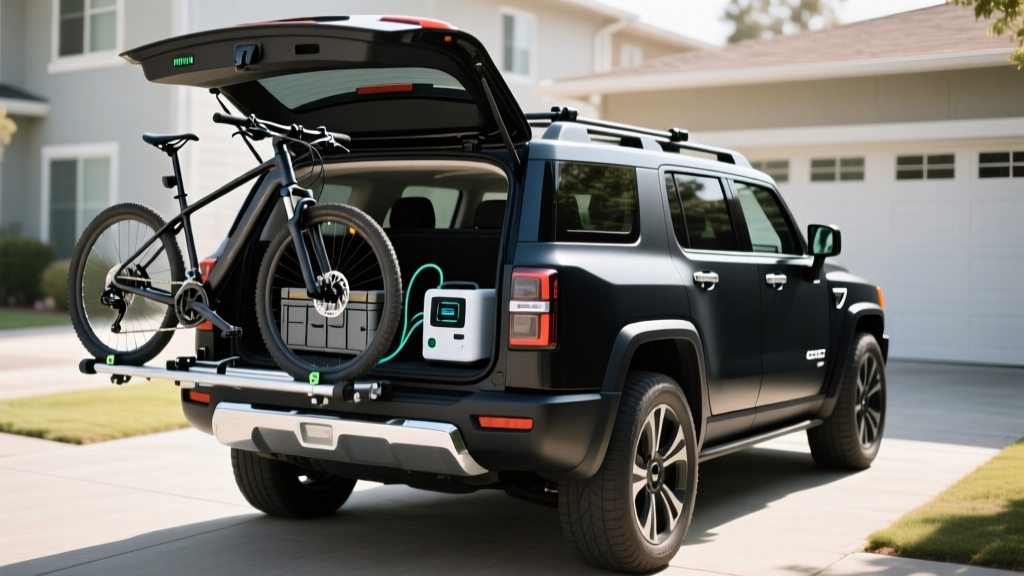
- Hitch-mounted rack (2" receiver): The Hummer EV comes with a 2-inch hitch receiver standard. A platform-style rack (Thule EasyFold, 1Up USA) handles 2–4 e-bikes up to 60–80 lbs each. This is the most range-efficient external option.
- Roof-mounted rack: Possible with aftermarket crossbars on the available roof rail system, but the Hummer EV's height (over 81 inches) makes loading bikes overhead physically challenging and adds significant aerodynamic drag.
- Towing a bike trailer: With an 11,500-lb tow rating, pulling a lightweight enclosed motorcycle/bike trailer (2,000–3,000 lbs loaded) is well within capacity. Range impact is substantial, however.
The 5-foot bed is the Hummer EV's main limitation for cyclists who prefer in-bed transport. If you regularly haul three or more bikes without a rack, a longer-bed truck or a dedicated van may serve better. For one or two bikes, the hitch rack + midgate combo is the sweet spot.
Pricing, Trims, and Federal Tax Credit Eligibility
| Trim | 2026 Base MSRP | §30D Credit Eligible? | Effective Price (if eligible) |
|---|---|---|---|
| 2X (Dual-Motor) | ~$106,400 | No — exceeds $80,000 truck MSRP cap | $106,400 |
| 3X (Tri-Motor) | ~$126,400 | No — exceeds $80,000 truck MSRP cap | $126,400 |
| Edition 1 (sold out) | ~$112,595 | No — exceeds MSRP cap | $112,595 |
This is the hard truth for Hummer EV buyers eyeing the federal §30D clean vehicle credit: the Hummer EV Pickup does not qualify. The IRS caps eligible trucks, SUVs, and vans at an $80,000 MSRP ceiling. Every Hummer EV trim clears that bar by a wide margin. There is no workaround — even the base 2X trim starts above $106,000 before options.
State-level incentives may partially offset the cost. California's CVRP program, Colorado's state EV credit, and various utility rebates can shave $2,000–$7,500 off the purchase or lease price depending on your jurisdiction and income. Check your state's energy office and local utility for current programs, as these change annually and often have their own income caps.
For buyers who need the Hummer EV's capability but want a tax credit, the EPA's fueleconomy.gov database lists qualifying trucks like the Ford F-150 Lightning and Chevrolet Silverado EV, which fall under the MSRP cap in certain trims. Neither matches the Hummer EV's battery size or tow rating, but both can haul bikes competently at a lower entry price.
Performance and Drivetrain: Overkill for the Bike Path, Perfect for the Trailhead
The 3X trim's tri-motor setup produces 830 horsepower and an estimated 1,200 lb-ft of torque, launching the 10,000-pound truck to 60 mph in roughly 3.0 seconds in Watts to Freedom (WTF) launch mode. This is spectacular party-trick performance, but for cyclists, the more relevant metric is low-speed torque control. The Hummer EV's instant electric torque makes creeping up rutted forest service roads to remote trailheads effortless — no gear-hunting, no clutch modulation, just steady, silent crawl.
The available four-wheel steer (CrabWalk) lets the truck move diagonally at low speeds, which is genuinely useful on narrow, obstacle-strewn access roads where you're threading between boulders with bikes on the roof. The 35-inch Goodyear Wrangler Territory tires (standard on 3X) provide aggressive grip without excessive road noise on the highway portion of your drive.
Air suspension is standard and offers adjustable ride height: lower it on the highway for better aero efficiency (and range), raise it for ground clearance on rough access roads. The Extract Mode lifts the truck an additional 6 inches for extreme obstacles — though if you're taking a $130,000 truck with bikes on top through boulder fields, you may want to reconsider your route planning.
Tech, Safety, and Driver Assistance
The Hummer EV runs GMC's latest infotainment system on a 13.4-inch diagonal touchscreen, with a 12.3-inch driver display. For adventure use, the built-in off-road navigation with trail mapping is a standout feature — it shows pitch/roll angles, tire pressure, and torque distribution in real time. Apple CarPlay and Android Auto are wireless, and the available 18-camera UltraView system includes underbody cameras for spotting trail obstacles (or confirming you haven't run over a dropped bike lock).
On the driver-assistance front, Super Cruise — GM's Level 2 hands-free driving system — is available on over 750,000 miles of compatible highways. This is a genuine road-trip asset: on long interstate stretches to distant trailheads, Super Cruise handles steering, acceleration, and braking while you remain attentive (a driver-monitoring camera ensures your eyes stay on the road). It is not autonomous driving — you must stay engaged — but it significantly reduces fatigue on 400-mile drives to remote riding destinations.
Pros and Cons for Bike-Hauling EV Buyers
Pros
- Massive 246 kWh battery provides unmatched range buffer under load
- 11,500-lb tow rating handles any bike trailer with ease
- Standard 2-inch hitch receiver for platform bike racks
- Midgate extends load floor to ~8 ft for in-bed bike transport
- 350 kW DC fast charging (800V) for quick trailhead pit stops
- Super Cruise reduces fatigue on long highway drives to ride destinations
- Air suspension + 4-wheel steer for rough trailhead access roads
Cons
- No federal §30D tax credit — exceeds $80K MSRP cap
- $106,000+ starting price is steep for a bike-hauling rig
- 5-foot bed is short for a full-size truck — limits in-bed bike storage
- ~72 kWh/100 mi efficiency is poor; high charging cost on road trips
- 81+ inch height makes roof-rack loading difficult
- 12–14 hour Level 2 home charge due to enormous pack size
- Real-world range with bikes + towing can drop below 180 miles
Who Should Buy the Hummer EV for Bike Hauling?
The Hummer EV Pickup makes sense as a bike-hauling adventure rig for a narrow but real buyer profile: you want an EV with maximum battery capacity (to absorb the range hit of racks and trailers), you regularly access remote trailheads on rough roads where ground clearance and four-wheel steer matter, and your budget comfortably exceeds $110,000 without relying on a federal tax credit.
If your primary goal is efficient bike transport on paved roads to nearby trail networks, the Ford F-150 Lightning (starting around $55,000, eligible for §30D in qualifying trims) or the Rivian R1T (starting around $75,000, with its innovative Gear Tunnel for enclosed bike storage) are more practical and cost-effective choices. Both tow competently, charge quickly, and offer better efficiency.
The Hummer EV's edge is raw capability and range reserve. No other EV on the market carries a 246 kWh battery, and that translates to a unique ability to haul heavy loads over long distances with fewer charge stops — even if those stops take longer due to the pack's sheer size. For the cyclist who also needs a daily driver, a trail-access vehicle, and a statement piece, the Hummer EV delivers. For everyone else, it's magnificent overkill.
Frequently Asked Questions
What is the real-world range of the GMC Hummer EV with bikes on a rack?
With a hitch-mounted rack carrying two e-bikes, expect roughly 260–285 miles on the highway in mild weather. A roof-mounted rack with bikes creates more aerodynamic drag, reducing range to approximately 200–230 miles. Cold weather and towing will reduce these figures further.
How fast does the Hummer EV charge at home and on the road?
On a 48-amp Level 2 home charger (11.5 kW), expect roughly 17 miles of range per hour, or about 12–14 hours for a full charge. At a 350 kW DC fast charger, a 10–80% session takes approximately 30 minutes, though real-world speeds depend on station availability, battery temperature, and state of charge.
Does the GMC Hummer EV qualify for the federal EV tax credit?
No. Under current IRS §30D rules, trucks must have an MSRP at or below $80,000 to qualify. Every Hummer EV trim exceeds this cap. State incentives and utility rebates may offer partial offsets — check your local programs.
Can the Hummer EV tow a bike trailer?
Yes. The Hummer EV Pickup has an 11,500-lb maximum tow rating. A lightweight enclosed bike trailer loaded with multiple e-bikes typically weighs 2,000–3,500 lbs — well within capacity. However, towing significantly impacts range, reducing it to approximately 150–180 miles depending on weight, speed, and terrain.
Is the Hummer EV worth buying over the Rivian R1T or F-150 Lightning for bikes?
If budget is secondary and you need maximum range reserve, ground clearance for rough trailheads, and unmatched battery capacity, the Hummer EV is unique. For most cyclists, the Rivian R1T's Gear Tunnel (enclosed storage for bikes) or the F-150 Lightning's lower price and tax-credit eligibility make them more practical choices. The Hummer EV is a capability-first truck that happens to haul bikes well — not a purpose-built cycling rig.
What battery chemistry does the Hummer EV use, and how long will it last?
The Hummer EV uses GM's Ultium platform with NMC (nickel manganese cobalt) pouch cells in a double-stacked configuration. GM warranties the battery for 8 years or 100,000 miles against defects and excessive capacity loss (typically defined as dropping below 60–70% of original capacity). NMC chemistry offers high energy density but is more sensitive to sustained 100% charging and extreme heat than LFP cells. For longevity, charge to 80% for daily use and reserve 100% for road trips.