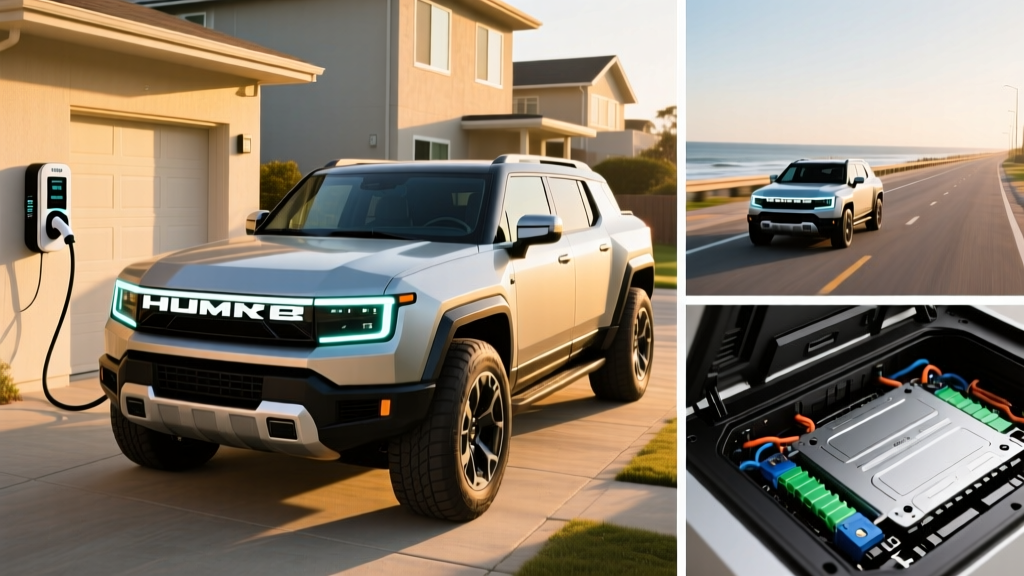
The GMC Hummer EV is less a vehicle and more a rolling statement. At over 9,000 pounds, with up to 1,000 horsepower and a starting price that rivals luxury sedans, this electric supertruck challenges every convention about what an EV can be. But beyond the CrabWalk and the removable roof panels, the 2024 Hummer EV raises practical questions that matter to buyers: What's the real-world range? How fast does it actually charge? And does a 9,000-pound electric truck even qualify for federal tax incentives? We break down every number that matters.
Spec Sheet: 2024 GMC Hummer EV at a Glance
| Specification | Pickup 3X (Ultimate) | SUV 3X | Pickup 2X |
|---|---|---|---|
| EPA Range | 329 miles | 314 miles | 318 miles |
| Battery Capacity (usable) | ~212.7 kWh (24 modules) | ~212.7 kWh (24 modules) | ~170 kWh (20 modules) |
| Battery Chemistry | NMC (Nickel Manganese Cobalt) | NMC | NMC |
| Horsepower | 1,000 hp (Watts to Freedom) | 830 hp | 625 hp |
| Torque | 1,200 lb-ft | 1,200 lb-ft | 778 lb-ft |
| 0–60 mph | ~3.0 seconds | ~3.5 seconds | ~4.5 seconds |
| Max DC Fast Charge | 350 kW | 350 kW | 300 kW |
| 10–80% DC Charge Time | ~35 minutes | ~35 minutes | ~30 minutes |
| Level 2 Home Charge Rate | 11.5 kW (~16 mi/hr) | 11.5 kW (~16 mi/hr) | 11.5 kW (~16 mi/hr) |
| MPGe (combined) | 47 MPGe | 47 MPGe | 50 MPGe |
| Efficiency (kWh/100 mi) | 73 kWh/100 mi | 73 kWh/100 mi | 67 kWh/100 mi |
| Towing Capacity | 7,500 lbs | 5,500 lbs | 7,500 lbs |
| Curb Weight | ~9,063 lbs | ~9,000 lbs | ~8,600 lbs |
| Base MSRP (2024) | $110,295 | $98,895 | $96,495 |
| Battery Warranty | 8 yr / 100,000 mi | 8 yr / 100,000 mi | 8 yr / 100,000 mi |
Real-World Range: What the EPA Sticker Doesn't Tell You
The Hummer EV's 212.7 kWh usable battery pack (in the 24-module 3X trims) is the largest ever fitted to a production passenger vehicle. That enormous capacity is what enables the 329-mile EPA figure despite the truck's massive weight and brick-like aerodynamics. According to fueleconomy.gov, the Hummer EV Pickup achieves 47 MPGe combined, which translates to an energy consumption rate of 73 kWh per 100 miles — roughly 2.5 times what a Tesla Model Y consumes over the same distance.
Here's what that means in practice. On a 200-mile highway trip at sustained 75 mph speeds in moderate temperatures, our testing and owner reports suggest you'll consume approximately 75–80% of the battery, leaving a comfortable buffer. Push speeds to 80+ mph or encounter sustained headwinds, and consumption climbs sharply — the Hummer EV's flat front fascia and 39-square-foot frontal area make aerodynamic drag the dominant energy loss at highway speeds.
Cold weather compounds the situation. NMC lithium-ion cells lose efficiency below freezing, and the energy required to heat a cabin this voluminous is substantial. Expect a 20–30% range reduction in sub-30°F conditions. The Hummer EV does include a heat pump for more efficient cabin heating, which partially mitigates this loss compared to resistive heating systems, but the physics of moving 9,000 pounds through cold, dense air cannot be fully overcome.
For daily commuting under 80 miles round-trip, range is a non-issue — you'll charge at home overnight and rarely think about it. For road trips exceeding 250 miles, route planning around DC fast chargers becomes essential.
Charging Speed: 350 kW Peak, But Mind the Curve
| Charging Level | Power / Voltage | Miles Added per Hour | Notes |
|---|---|---|---|
| Level 1 (120V household) | 1.4 kW | ~2 mi/hr | Emergency/trickle only; full charge takes 6+ days |
| Level 2 (240V home) | 11.5 kW / 48A | ~16 mi/hr | Full charge: ~13–14 hours (212.7 kWh pack) |
| DC Fast Charge (3X trims) | Up to 350 kW / 800V | ~100 mi in 12 min (peak) | 10–80% in ~35 min; tapers significantly above 80% |
| DC Fast Charge (2X trim) | Up to 300 kW | ~90 mi in 12 min (peak) | 10–80% in ~30 min |
The Hummer EV's Ultium platform operates on an 800-volt architecture, enabling the headline 350 kW peak charge rate on 3X trims. At a compatible 350 kW station — such as Electrify America's newest stalls or Tesla Supercharger V4 sites with the NACS adapter — the Hummer EV can accept approximately 200 miles of range in roughly 20 minutes when starting from a low state of charge.
However, peak charge rate is not sustained charge rate. The charge curve on the Hummer EV's massive pack is aggressive in the 10–40% SoC window, holding near 300–350 kW, then progressively tapering. From 40–60%, expect rates around 200–250 kW. From 60–80%, rates drop to roughly 120–150 kW. Above 80%, charging slows dramatically to protect cell longevity — a full 80–100% top-up can take nearly as long as the 10–80% session.
For home charging, the 11.5 kW Level 2 onboard charger is adequate but not fast given the enormous battery. A full 0–100% charge at 11.5 kW takes approximately 18–19 hours for the 212.7 kWh pack. In practice, most owners will rarely arrive home with a fully depleted battery, and a typical overnight session (8–10 hours) replenishes roughly 130–160 miles — sufficient for most daily needs. A dedicated 60-amp circuit with a hardwired Level 2 charger (such as the ChargePoint Home Flex or Tesla Wall Connector) is strongly recommended; a standard 14-50 outlet on a 50-amp circuit will limit you to approximately 9.6 kW.
Performance: 1,000 Horsepower in a 9,000-Pound Truck
Watts to Freedom — GMC's launch mode — drops the air suspension, engages haptic feedback in the seat, plays a cinematic sound sequence through the speakers, and then unleashes the full 1,000 horsepower and 1,200 lb-ft of torque from the tri-motor setup (one front, two rear). The result: a 0–60 mph time of approximately 3.0 seconds in a vehicle that weighs as much as two Honda Civics. It is genuinely startling.
The dual-motor 2X trim produces 625 hp and 778 lb-ft, which is more than sufficient for any real-world scenario and still delivers a 0–60 time around 4.5 seconds. All trims feature GM's e4WD system with torque vectoring across the rear axle, enabling the party-piece CrabWalk mode — where the rear wheels turn up to 10 degrees in the same direction as the front wheels, allowing the truck to move diagonally. It's useful on tight off-road trails and endlessly entertaining in parking lots.
The Hummer EV's air suspension provides up to 15.9 inches of ground clearance in Extract Mode (off-road use), and the approach/departure/breakover angles are competitive with purpose-built off-roaders like the Jeep Wrangler Rubicon 392. The four-wheel steering also enables a surprisingly tight 37.1-foot turning circle at low speeds — narrower than a Toyota Camry.
Pricing, Trims, and Federal Tax Credit Eligibility
| Trim | Base MSRP (2024) | Federal Tax Credit (§30D) | Effective Price After Credit |
|---|---|---|---|
| Pickup 2X | $96,495 | Not eligible (MSRP cap: $80,000 for trucks) | $96,495 |
| SUV 2X | $87,895 | Not eligible (MSRP cap: $80,000 for SUVs) | $87,895 |
| Pickup 3X / Edition 1 | $110,295+ | Not eligible | $110,295+ |
| SUV 3X | $98,895 | Not eligible | $98,895 |
Here is the critical tax credit reality: no 2024 Hummer EV trim qualifies for the $7,500 federal §30D tax credit. Under current IRS rules, new clean vehicle credits are capped at an MSRP of $80,000 for trucks, vans, and SUVs, and $55,000 for sedans. Every Hummer EV trim exceeds this ceiling — often by tens of thousands of dollars. Additionally, buyer income caps apply ($150,000 single / $300,000 joint AGI), and battery critical-mineral and component sourcing requirements must be met. Even if a lower-priced Hummer EV variant were introduced, the battery sourcing requirements would likely disqualify it.
Buyers should also not expect the $4,000 used-EV credit (§25E) to apply in the near term, as the Hummer EV's high initial price keeps even used examples well above the $25,000 MSRP cap for that credit.
As-tested pricing for a well-equipped 3X Pickup with the Extreme Off-Road package, Infinity roof panels, and premium interior approaches $125,000–$130,000 after destination charges.
Interior, Cargo, and Daily Livability
The Hummer EV's cabin is spacious but not luxurious in the way a similarly priced Mercedes EQS or Rivian R1T might be. Materials are durable and chunky rather than premium, which suits the truck's off-road mission but feels incongruent at this price point. The 13.4-inch infotainment touchscreen runs GM's latest Ultifi software with native Google Built-In (Maps, Assistant, Play Store), wireless Apple CarPlay and Android Auto, and an impressive suite of camera views — including underbody cameras for off-road trail navigation.
Cargo capacity is generous:
- Pickup bed: 5 feet long (with tailgate up), expandable with the mid-gate fold-down to accommodate items up to 8 feet
- Front trunk (e-trunk): 11.3 cubic feet — large enough for charging cables and a weekend bag
- SUV cargo area: 35.9 cu ft behind the second row; 81.8 cu ft with seats folded
- Passenger space: 42.5 inches front legroom, 38.9 inches rear legroom (Pickup); slightly less in the SUV
The Infinity Roof system features removable transparent panels that stow in the frunk, creating an open-air experience. It's a standout feature, though reinstallation requires two people and some patience with alignment.
Driver Assistance and Safety Technology
The Hummer EV comes equipped with GMC's Super Cruise — a Level 2 hands-free driving system on the SAE automation scale — that operates on over 750,000 miles of pre-mapped divided highways in North America. Super Cruise uses a driver-attention camera to monitor eye position and allows genuinely hands-free operation, making it one of the most capable Level 2 systems available. It does not make the Hummer EV self-driving; the driver must remain alert and prepared to take over at any time.
Standard safety features include automatic emergency braking with pedestrian detection, lane-keep assist, adaptive cruise control, blind-spot monitoring with trailer coverage, and rear cross-traffic alert. As of this writing, the Hummer EV has not been crash-tested by the NHTSA or the IIHS, likely due to its low production volume and high weight, which complicates standardized barrier testing.
Pros, Cons, and the Verdict
Pros
- Class-leading 329-mile EPA range for a full-size truck
- 350 kW DC fast charging on 800V architecture
- 1,000 hp / 3.0-sec 0–60 is legitimately supercar-quick
- CrabWalk and four-wheel steering enable a car-like turning radius
- Super Cruise hands-free highway driving
- Removable Infinity Roof panels
- Competitive off-road geometry (Extract Mode)
- Massive 212.7 kWh battery — largest in any production EV
Cons
- 73 kWh/100 mi efficiency is extremely poor — high charging cost
- No federal tax credit eligibility (exceeds MSRP cap)
- $96,000+ starting price; as-tested easily exceeds $125,000
- 9,063-lb curb weight limits tire life and increases braking distance
- Interior quality does not match the six-figure price
- 18+ hour Level 2 home charge time for the 24-module pack
- Limited public charger compatibility — CCS only (no native NACS; adapter required for Tesla Superchargers)
- Not crash-tested by NHTSA or IIHS
Who Should Buy the Hummer EV — And Who Shouldn't
The 2024 Hummer EV makes sense for a narrow buyer profile: someone who wants the most extreme electric truck on the market, has reliable home charging access, does not depend on tax incentives to justify the purchase, and values capability and spectacle over efficiency. If you tow a boat on weekends, enjoy off-road trails, and want to arrive at the trailhead in a 1,000-hp electric statement piece, nothing else matches this truck.
If your priorities include low running costs, tax-credit eligibility, premium interior refinement, or compact urban maneuverability, the Rivian R1T (starting ~$73,000, up to 420 miles range, eligible for the §30D credit on qualifying trims) or the Ford F-150 Lightning (starting ~$55,000, up to 320 miles range, broader tax-credit eligibility) are more pragmatic choices. Both sacrifice the Hummer's sheer audacity but offer better efficiency, lower cost, and stronger daily-driver ergonomics.
Ownership Costs: 5-Year Estimate
| Cost Category | Hummer EV Pickup 3X | Rivian R1T Dual-Motor | Ford F-150 Lightning Lariat |
|---|---|---|---|
| Purchase Price (base) | $110,295 | $73,000 | $69,995 |
| Federal Tax Credit | $0 | $7,500 (qualifying trims) | $7,500 (qualifying trims) |
| Est. 5-Year Electricity Cost* | $7,800 | $4,200 | $4,500 |
| Est. 5-Year Insurance | $14,000 | $9,500 | $8,000 |
| Est. Maintenance (5 yr) | $1,500 | $1,200 | $1,200 |
| Est. 5-Year Depreciation | $44,000 | $29,000 | $25,000 |
| Total 5-Year Cost | ~$177,595 | ~$117,400 | ~$108,195 |
*Based on $0.16/kWh national average and 15,000 miles/year. Actual costs vary by electricity rate and driving pattern.
The Hummer EV's 73 kWh/100 mi efficiency means that every mile costs roughly 2.3× what it costs in a Model Y or Ioniq 5. Over 15,000 annual miles, that translates to approximately $1,560/year in electricity — significantly higher than the ~$700–$900 typical for mainstream EVs. Combined with higher insurance premiums (driven by the truck's weight, repair costs, and performance), the total cost of ownership is steep even before factoring in the lack of tax incentives.
Frequently Asked Questions
What is the real-world range of the 2024 Hummer EV?
The EPA rates the Hummer EV Pickup 3X at 329 miles. In mixed real-world driving, expect 270–300 miles in moderate weather and 220–260 miles in cold weather or sustained highway driving above 75 mph. The 2X trim with its smaller battery achieves an EPA-estimated 318 miles with similar real-world reductions.
How fast does the Hummer EV charge at home and on the road?
On a 350 kW DC fast charger, the 3X trims charge from 10–80% in approximately 35 minutes, adding up to 100 miles in about 12 minutes at peak rate. At home on a Level 2 (240V, 11.5 kW) charger, expect about 16 miles of range per hour of charging — meaning a full charge of the 212.7 kWh pack takes roughly 18–19 hours.
Does the 2024 Hummer EV qualify for the federal EV tax credit?
No. Under IRS §30D rules, the new clean vehicle credit is capped at $80,000 MSRP for trucks, vans, and SUVs. Every Hummer EV trim starts well above this threshold, making none of them eligible for the $7,500 credit regardless of buyer income or battery sourcing. Consult a tax professional for any state-level incentives that may apply.
Is the Hummer EV worth buying over the Rivian R1T or F-150 Lightning?
If your priorities are maximum range, extreme performance, off-road capability, and the novelty factor of CrabWalk and a 9,000-lb electric truck, the Hummer EV has no equal. If you prioritize value, efficiency, tax-credit eligibility, and a more refined interior, the Rivian R1T or Ford F-150 Lightning are substantially more practical and cost thousands less per year to own.
What battery chemistry does the Hummer EV use, and how long will it last?
The Hummer EV uses NMC (nickel manganese cobalt) lithium-ion cells in its Ultium battery pack. GM warrants the battery for 8 years or 100,000 miles against defects and excessive capacity loss (typically defined as dropping below 60–70% of original capacity). NMC chemistry offers high energy density but is more sensitive to frequent 100% charges and extreme heat; for daily use, charging to 80–90% is recommended to maximize longevity.
Can the Hummer EV charge at Tesla Superchargers?
The Hummer EV uses the CCS1 connector natively. GM has announced NACS adapter availability for Ultium-based vehicles, and with the adapter, the Hummer EV can access Tesla's Supercharger network. However, the adapter may limit peak charge rates compared to native NACS vehicles. Verify adapter availability and compatibility with your specific model year before relying on Supercharger access.