Quick Answer: How to Winterize an Electric Car
Winterizing an EV means preparing for 15–30% range loss in freezing temperatures, slower DC fast charging until the battery warms, and higher cabin-heating energy use. The core steps are: (1) install or verify a Level 2 home charger so you can precondition while plugged in, (2) switch to winter tires rated for EV torque and weight, (3) enable battery preconditioning in your vehicle's app or navigation settings, (4) check your 12V auxiliary battery, and (5) adjust your route planning to add a 20–25% range buffer for highway trips below 32°F. Unlike gas cars, EVs don't need antifreeze changes or winter fuel blends, but cold chemistry demands smarter charging habits.
Why Cold Weather Hits EVs Harder Than Gas Cars
Internal combustion engines waste roughly 60–70% of fuel energy as heat. In winter, that waste heat is "free" cabin warmth. An electric motor is 85–90% efficient, meaning very little waste heat exists. To keep you warm, an EV must generate heat electrically — pulling directly from the traction battery.
According to fueleconomy.gov, lithium-ion batteries operate optimally between 68–77°F (20–25°C). Below freezing, two things happen simultaneously:
- Increased internal resistance: The electrolyte thickens, slowing ion movement. This reduces both discharge power (acceleration) and charge acceptance (regenerative braking and DC fast charging).
- Cabin heating load: A heat pump system draws 1–3 kW continuously in cold weather; a resistive PTC heater draws 4–6 kW. On a 75 kWh battery, running a PTC heater at 5 kW for a 2-hour highway drive consumes 10 kWh — roughly 13% of usable capacity just for heat.
| Factor | Electric Vehicle (BEV) | Gas Car (ICE) |
|---|---|---|
| Cold-weather range/MPG loss | 15–30% range reduction at 20°F vs 70°F | 10–15% MPG reduction (short trips worse) |
| Cabin heat source | Battery-powered (heat pump or PTC) | Waste engine heat (free once warm) |
| Warm-up time to heat | Instant (electric heat, 10–30 seconds) | 3–8 minutes for engine to warm |
| Idling/pretending energy use | ~1–2 kWh/hour (negligible) | ~0.2–0.4 gal/hour (~$0.70–$1.40) |
| Cold-start reliability | Excellent (no cranking, no fuel gelling) | Moderate (battery cranking amps drop) |
| Fueling/charging speed impact | DC fast charge 20–40% slower until warm | No meaningful change |
| Winter maintenance items | Tires, wipers, washer fluid, cabin filter | Tires, wipers, fluid, antifreeze, oil, belts |
Real-World Range Loss: What the Numbers Actually Show
Not all EVs lose range equally in winter. Vehicles equipped with a heat pump (standard on Tesla Model Y, Hyundai Ioniq 5, Kia EV6, and most 2025+ models) typically lose 15–22% range at 20°F. Vehicles relying on resistive PTC heaters (older Nissan Leaf, some base-trim EVs) can lose 25–35%.
| Vehicle | EPA Range | Heat System | Est. Winter Range | % Loss |
|---|---|---|---|---|
| Tesla Model Y LR (2026) | 320 mi | Heat pump | ~255–270 mi | ~16–20% |
| Hyundai Ioniq 5 LR AWD | 290 mi | Heat pump | ~235–250 mi | ~14–19% |
| Ford Mustang Mach-E ER AWD | 290 mi | Heat pump | ~230–245 mi | ~16–21% |
| Chevrolet Equinox EV RS | 319 mi | Heat pump | ~255–275 mi | ~14–20% |
| Nissan Leaf SV Plus (2024) | 212 mi | PTC heater | ~145–165 mi | ~22–32% |
Highway vs. city matters enormously. City driving with frequent stops lets regenerative braking recover energy (though regen is limited when the battery is cold). Highway driving at 70+ mph in cold, dense air maximizes both aerodynamic drag and heating load — the worst-case scenario.
Common Winter EV Myths vs. Facts
| Myth | Fact |
|---|---|
| "EVs can't handle winter." | Norway, where EVs exceed 80% of new car sales, averages 27°F in winter. Properly equipped EVs with heat pumps and preconditioning perform reliably in sub-zero conditions. |
| "You'll get stranded with no range." | With preconditioning while plugged in and route planning with a 20–25% buffer, winter stranding is rare. EVs also idle indefinitely on battery with heat — a gas car runs out of fuel. |
| "Cold destroys the battery." | Cold temporarily reduces capacity but doesn't cause permanent degradation unless you charge at high DC rates while the battery is frozen. Modern BMS systems prevent this. |
| "Regen braking is dangerous on ice." | Most EVs automatically reduce regen aggressiveness when traction control detects slip. You can also manually set regen to low for icy conditions. |
Your Winter Charging Strategy: Preconditioning Is Everything
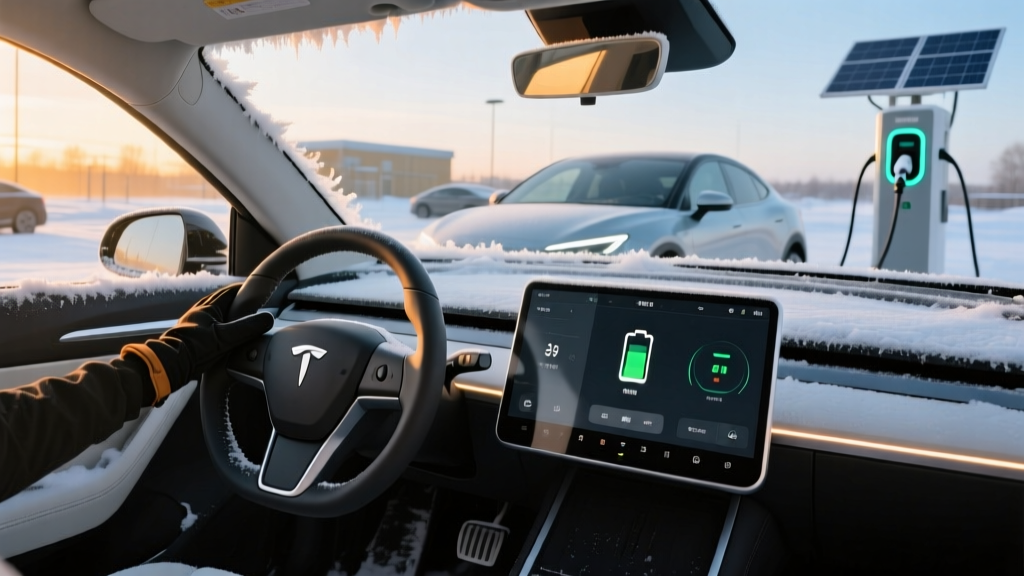
The single most impactful thing you can do is precondition while plugged in. This means warming the battery and cabin using grid power before you leave — not battery power.
How preconditioning works: When you set a departure time in your EV's app or schedule, the vehicle activates its thermal management system 15–45 minutes before departure. It warms the battery pack to ~68–77°F and heats the cabin to your target temperature. Because you're plugged into Level 2 power (typically 7–11.5 kW), this energy comes from the grid, not the battery.
The charging speed payoff is massive. A cold battery at 20°F arriving at a DC fast charger might accept only 40–60 kW initially, even if its peak rate is 230+ kW. A preconditioned battery can hit peak rate within 2–3 minutes. This can mean the difference between a 25-minute and a 50-minute charge stop.
| Condition | Initial Charge Rate | 10–80% Time (250 kW-capable EV) | Energy Added in 20 Min |
|---|---|---|---|
| Battery at 20°F, no preconditioning | 40–70 kW | ~45–55 minutes | ~20–25 kWh |
| Battery preconditioned to 70°F | 200–250 kW | ~18–22 minutes | ~55–65 kWh |
If you don't have home charging, preconditioning becomes harder but not impossible. Most EVs allow you to initiate preconditioning remotely via the app while still plugged into a public Level 2 charger. Plan your day so the car can warm up during the last 20–30 minutes of a public charge session.
The Complete Winter Preparation Checklist
Tires: The Most Important Upgrade
EVs are 500–1,000 lbs heavier than comparable gas cars and deliver instant torque. This combination demands winter tires with adequate load rating and EV-optimized compounds. Look for the Three-Peak Mountain Snowflake (3PMSF) symbol. Popular EV-rated winter tires include the Michelin X-Ice Snow, Bridgestone Blizzak WS90, and Nokian Hakkapeliitta R5 EV.
Cost: $600–$1,200 for a set of four, plus $100–$200 for mounting/balancing. On dedicated wheels (recommended to avoid biannual remounting): add $400–$800 for a wheel set.
Fluids and Wipers
- Washer fluid: Switch to a -30°F rated winter blend. Summer fluid freezes on the windshield.
- Wiper blades: Install winter/beam-style blades that resist ice buildup. Cost: $30–$60.
- Coolant: EV battery thermal systems use specific coolant formulations. Check your owner's manual — most are sealed systems requiring no seasonal change, but verify level.
The 12V Battery: The Hidden Failure Point
Every EV has a standard 12V auxiliary battery that powers electronics, door locks, and the computer that connects the high-voltage traction battery. Cold weather reduces 12V battery cranking capacity by 30–50%. A dead 12V battery will brick your EV just as effectively as an empty traction battery — and you can't jump-start it the traditional way on most models.
Action: Test your 12V battery before winter if it's over 3 years old. Replacement cost: $150–$350. Some EVs (Tesla, Rivian) use a lithium 12V battery with a much longer lifespan.
Winter Ownership Costs: EV vs Gas
Winter shifts the cost equation. Electricity rates stay stable (or decrease slightly with lower demand in some regions), while gasoline prices often rise due to winter-blend fuel requirements. However, the EV's reduced efficiency means higher per-mile energy costs than in summer.
| Cost Category | EV (Home L2 Charging) | Gas Car (28 MPG avg) |
|---|---|---|
| Energy/Fuel | $60–$90 (at $0.14/kWh, ~3.5 mi/kWh winter) | $145–$170 (at $3.20/gal, ~25 MPG winter) |
| Winter tires (amortized/5 months) | $100–$170/mo | $100–$170/mo |
| Maintenance (oil, filters, etc.) | $0–$15 (washer fluid, wipers) | $30–$60 (oil change interval may hit) |
| Cold-start issues/repairs | $0 | $0–$50 (battery, starter strain) |
| Total monthly (winter) | $160–$275 | $275–$450 |
Even with range loss and increased electricity consumption, the EV typically saves $100–$175 per winter month on energy alone. The gap narrows if you rely exclusively on DC fast charging at $0.35–$0.50/kWh, which pushes EV winter fuel costs to $100–$150/month.
Decision Framework: Your Winter EV Readiness
Should You Drive Your EV Through Winter? (Spoiler: Yes — With Prep)
- If you have home Level 2 charging → You're in the best position. Precondition daily, start every trip at 100% SoC, and enjoy instant cabin heat. Your EV will outperform a gas car in cold-start reliability.
- If you rely on public Level 2 only → Plan to precondition at the end of each charge session before driving. Budget 20–30 minutes extra for DC fast stops. Keep your SoC above 40% at all times.
- If you have no reliable charging access → Winter amplifies range anxiety significantly. Consider a PHEV instead, which gives you gas-engine backup when battery range drops. A PHEV like the Toyota RAV4 Prime (42 mi electric range, 38 MPG gas) eliminates the winter charging problem.
- If you regularly drive 200+ miles in sub-zero temps → Choose an EV with a heat pump and 300+ mile EPA range (giving you ~240+ winter miles). Plan charging stops every 180–200 miles to maintain a comfort buffer.
Frequently Asked Questions
Does charging an EV in extreme cold damage the battery?
No — modern battery management systems (BMS) will restrict or refuse charging if the battery is below safe temperature thresholds. The BMS may warm the battery first using grid power before accepting a charge. This is why charging appears slower in cold weather; it's a protective feature, not a defect. Permanent lithium plating damage only occurs if you force high-current charging on a frozen cell, which production EVs prevent.
Should I charge to 100% in winter?
For daily driving, stick to 80–90% to preserve battery longevity (especially on NMC chemistry batteries). For long winter road trips, charging to 100% right before departure is fine and gives you maximum range buffer. LFP chemistry batteries (Tesla Model 3 RWD, some BYD models) can be charged to 100% regularly without degradation concerns — check your owner's manual for your specific chemistry recommendation.
How much does a heat pump actually help?
A heat pump is 2–4× more efficient than a resistive PTC heater. At 20°F, a PTC heater may draw 5 kW to maintain cabin temperature, while a heat pump draws 1.5–2.5 kW for the same warmth. Over a 3-hour highway drive, that's a difference of ~8–10 kWh saved — translating to roughly 25–35 extra miles of range. Heat pumps lose some advantage below 10°F but still outperform PTC heaters.
Can I use a gas-powered cabin heater or auxiliary heater in my EV?
No. EVs have no fuel source for a combustion heater. Some commercial EVs and older models (like early BMW i3 variants) offered an optional gasoline range-extender or diesel heater, but these are not available on modern mass-market EVs. Your options are heat pump, PTC electric heater, heated seats/steering wheel (which use far less energy — typically 100–200W combined), and preconditioning.
What about winterizing a plug-in hybrid (PHEV)?
PHEVs are the easiest electrified vehicles to winterize. The gas engine provides waste heat for the cabin, the smaller battery suffers less range-loss impact on total driving, and you always have the gas tank as backup. Follow the same tire, wiper, and 12V battery advice. Plug in nightly to maximize electric-only miles for short commutes. According to fueleconomy.gov, the Toyota RAV4 Prime delivers 42 miles of electric range, which drops to roughly 32–36 miles in freezing weather — still covering most commutes.
Do I need to worry about my EV's coolant in winter?
EV battery thermal management systems use a glycol-water coolant mix, similar to gas cars. This coolant is typically rated to -40°F and is a sealed, maintenance-free system for 100,000+ miles. Check your owner's manual for the specific service interval. Unlike gas cars, you do not need seasonal coolant flushes — but do verify the reservoir level annually.
Winter EV ownership is not only viable — it's often preferable to a gas car. Instant heat, no cold-start struggles, no frozen fuel lines, and lower operating costs make a well-prepared EV an excellent winter daily driver. The key is respecting the physics: precondition while plugged in, plan for 20–25% range reduction, and invest in proper winter tires. With those steps in place, your EV will handle whatever the season delivers.