Quick Answer: How to Use an Electric Mower
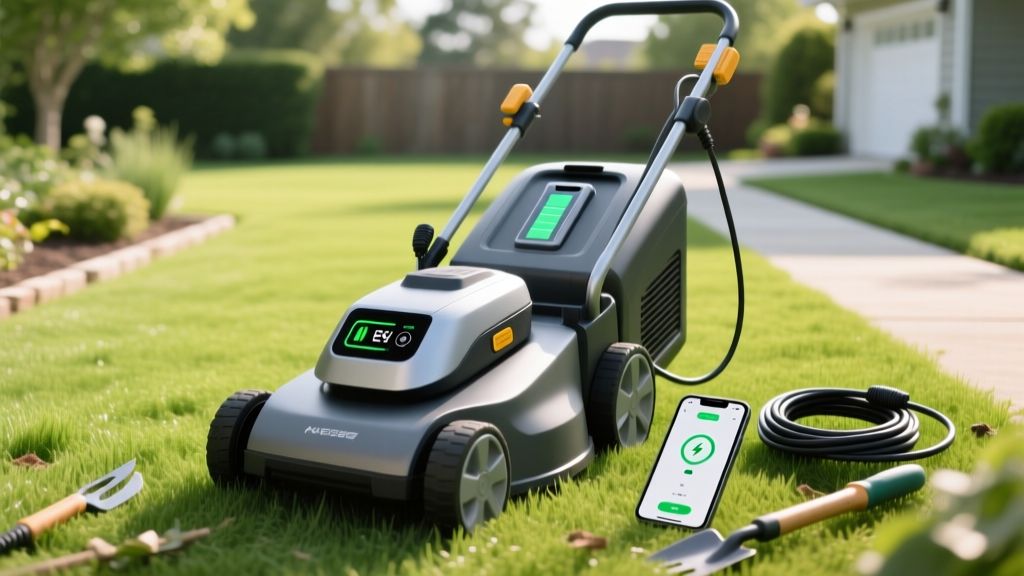
An electric mower runs on a rechargeable lithium-ion battery pack (typically 2.0–12.0 Ah at 40V–82V, yielding 80–976 Wh of stored energy). To use one: insert a fully charged battery, adjust the cutting height (usually 1.5"–4.0" across 5–7 positions), press the safety key and bail lever, and push or engage the self-propel drive. A fully charged 4.0 Ah / 80V battery (320 Wh) typically mows a ¼-acre lot in 35–45 minutes before needing a 60–90 minute recharge on a standard 120V charger. Unlike gas mowers, there is no pull-start, no oil, no spark plug, and no carburetor to maintain — but you must plan around battery runtime and your yard's size.
If you drive an EV, you already understand the core principles behind battery-electric lawn equipment: stored kWh determines your range, charging speed depends on your outlet, and real-world performance depends on terrain, temperature, and load. An electric mower applies the same physics at a smaller scale. This guide translates what you know about electric vehicles into practical mower ownership — with real numbers, cost breakdowns, and a decision framework to help you choose the right setup.
Electric Mower Basics: Battery Specs That Actually Matter
The single most important spec on any electric mower is the battery's watt-hours (Wh), which is the lawn-care equivalent of an EV's kWh battery capacity. Watt-hours determine how long the mower can run before needing a recharge. Here's how to calculate it:
Watt-hours = Volts × Amp-hours (Ah)
For example, an EGO Power+ 56V 7.5 Ah battery stores 420 Wh. A Ryobi 40V 6.0 Ah battery stores 240 Wh. Just as a 75 kWh EV battery gives you more highway range than a 40 kWh pack, a higher-Wh mower battery gives you more cutting time.
| Battery (V × Ah) | Watt-Hours (Wh) | Typical Runtime | Suitable Yard Size |
|---|---|---|---|
| 40V × 4.0 Ah | 160 Wh | 20–25 min | Up to ⅛ acre |
| 40V × 6.0 Ah | 240 Wh | 30–40 min | Up to ¼ acre |
| 56V × 5.0 Ah | 280 Wh | 35–45 min | Up to ⅓ acre |
| 56V × 7.5 Ah | 420 Wh | 50–60 min | Up to ½ acre |
| 56V × 12.0 Ah | 672 Wh | 70–90 min | Up to ¾ acre |
| 82V × 8.0 Ah (Snapper/Commercial) | 656 Wh | 60–75 min | Up to 1 acre |
Real-world caveat: Just as an EV's EPA range drops at highway speeds or in cold weather, mower runtime shrinks in tall or wet grass, on slopes, and in self-propel mode. Expect 15–25% less runtime than marketing claims when cutting thick summer growth. A battery rated for "60 minutes" in ideal conditions may deliver 45 minutes in a dense Bermuda lawn.
Charging Your Electric Mower: Level 1 Is All You Get
Unlike EVs, which offer Level 2 (240V) home charging and DC fast charging on the road, electric mowers charge exclusively from a standard 120V household outlet. The charger draws between 90W and 300W depending on the model. Here's what that means for recharge times:
| Battery Capacity | Charger Power | 0–100% Charge Time |
|---|---|---|
| 160 Wh (40V/4.0 Ah) | ~90W | ~2 hours |
| 280 Wh (56V/5.0 Ah) | ~180W | ~2.5 hours |
| 420 Wh (56V/7.5 Ah) | ~210W | ~3 hours |
| 672 Wh (56V/12.0 Ah) | ~270W | ~3.5–4 hours |
Some brands like EGO offer a rapid charger that cuts charge times roughly in half (a 56V/7.5 Ah battery charges in ~60 minutes instead of ~180 minutes). If you have a large yard requiring two batteries, a rapid charger is worth the $80–$120 premium.
EV owner parallel: Think of the standard mower charger as Level 1 EV charging — slow but adequate when you can charge overnight. The rapid charger is closer to a modest Level 2. There is no DC fast charging equivalent for mowers.
Electric Mower vs. Gas Mower: Cost and Performance Compared
The decision between electric and gas mirrors the EV vs. ICE calculation: higher upfront cost, lower running cost, less maintenance, but constraints around "range" (runtime) and "refueling" (recharging). Here's how the numbers stack up for a typical ¼-acre suburban lawn:
| Cost Factor | Electric (56V, 21" deck) | Gas (160cc, 21" deck) |
|---|---|---|
| Purchase price | $450–$650 | $280–$400 |
| Annual fuel/energy cost | $3–$6 (electricity) | $40–$65 (gasoline at ~$3.50/gal) |
| Annual maintenance | $0 (blade sharpening only) | $30–$50 (oil, air filter, spark plug, winterization) |
| Battery replacement (Year 4–5) | $150–$250 | N/A |
| 5-year fuel + maintenance total | $165–$280 + battery | $350–$575 |
| Noise level | 65–75 dB (conversation level) | 85–95 dB (hearing protection recommended) |
| Emissions at point of use | Zero | CO₂, NOx, unburned hydrocarbons |
The electric mower breaks even against gas in roughly 3–4 years for a ¼-acre yard, even accounting for a mid-life battery replacement. For smaller yards, the gap narrows. For larger yards requiring multiple batteries, the upfront premium grows.
Data source: The EPA estimates that a typical gas lawn mower emits about 11 times the pollution per hour of operation as a modern passenger car (epa.gov). Switching to electric eliminates point-of-use emissions, though upstream electricity generation still matters — the same nuance EV owners already understand.
Real-World Ownership: What First-Time Buyers Should Know
Battery Degradation Is Real
Just like EV traction batteries, mower lithium-ion packs degrade over time and charge cycles. Most mower batteries are rated for 500–1,000 full charge cycles before dropping to 70–80% of original capacity. In practice, that means 4–6 years of typical weekend use before you notice meaningful runtime loss. A battery that once ran 50 minutes may deliver 35–40 minutes by year five.
Cold Weather Cuts Runtime
Lithium-ion batteries perform poorly below 50°F. If you mow in early spring or late fall, expect 15–30% runtime reduction — the same cold-weather penalty EV owners experience. Store and charge batteries indoors at room temperature for best results.
Wet Grass Demands More Power
Cutting wet or overgrown grass forces the motor to draw more current, draining the battery faster. This is the mower equivalent of an EV climbing a mountain pass. Plan to mow when grass is dry, or budget for a second battery.
Self-Propel Eats Battery
Engaging self-propel can reduce runtime by 20–30%. If your yard is flat and under ¼ acre, push mode saves significant energy. On hills or larger lots, self-propel is worth the runtime trade-off — much like using HVAC in an EV.
Common Electric Mower Myths — Fact-Checked
| Myth | Fact |
|---|---|
| "Electric mowers can't cut thick or tall grass." | Modern 56V and 80V brushless motors deliver torque comparable to 140–160cc gas engines. They handle thick fescue and Bermuda, but runtime drops 20–30% under heavy load. |
| "Batteries only last 2 years." | Quality lithium-ion mower batteries (EGO, Ryobi, Milwaukee) typically last 4–7 years with normal use. Most carry a 3-year warranty. |
| "You need solar panels to make it truly green." | Even on a coal-heavy grid, an electric mower uses ~$4/year in electricity for a ¼-acre lot — the upstream emissions are a fraction of burning 5–8 gallons of gasoline annually. |
| "Electric mowers are underpowered." | Brushless motors in 56V+ mowers produce cut quality equal to or better than mid-range gas mowers. The limitation is runtime, not power. |
| "I can use my EV charger for my mower." | Mower batteries use proprietary charging docks, not J1772/NACS/CCS connectors. They charge from a standard 120V outlet via the included charger. |
Decision Framework: Which Electric Mower Is Right for You?
If Your Yard Is Under ⅛ Acre (5,500 sq ft)
A 40V mower with a single 4.0 Ah battery (160 Wh) is sufficient. Expect 20–25 minutes of runtime. Budget: $250–$400. Brands: Ryobi 40V, Greenworks 40V, Craftsman V20.
If Your Yard Is ⅛ to ¼ Acre (5,500–11,000 sq ft)
A 56V mower with a 5.0–7.5 Ah battery (280–420 Wh) is the sweet spot. Expect 35–60 minutes of runtime. Budget: $400–$650. Brands: EGO Power+ 56V, Ryobi 40V HP (brushless), Toro 60V.
If Your Yard Is ¼ to ½ Acre (11,000–22,000 sq ft)
Get a 56V mower with a 7.5–12.0 Ah battery, or buy two 5.0 Ah batteries for swap-and-go mowing. Consider self-propel. Budget: $550–$850 including a second battery. Brands: EGO Power+ with rapid charger, Milwaukee M18 FUEL (if you're in the Milwaukee tool ecosystem).
If Your Yard Is Over ½ Acre
A riding mower or commercial-grade walk-behind becomes more practical. Electric riding mowers exist (Ryobi 48V, EGO 56V Z6 zero-turn) but cost $2,500–$5,000+ and require multiple large batteries. For very large properties, gas or a hybrid approach (electric for trimming, gas for bulk mowing) may still make sense — the same pragmatic calculation that leads some drivers to choose a PHEV over a BEV.
If You Already Own EV-Brand Batteries
Several tool ecosystems cross over to lawn care. If you own a Tesla Powerwall, that doesn't help — but if you own Milwaukee M18, DeWalt 20V MAX, Ryobi ONE+, or EGO 56V tools, buying a mower in the same platform lets you share batteries across drills, blowers, trimmers, and your mower. This is the ecosystem lock-in advantage, similar to how Tesla Supercharger access influenced EV buying decisions.
Cost Breakdown: What You'll Actually Spend
| Item | Cost Range | Notes |
|---|---|---|
| Mower (56V, 21" self-propel) | $450–$650 | Includes one battery and charger |
| Second battery (optional) | $150–$300 | Recommended for yards over ¼ acre |
| Rapid charger (optional) | $80–$120 | Cuts charge time by ~50% |
| Electricity per mowing season | $3–$8 | Based on ~5 kWh/season at $0.16/kWh national avg |
| Blade sharpening/replacement | $15–$30/year | Same as gas mowers |
| Battery replacement (Year 4–6) | $150–$300 | Depends on V/Ah; 3-year warranty typical |
For context, the U.S. Energy Information Administration reports the average residential electricity rate at roughly $0.16/kWh (eia.gov). Mowing a ¼-acre yard all season consumes approximately 4–6 kWh — about $1 worth of electricity. A gas mower covering the same area burns 5–8 gallons of fuel at roughly $3.50/gallon, costing $18–$28 per season. The per-season energy savings are modest in absolute dollars, but they compound over the mower's life.
Frequently Asked Questions
Can I leave my electric mower battery on the charger indefinitely?
Modern lithium-ion mower chargers have auto-shutoff and won't overcharge the battery. However, storing a battery at 100% state of charge for months accelerates degradation — the same principle as EV battery care. For long-term storage (winter), charge to 50–60% and store indoors at 50–70°F. Most manufacturers recommend this in their owner's manuals.
How long do electric mower batteries last before replacement?
Expect 4–7 years of typical residential use (25–35 mowings per year). Most name-brand batteries carry a 3-year warranty with a capacity retention guarantee. Replacement costs $150–$300 depending on voltage and Ah rating. Compare this to an EV battery replacement, which runs $5,000–$20,000 — the scale is different, but the chemistry and degradation physics are identical.
Are corded electric mowers worth considering?
Corded mowers (typically 12–13 amps, drawing 1,440–1,560W from a 120V outlet) offer unlimited runtime and cost $150–$250, but you're tethered to a 100-foot extension cord. They work for flat yards under ⅛ acre where an outlet is accessible. For most buyers, the cord hassle outweighs the savings — similar to why most EV buyers choose battery-electric over a plug-in hybrid with a short cord... er, electric-only range.
Does mowing in mulch mode use more battery?
Mulching requires the blade to cut clippings multiple times, which draws slightly more current than side-discharge or bagging. Expect 5–10% less runtime in mulch mode. The trade-off is free fertilizer and no bag to empty — a net positive for most lawns.
What about electric riding mowers and zero-turns?
Electric riding mowers and zero-turns are available from EGO (Z6, ~$4,000–$5,500), Ryobi (48V, ~$3,000–$4,500), and commercial brands like Mean Green and Stihl. They use multiple large battery packs (totaling 1,500–4,000 Wh) and offer 1–3 hours of runtime. They make sense for ½–2 acre flat properties where noise and emissions matter (residential neighborhoods, early-morning commercial work). For hilly terrain or properties over 2 acres, gas riding mowers still dominate due to runtime and refueling speed.
Can I charge my mower battery from my EV's V2L outlet?
If your EV has a Vehicle-to-Load (V2L) feature — available on the Hyundai Ioniq 5, Kia EV6, Ford F-150 Lightning, and Genesis GV60 — you can plug your mower charger into the V2L outlet (which provides a standard 120V, 15A household socket). A mower charger drawing 200–300W is well within V2L limits. This is useful for mowing at a remote property without grid power, essentially using your EV's 77–131 kWh traction battery as a massive portable power station.
The bottom line: if you've already made the switch to an electric vehicle, an electric mower is the most natural extension of that decision. The technology is mature, the cost math favors electric within 3–4 years, and the maintenance savings are real. The key is sizing your battery correctly for your yard — undershoot, and you'll be frustrated by mid-mow shutdowns; overshoot, and you're carrying weight and cost you don't need. Measure your lawn, pick your ecosystem, and budget for a second battery if you're anywhere near the runtime limit.