The Keyless Question: How Do You Actually Start a Tesla Model 3?
If you've just climbed into a Tesla Model 3 for the first time, you might spend a confused minute looking for a start button, an ignition slot, or even a traditional instrument cluster. There isn't one. The 2026 Tesla Model 3 — now sold in its heavily refreshed "Highland" and subsequent iterations — eliminates every physical control associated with starting a car. No key fob to turn, no button to press, no engine to idle.
So how to start a Tesla Model 3 comes down to three steps:
- Unlock the car using your phone key (Bluetooth), key card (NFC tap on the B-pillar), or optional key fob.
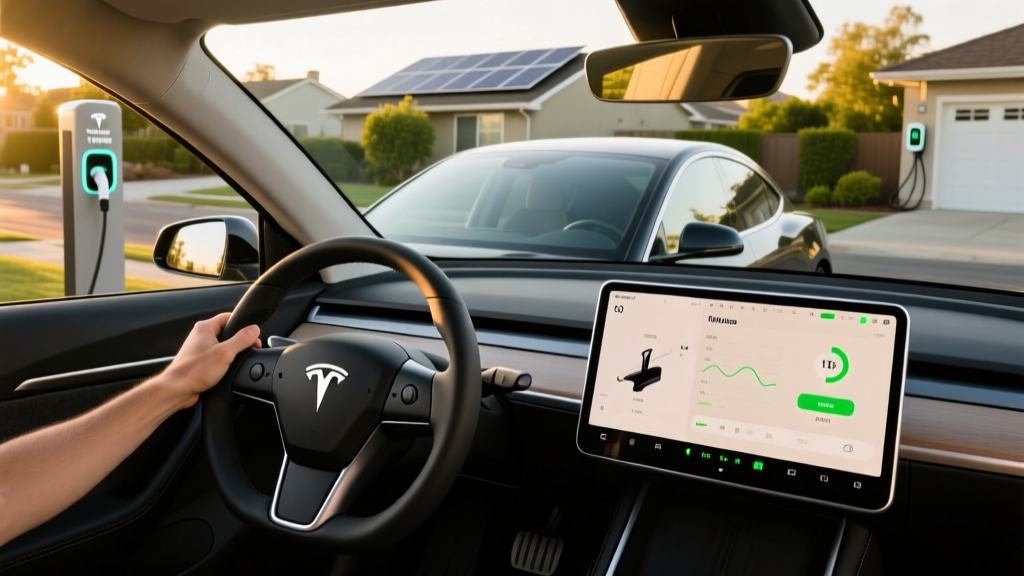
- Sit down and press the brake pedal. The 15.4-inch center touchscreen powers on instantly, the car's systems initialize, and the instrument panel appears on the driver-side portion of the screen.
- Select Drive (D) or Reverse (R) via the right-side steering-column stalk, then release the brake and press the accelerator.
That's it. The car is "on" the moment you press the brake with a valid key authenticated. To "turn off" the Model 3, you simply shift to Park, exit the vehicle, and walk away — it powers down automatically. You can also tap Controls → Safety → Power Off on the touchscreen if you're sitting inside and want to shut systems down manually.
With the starting procedure covered, let's dig into the specs, range, charging, and ownership economics that matter just as much as the keyless experience.
2026 Tesla Model 3: Core Specifications at a Glance
| Specification | Long Range RWD | Long Range AWD | Performance AWD |
|---|---|---|---|
| EPA Range | 363 mi | 341 mi | 315 mi |
| Battery (usable) | ~79 kWh (NMC) | ~79 kWh (NMC) | ~79 kWh (NMC) |
| Drivetrain | Rear-Wheel Drive | Dual-Motor AWD | Dual-Motor AWD |
| Horsepower | ~346 hp | ~440 hp | ~510 hp |
| 0–60 mph | 4.9 sec | 4.2 sec | 2.9 sec |
| MPGe (combined) | 132 MPGe | 125 MPGe | 115 MPGe |
| Efficiency | 25 kWh/100 mi | 27 kWh/100 mi | 29 kWh/100 mi |
| Base MSRP | $38,990 | $43,990 | $52,990 |
| Battery Warranty | 8 years / 120,000 miles (70% capacity retention) | ||
Source: fueleconomy.gov and Tesla's official specifications. Figures reflect 2026 model-year data and may vary by wheel size and options.
Real-World Range vs. the EPA Sticker
EPA estimate: 363 miles (Long Range RWD, 18" wheels)
Real-world highway (70 mph, 75°F): ~290–320 miles
Cold-weather highway (30°F, heater on): ~220–260 miles
City/regenerative driving: ~340–360 miles
The EPA test cycle is generous to EVs because it includes substantial stop-and-go driving where regenerative braking recaptures energy. On a sustained 70–75 mph highway run in moderate temperatures, expect to use roughly 85–90% of the EPA sticker — putting the Long Range RWD around 300–320 miles before you'd want to stop. In freezing conditions with the cabin heater running, energy consumption climbs 25–35%, cutting range to roughly 220–260 miles. The Model 3's heat pump (standard on all 2026 trims) helps mitigate this compared to older resistive-heater EVs, but physics still wins in deep cold.
If your commute is mostly city and suburban with frequent stops, you'll land much closer to — or sometimes above — the EPA number thanks to aggressive regenerative braking on the "Chill" or standard modes.
Charging Speed: DC Fast, Level 2, and Level 1
Tesla's Supercharger network remains the gold standard for public charging reliability, and the 2026 Model 3 takes excellent advantage of it. Here's what to expect across charging levels:
| Charging Level | Power (kW) | Miles Added per Hour | Notes |
|---|---|---|---|
| Level 1 (120V household) | ~1.4 kW | ~3–5 mi/hr | Emergency/trickle only |
| Level 2 (240V home, 48A) | ~11.5 kW | ~44 mi/hr | Full charge in ~7 hours |
| DC Fast Charge (V3 Supercharger) | Peak 250 kW | ~1,000+ mi/hr (peak) | 10–80% in ~25 min |
| DC Fast Charge (V4 Supercharger) | Peak 250 kW | ~1,000+ mi/hr (peak) | Same peak; improved cable/cooling |
Charging-curve reality check: The Model 3 peaks at 250 kW only between roughly 10–30% state of charge. Above 50%, the rate tapers significantly — by 80%, you're pulling around 60–80 kW. This is normal lithium-ion behavior, but it means the advertised "10–80% in 25 minutes" is accurate while a "10–100%" session would take closer to 50–55 minutes. For road trips, plan to charge to 80% and move on — the last 20% is painfully slow.
At home, a Tesla Wall Connector on a 60-amp circuit delivers up to 11.5 kW (48 amps continuous), adding about 44 miles of range per hour. A typical overnight charge from 20% to 80% takes roughly 4–5 hours — more than enough for daily driving. The Model 3 uses the NACS (North American Charging Standard) connector natively, which is now being adopted by Ford, GM, Rivian, and most other automakers, making Tesla's Supercharger network the de facto national fast-charging backbone.
Performance, Efficiency, and Driving Dynamics
The base Long Range RWD Model 3 hits 60 mph in 4.9 seconds with roughly 346 horsepower — quick by any sedan standard. The dual-motor Long Range AWD drops that to 4.2 seconds with 440 hp, while the Performance variant rockets to 60 in 2.9 seconds with approximately 510 hp and includes track-oriented features like a dedicated Track Mode, adaptive dampers, and high-performance brakes.
Efficiency is where the Model 3 truly shines. At 25 kWh/100 miles (Long Range RWD), it's one of the most efficient EVs on the market, translating to 132 MPGe combined per fueleconomy.gov. That efficiency directly reduces your charging costs and extends practical range. For comparison, many competing electric sedans consume 28–32 kWh/100 mi.
The Highland refresh brought substantial improvements to ride quality, cabin noise isolation, and suspension tuning. The 2026 Model 3 is noticeably quieter at highway speeds than pre-2024 models, with ventilated front seats, ambient lighting, and a rear-seat touchscreen as standard equipment.
Interior Space, Cargo, and Tech
Passenger space:
- Front legroom: 42.7 inches
- Rear legroom: 35.2 inches
- Front headroom: 40.3 inches
- Rear headroom: 37.1 inches
Cargo volume: 23 cubic feet (trunk) + approximately 3 cubic feet (frunk), totaling ~26 cu ft. The trunk opening is wide and the 60/40 split-folding rear seats expand capacity for longer items.
The cabin is minimalist by design — some would say stark. The 15.4-inch touchscreen handles virtually every function: climate, mirrors, glovebox, media, navigation, and vehicle settings. There are no physical stalks for turn signals (they're on the steering wheel face) and no traditional gear selector (it's a column stalk). This takes adjustment. Wireless phone charging, a premium 17-speaker audio system, and HEPA air filtration round out the tech package.
Driver assistance: Basic Autopilot (traffic-aware cruise control and lane centering) is standard. Full Self-Driving (Supervised) — which adds automatic lane changes, traffic light/stop sign recognition, and more — is a $8,000 add-on or $99/month subscription. Critical clarification: FSD is SAE Level 2, meaning the driver must remain fully engaged and supervising at all times. It is not autonomous driving.
Pricing, Trims, and Federal Tax Credit Eligibility
| Trim | Base MSRP | Est. As-Tested | §30D Credit Eligibility |
|---|---|---|---|
| Long Range RWD | $38,990 | $40,500–$43,000 | Likely eligible (partial or full) |
| Long Range AWD | $43,990 | $45,500–$48,000 | Likely eligible (partial or full) |
| Performance AWD | $52,990 | $54,500–$58,000 | Likely eligible (partial or full) |
The Model 3 qualifies under the IRS §30D clean vehicle credit rules because it is assembled in Fremont, California, and Tesla has worked to source battery components and critical minerals from FTA-partner nations. However, the credit amount — up to $7,500 — depends on meeting two separate $3,750 requirements: battery component sourcing and critical mineral sourcing. Tesla's sourcing compliance shifts periodically, so verify current status on fueleconomy.gov's tax credit page before purchasing.
Buyer eligibility requirements (2026):
- MSRP cap: Sedans must be under $55,000 — this eliminates the Performance trim from credit eligibility
- Income cap: Modified AGI must not exceed $150,000 (single), $225,000 (head of household), or $300,000 (joint)
- Point-of-sale transfer: You can apply the credit at purchase, reducing your out-of-pocket cost immediately
For the Long Range RWD at $38,990, a qualifying buyer could pay as little as ~$31,490 after the full $7,500 credit — making it one of the best value propositions in the EV sedan segment. Consult a tax professional to confirm your personal eligibility, as rules are subject to change per IRS guidance.
Pros, Cons, and Who Should Buy
✅ Pros
- Class-leading efficiency (25 kWh/100 mi)
- Best-in-class Supercharger network access
- 250 kW DC fast charging, 10–80% in ~25 min
- Over-the-air updates continuously add features
- Strong resale value relative to EV peers
- Excellent safety ratings (IIHS Top Safety Pick+)
- Minimalist interior is spacious for the footprint
❌ Cons
- No physical buttons — everything via touchscreen
- Turn signals on steering wheel face take adaptation
- Rear visibility is limited; rely on cameras
- Panel gaps and paint quality still inconsistent
- FSD ($8,000) remains Level 2, not autonomous
- Insurance premiums run 20–40% above segment average
- No Apple CarPlay or Android Auto
Best for: Daily commuters who can charge at home, tech-forward buyers who appreciate OTA updates, and road-trippers who value the Supercharger network. The Long Range RWD at ~$31,500 after tax credits is the value sweet spot.
Consider alternatives if: You need physical controls, prefer Apple CarPlay, frequently carry rear-seat adults who need more legroom, or want a traditional dealership service experience. The Hyundai Ioniq 6 (361 mi range, CarPlay support) and BMW i4 (more conventional interior, dealer network) are strong competitors.
Frequently Asked Questions
Do I need a key to start the Tesla Model 3?
You need an authenticated key method — either your smartphone (via Bluetooth), an NFC key card, or an optional key fob. Once authenticated, pressing the brake pedal activates all vehicle systems. There is no start/stop button.
What happens if my phone battery dies and I need to drive?
Keep the NFC key card in your wallet as a backup. Tap it on the driver-side B-pillar to unlock, then place it on the center console reader to enable driving. Tesla also provides a one-time PIN code via the app as an emergency unlock method.
Does the Tesla Model 3 qualify for the $7,500 federal tax credit in 2026?
The Long Range RWD and Long Range AWD trims (both under the $55,000 sedan MSRP cap) are expected to qualify for the full or partial §30D credit, assuming the buyer meets income thresholds and battery sourcing requirements are current. The Performance trim at $52,990 is close to the cap and eligibility may vary. Always verify on fueleconomy.gov before purchasing.
How much does it cost to charge a Model 3 at home vs. Superchargers?
At the US average residential electricity rate of ~$0.17/kWh, a full 79 kWh charge costs roughly $13.40 — about $0.04–0.05 per mile. Supercharger rates average $0.25–0.35/kWh depending on location, or roughly $0.07–0.10 per mile. Both are substantially cheaper than a comparable gas sedan at current fuel prices.
How long will the Model 3 battery last?
Tesla warranties the battery for 8 years or 120,000 miles (whichever comes first) with a minimum 70% capacity retention guarantee. Real-world data from high-mileage owners suggests NMC packs in the Model 3 degrade roughly 10–12% over the first 100,000 miles, then slow considerably. Many packs are projected to retain 80%+ capacity at 150,000+ miles.
Is the Tesla Model 3 self-driving?
No. Even with the optional Full Self-Driving (Supervised) package, the Model 3 is an SAE Level 2 driver-assistance system. You must keep your hands on the wheel and eyes on the road at all times. True autonomous driving (Level 4) is currently limited to geofenced robotaxi services like Waymo — not available in consumer vehicles.