Why Sharing Your Tesla Key Matters for Model Y Owners
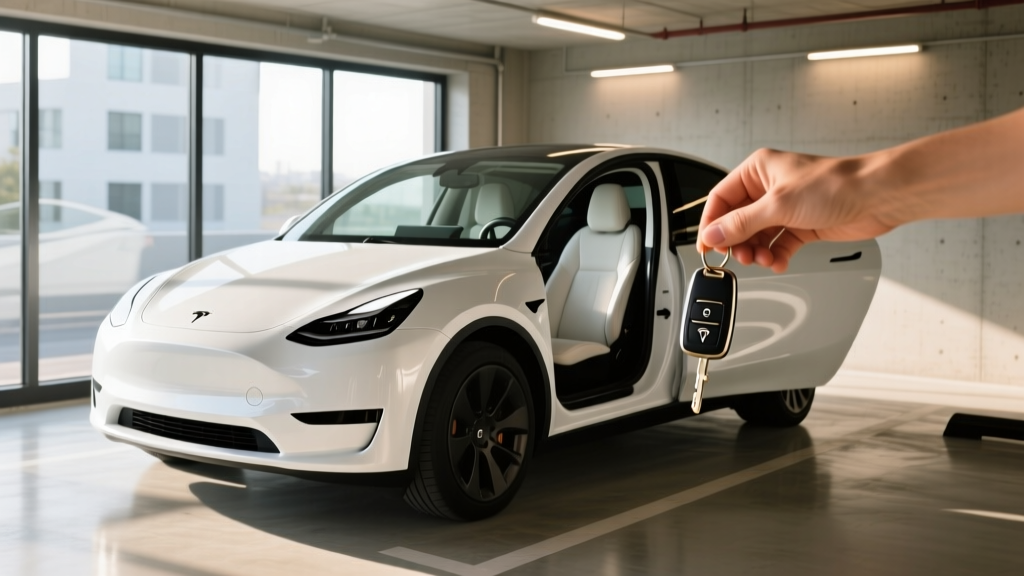
If you own a 2026 Tesla Model Y, one of the first practical questions family members or fleet managers ask is: how to share Tesla key access with other drivers. Unlike traditional vehicles with physical key fobs you can hand off, Tesla relies on a smartphone-as-key system, optional key cards, and the Tesla app for remote access. Understanding the digital key ecosystem is essential before you hand your Model Y over to a spouse, teen driver, or colleague.
This guide walks through the exact steps for sharing key access, then provides a full 2026 Model Y spec profile so you know exactly what vehicle you're granting access to — from EPA range and DC fast-charge speeds to federal tax credit eligibility under current IRS §30D rules.
Step-by-Step: How to Share Tesla Key Access
Tesla offers three methods for granting another driver access to your Model Y. Here's how each works:
Method 1: Add a Driver via the Tesla App (Recommended)
- Open the Tesla app on your phone (the primary owner's account).
- Tap Security → Manage Drivers.
- Select Add Driver and enter the person's name and email address.
- The recipient receives an invitation email. They must download the Tesla app and create or log into their own Tesla account.
- Once accepted, the new driver can use their phone as a key (via Bluetooth proximity) and access climate controls, location, and vehicle status from their own app.
Limit: Tesla allows up to 5 additional drivers per vehicle as of the 2026 software release.
Method 2: Pair a Physical Key Card
Every Model Y ships with two NFC key cards. To pair an additional card:
- Sit in the driver's seat with a paired phone key or existing key card.
- On the touchscreen, go to Controls → Locks.
- Tap the + icon and scan the new key card on the center console reader (behind the cup holders).
- Confirm the pairing. Name the key for easy identification (e.g., "Spouse," "Valet").
Method 3: Remote Unlock via the App
If someone needs one-time access and hasn't been added as a driver, you can remotely unlock the Model Y from anywhere with cellular service. Open the Tesla app → tap Unlock. The doors will unlock for that session, but the car cannot be driven without a paired phone key or key card present.
2026 Tesla Model Y: Real-World Range and Efficiency
The 2026 Model Y (Juniper refresh) continues with two primary battery and drivetrain configurations. Here's what the EPA rates and what you'll actually experience:
Long Range AWD: EPA-estimated 320 miles. Real-world highway driving at 70-75 mph yields approximately 270-290 miles. In sub-freezing temperatures (below 32°F), expect 220-250 miles due to cabin heating demands and battery chemistry limitations.
Rear-Wheel Drive (Standard): EPA-estimated 290 miles. Real-world highway: ~245-265 miles. Cold weather: ~200-225 miles.
Efficiency ratings from fueleconomy.gov place the Long Range AWD at approximately 122 MPGe combined (28 kWh/100 mi), while the RWD variant achieves roughly 128 MPGe combined (26 kWh/100 mi). The RWD model's lighter weight and single motor give it a slight efficiency edge in mixed driving.
Battery, Chemistry, and Charging Speeds
Understanding what's under the floor matters when you're sharing access with drivers who may need to charge independently.
| Spec | Long Range AWD | Rear-Wheel Drive |
|---|---|---|
| Usable Battery Capacity | ~75 kWh (NMC) | ~60 kWh (LFP) |
| Max DC Fast-Charge Rate | 250 kW peak | 170 kW peak |
| 10-80% DC Fast-Charge Time | ~25 minutes | ~30 minutes |
| Level 2 Home Charging (11.5 kW) | ~44 mi/hr | ~44 mi/hr |
| Charge Port | NACS (native Tesla) | NACS (native Tesla) |
LFP vs. NMC — what shared drivers need to know: The RWD Model Y uses a lithium iron phosphate (LFP) battery, which Tesla recommends charging to 100% at least once per week for accurate state-of-charge calibration. The Long Range uses nickel manganese cobalt (NMC) chemistry, which benefits from daily charging limits set to 80-90% to reduce long-term degradation. If you're sharing your Model Y with another driver, communicate which chemistry your trim uses — it affects their daily charging habits.
Charging curve reality: The Long Range's 250 kW peak is only sustained between roughly 10-30% state of charge. From 50-80%, the rate tapers to 80-120 kW. This means a 10-80% session takes ~25 minutes, but a 10-95% session can stretch past 45 minutes. Plan road-trip stops accordingly.
Performance and Drivetrain
| Metric | Long Range AWD | RWD |
|---|---|---|
| Horsepower | ~384 hp (dual motor) | ~295 hp (single motor) |
| 0-60 mph | 4.8 seconds | 6.6 seconds |
| Drivetrain | Dual-motor AWD | Rear-wheel drive |
| Top Speed | 135 mph | 135 mph |
The dual-motor AWD system provides confident traction in rain and light snow, and the instant torque delivery makes highway merging effortless. The RWD variant is perfectly adequate for commuting and fair-weather driving but will feel noticeably slower when fully loaded with passengers and cargo.
Pricing, Trims, and Federal Tax Credit Eligibility
| Trim | Base MSRP | §30D Credit Eligible? | Est. After Credit |
|---|---|---|---|
| Rear-Wheel Drive | $44,990 | Up to $7,500 (if sourcing rules met) | ~$37,490 |
| Long Range AWD | $48,990 | Up to $7,500 (if sourcing rules met) | ~$41,490 |
| Performance (if available) | $52,490 | Up to $7,500 (if sourcing rules met) | ~$44,990 |
IRS §30D tax credit rules for 2026: The Model Y qualifies as an SUV under the IRS MSRP cap of $80,000. However, the full $7,500 credit depends on two sub-requirements that change annually:
- Critical minerals: A percentage of battery minerals must be sourced from the U.S. or a free-trade-agreement country (threshold increases each year through 2026).
- Battery components: A percentage of battery components must be manufactured or assembled in North America (threshold also increases annually).
- Buyer income caps: Modified adjusted gross income must not exceed $150,000 (single), $225,000 (head of household), or $300,000 (joint filers).
Tesla's U.S.-built Model Y has historically met both sourcing requirements, but always verify current-year eligibility on fueleconomy.gov before purchasing. The credit can now be transferred to the dealer at point of sale, reducing your out-of-pocket cost immediately rather than waiting for a tax refund.
Cargo, Interior Space, and Practicality
The Model Y remains one of the most practical compact electric SUVs for families:
- Cargo (behind 2nd row): 30.2 cu ft
- Cargo (2nd row folded): 72.0 cu ft
- Front trunk (frunk): 4.1 cu ft
- Rear legroom: 41.6 inches
- Front headroom: 41.0 inches
- Seating: 5-passenger standard; optional 7-seat (small 3rd row, best for children)
The flat floor and hatchback design make loading strollers, groceries, and luggage straightforward. The optional third row is tight — suitable only for children under about 5'4" on short trips.
Standout Tech and Notable Drawbacks
- Access to Tesla Supercharger network (17,000+ stalls in North America)
- Over-the-air updates continuously add features
- Heat pump standard — efficient cold-weather cabin heating
- Minimalist interior with 15.4" touchscreen
- Standard Autopilot (SAE Level 2 driver assist)
- Phone-as-key system with easy sharing
- No physical buttons — all controls via touchscreen (wipers, glovebox, mirrors)
- Rear visibility is limited; relies heavily on cameras
- FSD (Supervised) costs $8,000 extra and is still SAE Level 2 — not self-driving
- Ride can feel firm on rough pavement vs. competitors
- No Apple CarPlay or Android Auto
- Insurance premiums tend to run 15-25% above segment average
Warranty and Long-Term Ownership
| Coverage | Long Range AWD | RWD (LFP) |
|---|---|---|
| Basic Vehicle | 4 years / 50,000 mi | 4 years / 50,000 mi |
| Battery & Drive Unit | 8 years / 120,000 mi (70% min. retention) | 8 years / 100,000 mi (70% min. retention) |
Tesla's battery warranty guarantees at least 70% capacity retention over the warranty period. Real-world data from high-mileage Tesla owners suggests NMC packs typically retain 85-90% capacity at 100,000 miles when not routinely charged to 100%. LFP packs in the RWD model tend to show even slower degradation due to the chemistry's inherent cycle-life advantage.
Is the 2026 Model Y Worth It vs. Competitors?
Choose the Model Y if: You prioritize Supercharger network access, want OTA software updates, need a practical family EV with strong cargo space, and value the seamless phone-as-key sharing system.
Consider the Hyundai Ioniq 5 if: You prefer 800V ultra-fast charging (10-80% in ~18 min), want physical buttons, or need V2L (vehicle-to-load) capability for powering devices.
Consider the Ford Mustang Mach-E if: You want a more traditional driving feel, prefer BlueCruise hands-free highway driving (on approved roads), or want Apple CarPlay support.
Consider the Chevrolet Equinox EV if: Budget is paramount and you want a lower entry price (~$33,000 base) with adequate 300+ mile range.
Frequently Asked Questions
What is the real-world range of the 2026 Tesla Model Y?
The Long Range AWD achieves an EPA-estimated 320 miles, but expect 270-290 miles in real-world highway driving at 70-75 mph, and 220-250 miles in sub-freezing conditions. The RWD model is EPA-rated at 290 miles with real-world highway expectations of 245-265 miles.
How fast does the Model Y charge at home and on the road?
On a Level 2 home charger (11.5 kW / 48-amp circuit), the Model Y adds approximately 44 miles of range per hour, meaning a full charge from 10% takes about 7-8 hours overnight. On DC fast charging, the Long Range peaks at 250 kW (10-80% in ~25 minutes), while the RWD peaks at 170 kW (10-80% in ~30 minutes). Both use the NACS connector natively, granting direct access to Tesla Superchargers without an adapter.
How much does the 2026 Model Y cost after federal tax credits?
The RWD starts at $44,990 and the Long Range AWD at $48,990. If you meet IRS §30D income caps and the vehicle meets current-year battery sourcing requirements, you may qualify for up to $7,500 — bringing the RWD to approximately $37,490 and the Long Range to approximately $41,490. The credit can be applied at point of sale. Always verify eligibility on fueleconomy.gov and consult a tax professional.
Does the 2026 Model Y qualify for the federal EV tax credit?
The Model Y is classified as an SUV and falls well under the $80,000 MSRP cap. Historically, U.S.-built Model Y vehicles have met critical-mineral and battery-component sourcing requirements. However, these thresholds tighten annually. Buyer income must not exceed $150K (single), $225K (head of household), or $300K (joint). Confirm current-year status on the IRS clean vehicle credit page.
Can I share Tesla key access with someone who doesn't have a Tesla account?
No. The shared driver must create a free Tesla account and download the Tesla app to use their phone as a key. Alternatively, you can lend them one of the physical NFC key cards that ship with the vehicle — no account required for basic lock/unlock/drive functionality via the card.
What happens if I lose my Tesla key card or phone?
If you lose a paired key card, remove it immediately from Controls → Locks on the touchscreen to prevent unauthorized access. If you lose your phone, log into your Tesla account from another device and revoke that phone's access. You can always use the other key card, another driver's paired phone, or remote-unlock via the Tesla app on a different device.