Quick Answer: How Can You Recognize an Electric Vehicle?
You can identify an electric vehicle (EV) by four immediate visual and physical cues: (1) a charging port instead of a fuel filler door, typically on the driver-side front fender or rear quarter panel; (2) the absence of an exhaust pipe; (3) model-specific badges such as "EV," "e-" (e.g., Hyundai Ioniq 5), "EQ" (Mercedes), "bZ" (Toyota), or "Lightning" (Ford F-150); and (4) near-silent operation at low speeds with no engine vibration at idle. Under the hood, a battery electric vehicle (BEV) has no internal combustion engine — instead you'll find a compact electric drive unit and power electronics where an engine block would normally sit.
If you're shopping for your first electrified car or simply trying to tell what's parked next to you at a charging station, knowing how to distinguish a true battery electric vehicle from a hybrid, plug-in hybrid, or conventional gas car is the first step toward making a smart purchase. This guide walks through every identifier — from exterior hardware to spec-sheet details — and then puts real numbers behind the ownership decision.
Exterior Hardware: The Fastest Way to Spot an EV
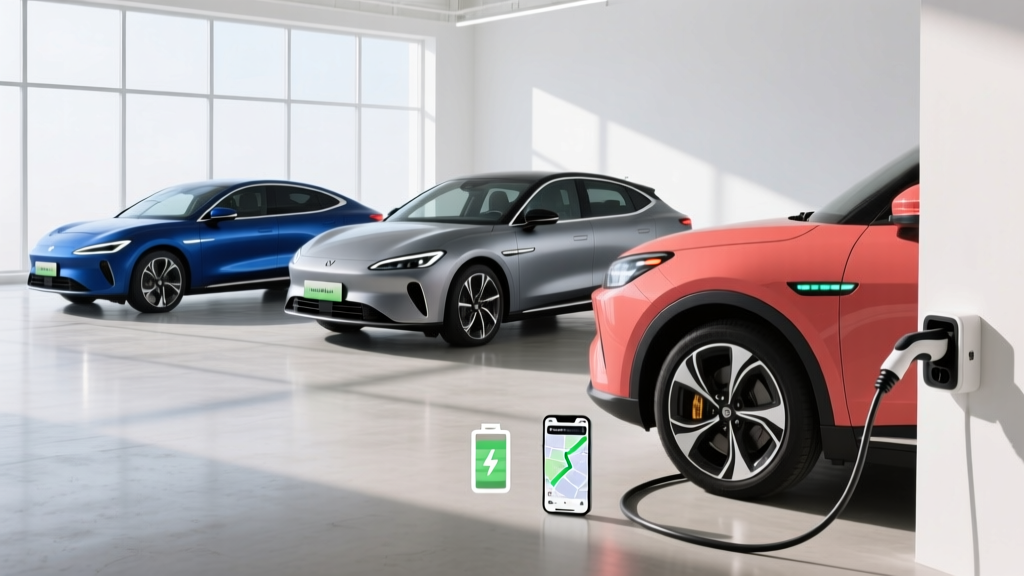
The most reliable physical indicator is the charging port. Every BEV has one, and it looks nothing like a gas cap. In North America, you'll see one of three connector types:
- NACS (North American Charging Standard) — the slim Tesla-originated connector now adopted by Ford, GM, Rivian, Hyundai, Kia, Volvo, and most major automakers for 2025–2026 models.
- CCS1 (Combined Charging System) — the bulkier oval connector still found on older Volkswagen ID.4, BMW i4, and some Stellantis models.
- CHAdeMO — the legacy round connector, now almost exclusively on the Nissan Leaf, which is being phased out.
Gas cars have a fuel filler door; hybrids and PHEVs have both a fuel door and a charging port. A pure BEV has only the charging port — no fuel door anywhere on the body.
The exhaust test is equally definitive. Look under the rear bumper. A BEV has no tailpipe, no muffler, and no exhaust hangers. If you see a chrome or black tip protruding from the rear valance, the vehicle burns fuel in some capacity — it's either a gas car, a conventional hybrid (HEV), or a plug-in hybrid (PHEV).
Badges, Branding, and Model Naming Conventions
Automakers use specific nomenclature to signal electrification. Here's a cheat sheet for current 2025–2026 model-year vehicles:
| Badge / Prefix | Automaker | Example Models | Type |
|---|---|---|---|
| EV / Electric | General Motors, Kia | Cadillac Optiq, Kia EV6, EV9 | BEV |
| Ioniq | Hyundai | Ioniq 5, Ioniq 6, Ioniq 9 | BEV |
| bZ | Toyota | bZ4X, bZ3C | BEV |
| EQ | Mercedes-Benz | EQS, EQB, EQE SUV | BEV |
| i (iX, i4, i7) | BMW | i4, iX, i7 | BEV |
| Lightning | Ford | F-150 Lightning | BEV |
| e- / e-Tron | Audi, Dodge | Audi Q6 e-tron, Dodge Charger Daytona | BEV |
| Plug-In Hybrid / PHEV | Various | Toyota RAV4 Prime, Jeep Wrangler 4xe | PHEV |
| Hybrid / HEV | Various | Toyota Camry Hybrid, Honda CR-V Hybrid | HEV |
If the badge doesn't make it obvious, check the window sticker (Monroney label). A BEV will display kWh (battery energy capacity) and MPGe (miles-per-gallon-equivalent), not MPG. A PHEV will show both an MPGe rating for electric mode and an MPG rating for gas-only operation. A conventional hybrid shows only MPG. According to fueleconomy.gov, the EPA's official source, BEVs typically range from 84 MPGe (large electric trucks) to 146 MPGe (efficient sedans like the Lucid Air).
EV vs Gas vs Hybrid: A Data-Driven Comparison
Recognizing an EV matters because the ownership experience differs fundamentally from a gas car. Here's how the numbers stack up for three popular 2026 models in the compact crossover segment:
| Spec | Hyundai Ioniq 5 SE (BEV) | Toyota RAV4 Prime (PHEV) | Toyota RAV4 LE (Gas) |
|---|---|---|---|
| Powertrain | Single-motor BEV | 2.5L 4-cyl + electric motors | 2.5L 4-cylinder |
| EPA Range / MPG | 303 mi (EPA); ~260 mi real-world highway | 42 mi electric + 38 MPG gas | 30 MPG combined |
| Battery | 84 kWh usable, NMC | 18.1 kWh, NMC | None (12V auxiliary only) |
| Peak DC Charge Rate | 240 kW (10–80% in ~18 min) | N/A (Level 2 only, ~2.5 hrs) | N/A |
| 0–60 mph | 7.4 sec | 5.7 sec | 8.1 sec |
| Horsepower | 225 hp | 302 hp combined | 203 hp |
| Base MSRP | $42,600 | $44,900 | $29,600 |
| Fed. Tax Credit (§30D) | Up to $7,500 (eligibility varies) | Up to $7,500 (eligibility varies) | None |
| Annual Fuel/Energy Cost* | ~$600 (home charging) | ~$900 (mixed electric + gas) | ~$1,800 (gas only) |
| Battery Warranty | 10 yr / 100,000 mi | 10 yr / 150,000 mi | N/A |
*Based on 15,000 mi/yr, $0.16/kWh home electricity, $3.40/gal gas. Source: fueleconomy.gov estimates.
The Ioniq 5's real-world highway range drops to roughly 260 miles at sustained 75 mph speeds, and cold weather (below 30°F) can reduce range by 20–30% due to cabin heating demands and battery chemistry limitations. These are the numbers automakers don't put on the billboard, but they matter for road-trip planning.
Real Ownership Costs: The 5-Year Breakdown
Recognizing an EV on the lot is easy. Recognizing whether it saves you money requires a cost comparison that includes purchase price, energy, maintenance, insurance, and depreciation. Here's a realistic 5-year / 75,000-mile projection:
| Cost Category | BEV (Ioniq 5 SE) | Gas (RAV4 LE) |
|---|---|---|
| Purchase Price (after $7,500 credit) | $35,100 | $29,600 |
| Energy / Fuel (5 yrs) | $3,000 | $9,000 |
| Maintenance (5 yrs) | $1,200 (cabin filter, wipers, tire rotation, brake fluid) | $3,800 (oil, filters, brakes, spark plugs) |
| Insurance (5 yrs avg) | $10,500 (~$2,100/yr) | $7,800 (~$1,560/yr) |
| Estimated Depreciation | $14,000 | $11,500 |
| Total 5-Year Cost | $63,800 | $61,700 |
| Cost Per Mile | $0.85 | $0.82 |
Note: Insurance premiums for EVs run 15–30% higher than comparable gas vehicles due to higher repair costs and battery replacement risk. Tax credit eligibility depends on buyer income limits, vehicle MSRP caps, and battery component sourcing per IRS §30D rules. Always verify with a tax professional.
The BEV breaks even or pulls ahead when: (1) you qualify for the full tax credit, (2) you charge primarily at home on off-peak electricity rates, and (3) you keep the vehicle beyond 5 years, where the maintenance and fuel savings compound.
What a First-Time EV Buyer Must Know Before Purchasing
If you've identified a vehicle as a BEV and you're considering buying it, these practical factors determine whether EV ownership will work for your life:
Home Charging Access Is Non-Negotiable for Most Owners
Over 80% of EV charging happens at home. A Level 2 home charger (240V, 32–48 amps) adds 25–35 miles of range per hour and costs $500–$1,500 for the equipment plus $800–$2,500 for professional installation by a licensed electrician, depending on whether your electrical panel needs an upgrade to 200 amps. If you live in an apartment or lack a dedicated parking spot with outlet access, public charging becomes your primary fueling method — and it costs 2–4× more per kWh than home electricity.
Understand the Charge Curve — Peak kW Is Not Sustained kW
When an automaker advertises "240 kW DC fast charging," that's the peak rate the battery accepts at a low state of charge (typically 10–30%). As the battery fills, the charge rate tapers to protect cell health. A 10–80% session on a 240 kW-capable vehicle takes roughly 18–22 minutes, but 80–100% can take an additional 25+ minutes. Plan road trips around 10–80% charges to minimize stop time.
Cold Weather Reduces Range — Plan for It
Lithium-ion batteries lose efficiency in cold temperatures. At 20°F, expect 20–30% range reduction compared to the EPA sticker. A 303-mile EPA-rated Ioniq 5 may deliver only 210–240 miles in freezing highway conditions. Vehicles with a heat pump (standard on many 2025–2026 Hyundai, Kia, Tesla, and BMW models) mitigate cabin-heating energy draw and recover roughly 5–10% of that lost range.
Common EV Misconceptions — Myth vs. Fact
| Myth | Fact |
|---|---|
| "EV batteries need replacing every 5 years." | Modern NMC and LFP batteries degrade roughly 1–2% per year. Most retain 85–90% capacity at 100,000 miles. Federal law mandates battery warranties of at least 8 years/100,000 miles; Hyundai and Kia offer 10 years/100,000 miles. |
| "EVs are worse for the environment because of electricity generation." | Even on a coal-heavy grid, a BEV produces fewer lifetime emissions than a comparable gas car, according to lifecycle analyses by the Union of Concerned Scientists. On a grid with 40%+ renewables, the advantage is dramatic. |
| "Charging takes too long for road trips." | A 10–80% DC fast charge at 150–250 kW takes 18–30 minutes — roughly the time for a rest stop. Networks like Tesla Supercharger, Electrify America, and EVgo now cover all major US interstate corridors. |
| "All EVs qualify for the $7,500 tax credit." | The §30D credit has MSRP caps ($80,000 for SUVs/trucks, $55,000 for sedans), buyer income limits ($150K single / $300K joint), and battery sourcing requirements that disqualify several models. Check fueleconomy.gov for the current eligible-vehicle list. |
| "EVs are slow." | Electric motors deliver instant torque. The Tesla Model 3 Performance does 0–60 in 2.9 seconds. Even mainstream models like the Ioniq 5 hit 60 mph in under 7.5 seconds — quicker than most gas crossovers. |
Decision Framework: Is an EV, PHEV, or Gas Car Right for You?
Choose a Battery Electric Vehicle (BEV) if:
- You have reliable home Level 2 charging access
- Your daily commute is under 80 miles round-trip
- You take road trips fewer than 6 times per year (or don't mind 20-minute charging stops)
- You qualify for the federal tax credit or state incentives
- You want the lowest per-mile operating cost and minimal maintenance
Choose a Plug-In Hybrid (PHEV) if:
- You want electric-only commuting (typically 30–45 miles) but gas flexibility for road trips
- You can charge at home but lack confidence in public charging infrastructure
- You frequently drive in rural areas or extreme cold where range loss is a concern
- You want to reduce fuel consumption without full EV commitment
Stick with a Gas Vehicle (or conventional HEV) if:
- You have no access to home or workplace charging
- Your budget is under $28,000 and you need the lowest upfront cost
- You regularly tow heavy loads (over 5,000 lbs) over long distances
- You live in an area with sparse public charging infrastructure and extreme winters
How to Verify a Used EV's Battery Health
If you're recognizing an EV in the used market, battery condition is the single most important factor. Request the vehicle's State of Health (SoH) report, which many dealerships and services like Recurrent Auto can provide. An SoH of 90% or above at under 60,000 miles is excellent. Below 80% capacity, the battery may qualify for warranty replacement — check the manufacturer's threshold (most guarantee 70% capacity retention over the warranty period).
Also verify the vehicle's charging history. Frequent DC fast charging above 150 kW accelerates degradation slightly compared to Level 2 home charging. A CARFAX or AutoCheck report can reveal whether the vehicle was primarily fleet-operated (heavy fast-charging use) or individually owned.
Frequently Asked Questions
Can you tell an EV apart from a gas car just by looking at it?
Yes, in most cases. The absence of an exhaust pipe, the presence of a charging port (no fuel filler door), and EV-specific badges or model names are reliable visual identifiers. Some EVs, like the Hyundai Ioniq 5 or Tesla Model Y, have distinctive designs with no front grille, making them immediately recognizable. However, some EVs share body shells with gas counterparts (e.g., Volvo XC40 Recharge vs. gas XC40), so check for the charging port and badge to confirm.
Do all EVs look futuristic or different from normal cars?
No. While some EVs like the Tesla Cybertruck or Hyundai Ioniq 5 have bold, aerodynamic styling, many are designed to look nearly identical to their gas-powered siblings. The BMW i4 looks like a conventional 4 Series Gran Coupe. The Ford F-150 Lightning is visually close to the gas F-150. The distinguishing features are always the charging port, the lack of a tailpipe, and the badge.
How do I know if a vehicle is a BEV, PHEV, or HEV?
A BEV has a charging port and no fuel door. A PHEV has both a charging port and a fuel door — it can run on electricity alone for 25–45 miles before the gas engine kicks in. A conventional HEV (like the Toyota Prius) has a fuel door only and no charging port; it uses regenerative braking to charge a small battery that assists the gas engine but never drives on electricity alone for meaningful distances.
What's the difference between kW and kWh when looking at EV specs?
This is the most common point of confusion. kW (kilowatts) measures power — how fast energy flows, like the flow rate of a gas pump. It determines charging speed and motor output. kWh (kilowatt-hours) measures energy capacity — how much the battery holds, like the size of a gas tank. A vehicle with an 84 kWh battery and a 240 kW peak charge rate can accept energy very quickly but stores a fixed total amount. Think of kWh as your "tank size" and kW as your "pump speed."
Are EVs really cheaper to own than gas cars?
Over a 5–10 year horizon, EVs typically cost less per mile to operate due to cheaper electricity vs. gasoline and dramatically lower maintenance (no oil changes, fewer brake replacements due to regenerative braking, no spark plugs or timing belts). However, the upfront purchase price is higher, insurance premiums run 15–30% more, and depreciation can be steeper. The total cost advantage depends on your annual mileage, electricity rates, tax credit eligibility, and how long you keep the vehicle.