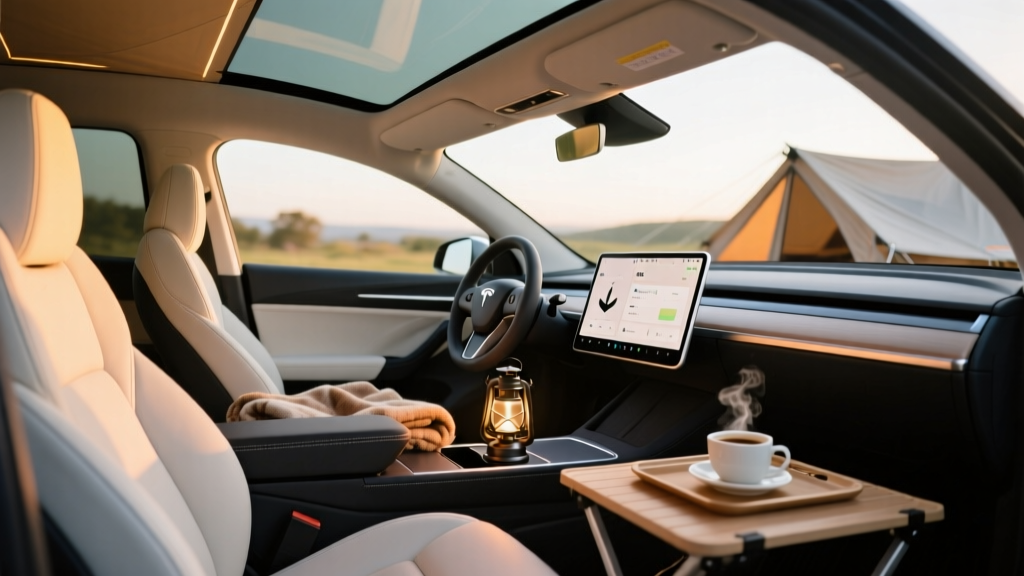
Tesla's Camp Mode is one of the most practical — and underused — software features in any electric vehicle. It turns your Tesla into a climate-controlled, ventilated sleeping pod, maintaining cabin temperature and airflow for hours without the car "falling asleep" on you. Whether you're car-camping in a Model Y, catching a nap at a rest stop in a Model 3, or tailgating in a Model X, knowing how to activate Camp Mode (and what it actually does to your battery) is essential.
Below, we walk through the exact steps to enable Camp Mode on every current Tesla, explain the battery and energy implications, and then dive into a full 2026 spec profile of the Tesla Model Y — the most popular Tesla for camping thanks to its cargo volume and available LFP battery.
How to Put Tesla in Camp Mode: Step-by-Step
Camp Mode is available on every current Tesla model (Model 3, Model Y, Model S, Model X, and Cybertruck) running software version 2022.44 or later. Here's how to activate it:
- Park the vehicle. Camp Mode can only be enabled while the car is in Park.
- Tap the fan icon at the bottom of the touchscreen (the climate control shortcut bar).
- Swipe to "Camp" — you'll see three mode options at the top of the climate panel: On, Camp, and Dog. Tap Camp.
- Set your desired temperature. Tesla recommends 68–72°F for overnight comfort.
- Confirm battery level. Tesla requires at least 15% State of Charge (SoC) remaining to enable Camp Mode. If you're below that threshold, the option will be grayed out.
Once active, Camp Mode maintains cabin temperature, keeps the ventilation system running, and leaves USB ports powered so you can charge devices overnight. The touchscreen stays on (displaying a campfire animation) but can be turned off by tapping the screen and selecting "Close." Audio from media will continue playing if selected.
What Camp Mode Actually Does to Your Battery
Expect Camp Mode to consume roughly 1–2% of battery per hour in mild weather (60–75°F outside). In freezing conditions (below 32°F), consumption can rise to 3–5% per hour as the heat pump works harder. Over an 8-hour night in moderate temps, you'll use approximately 10–16% of your total battery capacity. On a Model Y Long Range with its 75 kWh usable battery, that translates to roughly 30–45 miles of range consumed overnight.
2026 Tesla Model Y: Full EV Profile & Specs
The Model Y remains Tesla's best-selling vehicle and the most popular EV for camping, thanks to its hatchback cargo area that accommodates a full-size mattress with the rear seats folded. For 2026, the Model Y received the "Juniper" refresh with updated styling, a ventilated front row, ambient lighting, and a rear-seat touchscreen.
| Spec | Long Range AWD | Performance |
|---|---|---|
| EPA Range | 320 miles | 298 miles |
| Battery (usable) | ~75 kWh, NMC | ~75 kWh, NMC |
| Drivetrain | Dual-motor AWD | Dual-motor AWD |
| Horsepower | 384 hp | 456 hp |
| 0–60 mph | 4.8 sec | 3.5 sec |
| Max DC Fast Charge | 250 kW | 250 kW |
| 10–80% DC Charge | ~27 min | ~27 min |
| Level 2 Home Charge | 11.5 kW (~44 mi/hr) | 11.5 kW (~44 mi/hr) |
| Efficiency (MPGe) | 111 MPGe combined | 104 MPGe combined |
| Cargo Volume | 76 cu ft (seats folded) | 76 cu ft (seats folded) |
| Base MSRP | $46,630 | $52,130 |
Source: EPA fueleconomy.gov and Tesla.com specifications. Prices reflect 2026 model year before destination fees.
Real-World Range: What the EPA Sticker Doesn't Tell You
EPA sticker: 320 miles.
Real-world highway (70 mph, 72°F): ~270–285 miles.
Real-world highway in winter (30°F): ~220–245 miles.
City driving with regen (65°F): ~300–315 miles.
Camping overnight (8 hrs, 65°F): subtract ~35 miles equivalent.
The Model Y Long Range's 320-mile EPA rating is competitive, but real-world results depend heavily on speed and temperature. At sustained 70 mph highway speeds, expect to lose roughly 10–15% from the EPA figure. Add freezing temperatures and the heat pump's energy draw, and you're looking at a 25–30% reduction. This matters for camping trips: if you're driving 200 miles to a campsite in December and plan to run Camp Mode overnight, you'll want to arrive with at least 50% SoC.
The Model Y uses NMC (nickel manganese cobalt) chemistry in the Long Range and Performance trims, which offers higher energy density than LFP but is more sensitive to prolonged 100% SoC storage. Tesla recommends daily charging to 80% for NMC packs and only charging to 100% when you need full range for a trip.
Charging Speed: DC Fast, Level 2, and Campsite Realities
| Charging Level | Power (kW) | Speed | Notes |
|---|---|---|---|
| Level 1 (120V) | 1.4 kW | ~5 mi/hr | Emergency/trickle only |
| Level 2 (240V, 48A) | 11.5 kW | ~44 mi/hr | Full charge in ~7 hrs |
| DC Fast (V3 Supercharger) | 250 kW peak | ~162 mi in 15 min | 10–80% in ~27 min; tapers above 80% |
| DC Fast (V4 Supercharger) | 250 kW peak | ~162 mi in 15 min | Same peak; improved cable management |
A critical detail for road-trippers and campers: the Model Y's charge curve peaks at 250 kW only between roughly 10–30% SoC. By 50% SoC, power drops to approximately 150 kW, and above 80% it tapers sharply below 50 kW. This means a 10–80% session takes about 27 minutes, but topping from 80–100% can add another 25+ minutes. Plan your Supercharger stops to arrive at low SoC and leave at 80% for the fastest experience.
For camping specifically, many campgrounds offer 240V NEMA 14-50 outlets (the same as a home dryer). With Tesla's Mobile Connector and the NEMA 14-50 adapter, you can charge at up to ~30 miles per hour at your campsite — more than enough to replenish a night of Camp Mode use.
Pricing, Tax Credit, and Total Cost
| Trim | MSRP | Est. §30D Credit | Effective Price* |
|---|---|---|---|
| Long Range AWD | $46,630 | Up to $7,500 | ~$39,130 |
| Performance AWD | $52,130 | Up to $7,500 | ~$44,630 |
*Effective price assumes full §30D credit eligibility. Actual credit amount depends on battery sourcing and critical mineral requirements. See IRS §30D guidelines.
- MSRP cap: SUVs/vans/pickups must be ≤$80,000 — the Model Y qualifies.
- Income cap: Modified AGI ≤$150,000 (single), $225,000 (head of household), $300,000 (joint).
- Battery sourcing: The credit splits into two halves ($3,750 each) — one for critical minerals and one for battery component assembly. Sourcing requirements tighten annually; verify current-year compliance on IRS.gov.
- Point-of-sale transfer: As of 2024+, you can transfer the credit to the dealer at purchase, reducing your out-of-pocket cost immediately rather than waiting for tax filing.
Camp Mode Energy Use & Overnight Comfort by Model
Not all Teslas are equal when it comes to camping. Here's how Camp Mode energy consumption and sleeping space compare across the 2026 lineup:
| Model | Overnight Use (8 hrs, mild) | Cargo (seats down) | Mattress Fit |
|---|---|---|---|
| Model 3 | ~8–12% SoC | 64.9 cu ft | Twin (tight) |
| Model Y | ~10–16% SoC | 76 cu ft | Full/Queen (custom) |
| Model S | ~10–14% SoC | 79.3 cu ft | Full (with platform) |
| Model X | ~12–18% SoC | 88.1 cu ft | Queen |
| Cybertruck | ~12–16% SoC | Bed + cabin | Full (in bed w/ topper) |
The Model Y is the camping sweet spot: enough cargo space for a custom-fit queen mattress platform, efficient enough heat pump to keep overnight energy draw manageable, and the Supercharger network means you're never far from a quick top-up.
Standout Tech & Notable Drawbacks
Pros
- Class-leading Supercharger network access (17,000+ V3/V4 stalls in North America)
- OTA updates continuously add features — Camp Mode itself was added via software
- Heat pump standard on all trims (efficient cold-weather HVAC)
- 76 cu ft cargo space fits a mattress platform for camping
- 250 kW DC fast charging — among the fastest in its price class
- Standard Autopilot (SAE Level 2) for highway driving assist
Cons
- No Apple CarPlay or Android Auto — Tesla's proprietary infotainment only
- Turn-signal stalks removed in Juniper refresh — steering-wheel buttons instead
- Ride quality still firm on rough roads compared to Hyundai Ioniq 5 or Ford Mustang Mach-E
- NMC battery requires 80% daily charge limit (unlike LFP packs you can charge to 100%)
- FSD (Supervised) costs $8,000 extra or $99/mo and remains SAE Level 2 — not autonomous
- No physical buttons for climate — all touchscreen-controlled
Warranty & Long-Term Ownership
Tesla's warranty coverage for the 2026 Model Y:
- Basic vehicle: 4 years / 50,000 miles
- Battery & drive unit: 8 years / 120,000 miles (Long Range & Performance)
- Battery capacity retention: Tesla warrants minimum 70% capacity retention over the warranty period
Real-world degradation data from fleet analyses shows NMC Tesla packs losing roughly 8–12% capacity over the first 100,000 miles, with the steepest drop occurring in the first 20,000 miles before leveling off. If you plan to use Camp Mode frequently, the additional overnight cycling is negligible — a single night of Camp Mode uses roughly 1/10th of a full charge cycle, meaning a year of weekend camping adds only ~5 full equivalent cycles to the battery.
Is the Model Y Worth It for Camping vs. Competitors?
Choose the Tesla Model Y if:
- You want the most mature DC fast-charging network (Superchargers) for remote camping trips
- You value OTA software updates that continuously improve Camp Mode and vehicle features
- You prioritize efficiency — 111 MPGe combined is best-in-class for a dual-motor AWD EV SUV
- You want a proven platform with extensive third-party camping accessories (mattress platforms, window screens, awning kits)
Consider a competitor if:
- Hyundai Ioniq 5: You prefer a more comfortable ride, physical climate buttons, and 800V architecture for faster 10–80% charging (~18 min at 350 kW chargers)
- Ford Mustang Mach-E: You want Apple CarPlay/Android Auto and a more traditional driving feel
- Kia EV6: You need the fastest DC charging in the segment (350 kW capable, 10–80% in ~18 min)
- Rivian R1S: You need true off-road capability and three-row seating for larger families
Frequently Asked Questions
Does Camp Mode drain the Tesla battery significantly?
In mild weather (60–75°F), Camp Mode uses approximately 1–2% of battery per hour, or about 10–16% over an 8-hour night. In freezing weather, consumption can double to 3–5% per hour due to heat pump demand. On a Model Y Long Range with 320 miles of range, a typical summer night costs you roughly 35–50 miles of range.
Can I use Camp Mode while charging at a Supercharger?
Yes. Camp Mode remains active while the vehicle charges. This is useful at destination chargers or campground Level 2 outlets — you can sleep comfortably while the car replenishes its battery overnight.
What's the minimum battery level to enable Camp Mode?
Tesla requires at least 15% State of Charge to activate Camp Mode. If your SoC drops below this threshold while Camp Mode is running, the system will alert you and may shut down climate control to preserve enough energy for driving.
Does the 2026 Model Y qualify for the $7,500 federal tax credit?
The Model Y qualifies for the IRS §30D Clean Vehicle Credit (up to $7,500) if you meet the income cap ($150K single / $300K joint), the MSRP is under $80,000 (it is), and the battery meets current-year critical mineral and component sourcing requirements. The credit can be transferred to the dealer at point of sale. Verify eligibility on IRS.gov before purchasing, as sourcing rules tighten annually.
How does Camp Mode differ from Dog Mode and Keep Climate On?
All three maintain cabin temperature, but they serve different purposes. Camp Mode keeps USB ports powered, allows media playback, and displays a campfire animation — designed for overnight use with occupants inside. Dog Mode displays a message on the screen letting passersby know your pet is safe and the climate is controlled. Keep Climate On simply maintains temperature without the extra features. For camping, Camp Mode is the correct choice.
Is the Model Y's NMC battery a concern for longevity?
NMC batteries offer higher energy density than LFP but are more sensitive to sustained high SoC. Tesla recommends charging to 80% daily and only going to 100% for trips. Real-world data shows NMC packs retaining 88–92% capacity at 100,000 miles. The 8-year/120,000-mile warranty covers you if capacity drops below 70%. For frequent campers, the impact of overnight Camp Mode cycling is minimal — roughly 5 extra full cycles per year of weekend use.
Can I precondition the battery before Supercharging on a camping trip?
Yes — and you should. Set the Supercharger as your navigation destination, and the Model Y will automatically precondition the battery to optimal temperature (roughly 95–105°F) for the fastest charge curve. In cold weather, preconditioning can reduce your 10–80% charge time by 10–15 minutes compared to arriving with a cold battery. This is especially important when camping in mountain or northern regions.
Sources: EPA fueleconomy.gov, IRS §30D Clean Vehicle Credit, Tesla.com official specifications. All pricing and specs reflect 2026 model year at time of publication. Tax credit eligibility varies — consult a tax professional.