Why "How to Open a Tesla" Is One of the Most-Asked EV Questions
If you've ever walked up to a Tesla Model 3 for the first time, you've probably paused at the door. There are no conventional handles, no visible keyholes on most trims, and the interior release is a small thumb button rather than a pull lever. That sleek, flush-door design is a big part of Tesla's minimalist appeal — and also the reason "how to open a Tesla" is one of the most-searched phrases among new owners, ride-share passengers, and curious onlookers.
This guide covers every way to open the 2026 Tesla Model 3 "Highland" refresh from outside and inside, what to do if the 12V auxiliary battery dies, and how the car's child-lock and valet features change the picture. After the door-opening walkthrough, I'll give you the full EV-buyer profile — range, charging, pricing, and whether the 2026 Model 3 is still the default electric sedan to beat.
Every Way to Open a Tesla Model 3 From the Outside
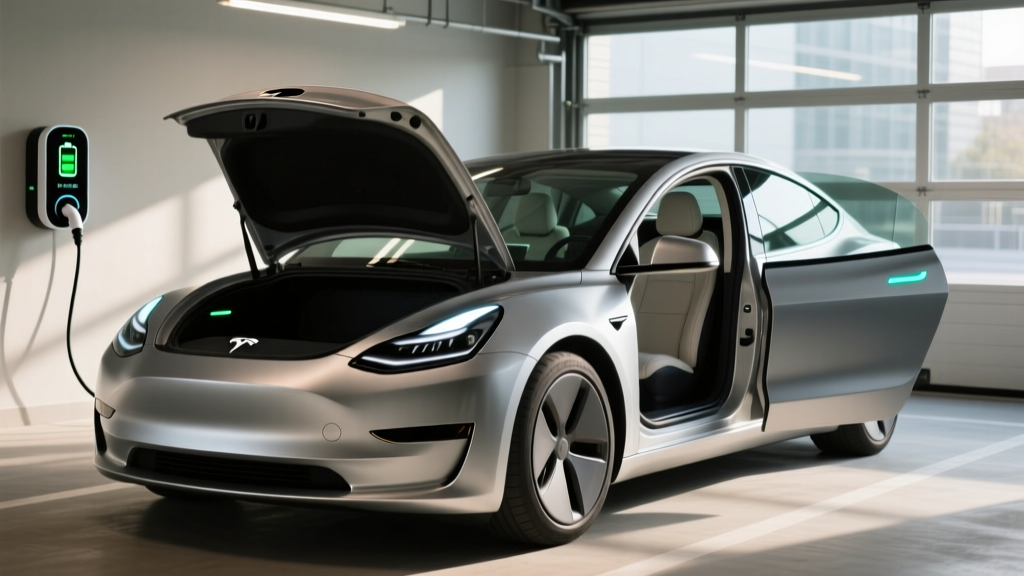
The 2026 Model 3 uses Tesla's second-generation flush door handles. They don't auto-present like a Model S or Model X; instead, you press the wide end of the handle and the narrow end pivots out for you to pull. Here are the legitimate entry methods:
- Phone Key (Bluetooth): With your paired smartphone in your pocket, press the wide side of the handle. The car wakes, unlocks, and the handle pivots out. This is how ~90% of owners enter daily.
- Key Card (RFID): Tap the Tesla key card on the B-pillar just below the driver's window (look for the card icon etched into the trim). The car unlocks; then press the handle as above.
- Key Fob (optional accessory): Press the fob's unlock button, or with the fob in your pocket, press the handle.
- Tesla App Remote Unlock: From the Tesla app, tap Controls → Unlock. Useful when a passenger arrives before you, or when a delivery driver needs trunk access.
- Manual mechanical override: There is no traditional exterior key blade on the 2026 Model 3. If the 12V battery is fully dead and no method above works, Tesla's roadside assistance or a flatbed is the official route — see the dead-battery section below.
Opening the Doors From the Inside — Including the Emergency Release
Inside, each door has a small electronic button at the top of the armrest where a traditional handle would sit. Press it with your thumb and push the door open. This is an electronic release — it signals the latch to open. That matters in two situations:
- Child Safety Locks (rear doors): When enabled in Controls → Locks, the interior electronic button on the rear doors is disabled. You must open rear doors from the outside, or use the mechanical emergency release.
- Emergency Mechanical Release (front doors): Pull the window-switch panel on the door upward to expose a manual pull-cable. This bypasses the electronic latch entirely — essential if the 12V system fails or in a crash scenario. Rear doors have a similar cable behind the armrest trim; the owner's manual shows the exact location.
Frunk, Trunk, and Glovebox: The Other "How to Open" Questions
The Model 3's front trunk (frunk) has no exterior button. Open it from the touchscreen (Controls → Frunk), the Tesla app, or by voice: "Open frunk." The rear trunk opens via the exterior button recessed above the license plate (only works when the car is unlocked or your phone key is detected), the touchscreen, or the app.
The glovebox is software-locked: tap the Controls menu or say "Open glovebox." This is also where you'd configure the PIN to Drive feature, which locks out the drivetrain until a 4-digit code is entered — a meaningful anti-theft layer.
What If the 12V Battery Is Dead? The Recovery Playbook
The 2026 Model 3 uses a 16V lithium-ion auxiliary battery (replacing the old 12V lead-acid in earlier years). It's far more reliable, but it can still go flat from long disuse, a failed DC-DC converter, or extreme cold. When it does, the electronic door handles, phone key, and touchscreen all stop responding.
Step 1 — External 12V jump points: Behind the front bumper's lower tow-eye cover are two metal contact points. Connecting a 12V lithium jump-starter or booster pack here wakes the car enough to unlock the doors and power the electronics. (See Tesla's owner's manual for exact contact locations.)
Step 2 — Once inside: If the main high-voltage pack still has charge, the DC-DC converter will recharge the 12V system automatically. If the HV pack is also depleted, you need a flatbed tow to a Supercharger or service center — never tow a Tesla with wheels on the ground.
Step 3 — Prevention: Sentry Mode, cabin overheat protection, and third-party apps can drain the 12V if the car sits unplugged for weeks. Tesla recommends keeping the car plugged into a Level 2 charger when parked long-term; the car will maintain both batteries.
2026 Tesla Model 3: The Full EV Buyer Profile
Opening the door is the easy part. Deciding whether to buy one requires the numbers. Here are the 2026 Model 3 specs that matter, updated for the current "Highland" generation.
| Spec | RWD (Standard Range) | Long Range AWD | Performance AWD |
|---|---|---|---|
| EPA Range | 363 mi | 346 mi | 315 mi |
| Battery (usable) | ~60 kWh (LFP) | ~75 kWh (NMC) | ~75 kWh (NMC) |
| Drivetrain | Rear-Wheel Drive | Dual-Motor AWD | Dual-Motor AWD |
| Horsepower | 271 hp | 346 hp | 510 hp |
| 0-60 mph | 5.8 sec | 4.2 sec | 2.9 sec |
| Peak DC Charge Rate | 170 kW | 250 kW | 250 kW |
| 10-80% DCFC Time | ~25 min | ~25 min | ~25 min |
| Level 2 Home Rate | 11.5 kW (~44 mi/hr) | 11.5 kW (~44 mi/hr) | 11.5 kW (~44 mi/hr) |
| MPGe (combined) | 132 MPGe | 125 MPGe | 113 MPGe |
| Base MSRP | $38,990 | $45,990 | $53,990 |
Source: fueleconomy.gov and Tesla spec sheets. Prices exclude $1,390 destination fee.
The RWD's 363-mile EPA rating is best-in-class for the segment, but real-world results depend heavily on conditions. Expect ~310-330 miles on mixed suburban driving, ~260-280 miles at sustained 75-mph highway speeds, and ~220-250 miles in sub-30°F winter conditions without preconditioning. The Long Range AWD's 346-mile EPA figure typically delivers ~290 miles highway in mild weather. Always precondition the battery via the Tesla app before a fast-charge stop or cold-weather departure — it recovers meaningful range and charge speed.
Charging the 2026 Model 3: Home, Supercharger, and NACS
Every 2026 Model 3 ships with the native NACS (J3400) charge port — the North American Charging Standard Tesla helped establish and that most rival automakers have adopted. That means direct access to 20,000+ Supercharger stalls without an adapter, plus growing third-party networks (Electrify America, EVgo) now deploying NACS cables.
| Level | Power | Miles Added per Hour | Typical Use Case |
|---|---|---|---|
| Level 1 (120V) | ~1.4 kW | ~5 mi/hr | Emergency / overnight top-up |
| Level 2 (240V, 48A) | 11.5 kW | ~44 mi/hr | Home Wall Connector, full overnight charge |
| DC Fast (V3 Supercharger) | 170-250 kW | ~175 mi in 15 min (Long Range) | Road trips |
Charging-curve reality: The 250-kW peak on Long Range and Performance trims is a brief maximum reached around 15-25% State of Charge (SoC). Above 50%, the rate tapers to ~120 kW, and above 80% it drops sharply to ~40 kW to protect the cells. That's why Tesla (and every other EV maker) quotes 10-80% times rather than 0-100%. The LFP battery in the RWD can be charged to 100% regularly without degradation concerns — a real ownership advantage over NMC, which Tesla recommends keeping at 80% for daily use.
Pricing, Trims, and the Federal Tax Credit (§30D)
| Trim | Base MSRP | As-Tested (typical) | §30D Credit Eligibility |
|---|---|---|---|
| RWD (Standard Range) | $38,990 | $41,380 (+ dest., paint) | Eligible up to $7,500 if buyer + sourcing rules met |
| Long Range AWD | $45,990 | $48,380 | Eligible up to $7,500 if buyer + sourcing rules met |
| Performance AWD | $53,990 | $56,380 | Eligible up to $7,500 if buyer + sourcing rules met |
The §30D tax credit is not automatic. For 2026, the IRS rules (see IRS.gov §30D) require ALL of the following:
- MSRP cap: Sedan MSRP must be ≤ $55,000. The RWD and Long Range qualify; the Performance trim at $53,990 MSRP qualifies, but adding options that push the total above $55,000 can disqualify it — verify on the Monroney sticker.
- Buyer income cap: Modified AGI ≤ $150,000 (single), $225,000 (head of household), $300,000 (joint).
- Battery sourcing: Critical minerals and battery components must meet escalating North American/free-trade-partner thresholds. Tesla's U.S.-built packs have largely met these requirements in recent model years, but the split between the $3,750 critical-minerals half and the $3,750 components half can change mid-year. Confirm the exact credit amount at point of sale.
- Point-of-sale transfer: Since 2024, you can transfer the credit to the dealer at purchase, reducing the cash price by up to $7,500 on the spot — rather than waiting to claim it on your tax return.
With the full $7,500 applied, the RWD Model 3 effectively drops from ~$41,380 out-the-door to ~$33,880 — undercutting most mid-size gas sedans once fuel and maintenance savings are factored in over 5 years.
Who Should Buy the 2026 Model 3 — and Who Shouldn't
Best for: Solo commuters, couples, and tech-forward buyers who want the most efficient, longest-range electric sedan under $50,000. The RWD trim's 363-mile EPA rating and LFP battery (charge it to 100% daily, no stress) make it arguably the best value in the EV market. The Supercharger network remains the most reliable DC fast-charging ecosystem in North America.
Think twice if: You regularly carry rear-seat adults over 6 feet tall (rear legroom is 35.2 inches — adequate but not generous), need more than 23 cu ft of cargo space (the Model Y's hatchback offers 72 cu ft), or prefer physical buttons and Apple CarPlay/Android Auto. Tesla's touchscreen-only interface is still polarizing in 2026, and there is no smartphone mirroring — only native Tesla apps and Bluetooth audio.
- Class-leading 363-mi EPA range (RWD)
- LFP battery: 100% daily charge OK, lower degradation risk
- Native NACS port + Supercharger access
- 250-kW peak DC fast charging (LR/Perf)
- Over-the-air updates add features post-purchase
- Strong resale value vs. legacy EV sedans
- No Apple CarPlay / Android Auto
- Rear-seat space tight for tall adults
- All-screen interface not for everyone
- Insurance premiums ~15-25% above segment average
- Performance trim brushes §30D MSRP cap
- Turn-signal stalks removed (steering-wheel buttons)
Warranty, Ownership Costs, and Long-Term Battery Outlook
Tesla's 2026 warranty package:
- Basic vehicle: 4 years / 50,000 miles
- Battery & drive units: 8 years / 100,000 miles (RWD) or 8 years / 120,000 miles (Long Range, Performance), with a minimum 70% capacity retention threshold during the warranty period.
LFP chemistry in the RWD has shown notably slower degradation than NMC in field data from Recurrent Auto and Tesla's own impact reports — most owners report 90%+ State of Health (SoH) after 100,000 miles. Out-of-warranty battery replacement remains expensive (~$12,000-$16,000 installed), but complete pack failure is rare; individual module service is increasingly available at independent EV shops.
Five-year total cost of ownership, per Edmunds TCO methodology, typically runs $8,000-$12,000 less than a comparable BMW 3 Series or Audi A4 when factoring fuel, maintenance, and the federal credit — even with the higher insurance line item.
Frequently Asked Questions
Can you open a Tesla without a phone or key card?
Not easily. The 2026 Model 3 has no exterior keyhole. You need a paired phone, the RFID key card, the optional fob, or the Tesla app. If all fail and the 12V battery is dead, use the front-bumper jump points with a 12V booster to wake the car, then unlock via the touchscreen.
Is the Tesla Model 3 a good first EV?
Yes, particularly the RWD trim. The 363-mile EPA range eliminates range anxiety for most drivers, home Level 2 charging is straightforward, and the Supercharger network removes road-trip friction. The main adjustment for new EV owners is planning charging around stops rather than refueling en route.
Does the 2026 Model 3 qualify for the full $7,500 federal tax credit?
Most buyers will qualify on the RWD and Long Range trims, provided their modified AGI is under IRS thresholds and the vehicle's battery sourcing meets current-year §30D rules. Verify at the point of sale — credit amounts can shift based on supply-chain sourcing percentages. See IRS.gov for current rules.
How does the Model 3 compare to the Hyundai Ioniq 6 or BMW i4?
The Ioniq 6 offers similar range (up to 361 mi EPA) and a more conventional interior with physical buttons, but uses CCS (with NACS adapter required for Superchargers). The BMW i4 is more luxurious but starts ~$15,000 higher. The Model 3's Supercharger access and software ecosystem remain its strongest differentiators.
What happens if I lock my key card inside the Tesla?
If your phone key is paired and has battery, the car will unlock as you approach. If both are unavailable, use the Tesla app from any browser or phone to remote-unlock. As a last resort, Tesla roadside assistance can verify ownership and unlock remotely.