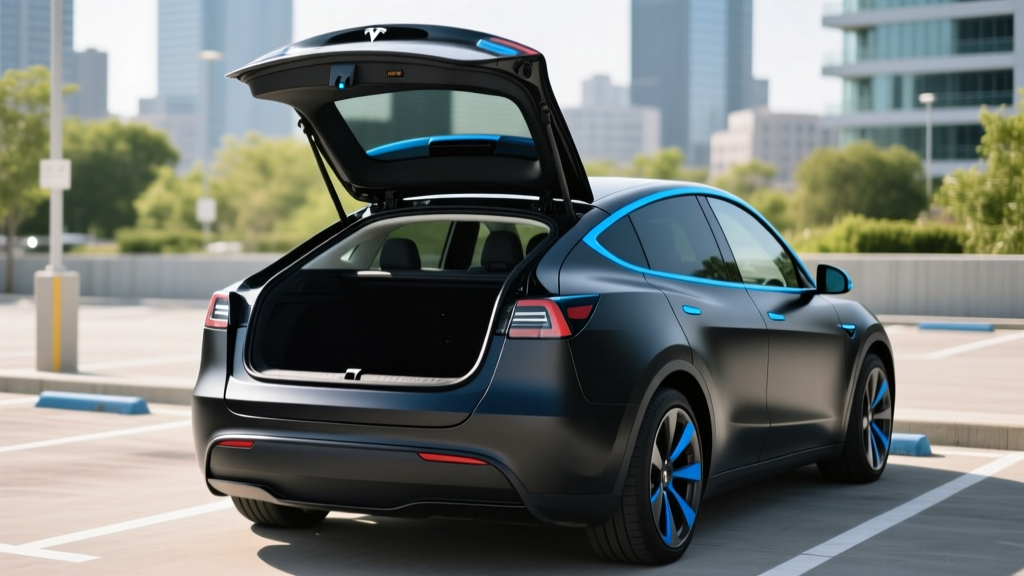
If you've just taken delivery of a Tesla — or you're sitting in a friend's Model Y trying to figure out where the hood release is — you're not alone. Unlike conventional cars, Tesla vehicles have no physical hood latch. The front trunk, or frunk, is opened entirely through software. Below, we walk through every method for opening a Tesla frunk across all current models, then dive deep into a full profile of the 2026 Tesla Model Y, the vehicle most frunk-curious searchers are actually considering.
How to Open the Tesla Frunk: Every Method Explained
Every current-production Tesla — the Model 3, Model Y, Model S, and Model X — uses the same core principle: the frunk latch is electronically actuated. There is no mechanical cable or lever. Here are the methods available to you:
1. From the Touchscreen (Inside the Vehicle)
Tap the car icon at the bottom-left corner of the touchscreen to open the Controls menu. Then tap the "Frunk" button (labeled with a front-car icon). The latch releases with an audible click, and you can lift the frunk lid. On the refreshed Model 3 Highland and 2025+ Model Y Juniper, the controls layout places this button under Controls → Open → Frunk.
2. From the Tesla Mobile App
Open the Tesla app on your phone, select your vehicle, and tap "Controls" at the bottom of the screen. Then tap "Frunk." This works from any distance with cellular connectivity — useful if someone needs to drop something in while you're away from the car. The app sends the command over LTE, so expect a 1–3 second delay.
3. Using Voice Commands
Press the right scroll-wheel button on the steering wheel and say "Open frunk" (or "Open the front trunk"). The vehicle processes this locally and releases the latch. This is the fastest method when you're already seated.
4. From the Key Fob (Model S and Model X)
The Model S and Model X key fob has a dedicated frunk button — press the front section of the fob (the "hood" area) twice. The Model 3 and Model Y key fobs do not have a dedicated frunk button; you must use the app or touchscreen for those models.
5. Emergency Mechanical Release (All Models)
Every Tesla has a hidden mechanical frunk release for situations where the 12V battery is dead. On the Model Y and Model 3, remove the tow-eye cover on the front bumper, pull the emergency release cable (typically a looped wire), and the latch will disengage. On Model S/X, access is through a panel inside the frunk area itself. Consult your specific owner's manual for the exact location — this is a last-resort method and should not be used routinely.
2026 Tesla Model Y: Full EV Profile & Specs
Now that you know how to access that front storage space, let's look at the vehicle most buyers are researching: the refreshed 2026 Tesla Model Y (internally known as the "Juniper" refresh, which began deliveries in early 2025 and carries into the 2026 model year with minor updates).
| Spec | Long Range AWD | Performance |
|---|---|---|
| EPA Range | 320 miles | 298 miles |
| Battery (Usable) | ~78 kWh (NMC) | ~78 kWh (NMC) |
| Max DC Fast Charge | 250 kW (peak) | 250 kW (peak) |
| 10–80% DCFC Time | ~25 minutes | ~25 minutes |
| Level 2 Charge Rate | 11.5 kW (~44 mi/hr) | 11.5 kW (~44 mi/hr) |
| 0–60 mph | 4.8 seconds | 3.5 seconds |
| Horsepower | 384 hp | 456 hp |
| Drivetrain | Dual-Motor AWD | Dual-Motor AWD |
| MPGe (Combined) | 122 MPGe | 111 MPGe |
| Efficiency | 28 kWh/100 mi | 30 kWh/100 mi |
| Base MSRP | $46,630 | $52,130 |
| Federal Tax Credit | Up to $7,500 (§30D) | Up to $7,500 (§30D) |
| Battery Warranty | 8 yr / 120,000 mi | 8 yr / 120,000 mi |
Source: fueleconomy.gov, Tesla.com specifications (2026 model year). Pricing excludes destination fee.
Real-World Range: What to Actually Expect
EPA Sticker: 320 miles
Highway (70 mph, mild weather): ~270–290 miles
Mixed city/highway commute: ~290–310 miles
Cold weather (below 32°F, highway): ~220–260 miles
Cold weather with cabin preconditioning: ~250–280 miles
Tesla's efficiency remains among the best in the EV segment. The Model Y's heat pump (standard on all trims) recovers waste heat from the drivetrain to warm the cabin, reducing the winter range penalty compared to resistive-heater EVs. Still, lithium-ion batteries lose effective capacity in cold temperatures due to increased internal resistance — plan for roughly a 15–25% range reduction in sustained sub-freezing driving.
On a real-world 300-mile highway trip at 75 mph in 65°F conditions, independent testers have consistently recorded between 270 and 290 miles of usable range before the battery reaches 5% State of Charge. For road trips, plan Supercharger stops every 220–250 miles to keep charging sessions short (charging from 10–80% is far faster than pushing to 95%+, where the charge curve tapers sharply).
Charging Speed: DC Fast Charging and Home Setup
The Model Y uses the NACS (North American Charging Standard) connector natively — the same plug used across Tesla's Supercharger network. This is a significant infrastructure advantage: Tesla Superchargers consistently rank highest in reliability among DC fast-charging networks.
| Charging Level | Power (kW) | Miles Added per Hour | Notes |
|---|---|---|---|
| Level 1 (120V household) | ~1.4 kW | ~4–5 mi/hr | Emergency/trickle only |
| Level 2 (240V, 48A Wall Connector) | 11.5 kW | ~44 mi/hr | Ideal home setup; full charge in ~7 hrs |
| Level 2 (240V, 32A Mobile Connector) | 7.7 kW | ~30 mi/hr | Portable; NEMA 14-50 outlet |
| DC Fast (Supercharger V3) | 250 kW peak | ~1,000+ mi/hr (peak) | 10–80% in ~25 min; tapers above 80% |
| DC Fast (CCS adapter at non-Tesla DCFC) | Up to 150–250 kW | Varies by station | Tesla sells a CCS adapter (~$175) |
Understanding the charge curve: The Model Y will peak at 250 kW only when the battery is preconditioned (navigating to a Supercharger triggers automatic thermal preconditioning) and at a low State of Charge (below ~30%). Above 50% SoC, power drops to roughly 150 kW, and above 80% it falls to under 50 kW. This is why the industry standard measurement is 10–80% time — pushing past 80% on a road trip wastes more time per mile added than simply stopping again sooner.
Home charging cost: At the US average residential electricity rate of ~$0.16/kWh, a full 78 kWh charge costs roughly $12.50 — equivalent to about $0.04 per mile. Compare that to a 25 MPG gas SUV at $3.30/gallon ($0.13/mile), and the Model Y saves approximately $9 per 100 miles when charging at home. (Source: EIA)
Interior, Cargo, and Frunk Dimensions
The Juniper-refreshed Model Y offers meaningful improvements to cabin quietness and material quality over the pre-2025 models. Key dimensions:
- Rear cargo (behind 2nd row): 30.2 cu ft (up from 26.6 cu ft pre-refresh)
- Rear cargo (seats folded): 72.1 cu ft
- Frunk volume: 4.1 cu ft — enough for a charging cable kit, a small gym bag, or groceries you want separated from the main trunk
- Front legroom: 41.8 inches
- Rear legroom: 41.6 inches (notably generous for the segment)
- Seating: 5-passenger standard; 7-seat option available on Long Range (reduces cargo space)
The frunk itself is best used for items you access infrequently — the Tesla Mobile Connector, a tire inflator kit, or a small cooler. It is not deep enough for a full-size backpack. If you need maximum enclosed storage, the main trunk with its sub-trunk compartment is the primary cargo area.
Pricing, Trims, and Federal Tax Credit Eligibility
| Trim | Base MSRP | Potential §30D Credit | Effective Price |
|---|---|---|---|
| Long Range AWD | $46,630 | Up to $7,500 | ~$39,130 |
| Performance AWD | $52,130 | Up to $7,500 | ~$44,630 |
| Long Range AWD (7-seat) | $49,130 | Up to $7,500 | ~$41,630 |
Prices exclude $1,390 destination fee. Tax credit eligibility is subject to change.
- Vehicle MSRP cap: SUVs/vans/pickups must be ≤ $80,000 (Model Y qualifies)
- Buyer income cap: Modified AGI ≤ $150,000 (single) / $300,000 (joint) / $225,000 (head of household)
- Battery sourcing: Critical minerals and battery components must meet phased-in domestic/free-trade sourcing thresholds — Tesla has largely met these requirements for US-built Model Y, but verify at purchase via the dealer's IRS compliance report
- Point-of-sale transfer: As of 2024+, you can transfer the credit to the dealer at purchase, reducing the purchase price directly rather than waiting for a tax refund
- One credit per VIN, one vehicle per year per buyer
Always confirm current-year rules at IRS.gov and consult a tax professional. Rules and eligible VIN lists are updated periodically.
Tech, Driver Assistance, and Standout Features
The refreshed Model Y continues to offer one of the most capable — and most debated — tech suites in the EV market:
- Infotainment: 15.4-inch center touchscreen with integrated navigation, streaming (Netflix/YouTube while parked), and over-the-air (OTA) software updates that add features quarterly
- Autopilot (standard): Traffic-aware cruise control and lane-centering — this is SAE Level 2 driver assistance. You must keep your hands on the wheel and eyes on the road at all times.
- Full Self-Driving (Supervised): Optional $8,000 upgrade (or $99/month subscription) adds automatic lane changes, traffic-light recognition, and city-street navigation. Despite the name, this remains SAE Level 2 — the driver is fully responsible. Tesla has not achieved Level 4 autonomy in consumer vehicles.
- Ventilated front seats: New for the Juniper refresh — a meaningful addition for hot climates
- Power-folding 2nd row: Available on select trims, improving cargo flexibility
- HEPA air filtration: Bioweapon Defense Mode with HEPA filter remains standard
Tesla Autopilot and FSD (Supervised) are SAE Level 2 systems. The driver must remain engaged, monitor the road, and be prepared to take over at any moment. These are not "self-driving" systems. Only Level 4 services like Waymo operate without a driver — and those are robotaxi services, not consumer vehicles. (Source: SAE International)
Pros, Cons, and Competitor Comparison
- Class-leading Supercharger network access (17,000+ US stalls)
- Excellent efficiency (122 MPGe combined)
- Spacious rear seat and generous cargo area post-refresh
- Fast OTA updates continuously improve the vehicle
- Strong resale value relative to most EVs
- Heat pump standard — minimizes winter range loss
- No physical buttons — all climate/media controls via touchscreen
- FSD (Supervised) remains Level 2 despite the $8,000 price tag
- Panel gaps and build consistency still trail German/Japanese rivals
- No Apple CarPlay or Android Auto integration
- Insurance premiums run 15–30% higher than comparable gas SUVs
- Frunk is small (4.1 cu ft) compared to some competitors
Key competitors: The Ford Mustang Mach-E (EPA 320 mi, ~$44,995) offers a more traditional cockpit layout and Apple CarPlay. The Hyundai Ioniq 5 (EPA 305 mi, ~$45,500) charges faster on paper (350 kW peak on 800V architecture, 10–80% in ~18 min) but has a smaller cargo area and less mature charging-network access. The Model Y's combination of range, Supercharger infrastructure, and interior space keeps it as the segment benchmark for most buyers — but it is no longer the only strong option.
Who Should Buy the 2026 Tesla Model Y?
Choose the Model Y if:
- You road-trip regularly and want the most reliable DC fast-charging network
- You value OTA software updates that add features over time
- You want a spacious crossover with strong efficiency and good real-world range
- You can install Level 2 home charging (this is essential for any EV ownership experience)
- You refuse to give up Apple CarPlay/Android Auto
- You want physical buttons and a traditional instrument cluster
- You need a frunk larger than a gym bag (consider the Ford F-150 Lightning's massive frunk)
- Your budget is under $40,000 even after tax credits
Frequently Asked Questions
Can I open the Tesla frunk if the car is off or the battery is dead?
If the car is powered off but the 12V battery still has charge, you can open the frunk via the Tesla app (the car's cellular modem draws from the 12V battery). If the 12V battery is completely dead, you must use the emergency mechanical release cable located behind the front bumper tow-eye cover. This is why keeping a portable 12V jump pack in the main trunk is a sensible precaution.
Does the Model Y frunk have a drain?
No. The Model Y frunk does not have a drain plug. If you store wet items or use it as a cooler, place a liner or towel inside. Water that accumulates must be wiped out manually. Some owners install aftermarket silicone frunk liners for easier cleanup.
Is the Tesla Model Y eligible for the $7,500 federal tax credit in 2026?
As of this writing, the US-built Model Y qualifies for up to $7,500 under IRS §30D, provided the buyer meets income caps ($150K single / $300K joint) and the vehicle meets battery-sourcing requirements. Tesla provides a VIN-specific eligibility report at the point of sale. You can transfer the credit to the dealer for an immediate price reduction. Always verify current rules at IRS.gov before purchasing.
How much cargo can the Model Y actually hold?
With the rear seats up, you get 30.2 cu ft — enough for four carry-on suitcases plus a stroller. Fold the rear seats and you have 72.1 cu ft, competitive with a midsize gas SUV. The 4.1 cu ft frunk is best reserved for charging cables and small items.
What is the real-world range of the 2026 Model Y on a road trip?
Expect 270–290 miles at sustained highway speeds (70–75 mph) in mild weather. In winter conditions, plan for 220–260 miles. Always charge to 80% at Superchargers for the fastest session times — the charge curve slows dramatically past 80%.
Does the Model Y have Apple CarPlay?
No. Tesla uses its proprietary infotainment system exclusively. There is no Apple CarPlay, Android Auto, or any third-party phone-mirroring protocol. Navigation, music, and calls are handled natively through the Tesla interface or via Bluetooth audio.