Quick Verdict: Is the 2026 Tesla Model Y Still the EV to Beat?
The Tesla Model Y remains the best-selling electric vehicle in the United States for good reason: it pairs a usable 310-mile EPA range with the most reliable public charging network in the country. But "how to make a Tesla" work for your daily routine depends on understanding its real-world limits — not just the sticker specs. This 2026 guide walks through the exact numbers on range, charging, pricing, and tax-credit eligibility so you can decide whether the refreshed Model Y (codenamed Juniper) earns a spot in your driveway or whether a rival like the Hyundai Ioniq 5 or Ford Mustang Mach-E better fits your needs.
| Spec | Value |
|---|---|
| EPA Range | 310 miles |
| Battery (usable) | ~75 kWh, NMC (2170 cells) |
| Peak DC Fast Charge | 250 kW (V3 Supercharger) |
| 10–80% DC Charge Time | ~27 minutes |
| Level 2 Home Charge Rate | 11.5 kW / ~44 mi/hr |
| 0–60 mph | 4.8 seconds |
| Horsepower | 384 hp (dual motor) |
| Drivetrain | Dual-motor AWD |
| MPGe (combined) | 111 MPGe |
| Efficiency | 30 kWh/100 mi |
| Cargo (rear seats up) | 30.2 cu ft |
| Cargo (rear seats folded) | 72.1 cu ft |
| Rear Legroom | 41.6 in |
| Battery Warranty | 8 years / 120,000 miles |
| Base MSRP | $44,990 |
Real-World Range: What the EPA Number Doesn't Tell You
The EPA rates the 2026 Model Y Long Range AWD at 310 miles. That figure assumes a blended mix of city and highway driving at moderate temperatures. In practice, your mileage will vary — sometimes significantly.
- City / moderate climate: 295–315 mi (regen braking recovers energy in stop-and-go traffic)
- Highway at 70 mph: 260–280 mi (aerodynamic drag dominates at sustained speed)
- Cold weather (below 32°F): 215–250 mi (battery chemistry slows; cabin heating draws power)
- Towing (1,500-lb trailer): ~175–200 mi (expect roughly 40% range reduction)
The Juniper refresh improved thermal management with a standard heat pump across all trims, which helps mitigate winter losses compared to older Model Y variants. Still, if you live in the upper Midwest or Northeast and regularly drive 200+ miles in January, plan your charging stops accordingly.
According to fueleconomy.gov, the Long Range AWD achieves 111 MPGe combined. That translates to roughly 30 kWh per 100 miles — competitive with the Ioniq 5 (32 kWh/100 mi) but slightly thirstier than the single-motor RWD Model Y, which posts 122 MPGe.
Charging Speed: Supercharger Network vs. Home Level 2
Understanding how to make a Tesla charge efficiently means knowing the difference between kW (power — how fast energy flows) and kWh (energy — the battery's total capacity). The Model Y's 75 kWh battery fills at different rates depending on your charging method.
| Level | Power | Miles Added per Hour | Typical Use Case |
|---|---|---|---|
| Level 1 (120V outlet) | ~1.4 kW | ~3–4 mi/hr | Emergency / overnight trickle |
| Level 2 (240V, 48A Wall Connector) | 11.5 kW | ~44 mi/hr | Daily home charging (7–8 hrs for full charge) |
| DC Fast (V3 Supercharger) | Peak 250 kW | ~1,000 mi/hr (at peak) | Road trips: 10–80% in ~27 min |
| DC Fast (V4 Supercharger) | Peak 250 kW* | ~1,000 mi/hr (at peak) | Newer stations; same vehicle-side limit |
*The Model Y Juniper is limited to 250 kW on the vehicle side. V4 Supercharger posts capable of higher output will not charge this vehicle faster than V3 posts.
Charging curve reality: The 250 kW peak only holds between roughly 10–30% state of charge. From 30–60%, expect sustained rates around 150–175 kW. Above 80%, the car tapers aggressively to protect the NMC cells — charging from 80–100% can take as long as the 10–80% session. For road trips, plan to leave chargers at 80% unless you need every last mile to reach your destination.
Preconditioning matters. If you navigate to a Supercharger using the car's built-in navigation, the battery will warm itself to optimal temperature before you arrive, enabling peak charge rates even in cold weather. Arriving at a Supercharger without preconditioning (e.g., using a third-party app or driving to a charger not in the nav system) can reduce peak charge speed by 30–50% in winter.
Performance and Driving Dynamics
The Long Range AWD pairs dual permanent-magnet motors producing a combined 384 horsepower. The 0–60 mph sprint takes 4.8 seconds — quick enough for confident highway merging and passing, though the Performance trim (not reviewed here) drops that to 3.5 seconds at the cost of some range.
Ride quality in the Juniper generation improved noticeably over the pre-2025 Model Y, with revised damper tuning and acoustic glass reducing cabin noise. The steering remains precise but artificially weighted — a common Tesla trait. Regenerative braking is strong enough for one-pedal driving in most conditions, though Tesla removed the user-adjustable regen setting; it's now always-on at a fixed level.
Driver assistance: Every Model Y ships with Tesla's Basic Autopilot (adaptive cruise + lane centering). Full Self-Driving (Supervised) remains a SAE Level 2 system — meaning the driver must remain fully engaged with hands on the wheel and eyes on the road at all times. Despite the name, FSD does not make the car autonomous. It handles highway interchanges and some city streets impressively, but requires constant supervision and can make unpredictable decisions at construction zones or unusual intersections.
Interior, Cargo, and Daily Practicality
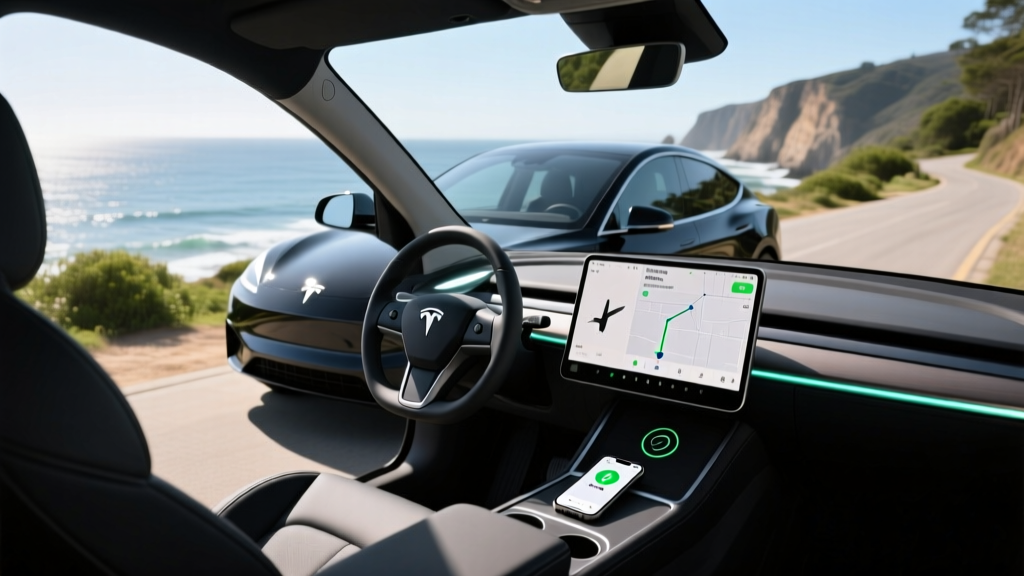
The Juniper interior is cleaner and more material-forward than previous generations. The 15.4-inch center touchscreen handles nearly all vehicle controls — there are no physical buttons for climate, mirrors, or glovebox. Some buyers love the minimalism; others find it distracting while driving. A rear 8-inch screen now serves second-row passengers for climate and entertainment.
Cargo capacity stands at 30.2 cubic feet behind the second row and 72.1 cubic feet with the 60/40 split rear seats folded. The front trunk (frunk) adds roughly 4.1 cubic feet for charging cables or a small bag. Rear legroom measures 41.6 inches — adequate for adults on longer trips, though the sloping roofline cuts into headroom for passengers over 6 feet tall.
Notable drawbacks:
- No physical buttons or stalks (turn signals are on the steering wheel face)
- No Apple CarPlay or Android Auto — Tesla's proprietary infotainment only
- Rear visibility is compromised by the thick C-pillar and small rear window
- No spare tire — only a tire repair kit
Pricing, Trims, and Federal Tax Credit Eligibility
The 2026 Model Y lineup is structured around three trims:
| Trim | Base MSRP | Est. After §30D Credit | EPA Range |
|---|---|---|---|
| Long Range RWD | $42,990 | $35,490* | 320 mi |
| Long Range AWD | $44,990 | $37,490* | 310 mi |
| Performance AWD | $49,990 | $42,490* | 285 mi |
*Assumes full $7,500 federal tax credit under IRS §30D. Eligibility is NOT guaranteed — see requirements below.
Federal tax credit requirements (2026 rules): Under IRS §30D, the $7,500 credit for the Model Y depends on three factors:
- MSRP cap: SUVs must be priced at or below $80,000. All Model Y trims qualify.
- Buyer income cap: Modified adjusted gross income must not exceed $150,000 (single), $225,000 (head of household), or $300,000 (joint filers).
- Battery sourcing: A percentage of critical minerals and battery components must be sourced from the U.S. or free-trade-agreement countries. Tesla has shifted significant supply chain to comply, but eligibility can change mid-year as sourcing percentages shift. Always verify current eligibility on the IRS website or with a tax professional before purchasing.
As of early 2026, Tesla lists the Model Y as eligible for the full $7,500 credit, and the point-of-sale transfer option allows buyers to apply the credit as an instant discount at delivery rather than waiting for a tax refund. However, buyers should confirm eligibility at the time of purchase — battery-sourcing compliance has changed for other manufacturers mid-year in the past.
Warranty and Long-Term Ownership Costs
Tesla covers the Model Y's battery and drive units for 8 years or 120,000 miles (whichever comes first), with a guaranteed minimum 70% capacity retention during that period. The limited vehicle warranty is 4 years / 50,000 miles.
Long-term battery degradation data from Tesla's fleet suggests NMC packs in the Model Y lose approximately 10–12% capacity over the first 150,000 miles, after which degradation tends to plateau. A full battery replacement outside of warranty currently runs $12,000–$16,000 depending on labor and pack availability — a cost worth factoring into 10-year ownership projections.
Insurance premiums for the Model Y tend to run 15–25% higher than comparable gas-powered crossovers, reflecting Tesla's higher repair costs and parts pricing. Average annual premiums range from $2,200–$3,400 depending on state, driving record, and coverage level.
Pros and Cons at a Glance
- Access to Tesla Supercharger network — the most reliable and extensive DC fast-charging network in North America
- Strong real-world efficiency (30 kWh/100 mi) keeps per-mile fuel costs low
- Over-the-air updates continuously add features and refinements
- Class-leading cargo volume for the electric crossover segment
- Heat pump standard — better cold-weather range retention
- Turn signals on steering wheel face — awkward during roundabouts and parking
- No CarPlay/Android Auto — you're locked into Tesla's ecosystem
- 250 kW peak charge rate trails competitors like the Ioniq 5 (350 kW capability)
- Higher insurance costs than segment average
- FSD (Supervised) requires constant driver attention despite its name
Who Should Buy the 2026 Model Y — And Who Shouldn't
- You road-trip frequently and want the lowest-stress public charging experience
- You need crossover cargo space with the option to fold seats flat for large items
- You want OTA updates and a tech-forward ownership experience
- You can charge at home with Level 2 and mostly use Superchargers for travel
- You want the fastest possible DC charging (Hyundai Ioniq 5 / Kia EV6 at 350 kW)
- You prefer physical buttons, CarPlay, or a more traditional cockpit layout
- You need a third row (consider the Kia EV9 or wait for the Model Y 7-seat option)
- Your budget is under $35,000 (consider the Chevy Equinox EV or a used Model Y)
Frequently Asked Questions
What is the real-world range of the 2026 Tesla Model Y?
The EPA rates it at 310 miles (Long Range AWD). In real-world driving, expect 260–280 miles on the highway, 295–315 miles in city driving, and 215–250 miles in freezing temperatures. The heat pump helps in winter but does not eliminate cold-weather range loss.
How fast does the Model Y charge at home and on the road?
At home on a 240V / 48A Tesla Wall Connector, the Model Y charges at 11.5 kW, adding roughly 44 miles of range per hour — a full charge takes 7–8 hours. On a V3 Supercharger, it peaks at 250 kW and charges from 10–80% in approximately 27 minutes, though the rate tapers significantly above 80%.
How much does a 2026 Model Y cost after the federal tax credit?
The Long Range AWD starts at $44,990 MSRP. If you qualify for the full $7,500 §30D credit (income under the cap, battery sourcing compliant), the effective price drops to approximately $37,490. The credit can be applied at point of sale as an instant discount.
Does the 2026 Model Y qualify for the federal EV tax credit?
As of early 2026, yes — the Model Y appears on the IRS eligible vehicle list for the full $7,500 credit. However, eligibility depends on your income (under $150K single / $300K joint), the vehicle's MSRP (under $80K for SUVs), and battery mineral/component sourcing percentages that can change. Verify at IRS.gov before committing.
Is the Model Y worth buying over the Hyundai Ioniq 5 or Ford Mach-E?
The Model Y wins on charging network access (Superchargers), cargo space, and software ecosystem. The Ioniq 5 charges faster (350 kW vs. 250 kW peak) and offers CarPlay. The Mach-E provides a more traditional driving feel and physical controls. If public charging reliability is your top priority, the Tesla ecosystem is still the strongest. If you value charging speed and cockpit ergonomics, test-drive the Ioniq 5 before committing.
Is Tesla's Full Self-Driving actually self-driving?
No. FSD (Supervised) is an SAE Level 2 driver-assistance system. The driver must remain fully attentive, keep hands on the wheel, and be prepared to take over at any moment. It is not autonomous driving. Only Level 4 services like Waymo operate without a human driver — and those are limited to specific geofenced areas.