The Tesla Fart Trick: A Quick How-To Before We Get Serious
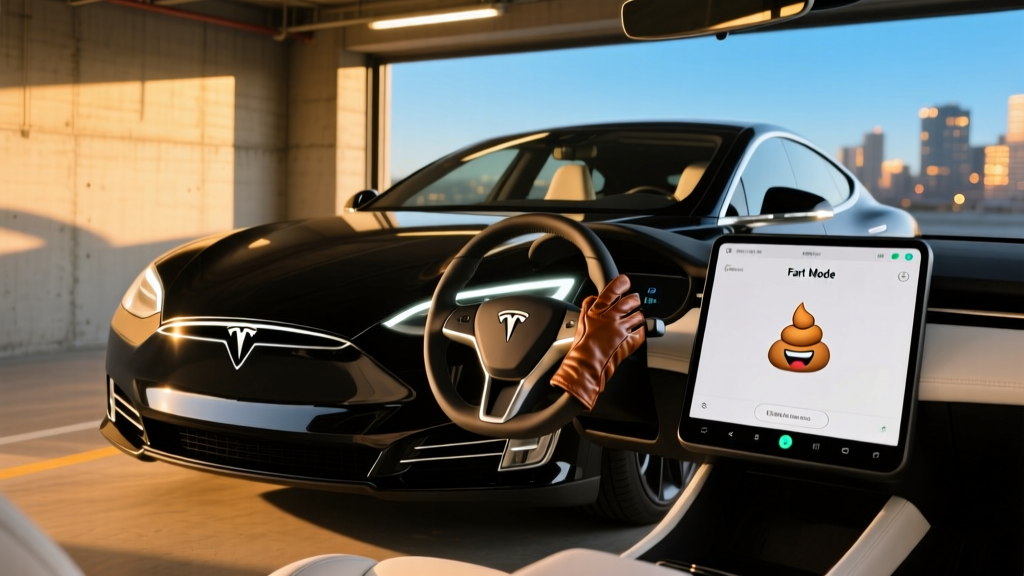
If you've seen a Tesla let out a loud, comical fart noise at a stoplight and wondered how on earth that happened, you're not alone. The Tesla fart feature is one of the most searched Easter eggs in the EV world, and it's surprisingly easy to activate. Here's exactly how to do it on any Tesla running recent software (2024+ builds).
Method 1: Boombox Mode (Parked or Driving)
- Tap the Toybox icon on your Tesla's touchscreen (the icon looks like a small box with toys).
- Select Boombox.
- Choose whether you want sound to play through the external speaker (Pedestrian Warning System speaker) or the internal cabin speakers.
- Scroll through the sound effects and select one of the available fart sounds (Tesla has included several over the years, from subtle to thunderous).
- Tap to play. If external mode is selected, the sound projects outside the vehicle.
Method 2: Emissions Testing Mode (The Classic)
- Go to Toybox on the touchscreen.
- Select Emissions Testing Mode.
- Choose your preferred sound: Close but no Cigar, Not a Fart, Bubbly, Mega Fart, or Fury of the Wookie.
- Set the trigger: play on demand, on turn signal activation, or on acceleration.
- When triggered via turn signal or acceleration, the sound plays through the external speaker automatically.
Now that we've covered the fun part, let's talk about the vehicle itself — because behind the Easter eggs is a serious, data-rich EV that deserves a thorough evaluation.
2026 Tesla Model 3: EPA Range, Battery Specs, and Real-World Efficiency
| Spec | Long Range RWD | Long Range AWD | Performance |
|---|---|---|---|
| EPA Range | 363 mi | 341 mi | 315 mi |
| Battery (usable) | ~75 kWh (NMC) | ~75 kWh (NMC) | ~75 kWh (NMC) |
| MPGe (combined) | 132 MPGe | 125 MPGe | 118 MPGe |
| kWh/100 mi | 25 | 27 | 28 |
| 0-60 mph | 4.9 sec | 4.2 sec | 2.9 sec |
| Horsepower | ~271 hp | ~346 hp | ~510 hp |
| Drivetrain | RWD (single motor) | AWD (dual motor) | AWD (dual motor) |
| Base MSRP | $42,490 | $47,490 | $54,990 |
Sources: EPA fueleconomy.gov, Tesla Model 3 configurator.
What Is the Real-World Range of the Model 3?
• City/mixed driving (55-65°F): ~310-330 mi — regen braking recovers energy in stop-and-go
• Highway at 70-75 mph: ~265-285 mi — aero drag dominates at speed
• Cold weather (below 32°F): ~225-260 mi — battery resistance + cabin heating draw ~15-30% range
• Worst case (highway + cold + headwind): ~200-220 mi — plan charging stops accordingly
The Model 3 Long Range uses an NMC (nickel manganese cobalt) lithium-ion pack. NMC offers higher energy density than LFP, which is why the Long Range achieves 363 miles in RWD form. However, NMC chemistry is more sensitive to sustained 100% state of charge — Tesla recommends daily charging to 80-90% and only charging to 100% before long trips. This is different from the base RWD model (where offered with LFP chemistry), which can be charged to 100% daily without degradation concerns.
At 25 kWh per 100 miles (Long Range RWD), the Model 3 remains one of the most efficient EVs on the market. For comparison, the Hyundai Ioniq 6 SE Long Range achieves 24 kWh/100mi, while the BMW i4 eDrive40 sits at 27 kWh/100mi. The Model 3's heat pump, standard since the 2021 refresh, significantly reduces cold-weather cabin-heating energy draw versus resistive heaters.
Charging Speed: DC Fast Charging and Home Level 2
| Charging Method | Max Power (kW) | Speed | Notes |
|---|---|---|---|
| Level 1 (120V outlet) | ~1.4 kW | ~3-4 mi/hr | Emergency/trickle only |
| Level 2 (240V, 48A) | 11.5 kW | ~37 mi/hr | Tesla Wall Connector or equivalent |
| DC Fast Charge (V3 Supercharger) | 250 kW peak | 10-80% in ~25 min | Peak sustained only to ~50% SoC |
| DC Fast Charge (V4 Supercharger) | 250 kW (current vehicle limit) | 10-80% in ~25 min | V4 cabinet supports more, car is bottleneck |
The Model 3 charges via the NACS (North American Charging Standard) connector natively — no adapter needed at Tesla Superchargers. With the broader industry adopting NACS for 2025+ models, the Supercharger network is now accessible to non-Tesla EVs as well, though Tesla owners still enjoy seamless plug-and-charge integration and typically lower per-kWh pricing.
Charging curve reality check: The "250 kW peak" figure is just that — a peak. In practice, the Model 3 Long Range sustains roughly 200-240 kW from 10-40% SoC, then tapers to ~150 kW by 55%, ~100 kW by 70%, and drops below 50 kW above 85%. This is why Tesla quotes 10-80% times rather than 0-100%. Always precondition your battery by entering a Supercharger as a navigation destination — this warms the pack and enables faster charge acceptance, especially in cold weather.
For home charging, the Tesla Wall Connector at 48 amps on a 240V/60A circuit delivers 11.5 kW, adding roughly 37 miles of range per hour. An overnight charge (8-10 hours) easily replenishes a full day's driving for most owners. Installation typically costs $500-$1,500 for the electrician work, plus $475 for the Wall Connector itself, though costs escalate to $2,000-$4,000+ if your electrical panel needs an upgrade to 200A service.
Pricing, Trim Levels, and Federal Tax Credit Eligibility
| Trim | Base MSRP | Destination | Total Before Credit | Est. After §30D Credit |
|---|---|---|---|---|
| Long Range RWD | $42,490 | $1,390 | $43,880 | ~$36,380* |
| Long Range AWD | $47,490 | $1,390 | $48,880 | ~$41,380* |
| Performance | $54,990 | $1,390 | $56,380 | ~$48,880* |
*Tax credit amount depends on individual eligibility. See checklist below.
Does the Model 3 Qualify for the Federal EV Tax Credit?
The Tesla Model 3 has been a perennial qualifier for the IRS §30D Clean Vehicle Credit, but eligibility is not automatic. Here's the 2026 checklist:
- MSRP Cap: Vehicle must have an MSRP ≤ $55,000 for sedans (Model 3 qualifies in all current trims)
- Buyer Income Cap: Modified AGI must not exceed $150,000 (single), $225,000 (head of household), or $300,000 (joint filers)
- Battery Sourcing: Critical minerals and battery components must meet escalating domestic/free-trade-agreement sourcing thresholds — Tesla has largely met these requirements for US-built Model 3s, but verify at purchase
- Final Assembly: Must occur in North America (Model 3 is built in Fremont, CA and Austin, TX — qualifies)
- Point-of-Sale Transfer: As of 2024+, you can transfer the credit to the dealer at purchase for an upfront price reduction rather than waiting to claim it on your tax return
- Credit Amount: Up to $7,500 — split between $3,750 for critical minerals compliance and $3,750 for battery component compliance. The exact amount depends on current-year sourcing percentages.
Important: Tax credit rules evolve annually. Always confirm current eligibility on irs.gov or with a tax professional before relying on the credit in your purchase decision.
Interior, Cargo Space, and Technology
The 2026 Model 3 "Highland" refresh interior is noticeably improved over the pre-2024 version. Tesla added ventilated front seats, ambient lighting, a rear touchscreen for passengers, acoustic glass all around, and higher-quality soft-touch materials. The minimalist aesthetic remains — no instrument cluster, no physical stalks (turn signals are now steering-wheel buttons), and all climate/media controls live on the 15.4-inch central touchscreen.
| Dimension | Measurement |
|---|---|
| Front legroom | 42.7 in |
| Rear legroom | 35.2 in |
| Cargo volume (rear seats up) | 23.1 cu ft |
| Cargo volume (rear seats folded) | 60.0 cu ft |
| Frunk (front trunk) | 3.1 cu ft |
Standout tech: The Model 3 runs Tesla's infotainment system with native Spotify, Netflix, YouTube, and Arcade (games playable while parked). Navigation includes real-time Supercharger routing with battery preconditioning. Over-the-air updates continue to add features — Tesla regularly ships UI improvements, new Easter eggs (including the fart sounds), and efficiency optimizations years after purchase.
Driver assistance: Basic Autopilot (Traffic-Aware Cruise Control + Autosteer) is standard. Enhanced Autopilot ($6,000) adds Auto Lane Change, Navigate on Autopilot, Autopark, and Summon. Full Self-Driving (Supervised) at $8,000 adds traffic light/stop sign recognition and city street autosteer.
Notable drawbacks: The button-based turn signals (replacing the traditional stalk) remain divisive — many drivers find them less intuitive, especially in roundabouts or when the steering wheel is turned. Rear visibility is limited by the sloping rear glass. The ride, while improved with new dampers in the Highland refresh, is still firmer than competitors like the Hyundai Ioniq 6 or BMW i4.
Warranty and Long-Term Ownership
| Coverage | Terms |
|---|---|
| Basic Vehicle Limited Warranty | 4 years / 50,000 miles |
| Battery & Drive Unit Warranty | 8 years / 120,000 miles (Long Range) — minimum 70% capacity retention |
| Roadside Assistance | 4 years / 50,000 miles |
Tesla's battery warranty guarantees that the pack will retain at least 70% of its original capacity over 8 years or 120,000 miles (for Long Range variants). Real-world data from Tesla's fleet suggests average degradation of roughly 10-12% over 150,000 miles for NMC packs, meaning most owners will remain well within warranty thresholds. Battery replacement out of warranty runs approximately $12,000-$16,000 for the Model 3, though this is rare within the vehicle's typical lifespan.
Is the Model 3 Worth Buying vs. Key Competitors?
✅ Pros
- Class-leading efficiency (25 kWh/100mi)
- Supercharger network access (seamless plug-and-charge)
- 363 mi max EPA range tops the segment
- OTA updates keep the car current for years
- Strong resale value vs. most EVs
- Extensive Easter eggs (Boombox, fart mode, light shows)
- Excellent safety ratings (NHTSA 5-Star)
❌ Cons
- Button turn signals take adjustment
- Firm ride vs. Hyundai Ioniq 6, BMW i4
- Rear seat space tighter than midsize sedans
- No Apple CarPlay / Android Auto
- FSD add-on is expensive and still Level 2
- Service center wait times can be long in some markets
- Minimalist interior not for everyone
How Does It Compare?
vs. Hyundai Ioniq 6 SE Long Range: The Ioniq 6 edges out the Model 3 on efficiency (24 vs 25 kWh/100mi) and offers CarPlay, but its CCS charging network is less reliable than Superchargers, and its 361-mile EPA range is nearly identical. The Ioniq 6 starts around $42,000 — essentially the same price. Choose the Ioniq 6 if you prefer physical controls and CarPlay; choose the Model 3 for Supercharger access and OTA evolution.
vs. BMW i4 eDrive40: The i4 offers a more premium interior, better ride quality, and CarPlay, but starts ~$10,000 higher and delivers only 307 miles EPA. It's the driver's choice if budget isn't the primary concern.
vs. Polestar 2 Long Range: The Polestar 2 (refreshed with 320 mi EPA and Google built-in) is a compelling alternative with a more conventional interior, but it trails on range and charging speed. It appeals to buyers who want Scandinavian design and Google integration without the Tesla ecosystem.
- Supercharger network reliability is a top priority for road trips
- You value continuous OTA feature updates
- Maximum range per dollar matters to you
- You enjoy tech-forward minimalism (and fart jokes)
- You need Apple CarPlay or Android Auto
- You prefer physical buttons, stalks, and traditional controls
- Rear-seat passenger comfort is a priority (consider Model Y or Ioniq 5)
Who Is the 2026 Tesla Model 3 Best For?
Commuters: Ideal. The 363-mile range means most commuters charge once or twice a week at home. Efficiency keeps electricity costs low — at $0.13/kWh national average, that's roughly $3.25 per 100 miles versus $12-$15 for a comparable gas sedan.
Road trippers: The Supercharger network makes the Model 3 one of the best EVs for long-distance travel. V3/V4 Superchargers are abundant along major US highways, and Tesla's navigation automatically routes through chargers and preconditions the battery.
Families: Adequate for a family of three, tight for four. The 23.1 cu ft trunk fits two large suitcases, and the rear seat fits two adults comfortably on shorter trips. Families needing more space should consider the Model Y (76 cu ft cargo, available third row).
Towing: Not recommended. The Model 3 is not rated for towing. If you need tow capability, look at the Model Y (3,500 lb) or a truck-platform EV.
Frequently Asked Questions
Can you make a Tesla fart while driving?
Yes. Using Emissions Testing Mode, you can set the fart sound to trigger on acceleration or turn signal activation. The sound plays through the external Pedestrian Warning System speaker, making it audible to people outside the car. Boombox mode also allows manual sound playback while driving through the external speaker.
Is the Tesla fart feature still available in 2026?
Yes, as of the latest software builds, both Boombox and Emissions Testing Mode remain available in the Toybox menu. Tesla has occasionally added new sound variations through over-the-air updates. The feature uses the PWS (Pedestrian Warning System) speaker required by NHTSA for low-speed EV noise, so it's a hardware feature that won't disappear.
What is the real-world range of the 2026 Tesla Model 3 Long Range?
The EPA rates the Long Range RWD at 363 miles and the AWD at 341 miles. In real-world highway driving at 70-75 mph, expect 265-285 miles (AWD). In cold weather below freezing, range drops to approximately 225-260 miles due to battery resistance and cabin heating demands. City driving with regenerative braking typically yields 310-330 miles.
How much does the Model 3 cost after the federal tax credit?
The Long Range RWD starts at $43,880 including destination. If you qualify for the full $7,500 §30D credit (meeting income caps, MSRP limits, and battery sourcing requirements), the effective price drops to approximately $36,380. However, credit eligibility depends on your tax filing status, modified AGI, and the vehicle's current battery-sourcing compliance. Always verify on irs.gov.
Does the Model 3 have Apple CarPlay?
No. Tesla does not support Apple CarPlay or Android Auto in any model. The native infotainment system includes Spotify, Tidal, Netflix, YouTube, and a web browser, but phone integration is limited to Bluetooth calls and media. This is a dealbreaker for some buyers and a non-issue for others.
How long does the Tesla Model 3 battery last?
Tesla warranties the Long Range battery for 8 years/120,000 miles with a minimum 70% capacity retention guarantee. Fleet data indicates typical degradation of 10-12% over 150,000 miles. To maximize longevity, charge to 80-90% daily (NMC chemistry), avoid frequent Supercharging, and use scheduled charging to minimize time at high state of charge.