The 2026 Tesla Model Y: What Buyers Need to Know Before Ordering
If you've been searching for how to get a Tesla, the Model Y remains the brand's most popular entry point — and for good reason. The 2026 Tesla Model Y (refreshed internally as the "Juniper" update that debuted for the 2025 model year) brings a quieter cabin, revised suspension tuning, updated front and rear lighting, and a slightly larger battery pack compared to the pre-2025 version. It competes directly with the Hyundai Ioniq 5, Ford Mustang Mach-E, and Chevrolet Equinox EV in the compact electric crossover segment.
But ordering a Tesla is not like walking into a traditional dealership. Tesla sells direct-to-consumer, meaning you configure, order, and take delivery without a franchised dealer in the middle. This guide walks through the real specs, real-world range, charging realities, pricing after federal incentives, and the exact steps to get one on your driveway.
Real-World Range vs. EPA Estimates
Real-World Expectation: ~250–275 miles highway at 70 mph; ~210–240 miles in freezing temperatures with cabin heat
The 2026 Model Y Long Range AWD carries an EPA-estimated 310 miles of range on its 78.1 kWh usable battery pack (NMC chemistry). The rear-wheel-drive Standard Range variant uses a 60 kWh LFP (lithium iron phosphate) pack with a 290-mile EPA rating.
Those EPA numbers assume a mix of city and highway driving at moderate temperatures. In our experience and consistent with third-party highway range tests, expect roughly 250–275 miles on a flat interstate at 70 mph in 60–80°F weather. Cold weather (below 32°F) reduces usable range by 15–30% depending on whether you precondition the battery and use the heat pump effectively. The Model Y's standard heat pump is one of the best in the segment for minimizing winter losses, but physics still applies — a 310-mile sticker becomes roughly 220–250 miles in a 20°F January commute.
For the LFP-equipped Standard Range model, Tesla recommends periodic charging to 100% to maintain battery calibration, unlike the NMC Long Range pack where daily charging to 80% is optimal for longevity. This is a meaningful ownership difference buyers often overlook.
Battery, Charging Speed, and Home Setup
| Spec | Long Range AWD | Standard Range RWD |
|---|---|---|
| Usable Battery Capacity | 78.1 kWh (NMC) | 60 kWh (LFP) |
| Max DC Fast Charge Rate | 250 kW peak | 175 kW peak |
| 10–80% DC Fast Charge Time | ~25 minutes | ~28 minutes |
| Level 2 Home Charging (kW) | 11.5 kW (48A) | 11.5 kW (48A) |
| Level 2 Miles per Hour | ~44 mi/hr | ~37 mi/hr |
| Level 1 (120V) Miles per Hour | ~3–4 mi/hr | ~3–4 mi/hr |
| Charge Port / Connector | NACS (native Tesla) | NACS (native Tesla) |
Charging speed is where the Model Y's advantage becomes practical. At a Tesla V3 or V4 Supercharger (250 kW capable), the Long Range model peaks near 250 kW and sustains roughly 180–200 kW through the 20–60% state-of-charge window before tapering. The 10–80% charge takes approximately 25 minutes under ideal conditions — meaning a preconditioned battery and a charger not shared with another vehicle.
Here's the charging-curve reality many new EV owners discover: that "250 kW" peak is not sustained for the full session. Above 80% SoC, charge rates drop sharply to protect battery health, often falling below 50 kW. This is why road-trip strategy focuses on charging to 80% and moving on rather than waiting for a full top-off.
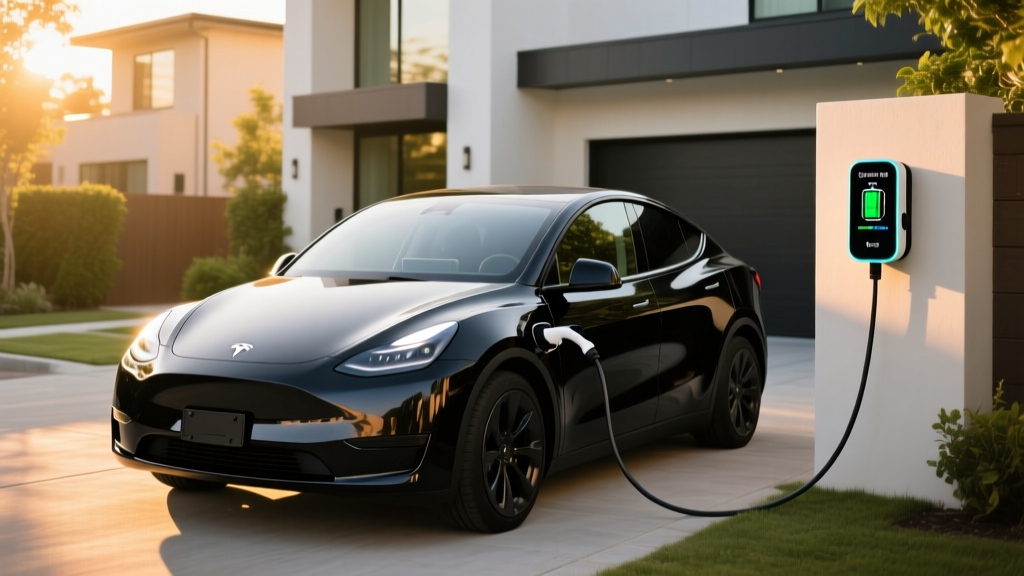
For home charging, the Model Y's onboard charger accepts up to 11.5 kW (48 amps) on a 240V Level 2 circuit. Using a Tesla Wall Connector on a 60-amp breaker, you'll add roughly 44 miles of range per hour — enough to fully replenish the Long Range pack overnight in about 7–8 hours. Installation costs for a Level 2 home setup typically run $800–$2,000 depending on whether your electrical panel needs an upgrade (a 200-amp panel is generally required for a dedicated 60-amp circuit). Always consult a licensed electrician for final specifications.
The native NACS (North American Charging Standard) connector means the Model Y plugs directly into Tesla's Supercharger network — currently the most reliable and extensive DC fast-charging network in the US with over 20,000 stalls. You can also use third-party networks like Electrify America or EVgo with the included NACS-to-CCS adapter (or at NACS-equipped third-party stations, which are expanding rapidly).
Performance, Efficiency, and Drivetrain
| Metric | Long Range AWD | Standard Range RWD |
|---|---|---|
| 0–60 mph | 4.8 seconds | 6.5 seconds |
| Horsepower | 384 hp (dual motor) | 295 hp (single motor) |
| Drivetrain | Dual Motor AWD | Rear-Wheel Drive |
| EPA MPGe (Combined) | 111 MPGe | 119 MPGe |
| Energy Consumption | 30 kWh/100 mi | 28 kWh/100 mi |
| Top Speed | 135 mph | 135 mph |
The Long Range AWD's dual-motor setup delivers 384 horsepower and a 4.8-second 0–60 mph time — quick enough to merge confidently onto any highway and satisfying at stoplights. The RWD model is more sedate at 6.5 seconds but still outpaces most gas-powered crossovers in its price range.
Efficiency is where Tesla continues to lead. At 111 MPGe combined (Long Range) and 119 MPGe (Standard Range), the Model Y extracts more miles per kilowatt-hour than nearly every competitor in its class. That 28–30 kWh/100 mi consumption figure translates to roughly $0.04–$0.06 per mile when charging at home on a $0.15/kWh utility rate — compared to $0.12–$0.16 per mile in a 25 MPG gas crossover at $3.50/gallon.
Pricing, Trims, and Federal Tax Credit Eligibility
| Trim | Base MSRP | Est. After §30D Credit* | Delivery Fee |
|---|---|---|---|
| Standard Range RWD | $44,990 | $37,490 | $1,390 |
| Long Range AWD | $48,990 | $41,490 | $1,390 |
| Long Range AWD (w/ FSD) | $56,990 | $49,490 | $1,390 |
*Federal tax credit amount shown is the maximum $7,500. Actual eligibility depends on income, battery sourcing, and MSRP caps. See checklist below.
The 2026 Model Y starts at $44,990 for the Standard Range RWD and $48,990 for the Long Range AWD before the $1,390 destination/delivery fee. Tesla's ordering process is configured entirely online — you select your trim, paint color, wheel option, and interior, then place a non-refundable order fee (typically $250).
- MSRP Cap: Vehicle must have an MSRP at or below $80,000 for SUVs — Model Y qualifies ✓
- Buyer Income Cap: Modified AGI ≤ $150,000 (single), $225,000 (head of household), $300,000 (joint) — verify via IRS.gov
- Battery Sourcing: Critical minerals and battery components must meet phased-in domestic/FCA-partner sourcing thresholds — Tesla has worked to qualify, but verify current status at purchase
- Point-of-Sale Transfer: You can transfer the credit to Tesla at purchase to reduce your out-of-pocket cost immediately (requires seller report and IRS registration)
- One Credit Per VIN: The vehicle must be new, purchased for personal use, and not previously claimed
Tax credit eligibility for the Model Y has fluctuated as battery-sourcing rules tighten under the Inflation Reduction Act. As of early 2026, the Model Y has generally qualified for the full $7,500 credit when purchased by eligible buyers, but the critical-minerals and battery-component thresholds increase annually. Always confirm current eligibility on the IRS qualified vehicles list before finalizing your order, and consult a tax professional for your specific situation.
Interior, Cargo, Tech, and Driver Assistance
The 2026 Model Y interior received meaningful improvements with the Juniper refresh: acoustic glass reduces cabin noise noticeably at highway speeds, ventilated front seats are now standard, and a rear-seat touchscreen gives passengers control over climate and entertainment. The minimalist aesthetic remains — no instrument cluster, all information routes through the 15.4-inch center touchscreen.
| Dimension | Measurement |
|---|---|
| Cargo Volume (rear seats up) | 30.2 cu ft |
| Cargo Volume (rear seats folded) | 72.1 cu ft |
| Front Legroom | 41.8 in |
| Rear Legroom | 37.5 in |
| Front Trunk (Frunk) | 4.1 cu ft |
| Seating Capacity | 5 passengers (optional 7-seat unavailable on 2026 refresh) |
On the technology front, Tesla's infotainment system remains among the most responsive in the industry — streaming apps, navigation with real-time Supercharger routing, and over-the-air updates that add features post-purchase. The Model Y includes basic Autopilot (traffic-aware cruise control and lane centering) as standard equipment.
Tesla Autopilot and the optional Full Self-Driving (Supervised) package are SAE Level 2 driver-assistance systems. They require continuous driver supervision — hands on or near the wheel, eyes on the road. They are not self-driving. FSD (Supervised) adds automatic lane changes, traffic light/stop sign recognition, and Navigate on Autopilot, but the driver remains fully responsible for the vehicle at all times. Only Level 4 services like Waymo operate without a human driver.
FSD (Supervised) adds $8,000 to the purchase price or is available as a $99/month subscription. Whether it's worth the cost is one of the most debated topics in EV ownership — the system is capable but inconsistent in construction zones and complex intersections, and it does not eliminate driver responsibility.
Warranty and Long-Term Ownership
| Component | Coverage |
|---|---|
| Basic Vehicle | 4 years / 50,000 miles |
| Battery & Drive Unit (Long Range) | 8 years / 120,000 miles (min 70% retention) |
| Battery & Drive Unit (Standard Range) | 8 years / 100,000 miles (min 70% retention) |
Tesla's battery warranty guarantees that the pack will retain at least 70% of its original capacity during the warranty period. Real-world degradation data from fleet monitoring suggests most Model Y NMC packs lose roughly 5–8% capacity in the first 50,000 miles, then degrade much more slowly — putting most owners well within warranty thresholds for the life of the vehicle.
Insurance costs tend to run 15–25% higher than comparable gas crossovers due to repair costs and Tesla's aluminum-intensive construction. Expect annual premiums in the $1,800–$2,600 range depending on your state, driving record, and coverage level. Get quotes before ordering — this is a real cost variable that surprises some buyers.
How to Get a Tesla Model Y: The Ordering Process
Unlike traditional automakers, Tesla does not operate franchised dealerships. Here is the step-by-step process to get a Model Y:
- Configure online at Tesla.com — select trim, color, wheels, and interior.
- Place your order with a $250 non-refundable fee. You'll receive an estimated delivery window.
- Complete financing or payment — Tesla offers in-house financing, or you can use your own bank/credit union. This is also where you elect the point-of-sale tax credit transfer if eligible.
- Home charger installation — order a Tesla Wall Connector ($475) and schedule an electrician for a 240V/60A circuit if you don't already have one.
- Delivery day — Tesla will notify you when your vehicle is ready. Delivery occurs at a Tesla Service Center or via direct-to-door delivery in some metro areas. Inspect the vehicle thoroughly before accepting — panel gaps and paint imperfections are the most common complaints.
- Post-delivery — everything is managed through the Tesla app: service requests, software updates, Supercharger billing, and mobile service scheduling.
Delivery timelines vary from 2–8 weeks depending on configuration and regional supply. Tesla occasionally offers inventory vehicles (pre-configured, ready for immediate delivery) at slight discounts — check the "Inventory" section on Tesla.com if you want to skip the wait.
Pros, Cons, and Key Competitors
- Class-leading efficiency (111–119 MPGe) and real-world range
- Access to Tesla Supercharger network — most reliable DC fast-charging in the US
- Over-the-air updates continuously improve the vehicle post-purchase
- Strong resale value relative to EV segment average
- Excellent cargo capacity (72.1 cu ft folded) for the class
- Heat pump standard — strong cold-weather efficiency
- No physical controls — all climate/media via touchscreen can distract while driving
- FSD (Supervised) costs $8,000 extra and remains SAE Level 2, not autonomous
- Insurance premiums run 15–25% higher than gas equivalents
- No Apple CarPlay or Android Auto integration
- Rear visibility is limited; relies heavily on cameras
- Service center wait times can be long in some metro areas
The Model Y's strongest competitors include the Hyundai Ioniq 5 (800V architecture, 10–80% in 18 minutes, NACS adapter required), the Ford Mustang Mach-E (more engaging to drive, lower starting price on base trims), and the Chevrolet Equinox EV (lower price point, 319-mile range on 3RS trim). None currently match Tesla's combination of Supercharger access, efficiency, and software integration, but the gap has narrowed considerably.
- Choose the Model Y if: You want maximum Supercharger access, top-tier efficiency, strong cargo space, and a proven software platform — and you can charge at home.
- Choose the Ioniq 5 if: You prioritize faster peak charging speeds (800V), prefer physical controls, or want a more distinctive design.
- Choose the Mach-E if: Driving dynamics matter most and you want a more traditional crossover feel with competitive range.
- Choose the Equinox EV if: Budget is the primary driver and you want the lowest cost-per-mile-of-range in the segment.
Frequently Asked Questions
What is the real-world range of the 2026 Tesla Model Y?
The EPA rates the Long Range AWD at 310 miles and the Standard Range RWD at 290 miles. In real-world highway driving at 70 mph, expect 250–275 miles from the Long Range and 230–255 miles from the Standard Range. In sub-freezing temperatures, subtract another 15–30% depending on conditions and preconditioning habits.
How fast does the Model Y charge at home and on the road?
At a 250 kW Supercharger, the Long Range model charges from 10–80% in approximately 25 minutes. At home on a 240V/48A Level 2 charger, it adds about 44 miles of range per hour, fully charging overnight in 7–8 hours. Level 1 (standard 120V outlet) adds only 3–4 miles per hour — suitable only for emergency trickle charging.
How much does a 2026 Model Y cost after tax credits?
The Standard Range RWD starts at $44,990 and the Long Range AWD at $48,990 before delivery fees. Eligible buyers can reduce the price by up to $7,500 through the federal §30D tax credit (or point-of-sale transfer), bringing the effective starting price to approximately $37,490 for the Standard Range model. Eligibility depends on buyer income, battery sourcing compliance, and MSRP caps — verify current status on IRS.gov.
Does the Tesla Model Y qualify for the federal EV tax credit?
As of early 2026, the Model Y has generally qualified for the full $7,500 federal tax credit for eligible buyers. However, battery component and critical mineral sourcing thresholds tighten annually under the Inflation Reduction Act. Confirm current eligibility on the IRS qualified vehicle list before ordering, and note that buyer income caps ($150K single / $300K joint) apply.
Is the Tesla Model Y worth buying vs. competitors?
The Model Y offers the best combination of range, efficiency, Supercharger network access, and software in its class. If you road-trip frequently, the Supercharger advantage is significant. If you primarily drive locally and value faster peak charging or physical controls, the Hyundai Ioniq 5 is a strong alternative. Test-drive both before deciding.
How long does the Model Y battery last?
Tesla warranties the Long Range battery for 8 years/120,000 miles and the Standard Range for 8 years/100,000 miles, guaranteeing at least 70% capacity retention. Real-world data from high-mileage Tesla fleets suggests NMC packs typically retain 85–92% capacity at 100,000 miles with normal charging habits (daily limit of 80%, occasional 100% for trips).