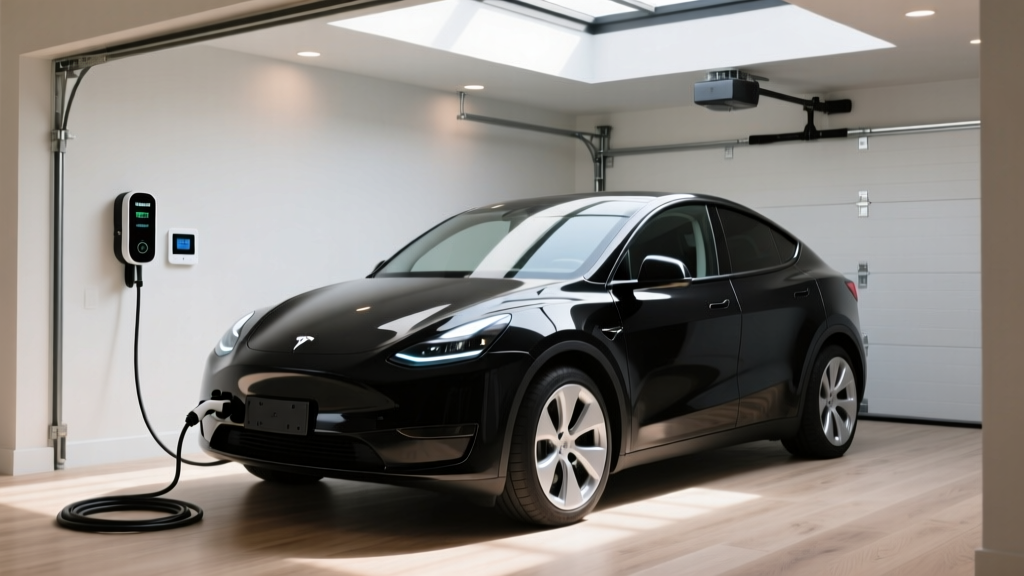
The Tesla Model Y remains the best-selling electric vehicle in the United States for good reason: strong range, access to the Supercharger network, and a software ecosystem that makes daily ownership relatively seamless. But for new owners and prospective buyers, one question dominates: how do you charge a Tesla at home? The answer determines your daily convenience, your electric bill, and whether you'll ever need to visit a public charger for routine driving.
This guide breaks down every home-charging option for the current 2025 Tesla Model Y, pairs those details with a full vehicle profile — range, battery chemistry, pricing, tax-credit eligibility — and gives you the exact numbers you need to plan an installation and budget accurately.
2025 Tesla Model Y: Core Specs at a Glance
Before wiring up a charger, you need to know what you're filling. The 2025 Model Y is offered in three trims, each with distinct battery packs, range figures, and powertrain configurations. Here are the numbers that matter.
| Spec | Long Range RWD | Long Range AWD | Performance |
|---|---|---|---|
| EPA Range | 320 mi | 307 mi | 277 mi |
| Battery (usable) | ~75 kWh (LFP) | ~75 kWh (NMC) | ~75 kWh (NMC) |
| Drivetrain | RWD, single motor | Dual-motor AWD | Dual-motor AWD |
| Horsepower | 346 hp | 384 hp | 456 hp |
| 0–60 mph | 6.5 sec | 4.8 sec | 3.5 sec |
| MPGe (combined) | 122 MPGe | 117 MPGe | 111 MPGe |
| Efficiency | 28 kWh/100 mi | 29 kWh/100 mi | 30 kWh/100 mi |
| Max DC Fast Charge | 170 kW | 250 kW | 250 kW |
| 10–80% DC Time | ~32 min | ~25 min | ~25 min |
| Base MSRP | $44,990 | $47,990 | $51,490 |
| Battery Warranty | 8 yr / 120,000 mi | 8 yr / 120,000 mi | 8 yr / 120,000 mi |
Sources: EPA / fueleconomy.gov, Tesla Model Y Design Studio
Real-World Range vs. the EPA Sticker
The Long Range AWD (307 mi EPA) typically delivers 260–285 miles in mixed conditions, while the Performance trim (277 mi EPA) realistically provides 230–250 miles when driven aggressively, which is often how Performance buyers use the car.
One factor that helps Tesla owners specifically: the navigation system automatically preconditions the battery when you route to a Supercharger. Preconditioning warms the battery to optimal temperature, which restores charging speed and partially mitigates cold-weather range loss. At home, you can enable scheduled departure preconditioning so the battery and cabin are warm using grid power rather than battery energy — this is a significant efficiency advantage in winter climates.
How Do You Charge a Tesla at Home? Three Options Explained
There are three ways to charge a Tesla Model Y at home, each with dramatically different speeds and installation requirements. Understanding the difference between kW (power — how fast energy flows) and kWh (energy — how much the battery holds) is essential here. The Model Y's battery holds roughly 75 kWh of usable energy. A 1 kW charger adds 1 kWh per hour. Simple math from there.
| Method | Power (kW) | Miles Added/Hour | Full Charge Time (0–100%) | Install Needed? |
|---|---|---|---|---|
| Level 1 (120V outlet, Mobile Connector) | ~1.3 kW | ~3–5 mi/hr | ~60+ hours | No (standard outlet) |
| Level 2 (240V, Mobile Connector + NEMA 14-50) | ~7.2–9.6 kW | ~25–37 mi/hr | ~8–11 hours | Yes — 240V outlet |
| Level 2 (240V, Tesla Wall Connector, hardwired) | Up to 11.5 kW (48A) | ~44 mi/hr | ~7 hours | Yes — hardwired, 60A circuit |
Level 1: The Emergency Backup
Every Model Y ships with a Mobile Connector. Plug it into a standard 120V household outlet, and you'll add roughly 3–5 miles of range per hour. That's 36–60 miles overnight — enough for short commutes under 30 miles round-trip, but impractical as a primary strategy. Level 1 is best treated as a fallback or a solution for very low-mileage drivers with long overnight parking windows.
Level 2 via NEMA 14-50 Outlet: The Most Popular Setup
Installing a 240V NEMA 14-50 outlet (the same type used for electric dryers and RV hookups) and pairing it with the Tesla Mobile Connector or a third-party Level 2 unit delivers 7.2–9.6 kW depending on the circuit amperage. On a 50-amp circuit (40 amps continuous), you'll see roughly 30–37 miles of range per hour — enough to fully replenish a depleted Model Y overnight in 8–11 hours.
This is the sweet spot for most owners. A licensed electrician can typically install a 14-50 outlet for $500–$1,500 if your electrical panel has capacity and the run is short. If you need a panel upgrade (from 100A to 200A service), add $1,500–$3,000+.
Level 2 via Tesla Wall Connector: Maximum Home Speed
The Tesla Wall Connector ($475 direct from Tesla) hardwires to a 60-amp circuit and delivers up to 11.5 kW (48 amps continuous) to the Model Y. That's roughly 44 miles of range per hour — the fastest Level 2 charging the Model Y's onboard charger can accept. A full charge from empty takes about 7 hours.
The Wall Connector also supports Wi-Fi for firmware updates, integrates with the Tesla app for scheduling and monitoring, and can share a single circuit with a second Wall Connector via Power Sharing — useful for two-EV households.
| Wall Connector unit | $475 |
| Electrician labor (standard install, short run) | $800–$1,800 |
| Permit & inspection | $50–$200 |
| Panel upgrade (if needed, 100A → 200A) | $1,500–$3,000+ |
| Typical total (no panel upgrade) | $1,325–$2,475 |
Always hire a licensed electrician and pull a permit. The 2025 Model Y uses the NACS (North American Charging Standard) connector natively — Tesla's proprietary plug, which is now being adopted industry-wide. The Wall Connector uses NACS natively. If you use a third-party J1772 Level 2 charger, you'll need Tesla's J1772 adapter (included with the car).
DC Fast Charging: Road-Trip Speeds and the Charge Curve
Home charging handles 90%+ of most owners' needs. For road trips, the Model Y taps into Tesla's Supercharger network — now opening to non-Tesla EVs — as well as CCS-equipped third-party networks via adapter.
The Long Range AWD and Performance trims peak at 250 kW on a V3 Supercharger, adding roughly 200 miles in 15 minutes under ideal conditions. However, peak kW is not sustained kW. The charge curve tapers significantly above 50% state of charge (SoC), and especially above 80%. A realistic 10–80% session takes about 25 minutes. Charging from 80–100% can add another 20–30 minutes — which is why Tesla (and all EV best practices) recommend charging to 80% on road trips and only charging to 100% when you'll drive immediately.
The Long Range RWD with its LFP battery is a partial exception: Tesla recommends charging LFP batteries to 100% at least once per week to maintain accurate state-of-charge calibration. LFP chemistry is more tolerant of high SoC storage, which is one of its advantages.
Pricing, Trims, and Federal Tax Credit Eligibility
| Trim | Base MSRP | Est. As-Tested* | §30D Credit Eligible? |
|---|---|---|---|
| Long Range RWD | $44,990 | $46,000–$50,000 | Yes — up to $7,500 (if sourcing & income qualify) |
| Long Range AWD | $47,990 | $49,000–$54,000 | Yes — up to $7,500 (if sourcing & income qualify) |
| Performance | $51,490 | $53,000–$58,000 | Yes — up to $7,500 (if sourcing & income qualify) |
*As-tested prices include destination fee, common options (paint, wheels, FSD).
The IRS §30D federal tax credit offers up to $7,500 for qualifying new EVs, but eligibility is not automatic. Here's what you need to verify:
- MSRP cap: SUVs (which the Model Y is classified as) must have an MSRP at or below $80,000. All 2025 Model Y trims clear this easily.
- Buyer income cap: Modified adjusted gross income must not exceed $300,000 (joint), $225,000 (head of household), or $150,000 (single).
- Battery sourcing: The $7,500 credit splits into two halves — $3,750 for critical-minerals sourcing and $3,750 for battery-component manufacturing. Sourcing requirements tighten annually. Tesla manufactures battery cells at its Nevada and Texas gigafactories, but critical-mineral supply chains vary. Check the latest fueleconomy.gov credit listings for the exact credit amount available at time of purchase.
- Point-of-sale transfer: As of 2024, buyers can transfer the credit to the dealer at purchase, reducing the out-of-pocket price immediately rather than waiting for tax filing. Tesla supports this at delivery.
Cargo, Interior Space, and Daily Practicality
The Model Y is a compact crossover, and its cargo capacity is a key selling point versus the Model 3 sedan.
- Cargo (rear seats up): 30.2 cu ft
- Cargo (rear seats folded): 72.1 cu ft
- Front trunk (frunk): 4.1 cu ft
- Rear legroom: 41.6 inches
- Front headroom: 41.0 inches
- Seating: 5 standard; optional 7-seat layout available (third row is very small, best for children)
The flat floor and hatchback design make loading bulky items straightforward. The optional tow hitch provides a 3,500-pound towing capacity (AWD trims), though towing cuts range roughly in half — expect 140–160 miles at highway speeds with a loaded trailer.
Tech, Driver Assistance, and Notable Drawbacks
The Model Y's 15.4-inch center touchscreen controls nearly every vehicle function — there are no physical buttons for climate, mirrors, or glovebox. This minimalist approach is polarizing: some owners love the clean aesthetic, others find it distracting while driving.
Standard Autopilot includes adaptive cruise control and lane-centering. This is an SAE Level 2 driver-assistance system — you must keep your hands on the wheel and remain fully engaged. The optional Full Self-Driving (Supervised) package ($8,000 one-time or $99/month) adds automated lane changes, traffic-light recognition, and city-street navigation, but remains Level 2. The driver is responsible at all times. No Tesla vehicle is a Level 4 or Level 5 autonomous car.
Other tech highlights include over-the-air software updates that regularly add features, a built-in dashcam and Sentry Mode (surveillance recording while parked), and access to Tesla's integrated navigation with real-time Supercharger availability.
Pros
- Best-in-class Supercharger network access
- Strong real-world efficiency (28–30 kWh/100 mi)
- Excellent cargo space for the segment
- Fast home Level 2 charging (up to 11.5 kW)
- OTA updates continuously improve the vehicle
- Point-of-sale tax credit reduces upfront cost
Cons
- No physical buttons — everything through the touchscreen
- Ride quality is firm, especially on 20-inch wheels
- FSD is expensive and still requires full driver supervision
- Insurance costs run 15–30% higher than comparable ICE SUVs
- Panel gap and build-quality variability still reported
- Third-row seat option is cramped and reduces cargo space
Who Is the Model Y Best For?
Daily commuters (30–80 mi round-trip): Ideal. Home Level 2 charging means you start every day with a full battery. The Long Range RWD at $44,990 is the value pick — 320 miles EPA and the lowest price in the lineup.
Families needing cargo flexibility: The hatchback and 72 cu ft of maximum cargo space outclass most compact SUVs. The optional third row works for small children on short trips, but a three-row SUV like the Kia EV9 or Rivian R1S is better for regular seven-passenger use.
Road-trip frequent flyers: Tesla's Supercharger network remains the most reliable and widespread DC fast-charging ecosystem in the U.S. The 250 kW peak charge rate on AWD/Performance trims keeps stops short — plan for 20–25 minutes every 200 miles or so.
Buyers without home charging access: This is the hard case. If you can't install a Level 2 charger at home or work, the Model Y (or any EV) becomes significantly less convenient. Relying solely on public DC fast charging accelerates battery wear and costs more per mile. Confirm your home-charging situation before purchasing.
Frequently Asked Questions
Can I charge a Tesla with a regular household outlet?
Yes, using the included Mobile Connector and a standard 120V outlet. However, you'll only gain 3–5 miles of range per hour. For a 75 kWh battery, a full charge from empty takes over 60 hours. This works only as a backup or for very low-mileage drivers. A 240V Level 2 setup is strongly recommended as the primary home-charging method.
Do I need a Tesla Wall Connector, or can I use a third-party charger?
You can use any J1772 Level 2 charger with the included J1772-to-NACS adapter. However, the Tesla Wall Connector offers the fastest home charge rate (11.5 kW / 44 mi/hr), native NACS compatibility without an adapter, and integration with the Tesla app for scheduling and energy monitoring. Third-party chargers like the ChargePoint Home Flex or Emporia Vue are solid alternatives if you prefer a non-Tesla ecosystem or need a longer cable.
Does the 2025 Model Y qualify for the full $7,500 federal tax credit?
All Model Y trims fall under the $80,000 SUV MSRP cap. However, the full $7,500 credit depends on battery-component and critical-minerals sourcing requirements, which tighten each year, plus your personal income (capped at $300K joint / $150K single). Check the current listing on fueleconomy.gov and consult a tax professional. The credit can be applied at point of sale, reducing your purchase price directly.
How much does it cost to charge a Model Y at home per month?
At the U.S. average residential electricity rate of ~$0.16/kWh (EIA, 2025), fully charging a 75 kWh battery costs about $12. If you drive 1,000 miles per month at 29 kWh/100 mi, you'll use roughly 290 kWh — about $46/month. That compares to roughly $100–$120/month in gasoline for a comparable ICE SUV at 25 MPG and $3.20/gallon. Time-of-use rates can lower this further if you charge overnight during off-peak hours.
Should I charge my Model Y to 100% every night?
It depends on the battery chemistry. The Long Range RWD uses an LFP (lithium iron phosphate) battery — Tesla recommends charging to 100% at least once per week for accurate SoC calibration. The Long Range AWD and Performance trims use NMC (nickel manganese cobalt) batteries, where daily charging to 80% is recommended for longevity, with 100% reserved for road trips when you'll drive immediately. Set your charge limit in the Tesla app accordingly.
Is the Model Y still worth buying versus competitors in 2025?
The Model Y's combination of range, Supercharger access, efficiency, and price remains hard to beat. Key competitors include the Hyundai Ioniq 5 (comparable range, 800V architecture for faster DC charging, but smaller cargo area), the Ford Mustang Mach-E (competitive pricing, less Supercharger access), and the upcoming refreshed Nissan Ariya. If Supercharger reliability and home-charging simplicity are your top priorities, the Model Y is still the default answer. If you prioritize ride comfort, physical controls, or build quality, test-drive the Ioniq 5 and Mach-E before committing.