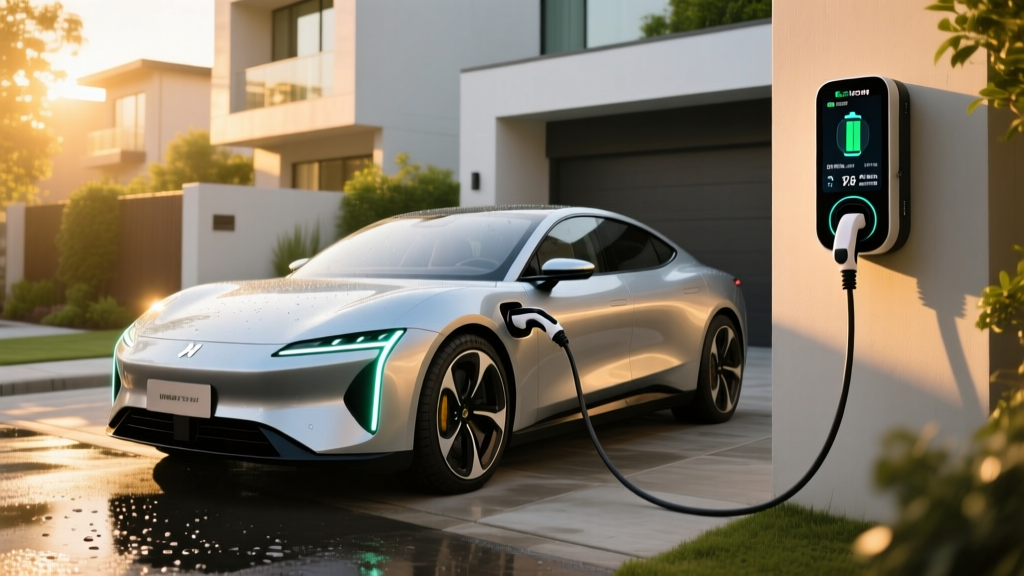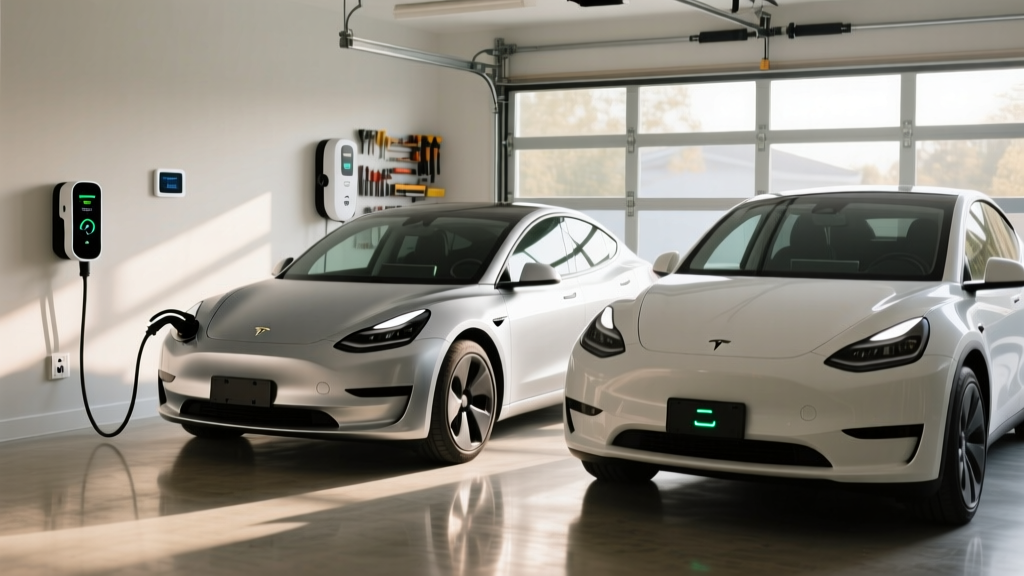
If you are researching how to charge a Tesla at home, you are likely weighing whether a standard 120V outlet is enough or if a 240V Level 2 setup is worth the investment. The answer depends on which Tesla you drive, how far you commute, and what your electrical panel can support. This guide covers home charging for the two most popular Teslas on the road — the 2026 Model 3 and 2026 Model Y — with exact charge rates, installation costs, battery specs, and federal tax-credit implications so you can plan your setup with confidence.
Tesla Model 3 and Model Y: 2026 Quick Specs
Before we talk charging hardware, here is the hardware you are charging. Both the Model 3 and Model Y received running updates through 2025-2026, but the core battery and charging architectures remain consistent with the refreshed "Highland" (Model 3) and "Juniper" (Model Y) platforms.
| Spec | Model 3 Long Range AWD | Model Y Long Range AWD |
|---|---|---|
| EPA Range | 341 miles | 320 miles |
| Battery Capacity (usable) | ~75 kWh (NMC) | ~75 kWh (NMC) |
| Battery Chemistry | NMC (Nickel Manganese Cobalt) | NMC (Nickel Manganese Cobalt) |
| Max DC Fast Charge | 250 kW (peak) | 250 kW (peak) |
| 10–80% DC Fast Charge | ~25 minutes | ~27 minutes |
| Onboard Charger (Level 2 AC) | 11.5 kW (48A) | 11.5 kW (48A) |
| Level 2 Charge Rate | ~44 mi/hr | ~37 mi/hr |
| 0–60 mph | 4.2 sec | 4.8 sec |
| Horsepower | ~346 hp | ~384 hp |
| Drivetrain | Dual-Motor AWD | Dual-Motor AWD |
| MPGe (combined) | 132 MPGe | 122 MPGe |
| Efficiency | 25 kWh/100 mi | 28 kWh/100 mi |
| Cargo Volume | 23 cu ft (trunk) + frunk | 76 cu ft (seats folded) + frunk |
| Rear Legroom | 35.3 in | 40.5 in |
| Battery Warranty | 8 yr / 120,000 mi | 8 yr / 120,000 mi |
| Base MSRP | $47,740 | $48,630 |
Sources: fueleconomy.gov, Tesla Home Charging
Real-World Range: What to Actually Expect
Model 3 Long Range: EPA 341 mi — expect ~290–310 mi on highway trips at 70–75 mph; ~230–260 mi in sub-freezing winter weather.
Model Y Long Range: EPA 320 mi — expect ~270–290 mi highway; ~210–240 mi in cold weather.
Real-world range drops 10–15% at sustained highway speeds and 20–30% in temperatures below 32°F due to cabin heating and increased battery resistance. Preconditioning the battery before departure recovers some of this loss.
The Model 3's lower, more aerodynamic sedan profile gives it a meaningful efficiency edge over the taller, heavier Model Y — roughly 3 kWh/100 mi less consumption. On a 300-mile road trip in mild weather, the Model 3 Long Range can often arrive with 10–15% battery remaining, while the Model Y will typically need a brief Supercharger stop. In winter, both vehicles lose range to resistive cabin heating (neither uses a heat pump in all trims equally, though recent models include one). Plan conservatively: if your one-way commute exceeds 130 miles in winter, you will want a full charge before departure.
How to Charge a Tesla at Home: Level 1 vs Level 2
Understanding the difference between power (kW) and energy (kWh) is essential. kW is the rate at which electricity flows — think of it as the width of a hose. kWh is the total amount of energy stored — the size of the bucket. A higher kW charge rate fills your kWh battery faster.
| Level | Voltage / Amps | Max Power (kW) | Model 3 Mi/Hr | Model Y Mi/Hr | Best For |
|---|---|---|---|---|---|
| Level 1 (Mobile Connector) | 120V / 12A | ~1.4 kW | ~3–4 mi/hr | ~3–4 mi/hr | Overnight top-up for short commuters (<30 mi/day) |
| Level 2 (Wall Connector) | 240V / 48A | 11.5 kW | ~44 mi/hr | ~37 mi/hr | Daily full charging, road-trip prep, cold climates |
| Level 2 (Wall Connector, 60A circuit) | 240V / 48A continuous | 11.5 kW | ~44 mi/hr | ~37 mi/hr | Same speed — 60A breaker required for 48A continuous draw |
| Level 2 (NEMA 14-50 outlet) | 240V / 32A (Mobile Connector) | ~7.7 kW | ~30 mi/hr | ~25 mi/hr | Flexible — use at home or take on the road |
Level 1 (120V) is the bare minimum. Plugging the Tesla Mobile Connector into a standard household outlet delivers roughly 1.4 kW, adding 3–4 miles of range per hour. Over 12 hours, that is 36–48 miles — enough for a short commute, but inadequate if you drive 60+ miles daily or need to recover from a road trip. Level 1 also charges slowly enough that battery preconditioning and cabin heating in winter can outpace incoming power.
Level 2 (240V) is what virtually every Tesla owner should install. Tesla's Wall Connector, hardwired on a 60-amp circuit, delivers up to 11.5 kW — limited by the car's onboard charger, not the wall unit. At 44 miles of range per hour in the Model 3, a depleted battery reaches full in roughly 8 hours. For most owners who plug in nightly, a 2–3 hour session restores the day's driving.
A popular middle-ground is the NEMA 14-50 outlet (the same 240V plug used by electric ranges and RV parks). Using the Mobile Connector with a 14-50 adapter, you get ~7.7 kW / 30 mi/hr. This is slower than a hardwired Wall Connector but offers portability and avoids hardwiring costs.
Home Charging Installation: Costs & Requirements
| Item | Cost Range | Notes |
|---|---|---|
| Tesla Wall Connector (hardware) | $420–$475 | Purchased directly from Tesla; includes 24-ft cable |
| Mobile Connector + NEMA 14-50 adapter | $200–$280 | Included with some new vehicles; adapter sold separately |
| Electrician: 60A circuit, hardwired run | $800–$2,500 | Depends on panel proximity, wall/floor penetrations, conduit length |
| Electrical panel upgrade (if needed) | $1,500–$4,000 | Required if existing panel is 100A or at capacity; upgrade to 200A |
| Permit & inspection | $50–$300 | Varies by municipality; some jurisdictions waive for EV installs |
| Total (no panel upgrade) | $1,270–$3,275 | Most common scenario for homes with 200A service |
| Total (with panel upgrade) | $2,770–$7,275 | Older homes with 100A panels or heavy existing loads |
The single biggest cost variable is your electrical panel. A modern 200-amp panel with spare breaker slots can usually accommodate a 60-amp EV circuit without issue. Older homes with 100-amp service may require a panel upgrade before a Level 2 install is safe. Always hire a licensed electrician to evaluate your panel load, wire gauge, and conduit requirements — a 60-amp circuit requires 6 AWG copper wire in most installations, and improper wiring is a fire hazard.
Some utilities offer rebates of $200–$500 for Level 2 charger installations, and certain states provide additional incentives. Check with your local utility before scheduling work.
Charging Speed on the Road: DC Fast Charging & the Charge Curve
At home, you charge slowly and conveniently. On road trips, Tesla's Supercharger network delivers DC fast charging at up to 250 kW (V3 stalls). However, peak charge rate is not sustained rate. Here is what the charge curve actually looks like:
- 10–30%: Peaks near 250 kW — adds ~150+ miles in ~10 minutes
- 30–60%: Tapers to ~150–180 kW — still fast, roughly 2–3 mi/kW
- 60–80%: Tapers to ~80–100 kW — charging slows to protect battery health
- 80–100%: Drops to <30 kW — the final 20% can take as long as 10–80%
This is why Tesla (and all EV makers) quote 10–80% times. For the Model 3 Long Range, that is approximately 25 minutes at a V3 Supercharger. The Model Y takes roughly 27 minutes due to its slightly higher consumption. Always precondition your battery by entering a Supercharger as your navigation destination — this warms the battery to optimal charging temperature and can shave 5–10 minutes off your stop, especially in cold weather.
Pricing, Trims & Federal Tax Credit Eligibility
| Trim | MSRP | Est. Price After §30D Credit* |
|---|---|---|
| Model 3 RWD | $38,990 | ~$31,490 (if eligible) |
| Model 3 Long Range AWD | $47,740 | ~$40,240 (if eligible) |
| Model 3 Performance | $54,630 | ~$47,130 (if eligible) |
| Model Y RWD | $44,990 | ~$37,490 (if eligible) |
| Model Y Long Range AWD | $48,630 | ~$41,130 (if eligible) |
| Model Y Performance | $53,130 | ~$45,630 (if eligible) |
*Federal tax credit of up to $7,500 is NOT guaranteed. Eligibility depends on multiple IRS requirements that change periodically.
- MSRP cap: Vehicle must be under $55,000 (sedans like Model 3) or $80,000 (SUVs/trucks like Model Y)
- Buyer income cap: AGI must not exceed $150,000 (single), $225,000 (head of household), or $300,000 (joint)
- Battery sourcing: Increasing percentages of critical minerals and battery components must be sourced from the U.S. or free-trade-agreement countries — Tesla's U.S.-built vehicles generally qualify, but verify at purchase
- Point-of-sale transfer: As of 2024+, you can transfer the credit to the dealer at purchase for an immediate price reduction, or claim it on your tax return
- Verify before buying: Check the latest rules at IRS.gov §30D — sourcing requirements tighten annually
Both the Model 3 and Model Y are assembled at Tesla's Fremont and Austin factories, and Tesla has worked to localize battery supply chains. However, critical-mineral sourcing thresholds increase each year under the Inflation Reduction Act. Always confirm eligibility with your tax professional and Tesla's point-of-sale system at the time of purchase.
Tech, Safety & Daily Ownership Experience
Infotainment: Both vehicles use a 15.4-inch center touchscreen running Tesla's proprietary OS. There is no Apple CarPlay or Android Auto — Tesla's native navigation, Spotify, and streaming apps are integrated. The interface is responsive, but the lack of phone-mirroring frustrates some buyers. All climate and mirror controls are screen-based, with no physical buttons.
Driver Assistance: Every Tesla ships with Basic Autopilot (adaptive cruise + lane centering). Full Self-Driving (Supervised) is a $8,000 option or $99/month subscription that adds automated lane changes, traffic-light recognition, and city-street navigation.
Tesla Autopilot and FSD (Supervised) are SAE Level 2 driver-assistance systems. The driver must keep hands on the wheel, eyes on the road, and remain ready to take over at any moment. These systems are not self-driving. Only Level 4 services like Waymo operate without a human driver in geofenced areas. Never sleep, read, or look away from the road while using Autopilot or FSD.
Safety: Both the Model 3 and Model Y have earned 5-star overall ratings from NHTSA and IIHS Top Safety Pick+ awards. Standard active safety includes automatic emergency braking, blind-spot monitoring, and lane-departure warning.
Notable Drawbacks:
- No physical buttons — all controls are touchscreen-based, which can distract while driving
- No Apple CarPlay / Android Auto support
- Build-quality variability — panel gaps and paint imperfections still reported, though improved since 2023
- Insurance costs tend to run 15–25% higher than comparable gas sedans/SUVs due to repair costs
- Rear-seat comfort in Model 3 is tight for tall adults on long trips
Pros, Cons & Who Should Buy
- Access to Tesla Supercharger network — the most reliable DC fast-charging network in North America
- Industry-leading efficiency (25–28 kWh/100 mi)
- Over-the-air updates continuously add features
- Strong resale value relative to most EVs
- Frunk + trunk cargo versatility (especially Model Y hatchback)
- Extensive home charging ecosystem (Wall Connector, Mobile Connector, destination chargers)
- Minimalist interior lacks physical controls
- No phone-mirroring (CarPlay/Android Auto)
- FSD is expensive and still requires full driver attention
- Insurance premiums above segment average
- Model 3 rear seat cramped for passengers over 6 feet
- NACS connector is standard, but CCS adapters are needed for some non-Tesla public chargers
Choose the Model 3 if: You prioritize efficiency, driving dynamics, and a lower purchase price. Ideal for commuters covering 40–100 miles daily who want maximum range per kWh and don't need cargo space.
Choose the Model Y if: You need family-friendly rear-seat space, hatchback cargo versatility (76 cu ft with seats folded), and a higher seating position. It is the better road-trip family hauler, though you sacrifice ~20 miles of range and ~10 MPGe vs. the Model 3.
Frequently Asked Questions
Can I charge a Tesla on a regular 120V outlet?
Yes. The Tesla Mobile Connector with a standard NEMA 5-15 adapter plugs into any 120V household outlet and delivers ~3–4 miles of range per hour (~1.4 kW). This works if your daily driving is under 30–40 miles and you can charge for 10–12 hours overnight. For heavier use, a 240V Level 2 installation is strongly recommended.
How long does it take to fully charge a Tesla at home on Level 2?
On a 48-amp, 11.5 kW Level 2 circuit (Tesla Wall Connector), a fully depleted Model 3 Long Range (~75 kWh) charges from 0–100% in approximately 7–8 hours. The Model Y takes roughly 8–9 hours due to slightly higher consumption. Most owners who plug in nightly only need 2–4 hours to restore daily driving miles.
Does Tesla qualify for the $7,500 federal tax credit in 2026?
It depends. Both the Model 3 and Model Y meet the MSRP caps ($55,000 for sedans, $80,000 for SUVs) and are assembled in the U.S. However, buyer income limits ($150K single / $300K joint) and battery critical-mineral sourcing requirements apply. Sourcing thresholds tighten each year. Verify current eligibility at IRS.gov and confirm with Tesla at point of sale.
Is a Tesla Wall Connector better than a third-party Level 2 charger?
For Tesla-only households, the Wall Connector ($420–$475) offers the best value: it supports the full 48A the car can accept, integrates with the Tesla app for scheduling, and has no CCS-connector compatibility issues. If you also own a non-Tesla EV with a CCS port, a third-party charger like the ChargePoint Home Flex or Emporia Level 2 may offer more flexibility, though you may need a NACS-to-CCS adapter for the Tesla.
How much does it cost to charge a Tesla at home vs. gasoline?
At the U.S. average residential electricity rate of ~$0.17/kWh (2026), fully charging a Model 3 Long Range (~75 kWh) costs roughly $12.75 for 341 miles of range — about $0.037 per mile. A comparable gas sedan getting 30 MPG at $3.40/gallon costs ~$0.113 per mile. Home charging is approximately one-third the per-mile cost of gasoline. Public DC fast charging is more expensive ($0.30–$0.50/kWh) but still competitive with gas on a per-mile basis.
Is the Tesla Model 3 or Model Y worth buying vs. competitors?
Against the Hyundai Ioniq 6 (EPA 361 mi, ~$42,000) and BMW i4 (EPA 307 mi, ~$57,000), the Model 3 Long Range offers a compelling middle ground of range, Supercharger network access, and software. The Model Y competes with the Ford Mustang Mach-E (EPA 312 mi, ~$45,000) and Hyundai Ioniq 5 (EPA 303 mi, ~$47,000), where Tesla's advantages are charging speed and network reliability, while competitors offer physical buttons, CarPlay, and sometimes lower pricing. If home Level 2 charging and Supercharger access matter most to you, Tesla remains the strongest ecosystem play in 2026.