Quick Answer: How to Charge an EV at Home
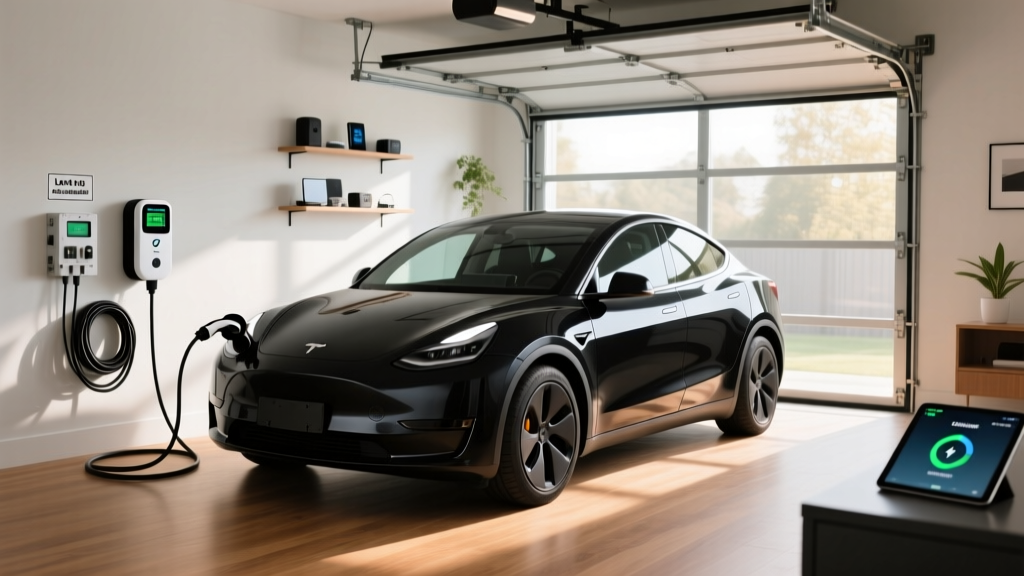
You have two realistic options. Level 1 charging plugs into any standard 120V household outlet and adds roughly 3–5 miles of range per hour — fine for plug-in hybrids or EVs driven under 30 miles daily. Level 2 charging requires a 240V circuit (like a dryer outlet) and adds 20–44 miles per hour, fully recharging most EVs overnight. A Level 2 home charger costs $500–$1,200 for hardware plus $800–$2,500 for professional installation, depending on your electrical panel. Most EV owners who install Level 2 report that home charging covers 90–95% of their driving needs.
Level 1 vs Level 2 Home Charging: What's the Real Difference?
Before buying any equipment, understand what each level actually delivers. The numbers below reflect real-world conditions, not marketing claims.
| Level | Voltage | Power (kW) | Miles Added/Hour | Full Charge (75 kWh Battery) | Best For |
|---|---|---|---|---|---|
| Level 1 | 120V (standard outlet) | 1.2–1.9 kW | 3–5 mi/hr | 40–65 hours | PHEVs, low-mileage commuters, temporary use |
| Level 2 | 240V (dedicated circuit) | 7.2–11.5 kW | 20–44 mi/hr | 7–11 hours | Daily EV drivers, full overnight recharge |
The critical distinction most new buyers miss: a Level 1 outlet technically works with any EV, but for a battery-electric vehicle with a 75–100 kWh pack, it's impractical as a primary strategy. If you drive 40 miles round-trip and plug in for 10 hours overnight on Level 1, you'll recover only 30–50 miles — barely enough on most days, and inadequate if you detour or drive in cold weather (where efficiency drops 15–30%). Level 2 solves this completely.
Important terminology note: kW (kilowatts) measures power — how fast energy flows into your car. kWh (kilowatt-hours) measures energy — the total capacity of your battery. Think of kW as the width of a hose and kWh as the size of the bucket you're filling. A 75 kWh battery charged at 11.5 kW takes roughly 6.5 hours from empty; at 1.4 kW (Level 1), it takes over 53 hours.
Level 2 Home Charger Installation: Cost Breakdown
Installation costs vary dramatically based on your home's electrical infrastructure. Here's what to budget for, based on typical 2026 pricing across US markets:
| Component | Simple Install (panel nearby) | Complex Install (panel upgrade / long run) |
|---|---|---|
| Level 2 charger hardware (hardwired or NEMA 14-50) | $400–$700 | $500–$1,200 |
| Electrician labor (240V circuit, 40–60A) | $500–$1,000 | $1,200–$2,500 |
| Electrical panel upgrade (100A → 200A, if needed) | N/A | $1,500–$3,500 |
| Permit and inspection | $50–$200 | $100–$350 |
| Total estimated cost | $950–$1,900 | $3,300–$7,550 |
The single biggest cost variable is whether your electrical panel has spare capacity. Most modern homes with a 200-amp panel can accommodate a 40–60 amp dedicated circuit without issue. Older homes with 100-amp service often need a panel upgrade before adding a high-amperage EV circuit. Get a licensed electrician to evaluate your panel before purchasing hardware — some utilities offer free or discounted pre-installation assessments.
Panel capacity gotcha: A 48-amp Level 2 charger requires a 60-amp circuit (National Electrical Code mandates circuits be rated at 125% of continuous load). Don't assume a 50-amp breaker is sufficient for a 48-amp charger. Your electrician will calculate available amperage using a load calculation per NEC Article 220.
Smart Charger vs. Dumb Charger: Is It Worth the Premium?
A "smart" charger ($500–$1,200) connects to Wi-Fi and offers scheduling, energy monitoring, and utility demand-response integration. A basic "dumb" charger ($300–$500) simply delivers power when plugged in. If your utility offers time-of-use (TOU) rates or EV-specific off-peak plans, a smart charger's scheduling feature pays for itself by ensuring you charge during the cheapest hours (typically 11 PM–6 AM). Popular 2026 options include the ChargePoint Home Flex, Emporia Level 2, and Tesla Wall Connector.
What Does Home EV Charging Actually Cost vs. Gas?
This is where EV ownership economics become compelling — but only if you can charge at home. Public DC fast charging narrows or eliminates the cost advantage.
| Scenario | Cost per kWh / Gallon | Cost per 1,000 Miles | Annual Cost (12,000 mi) |
|---|---|---|---|
| Home Level 2 (national avg. electricity $0.17/kWh, EV at 3.5 mi/kWh) | $0.17/kWh | $48.57 | $583 |
| Home Level 2 (off-peak TOU rate $0.09/kWh) | $0.09/kWh | $25.71 | $309 |
| Public DC fast charging ($0.35–$0.48/kWh avg.) | $0.42/kWh | $120.00 | $1,440 |
| Gas car (28 MPG combined, $3.40/gallon) | $3.40/gal | $121.43 | $1,457 |
| Hybrid HEV (50 MPG combined, $3.40/gallon) | $3.40/gal | $68.00 | $816 |
The data is clear: home-charged EVs cost 60–80% less to "fuel" than comparable gas vehicles. But rely exclusively on public fast charging and your costs match or exceed a gas car. This is why home charging access is the single most important factor in EV ownership satisfaction.
According to the U.S. Department of Energy's fueleconomy.gov, the average EV achieves 3–4 miles per kWh, though efficiency varies by model, driving style, and temperature. A Hyundai Ioniq 6 SE (one of the most efficient 2026 EVs) achieves roughly 4.2 mi/kWh, while a heavier SUV like the Ford F-150 Lightning manages closer to 2.0–2.3 mi/kWh.
Real-World Considerations: Climate, Driving Patterns & Access
EV ownership isn't one-size-fits-all. These factors determine whether home charging alone is sufficient:
Cold-Weather Range and Charging Impact
At 20°F, most EVs lose 20–35% of their EPA-rated range due to battery chemistry limitations and cabin heating demands. An EV rated at 300 miles EPA might deliver 195–240 real-world miles in freezing conditions. Home charging still works in cold weather, but charging speeds on Level 2 may be slightly reduced until the battery warms. If you garage your car, this effect is minimized. Some EVs with heat pumps (standard on many 2026 models from Hyundai, Kia, and Tesla) recover 5–10% of cold-weather efficiency compared to resistive heating.
Daily Driving Distance vs. Charging Speed
Map your typical week. The Federal Highway Administration reports the average American drives roughly 37 miles per day. At that rate, even Level 1 charging (adding ~40 miles over 10 hours) could technically keep up. But real life includes detours, errands, and weekend trips. Level 2 provides a buffer that makes ownership stress-free.
Apartment and Condo Dwellers
If you can't install a home charger, EV ownership is significantly harder. Options include workplace charging, public Level 2 networks (ChargePoint, EVgo, Electrify America), and DC fast charging. Some states now require landlords and HOAs to permit charger installation under "right-to-charge" laws. Check your local regulations before assuming installation is impossible.
Common Misconceptions About Home EV Charging
| Myth | Fact |
|---|---|
| "I need to charge to 100% every night" | Most manufacturers recommend daily charging to 80% (especially for NMC/NCA batteries). Set your car's charge limit to 80% and only charge to 100% before road trips. LFP batteries (found in some Tesla Model 3/Y and Ford Mustang Mach-E trims) tolerate regular 100% charges better. |
| "Home charging will spike my electric bill" | Adding an EV typically increases a household electric bill by $40–$70/month (at national average rates for 12,000 miles/year), far less than the $100–$120/month spent on gasoline for the same distance. |
| "I need a Tesla to use a Tesla Wall Connector" | The Tesla Wall Connector ships with a NACS (North American Charging Standard) plug, but with the industry-wide adoption of NACS by Ford, GM, Rivian, Hyundai, and others for 2025–2026 models, most new EVs can now use it natively or with a simple adapter. |
| "Level 2 charging degrades the battery faster than Level 1" | Level 2 home charging (7–11 kW) causes negligible additional degradation compared to Level 1. DC fast charging (50–350 kW) at high frequencies is what accelerates wear. Occasional DCFC is fine; daily DCFC is what to avoid. |
| "My home wiring can't handle an EV charger" | Most homes built after 1980 with 200-amp service can accommodate a Level 2 charger. A licensed electrician's load calculation will confirm this. Even 100-amp panels can sometimes support a lower-amperage (16–24 amp) Level 2 charger without upgrade. |
Tax Credits and Incentives for Home Charging
The federal Alternative Fuel Vehicle Refueling Property Credit (IRS Form 8911) covers up to 30% of home charger hardware and installation costs, capped at $1,000 per year. However, eligibility depends on whether your census tract qualifies as a low-income or non-urban area — a requirement that excludes many suburban and urban installations. Always verify eligibility on the IRS site or with a tax professional before counting on this credit.
Separately, the §30D New Clean Vehicle Credit of up to $7,500 applies to qualifying EV purchases (not charging equipment), subject to MSRP caps ($80,000 for SUVs/pickups/vans, $55,000 for sedans), buyer income limits ($150K single / $300K joint), and battery critical-mineral sourcing requirements that tighten annually. As of 2026, fewer models qualify for the full credit due to stricter sourcing rules. Check the latest IRS vehicle eligibility list before purchasing.
Many utilities also offer rebates of $200–$750 for Level 2 charger purchases or off-peak charging enrollment. Check your local utility's EV programs page.
Decision Framework: Which Home Charging Setup Is Right for You?
Use this guide to match your situation to the right setup:
- Choose Level 1 only if: You drive a PHEV with under 40 miles of electric range, your daily commute is under 25 miles, you have no ability to install a 240V circuit (renter without landlord approval), or you're waiting on a panel upgrade and need a temporary solution.
- Choose Level 2 (40-amp circuit / 32-amp charger) if: You drive a mid-size EV (60–80 kWh battery), your daily driving is 30–60 miles, your panel has limited spare capacity, or you want a balance of cost and speed.
- Choose Level 2 (60-amp circuit / 48-amp charger) if: You drive a large-battery EV (85–130 kWh, like an F-150 Lightning, Rivian R1T, or GMC Hummer EV), you frequently drive 60+ miles daily, or you want maximum overnight flexibility for road-trip recharging.
- Investigate panel upgrade + Level 2 if: Your home has 100-amp service, you already use significant 240V loads (electric range, dryer, HVAC), or your electrician's load calculation shows insufficient spare amperage.
- Rely on public charging if: You cannot install at home and have reliable workplace or public Level 2 access within 0.5 miles. Understand this increases your per-mile cost by 2–4x compared to home charging.
Step-by-Step: Installing Your First Home Charger
- Assess your electrical panel. Locate your main breaker and note its amperage (100A, 150A, or 200A). Check for open breaker slots. This gives you a rough sense of capacity before calling an electrician.
- Get a professional load calculation. A licensed electrician will perform an NEC Article 220 load calculation to determine if your panel can support a 40–60 amp EV circuit. Cost: typically $100–$250 for the assessment, often credited toward installation.
- Choose your charger. Match the charger's amperage to your available circuit. Key considerations: NACS vs. CCS connector compatibility with your vehicle, cord length (18–25 ft recommended), indoor/outdoor rating, and smart features for utility TOU scheduling.
- Obtain permits. Most jurisdictions require an electrical permit for a new 240V circuit. Your electrician typically handles this. Cost: $50–$350 depending on locality.
- Schedule installation and inspection. A standard install takes 2–6 hours. After completion, your local inspector will verify code compliance before you energize the circuit.
- Configure charge settings. Set your vehicle's charge limit to 80% for daily use (unless you have an LFP battery). Program charging schedules to coincide with off-peak utility hours if applicable.
Home Charging Equipment Picks for 2026
These are widely available, well-reviewed Level 2 chargers suited to most homes:
- ChargePoint Home Flex — Up to 50 amps (requires 60A circuit), NACS and J1772 options, Wi-Fi scheduling, ~$650. Strong utility integration.
- Emporia Level 2 Smart Charger — Up to 48 amps (60A circuit), energy monitoring with whole-home panel integration, ~$400. Best value for data-focused owners.
- Tesla Wall Connector — Up to 48 amps, NACS native, ~$475. Ideal for Tesla owners and the growing NACS-adopting fleet (Ford, GM, Rivian, Hyundai/Kia 2025+ models).
- Grizzl-E Smart — 40 amps (50A circuit), extreme cold/dust rated, Canadian-built, ~$450. Excellent for unheated garages and harsh climates.
Frequently Asked Questions
Can I plug my EV into a regular household outlet?
Yes. Every EV sold in the US includes (or supports) a Level 1 charging cable that plugs into a standard 120V NEMA 5-15 outlet. However, this delivers only 1.2–1.9 kW, adding 3–5 miles per hour. It's practical for PHEVs and occasional top-ups but too slow as a primary strategy for most battery-electric vehicles.
Do I need to charge my EV every night?
No. Modern EV batteries are large enough that most drivers need to charge only 2–4 times per week, depending on daily mileage. Set your car's charge limit to 80% for NMC/NCA chemistry and let it charge whenever plugged in. You don't need to start each session from a low state of charge — lithium-ion batteries prefer partial cycles over deep discharges.
Will charging an EV at home trip my circuit breaker?
Not if the circuit is properly sized. A dedicated 40–60 amp 240V circuit for your Level 2 charger is separate from your home's other loads. Problems arise only if someone installs a charger on a shared circuit or exceeds the panel's total load capacity — which is exactly why a professional load calculation is essential.
How long does a Level 2 charger take to fully charge my EV?
For a typical 75 kWh battery on a 48-amp (11.5 kW) Level 2 charger: approximately 6.5 hours from empty to full. For a larger 100 kWh battery: roughly 8.5–9 hours. In practice, you rarely charge from 0% — most sessions start at 20–30% and finish overnight in 4–6 hours.
Should I get a hardwired charger or one with a plug (NEMA 14-50)?
Hardwired units are slightly more reliable (no plug connection to degrade), support higher amperage (up to 48 amps / 60A circuit), and are preferred by most electricians. NEMA 14-50 plug-in units offer portability — you can take the charger with you if you move — but are limited to 40 amps continuous (50A circuit) and require a properly installed, high-quality 14-50 receptacle. Some cheap 14-50 outlets have caused overheating incidents; insist on a commercial-grade Hubbell or Bryant receptacle if going the plug-in route.
Does home charging affect my EV battery warranty?
No. Home Level 1 and Level 2 charging is the manufacturer-recommended method and does not void any warranty. Federal law requires EV battery warranties of at least 8 years / 100,000 miles (covering capacity retention, typically to 70% of original). Only misuse — such as leaving the car at 100% SoC in extreme heat for weeks — could potentially affect warranty claims.
What if I live in an apartment or don't have a garage?
Options include: requesting your landlord or HOA install a shared Level 2 charger (many states now have right-to-charge laws), using a curbside Level 2 network like ChargePoint or EVgo, relying on workplace charging, or choosing a PHEV instead of a full BEV to reduce charging frequency. Outdoor-rated Level 2 chargers can be installed on exterior walls or posts if you have driveway parking but no garage.