The Quick Answer: How to Charge an Electric Vehicle
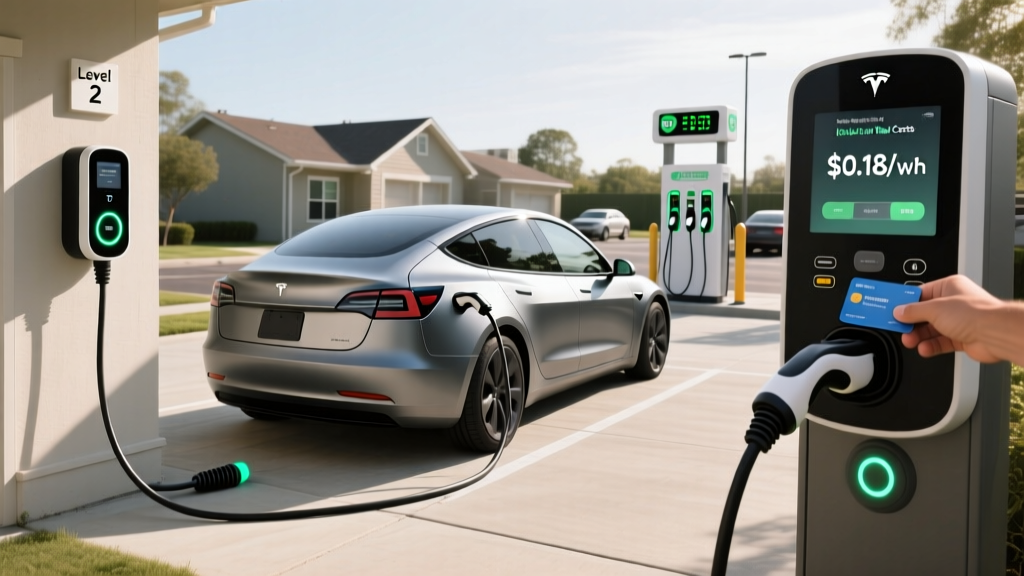
You charge an EV by plugging it into one of three power sources: a standard 120V wall outlet (Level 1, adding ~3–5 miles of range per hour), a 240V home or public AC charger (Level 2, adding ~20–44 miles per hour), or a DC fast charger along highways (Level 3, adding 150–300+ miles in 15–25 minutes). Most daily charging happens at home overnight on Level 2, where electricity costs roughly $0.04–$0.06 per mile — about one-third the fuel cost of a comparable gas car. For road trips, DC fast charging costs $0.12–$0.20 per mile depending on the network and time of day.
Understanding the Three Charging Levels
Before plugging in, you need to know the difference between kW (kilowatts) and kWh (kilowatt-hours). kW measures the rate of power delivery — like the diameter of a hose. kWh measures the total energy stored in your battery — like the size of the tank. A 75 kWh battery charged at 11 kW takes roughly 7 hours from empty to full.
| Level | Voltage | Power (kW) | Miles Added/Hour | Best For | Typical Cost |
|---|---|---|---|---|---|
| Level 1 | 120V AC | 1.0–1.4 kW | 3–5 mi | Overnight top-ups, PHEVs, low-mileage drivers | $0.03–$0.05/mi (home rate) |
| Level 2 | 240V AC | 3.3–19.2 kW | 12–75 mi | Daily home/workplace charging | $0.04–$0.06/mi (home); $0.10–$0.18/mi (public) |
| DC Fast Charge | 400–800V DC | 50–350 kW | 150–1,200 mi/hr equivalent | Road trips, quick top-ups | $0.12–$0.20/mi (varies by network) |
Level 1: The Emergency Backup
Every EV ships with a mobile cord that plugs into a standard household 120V outlet. It delivers about 1.2 kW — enough to add roughly 4 miles of range per hour of charging. For a plug-in hybrid with 30 miles of electric range (like the 2026 Toyota RAV4 Prime), Level 1 is perfectly adequate overnight. For a long-range BEV with a 75–100 kWh battery, Level 1 is impractical as a primary method: a full charge would take 60–80 hours.
Level 2: Where Most EV Owners Live
A 240V Level 2 station — the same voltage as your electric dryer — is the backbone of practical EV ownership. Most home chargers deliver 7.7 kW to 11.5 kW on a 40- to 48-amp circuit. At 11.5 kW, you add roughly 40–44 miles of range per hour, meaning an overnight session (8–10 hours) fully replenishes nearly any EV on the market.
Popular 2026 home units include the ChargePoint Home Flex ($699, up to 50 amps), the Tesla Wall Connector ($450, up to 48 amps), and the Emporia Level 2 ($399, up to 48 amps). All use the J1772 connector standard, which every non-Tesla EV in the US accepts. Tesla vehicles now ship with a NACS (North American Charging Standard) port, and adapters are widely available for J1772 Level 2 stations.
DC Fast Charging: Road-Trip Essential
DC fast chargers bypass the car's onboard charger and push current directly into the battery at 50–350 kW. Here's where the charging curve matters: an EV rated for "250 kW peak" does not sustain 250 kW for the entire session. Most vehicles charge fastest between 10% and 50% state of charge (SoC), then taper significantly above 80% to protect the battery. A typical 10–80% session on a 250 kW-capable vehicle takes 18–25 minutes; pushing from 80–100% can add another 20–30 minutes.
Home Charging Installation: What It Actually Costs
Assuming all readers have a garage or driveway with easy panel access would be a mistake. Home charging installation costs vary enormously based on your electrical panel's capacity, the distance from panel to charger location, and local permit requirements.
| Component | Low-End | High-End | Notes |
|---|---|---|---|
| Level 2 charger hardware | $399 | $699 | Emporia, ChargePoint, Tesla Wall Connector |
| Electrician labor (standard install) | $400 | $1,200 | Short run, 240V/50A circuit near panel |
| Electrician labor (complex install) | $1,200 | $3,500 | Long conduit runs, trenching, or sub-panel |
| Electrical panel upgrade (if needed) | $1,500 | $4,000 | Upgrading from 100A to 200A service |
| Permit and inspection | $50 | $300 | Varies by municipality |
| Total (typical scenario) | $850 | $2,200 | Most homes with 200A panel, short run |
Apartment and condo dwellers: If you lack dedicated parking with electrical access, your options narrow to workplace charging, public Level 2 stations, and DC fast charging. Several states now have "right to charge" laws requiring HOAs and landlords to permit installation — check your local regulations. Some public networks like ChargePoint and EVgo offer monthly subscription plans ($30–$50/month) that reduce per-kWh costs for frequent users.
Charging Costs vs. Gas: The Real-World Math
This is where EV ownership economics either shine or disappoint, depending on your electricity rate and driving patterns. The national average residential electricity rate in early 2026 sits around $0.17/kWh (EIA data). At an average EV efficiency of 3.5 miles per kWh (roughly 100 MPGe combined), that works out to $0.049 per mile charging at home.
A comparable gas vehicle averaging 28 MPG at $3.40/gallon costs $0.121 per mile in fuel alone. Over 15,000 annual miles, that's $735 in electricity versus $1,821 in gasoline — a $1,086 annual fuel savings.
| Scenario | Cost per Mile | Annual Cost | 5-Year Cost |
|---|---|---|---|
| EV — home charging only ($0.17/kWh) | $0.049 | $735 | $3,675 |
| EV — 70% home / 30% DC fast ($0.35/kWh avg) | $0.065 | $975 | $4,875 |
| EV — 100% public DC fast charging | $0.10–$0.14 | $1,500–$2,100 | $7,500–$10,500 |
| Gas car (28 MPG, $3.40/gal) | $0.121 | $1,821 | $9,105 |
| Hybrid (50 MPG, $3.40/gal) | $0.068 | $1,020 | $5,100 |
The numbers reveal a critical insight: EVs are cheapest to fuel when charged at home. If you rely entirely on public DC fast charging, your costs can approach or even exceed a hybrid's fuel costs. This is why home charging access is the single biggest factor in EV satisfaction.
Public Charging Networks: What to Expect in 2026
The US public charging landscape has consolidated significantly. The Tesla Supercharger network — now open to non-Tesla EVs via the NACS standard or Magic Dock adapter — operates over 30,000 stalls in North America, many at 250 kW (V3) or 350 kW (V4). Electrify America, EVgo, and ChargePoint round out the major DC fast-charging providers.
Real-world reliability varies. According to J.D. Power's 2025 EV Charging Experience study, Tesla Superchargers continue to lead in uptime and satisfaction, while non-Tesla networks have improved but still experience 10–15% failure rates at some locations. Before a road trip, check PlugShare or your vehicle's built-in navigation for real-time stall availability and user-reported status.
Connector Compatibility in 2026
The connector landscape has shifted decisively toward NACS. Ford, GM, Rivian, Hyundai, Kia, and most other automakers now equip their 2025+ EVs with the NACS port. Legacy CCS1 vehicles can access Superchargers via adapter. CHAdeMO remains only on the aging Nissan Leaf and is effectively a dead standard for new vehicles.
Real-World Charging Considerations: Climate, Battery Health, and Preconditioning
Cold Weather Charging
Lithium-ion batteries charge slower and hold less usable energy in cold temperatures. In testing below 20°F, expect 15–30% range reduction and significantly slower DC fast charging speeds unless you precondition. Preconditioning warms the battery before you arrive at a charger, either automatically (when you navigate to a charger in the vehicle's nav system) or manually via the vehicle's app. A preconditioned battery at a 250 kW charger might accept 200+ kW; a cold, un-preconditioned battery may cap at 50–80 kW for the first 10–15 minutes.
Battery Longevity and the 80% Rule
Most EV batteries use NMC (nickel manganese cobalt) or LFP (lithium iron phosphate) chemistry. NMC batteries degrade faster when regularly charged to 100% or deeply discharged; many manufacturers recommend daily charging to 80% and reserving 100% for road trips. LFP batteries (found in standard-range Tesla Model 3/Y, some Ford and Rivian models) tolerate regular 100% charges and generally offer longer cycle life, though at lower energy density.
Per fueleconomy.gov, federally mandated battery warranties require at least 8 years/100,000 miles of coverage with a capacity retention threshold (typically 70% of original capacity). In practice, data from Recurrent Auto shows most modern EV batteries retain 90%+ capacity after 100,000 miles under normal use.
Time-of-Use Rates and Smart Charging
Many utilities offer time-of-use (TOU) plans where off-peak electricity (typically 10 PM – 6 AM) costs 40–60% less than peak rates. Scheduling your EV to charge overnight on a TOU plan can reduce your effective cost to $0.03–$0.04 per mile. Most Level 2 chargers and EV apps support scheduled charging windows.
EV vs. Gas vs. Hybrid: Which Makes Sense for You?
| Factor | Battery EV (BEV) | Plug-in Hybrid (PHEV) | Gas / Standard Hybrid (HEV) |
|---|---|---|---|
| Fuel cost per mile | $0.04–$0.06 (home) | $0.04 electric / $0.10 gas | $0.07–$0.12 |
| Home charging needed? | Strongly recommended | Recommended for EV-mode value | No |
| Road-trip convenience | 20–30 min charging stops | No stops needed (gas backup) | 5 min fill-up |
| Maintenance cost/yr | ~$300–$500 | ~$500–$800 | ~$600–$1,000 |
| Federal tax credit (§30D) | Up to $7,500 (if eligible) | Up to $7,500 (if eligible) | None |
| Cold-weather range impact | 15–30% loss | Minimal (gas engine available) | Minimal |
| Typical starting MSRP | $30,000–$55,000 | $33,000–$52,000 | $24,000–$42,000 |
Common EV Charging Myths — Corrected With Data
| Myth | Fact |
|---|---|
| "EV batteries need replacing every few years" | Federal warranty mandates 8 yrs/100k mi minimum. Real-world data shows 90%+ capacity retention at 100k miles for modern packs. Full replacement (rare) costs $5,000–$20,000 depending on the vehicle. |
| "Charging takes hours on road trips" | Modern DC fast charging (10–80%) takes 18–25 minutes on vehicles with 200+ kW capability. That's roughly one rest stop per 2–3 hours of driving. |
| "You need solar panels to make EVs worthwhile" | Even on a coal-heavy grid, EVs produce fewer lifecycle emissions than gas cars (EPA analysis). On average US grid power, an EV emits roughly 60% less CO₂ per mile. |
| "Public chargers are always broken" | Tesla Supercharger uptime exceeds 99%. Non-Tesla networks average 85–90% uptime. Planning apps (PlugShare, A Better Routeplanner) show real-time status. |
| "Fast charging ruins the battery" | Occasional DC fast charging has minimal impact on long-term health. Modern thermal management systems keep cells within safe temperature ranges. Daily L2 home charging is ideal; frequent DCFC adds negligible degradation. |
Decision Framework: How Should You Charge?
If/Then Charging Guide
- If you have a garage/driveway with 240V access or panel capacity → Install a Level 2 home charger. This covers 90%+ of your charging needs at the lowest cost. Budget $800–$2,200 total.
- If you drive under 40 miles/day and only have a 120V outlet → Level 1 may suffice, especially for a PHEV or efficient BEV. Add 30–40 miles overnight.
- If you live in an apartment without charging → Prioritize workplace charging availability or a reliable public L2/DCFC route near your home. Consider a PHEV if DC fast-charging access is poor.
- If you road-trip frequently (>500 miles/month highway) → Choose an EV with 250+ kW DC fast charging capability and 300+ miles EPA range (e.g., Hyundai Ioniq 5, Tesla Model 3 Long Range, Chevrolet Silverado EV). Plan routes via A Better Routeplanner.
- If you live in a cold climate (sustained sub-30°F winters) → Budget for 20–30% winter range loss. Prioritize vehicles with heat pumps (standard on most 2025+ EVs) and always precondition before fast charging.
- If you can't install home charging and road-trip often → A PHEV (like the 2026 RAV4 Prime or Jeep Wrangler 4xe) gives you 25–40 miles of electric commuting with unlimited gas range. Best of both worlds.
Federal Tax Credit and Charging Incentives
Under IRS §30D rules, qualifying new EVs and PHEVs can receive up to $7,500 in federal tax credits — now available as a point-of-sale rebate transferred to the dealer. However, eligibility depends on:
- Buyer income caps: $150,000 single / $225,000 head of household / $300,000 joint MAGI
- MSRP caps: $55,000 for sedans, $80,000 for SUVs, trucks, and vans
- Battery sourcing requirements: Critical minerals and battery components must meet escalating domestic/free-trade-agreement thresholds each year
- Domestic assembly: Vehicle must undergo final assembly in North America
Additionally, the Alternative Fuel Vehicle Refueling Property Credit (§30C) provides up to $1,000 (30% of cost) for home charger installation in qualifying census tracts. Check your eligibility on the IRS site before purchasing equipment.
Frequently Asked Questions
Can I charge an EV from a regular household outlet?
Yes. A standard 120V outlet provides Level 1 charging at about 1.2 kW, adding 3–5 miles of range per hour. It's adequate for plug-in hybrids and low-mileage BEV drivers but too slow as a primary method for most long-range EVs. A full charge on a 75 kWh battery would take 60+ hours.
How much does it cost to install a Level 2 charger at home?
Expect $850–$2,200 for a typical installation (hardware + electrician + permit) if your electrical panel has spare capacity. If you need a panel upgrade from 100A to 200A service, add $1,500–$4,000. Always get a quote from a licensed electrician before purchasing equipment.
Is it bad to charge my EV to 100% every day?
For NMC batteries (most long-range EVs), daily 100% charging accelerates degradation slightly — most manufacturers recommend 80% for daily use and 100% for trips. For LFP batteries (standard-range Tesla Model 3/Y, some Ford models), regular 100% charging is fine and often recommended for accurate state-of-charge calibration.
How long does it take to charge an EV on a road trip?
On a modern DC fast charger (200–350 kW), a 10–80% session takes 18–25 minutes for vehicles with capable charge curves (e.g., Hyundai Ioniq 5, Porsche Taycan, Tesla Model 3). Older or lower-power EVs (50–100 kW peak) may take 35–60 minutes for the same session.
Do I need a Tesla to use Superchargers?
No. As of 2025, most major automakers have adopted the NACS connector, and Tesla Superchargers are open to non-Tesla EVs equipped with NACS ports or using Tesla's Magic Dock adapter. The Supercharger network now serves Ford, GM, Rivian, Hyundai, Kia, and other NACS-equipped vehicles.
What happens if I run out of charge on the road?
The same thing as running out of gas — you'll need a tow to the nearest charger. However, EVs provide extensive low-charge warnings and will route you to chargers proactively. Roadside assistance services (AAA and manufacturer programs) increasingly offer mobile charging or flatbed tows to the nearest station. In practice, "running out" is rare with modern 250+ mile range vehicles and good route planning.