Quick Answer: How Do You Charge an Electric Car at Home?
You charge an electric car at home by plugging it into either a standard 120-volt wall outlet (Level 1, adding ~3–5 miles of range per hour) or a professionally installed 240-volt circuit with a Level 2 wallbox (adding ~20–40 miles per hour). Most EV owners install a Level 2 charger in their garage or driveway, plug in overnight, and wake up to a full or near-full battery every morning — eliminating weekly gas station visits. Expect to pay $500–$1,800 for the charger hardware and $800–$3,500 for electrical installation depending on your panel capacity and wiring distance.
Level 1 vs Level 2: Which Home Charging Setup Do You Actually Need?
The single biggest decision in home EV charging is whether a standard outlet is enough or whether you need to invest in a 240V Level 2 installation. The answer depends on three numbers: your daily mileage, your car's battery size in kWh (kilowatt-hours — the energy capacity), and how many hours your car sits parked at home.
Level 1 charging uses a standard 120V household outlet and the portable cord that ships with most EVs. It delivers roughly 1.2–1.4 kW of power, which translates to about 3–5 miles of range per hour of charging. For a 250-mile EPA-rated EV with an 80 kWh battery, a full 0–100% charge on Level 1 takes approximately 60–70 hours.
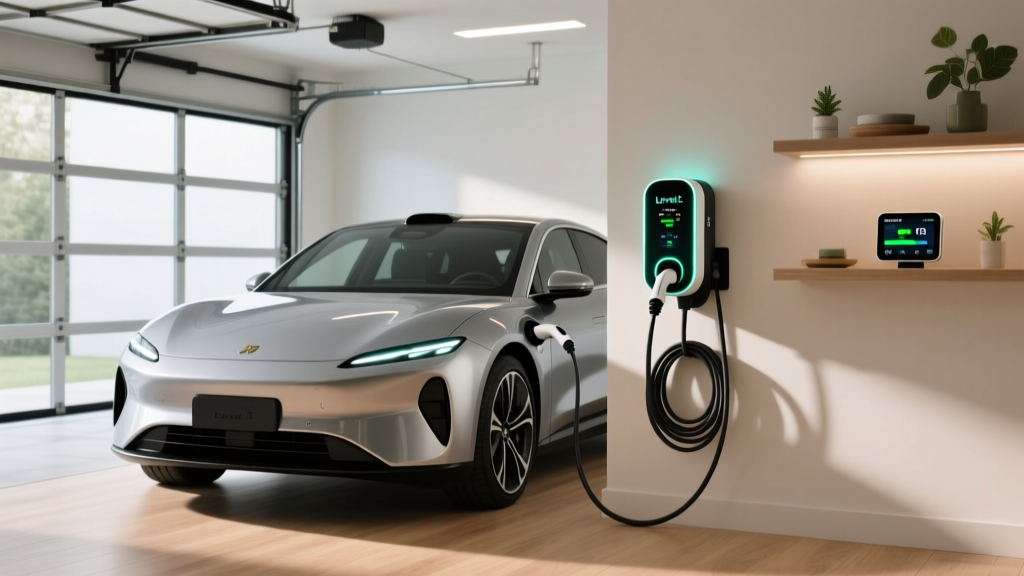
Level 2 charging requires a dedicated 240V circuit (the same voltage as your electric dryer or oven) and a wall-mounted or portable Level 2 charger. Most residential units deliver 7.2–11.5 kW, adding 20–44 miles of range per hour. That same 80 kWh battery charges from 0–100% in roughly 7–11 hours — easily overnight.
| Charging Level | Voltage | Power (kW) | Miles of Range Added/Hour | 0–100% Time (80 kWh Battery) | Best For |
|---|---|---|---|---|---|
| Level 1 | 120V | 1.2–1.4 kW | 3–5 miles | ~60–70 hours | Low daily mileage (<20 mi/day), PHEVs, budget setup |
| Level 2 (32A) | 240V | 7.7 kW | ~25 miles | ~10 hours | Most EV owners, typical garage install |
| Level 2 (48A) | 240V | 11.5 kW | ~37–44 miles | ~7 hours | Large batteries, high daily mileage, faster turnaround |
The practical rule: If your daily round-trip commute is under 30 miles and you park for 12+ hours overnight, Level 1 may technically suffice. But the overwhelming majority of EV owners — especially those with battery-electric vehicles (BEVs) rather than plug-in hybrids (PHEVs) — find Level 2 essential for convenience, flexibility, and the ability to precondition the battery without draining range.
Real Costs: Equipment, Electrical Work, and Your Monthly Bill
Home charging setup costs break into two categories: the upfront installation and the ongoing electricity cost. Here is what you can expect in 2026.
Upfront Installation Cost Breakdown
| Component | Low End | High End | Notes |
|---|---|---|---|
| Level 2 charger hardware (hardwired or NEMA 14-50 plug) | $350 | $750 | Popular options: ChargePoint Home Flex, Emporia Vue, Tesla Wall Connector |
| Electrical permit | $50 | $300 | Varies by municipality; required in most jurisdictions |
| Electrician labor (standard install, panel nearby) | $500 | $1,500 | Short wire run from panel to garage, 50A circuit |
| Electrical panel upgrade (if needed) | $1,500 | $4,000 | Required if your panel is 100A or has no spare capacity |
| Total (no panel upgrade) | $900 | $2,550 | Most common scenario for newer homes |
| Total (with panel upgrade) | $2,400 | $6,550 | Older homes with 100A service |
A critical detail many guides gloss over: your home's electrical panel capacity. If you have a 200-amp panel with available breaker slots, a 50-amp circuit for a Level 2 charger is straightforward. If you have a 100-amp panel — common in homes built before the 1990s — you will likely need a panel upgrade to 200A, which adds $1,500–$4,000. Always have a licensed electrician perform a load calculation before committing to a charger model.
Some utilities and state programs offer rebates covering $200–$1,000 of home charger installation costs. Check with your local utility and your state energy office for current programs.
Ongoing Electricity Cost: Charging at Home vs. Buying Gas
This is where EV ownership economics shift dramatically in your favor — if you charge at home. The U.S. average residential electricity rate in early 2026 is approximately $0.17 per kWh, though this varies enormously: roughly $0.12/kWh in parts of the Southeast and Pacific Northwest, and $0.30+/kWh in California and the Northeast.
| Vehicle Type | Efficiency | Cost per Mile | Annual Fuel/Energy Cost | 5-Year Cost |
|---|---|---|---|---|
| EV (home charging, $0.17/kWh avg) | 3.5 mi/kWh (115 MPGe) | $0.049 | $729 | $3,643 |
| EV (home charging, $0.12/kWh low-cost area) | 3.5 mi/kWh | $0.034 | $514 | $2,571 |
| EV (home charging, $0.30/kWh high-cost area) | 3.5 mi/kWh | $0.086 | $1,286 | $6,429 |
| Gas car (28 MPG combined) | 28 MPG | $0.114 (@ $3.20/gal) | $1,714 | $8,571 |
| Gas car (22 MPG combined, truck/SUV) | 22 MPG | $0.145 (@ $3.20/gal) | $2,182 | $10,909 |
At the national average electricity rate, home EV charging costs roughly one-third to one-half what gasoline costs per mile. Over five years, the fuel savings alone range from $3,000 to $7,000 depending on your local electricity rate, driving volume, and the gas vehicle you are replacing. Data from fueleconomy.gov lets you compare specific EV models against their gas equivalents with your local energy prices.
How to Set Up Level 2 Home Charging: A Step-by-Step Process
Here is the practical sequence for getting a Level 2 charger installed at your home, drawn from real-world ownership experience and common pitfalls.
Step 1: Check your electrical panel. Locate your main service panel and identify its amperage rating (100A, 150A, or 200A) and available breaker slots. A Level 2 charger on a 48A continuous circuit requires a 60A breaker. If you are unsure, a quick consultation with a licensed electrician ($100–$200 for a site visit) will give you a definitive answer.
Step 2: Choose your charger. Key specifications to evaluate:
- Amperage: 32A (7.7 kW) or 48A (11.5 kW) are the most common. Match to your circuit capacity and your car's onboard charger limit — many EVs max out at 11.5 kW acceptance, so a 48A charger captures the full rate.
- Connector type: The North American Charging Standard (NACS) is now the dominant connector for new EVs from Tesla, Ford, GM, Rivian, Hyundai, Kia, and others. CCS1 is still found on some 2023–2025 models. Most chargers offer both or adapter compatibility.
- Hardwired vs. plug-in: Hardwired units (directly connected to your wiring) support the full 48A and eliminate the need for a 240V outlet. Plug-in units use a NEMA 14-50 outlet (50A circuit), cap at 40A continuous, and offer portability if you move.
- Smart features: Wi-Fi-connected chargers enable scheduling (charge during off-peak utility rates), energy monitoring, and integration with solar panels or utility demand-response programs.
- Cable length: 18–25 feet is standard. Measure the distance from your planned mount point to your car's charge port.
Step 3: Get quotes from licensed electricians. Obtain at least two quotes. Ask specifically about wire gauge (6 AWG copper for 50A, 4 AWG for 60A), conduit requirements, and whether your panel needs a load calculation or upgrade. Confirm they will pull a permit — unpermitted electrical work can void your homeowner's insurance and create a safety hazard.
Step 4: Install and configure. A standard installation takes 2–4 hours. After installation, configure your charger's amperage setting to match the circuit (NEC code requires continuous loads to be 80% of breaker rating — a 60A breaker supports 48A continuous). Set charging schedules to align with off-peak utility hours if your provider offers time-of-use rates, which can drop your effective rate to $0.08–$0.12/kWh overnight.
EV vs. Gas vs. Hybrid: Where Does Home Charging Fit in the Decision?
Home charging access is the single most important factor in whether a full EV makes sense for your household. Here is a data-driven comparison of what ownership looks like across powertrains.
| Factor | Battery EV (BEV) | Plug-In Hybrid (PHEV) | Gas Vehicle (ICE) |
|---|---|---|---|
| Home charging needed? | Strongly recommended | Recommended for EV-mode benefit | No |
| Typical electric-only range | 250–370 miles (EPA) | 25–50 miles (EPA) | N/A |
| Level 2 home charge time (0–100%) | 7–12 hours | 2–5 hours | |
| Annual "fuel" cost (15k mi, avg rates) | $514–$1,286 | $400–$900 (mixed EV + gas) | $1,714–$2,182 |
| Oil changes | None | Yes (engine) | Yes |
| Federal tax credit (§30D) | Up to $7,500 (eligibility varies) | Up to $7,500 (eligibility varies) | None |
| Cold-weather range impact | 20–30% loss at 20°F | EV range drops; engine compensates | Minimal MPG loss |
The home-charging litmus test: If you can install a Level 2 charger at home (or already have access to one at a workplace or apartment building), a BEV delivers the lowest operating costs and the smoothest daily ownership experience. If you cannot charge at home — street parking only, no garage access, landlord restrictions — a PHEV becomes a more practical electrified option because its gas engine eliminates range dependence on public charging infrastructure, which remains inconsistent in many regions.
Common Home Charging Myths — Addressed With Facts
| Myth | Fact |
|---|---|
| "Charging at home will massively increase my electric bill." | At $0.17/kWh and 15,000 miles/year, home EV charging adds roughly $60/month to your electric bill — while eliminating $140+/month in gas. Net savings: $80+/month. |
| "I need to upgrade my entire electrical system." | Most homes with a 200A panel can add a 50–60A EV circuit without a panel upgrade. Only older 100A panels typically require replacement. A load calculation from a licensed electrician confirms your situation. |
| "Plugging into a regular outlet is too slow to be useful." | Level 1 (120V) adds 3–5 miles per hour. If you drive 25 miles/day and park for 10+ hours overnight, that's 30–50 miles recovered — enough for many commuters. PHEV owners often find Level 1 sufficient for their smaller 10–20 kWh batteries. |
| "Home charging is bad for the battery." | Level 2 home charging is actually gentler on battery chemistry than repeated DC fast charging. Modern EV battery management systems (BMS) regulate temperature and charge rate. Setting a daily charge limit of 80% (for NMC batteries) or 100% (for LFP batteries) further optimizes longevity. Most EV batteries retain 90%+ capacity after 100,000 miles. |
| "I need a Tesla-specific charger for a Tesla." | The Tesla Wall Connector works with NACS-equipped vehicles from other brands, and third-party NACS chargers (ChargePoint, Emporia) work with Teslas. The NACS connector is now the industry standard. |
Real-World Ownership Considerations Most Guides Skip
Cold-weather charging: In sub-freezing temperatures, EV batteries charge more slowly until they warm up. If your EV supports it, use scheduled departure preconditioning — the car warms the battery while still plugged in, using grid power instead of battery power. This preserves range and ensures full regenerative braking from the moment you leave. Expect 20–30% range reduction at 20°F compared to the EPA sticker; for example, an EPA-rated 310-mile EV may deliver 220–250 real-world miles in deep winter.
Apartment and condo charging: If you live in a multi-unit building without a dedicated garage circuit, your options are more limited. Some states (California, Colorado, New York, and others) have "right to charge" laws that prevent HOAs and landlords from unreasonably blocking charger installation. Shared Level 2 chargers in parking garages are increasingly common, with costs billed through the charger's networked software. If none of these are available, a PHEV may be the more pragmatic electrified choice.
Solar panel synergy: If you have rooftop solar, home EV charging becomes even cheaper — potentially near-zero marginal cost during daylight hours. Configure your charger to prioritize solar production hours (typically 10 AM–4 PM) or pair it with a home battery system to charge overnight from stored solar energy.
Federal tax credits and incentives: The IRS §30D clean vehicle credit can provide up to $7,500 toward a qualifying new EV purchase (not the charger itself), but eligibility depends on vehicle MSRP caps ($55,000 for cars, $80,000 for SUVs/trucks), buyer income limits ($150,000 single / $300,000 joint AGI), and battery critical-mineral sourcing requirements. As of 2026, the credit can be transferred to the dealer at point of sale, reducing your purchase price directly. Check current eligibility on irs.gov before relying on specific credit amounts. Some utilities and states also offer separate rebates for Level 2 charger hardware and installation — typically $200–$1,000.
Decision Framework: What Type of Home Charging Setup Is Right for You?
If-This-Then-That: Your Home Charging Decision
- If you drive under 30 miles/day, own a PHEV, and want zero upfront investment → Start with Level 1 (120V). The portable cord included with your car handles daily needs. Upgrade later if your driving increases.
- If you drive 30–80 miles/day, own a BEV, and have a 200A panel with spare capacity → Install a 48A Level 2 hardwired charger ($900–$2,000 all-in). This covers daily driving plus weekend trips with overnight recovery.
- If you drive 80+ miles/day or regularly tow with your EV → Install a 48A Level 2 charger and confirm your EV's onboard charger accepts 11.5 kW. This is essential for high-mileage households.
- If you have a 100A electrical panel → Budget for a panel upgrade to 200A ($1,500–$4,000) in addition to charger costs. Alternatively, a lower-amperage Level 2 unit (16A/3.8 kW) on a 20A 240V circuit may work without a panel upgrade — consult your electrician.
- If you rent or live in a condo without charger access → Explore workplace charging, public Level 2 networks (ChargePoint, EVgo, Electrify America), or consider a PHEV to reduce charging dependency.
- If you have rooftop solar → Install a smart Level 2 charger with solar integration (e.g., Emporia, Wallbox) and schedule charging during peak production hours to minimize grid electricity costs.
Frequently Asked Questions About Home EV Charging
Can I use a regular household outlet to charge my EV?
Yes. Every EV sold in the U.S. comes with or can use a Level 1 charging cord that plugs into a standard 120V outlet. It charges slowly — roughly 3–5 miles of range per hour — but is sufficient for plug-in hybrids with smaller batteries (10–20 kWh) and for BEV owners who drive under 30 miles per day and park overnight. Think of it as trickle charging: it works, but most BEV owners upgrade to Level 2 for practicality.
How much does it cost to install a Level 2 charger at home?
Total installed cost ranges from $900 to $2,550 for most homes with an adequate electrical panel. If your home requires a panel upgrade from 100A to 200A, add $1,500–$4,000. The charger hardware itself costs $350–$750; the rest is electrician labor, wire, conduit, and permitting. Always get multiple quotes and confirm the electrician will pull a permit.
Is it cheaper to charge an EV at home or at public stations?
Home charging is significantly cheaper. At the $0.17/kWh national average, home charging costs roughly $0.05 per mile. Public DC fast charging networks typically charge $0.30–$0.50/kWh, translating to $0.09–$0.14 per mile — comparable to or sometimes more expensive than gasoline. Public charging is essential for road trips but should not be your primary charging strategy for cost reasons.
Does home charging damage my EV battery?
No — Level 2 home charging is one of the gentlest ways to charge an EV battery. DC fast charging (50–350 kW) generates more heat and accelerates degradation slightly over time. Home Level 2 charging at 7–11 kW produces minimal thermal stress. For NMC (nickel manganese cobalt) batteries, set your charge limit to 80% for daily use and 100% only before long trips. For LFP (lithium iron phosphate) batteries, manufacturers typically recommend charging to 100% regularly to maintain calibration. Refer to your vehicle's owner manual for chemistry-specific guidance.
What's the difference between kW and kWh?
This is the most common point of confusion for new EV owners. kW (kilowatts) measures power — the rate at which energy flows, analogous to the flow rate of a garden hose. A 48A Level 2 charger delivers 11.5 kW of power. kWh (kilowatt-hours) measures energy — the total amount stored or consumed, analogous to the total gallons in a bucket. An 80 kWh battery holds 80 kilowatt-hours of energy. Charging an 80 kWh battery at 11.5 kW takes roughly 7 hours (80 ÷ 11.5 ≈ 7). Confusing these two leads to misreading charger specs and charge time estimates.
Do I need a smart charger, or is a basic unit fine?
A basic (non-connected) Level 2 charger works perfectly for charging your car. A smart charger adds Wi-Fi connectivity, which enables off-peak scheduling (charge when electricity is cheapest), energy monitoring, integration with solar panels, and utility demand-response programs that may earn you bill credits. If your utility offers time-of-use rates, a smart charger typically pays for its price premium ($50–$150 more) within the first year through optimized charging schedules.
Sources: U.S. Department of Energy / fueleconomy.gov for efficiency and MPGe data; IRS.gov for §30D clean vehicle credit rules; manufacturer specifications for onboard charger rates and battery capacities.