Quick Verdict: The Bolt Remains the Value EV Benchmark
The 2026 Chevrolet Bolt EV and Bolt EUV continue to anchor the affordable end of the electric-vehicle market. With an EPA-estimated 259 miles of range (Bolt EV) and a starting MSRP that undercuts nearly every competitor, the Bolt is the default answer for budget-conscious buyers entering the EV space. But value only matters if you can keep it charged efficiently. This guide breaks down exactly how to charge a Chevy Bolt at every level — from a standard wall outlet to a DC fast charger — plus real-world range expectations, pricing after federal incentives, and whether it still holds up against a rapidly evolving field of rivals.
Range Reality Check
EPA Estimate: 259 miles (Bolt EV) / 247 miles (Bolt EUV)
Real-World Expectation: Plan on roughly 220–240 miles in mixed driving. Highway-only trips at 75+ mph drop usable range to around 200–215 miles. In freezing temperatures (below 30°F), expect a 20–30% reduction, bringing effective range closer to 170–195 miles unless you precondition the battery while plugged in.
2026 Chevy Bolt: Core Specs at a Glance
| Specification | Bolt EV (Hatchback) | Bolt EUV (Crossover) |
|---|---|---|
| EPA Range | 259 miles | 247 miles |
| Battery Capacity | 65 kWh (usable), NMC lithium-ion | 65 kWh (usable), NMC lithium-ion |
| Motor Output | 200 hp / 266 lb-ft torque | 200 hp / 266 lb-ft torque |
| Drivetrain | FWD (single motor) | FWD (single motor) |
| 0–60 mph | ~6.5 seconds | ~6.8 seconds |
| Efficiency | 120 MPGe combined (28 kWh/100 mi) | 115 MPGe combined (29 kWh/100 mi) |
| Max DC Fast Charge | 55 kW (CCS1) | 55 kW (CCS1) |
| Level 2 Home Charge | 11.5 kW (~39 mi/hr) | 11.5 kW (~39 mi/hr) |
| Cargo Volume | 16.3 cu ft (56.6 cu ft max) | 16.3 cu ft (56.9 cu ft max) |
| Rear Legroom | 36.0 in | 39.1 in |
| Base MSRP | ~$26,500 (1LT) | ~$28,700 (LT) |
| Battery Warranty | 8 years / 100,000 miles | 8 years / 100,000 miles |
Source: fueleconomy.gov, Chevrolet product specifications.
How to Charge a Chevy Bolt: Every Level Explained
Understanding the Bolt's charging architecture is essential before you buy or install equipment. The Bolt uses a CCS1 (Combined Charging System) connector for DC fast charging and a J1772 connector for AC Level 1 and Level 2 charging. Here is the breakdown of each level and what it means in practice.
Level 1: Standard 120V Household Outlet
Plug the Bolt's included portable charge cord into any standard 120V, 15-amp outlet. You will add roughly 3 to 4 miles of range per hour of charging. A full 0–100% charge takes approximately 50–60 hours. Level 1 is viable only if your daily driving is under 30 miles and you can leave the car plugged in overnight every night. For most owners, this serves as a backup or trickle-charge option.
Level 2: 240V Home or Public AC Charging
This is where the Bolt shines for daily use. The onboard charger accepts up to 11.5 kW on a 48-amp Level 2 circuit. At this rate, you recover approximately 39 miles of range per hour, and a full 0–100% charge completes in roughly 7 hours. This means an overnight session on a home Level 2 charger will always deliver a full battery by morning.
| Charging Level | Power (kW) | Miles Added per Hour | 0–100% Time | Best Use Case |
|---|---|---|---|---|
| Level 1 (120V) | ~1.3 kW | 3–4 mi/hr | ~50–60 hours | Overnight backup, low-mileage commuters |
| Level 2 (240V, 48A) | 11.5 kW | ~39 mi/hr | ~7 hours | Daily home charging, workplace charging |
| DC Fast (CCS1) | 55 kW peak | ~100 mi in 30 min | 10–80% in ~45 min | Road trips, quick top-ups |
DC Fast Charging: The Bolt's Known Limitation
The 2026 Bolt's maximum DC fast-charge rate remains 55 kW via its CCS1 port. This is the most significant compromise in an otherwise compelling package. To put it in context, competitors like the Hyundai Kona Electric accept up to 100+ kW, and the Tesla Model 3 peaks at 170 kW on Superchargers (or 250 kW for newer variants).
At 55 kW peak, a 10–80% charge takes approximately 45 minutes. The charge curve is relatively flat up to around 60% State of Charge (SoC), then tapers noticeably above 80% — so plan to unplug at 80% on road trips to avoid diminishing returns. In practice, 55 kW means you will add about 100 miles of range in a half-hour stop. That is adequate for highway rest breaks, but it requires more patience than faster-charging rivals on long-distance trips.
Practical road-trip tip: Use the Bolt's built-in route planner or a third-party app like A Better Route Planner (ABRP) to identify CCS-compatible stations along your route. Networks like Electrify America, EVgo, and ChargePoint all support CCS1. Tesla Superchargers with Magic Dock adapters also work, though availability varies by station.
Home Charging Setup: What You Need to Install
To unlock the Bolt's full 11.5 kW Level 2 capability at home, you need a dedicated 240V circuit with a 60-amp breaker (the circuit must be rated 125% above the continuous 48-amp draw, per National Electrical Code). Here is a realistic cost breakdown:
| Item | Estimated Cost |
|---|---|
| Level 2 EVSE (48-amp hardwired, e.g., ChargePoint Home Flex, Wallbox Pulsar Plus) | $400–$700 |
| Electrician labor (240V/60A circuit run, ~30–50 ft from panel) | $600–$1,500 |
| Permit and inspection | $50–$200 |
| Electrical panel upgrade (if needed — 200A service) | $1,500–$3,000 |
| Total (no panel upgrade) | $1,050–$2,400 |
| Total (with panel upgrade) | $2,550–$5,400 |
Always hire a licensed electrician and pull a permit. The IRS Residential Clean Energy Credit covers up to 30% of home charger equipment and installation costs (capped at $1,000 for the EVSE portion under §30C), which can offset a meaningful share of the expense. Consult a tax professional to confirm eligibility for your specific situation.
Pricing, Trims, and Federal Tax Credit Eligibility
The 2026 Chevy Bolt is available in two body styles and multiple trims:
- Bolt EV 1LT: ~$26,500 MSRP
- Bolt EV 2LT: ~$29,500 MSRP (adds leatherette, heated seats, 360° camera)
- Bolt EUV LT: ~$28,700 MSRP (extra rear legroom, SUV styling)
- Bolt EUV Premier: ~$33,500 MSRP (premium interior, advanced safety suite)
Does the 2026 Chevy Bolt Qualify for the Federal EV Tax Credit?
Potentially — but eligibility under IRS §30D depends on several conditions that change periodically. Here is the checklist for new-vehicle purchases:
- MSRP Cap: The Bolt's MSRP falls well below the $55,000 cap for passenger cars (it qualifies on price).
- Buyer Income Cap: Adjusted gross income must not exceed $150,000 (single), $225,000 (head of household), or $300,000 (joint filers).
- Battery Sourcing: A percentage of critical minerals and battery components must be sourced from the U.S. or free-trade-agreement countries. GM has worked to localize Bolt battery supply, but exact 2026 sourcing compliance should be verified at the point of sale via the dealer's IRS compliance documentation.
- North American Assembly: The Bolt is assembled in the U.S. (Lake Orion, MI), satisfying this requirement.
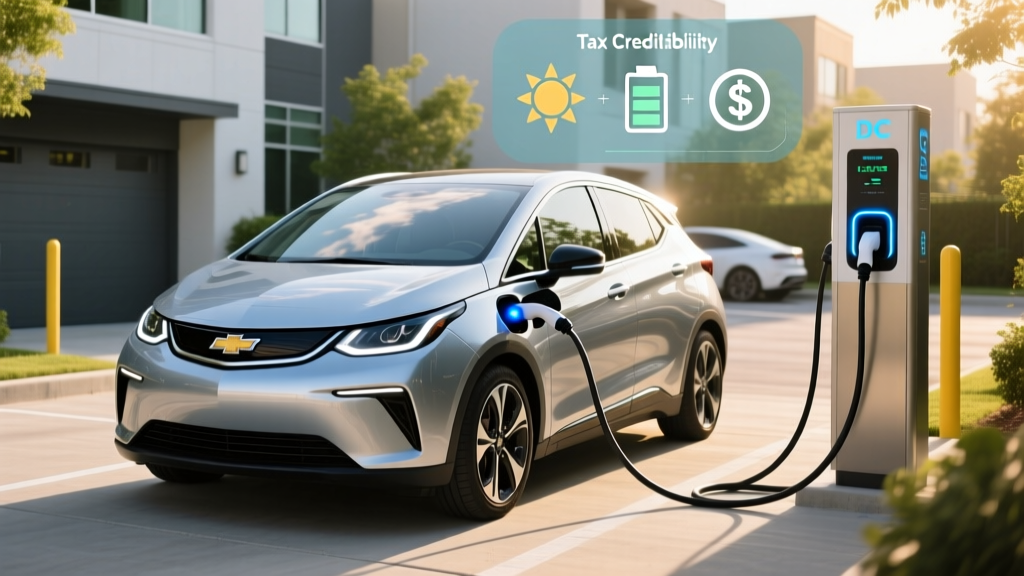
- Point-of-Sale Transfer: Eligible buyers can transfer the credit to the dealer at purchase, reducing the out-of-pocket price by up to $7,500 at the time of sale.
Bottom line: If the Bolt's battery sourcing meets the 2026 critical-mineral and component thresholds, an eligible buyer could see the base 1LT price drop from ~$26,500 to approximately $19,000 after the full $7,500 credit. Confirm current eligibility on fueleconomy.gov and with your tax advisor before purchase.
Performance, Efficiency, and Daily Driving
The Bolt's single front-mounted motor produces 200 horsepower and 266 lb-ft of torque, delivering a 0–60 mph time of approximately 6.5 seconds. That is genuinely quick for the price point — the instant torque makes city merging and highway passing effortless. The FWD layout means some torque steer under hard acceleration, but the low center of gravity (battery pack under the floor) keeps the Bolt planted through corners.
Efficiency is a strong suit: 120 MPGe combined (28 kWh per 100 miles) means charging costs are exceptionally low. At a national average electricity rate of $0.16/kWh, driving 100 miles costs roughly $4.48 — compared to $12–$15 for a 30 MPG gas car at current fuel prices. Over 15,000 miles per year, that is an annual fuel savings of approximately $1,100–$1,500.
The Bolt's regenerative braking system offers two modes: standard (coasting feel similar to a gas car) and one-pedal driving (aggressive regen that can bring the car to a full stop without touching the brake pedal). One-pedal mode is excellent for city commuting and extends range in stop-and-go traffic.
Tech, Interior, and Standout Features
The 2026 Bolt carries over a practical, if not flashy, interior:
- Infotainment: 10.2-inch touchscreen with wireless Apple CarPlay and Android Auto, built-in Google services on higher trims
- Driver Assistance: Chevy Safety Assist suite (automatic emergency braking, lane-keep assist, following-distance indicator, front pedestrian braking). Super Cruise hands-free driving is available on the EUV Premier trim on compatible mapped highways — this is an SAE Level 2 system requiring driver attention.
- Unique Feature: The EUV's extra 3.1 inches of rear legroom (39.1 in vs. 36.0 in) makes it meaningfully more practical for rear-seat passengers and child seats.
Notable drawbacks: No front trunk (frunk), rear visibility is compromised by thick C-pillars (mitigated by available 360° camera), and interior materials are hard plastics throughout — acceptable at this price, but noticeable versus competitors. The 55 kW DC charge rate remains the single biggest functional limitation for road-trip-heavy buyers.
Pros
- Lowest MSRP in the EV market for 250+ mile range
- Strong 11.5 kW Level 2 home charging speed
- 200 hp delivers quick, confident acceleration
- Eligible for up to $7,500 federal credit (sourcing-dependent)
- One-pedal driving ideal for city commuting
- 8-year/100,000-mile battery warranty
Cons
- 55 kW DC fast charging is slow vs. rivals (45 min for 10–80%)
- FWD only — no AWD option for snow-belt buyers
- Hard-plastic interior, no frunk
- CCS1 connector (no native NACS; requires adapter for Tesla Superchargers)
- Cold-weather range loss is significant without preconditioning
Is the 2026 Chevy Bolt Worth Buying vs. Competitors?
Choose the Bolt EV/EUV if: You prioritize lowest upfront cost, commute under 60 miles daily, have access to Level 2 home charging, and rarely take road trips exceeding 200 miles between stops. The Bolt is the best value-per-mile-of-range EV on the market, especially if you qualify for the full federal tax credit.
Look elsewhere if: You frequently drive 300+ mile road trips (the 55 kW charge rate will frustrate you), need AWD for harsh winters, or want the latest NACS-native charging ecosystem. Consider the Hyundai Kona Electric (faster DC charging, similar price), the Tesla Model 3 (Supercharger network, 170+ kW charging), or the Chevrolet Equinox EV (larger, longer range, faster charging, but higher MSRP).
Frequently Asked Questions
What is the real-world range of the Chevy Bolt?
The EPA rates the Bolt EV at 259 miles and the EUV at 247 miles. In real-world mixed driving, expect 220–240 miles. Highway-only driving at 75 mph drops this to roughly 200–215 miles. In sub-freezing weather, plan for 170–195 miles unless you precondition the battery while plugged in.
How fast does the Chevy Bolt charge at home?
On a 240V, 48-amp Level 2 charger, the Bolt charges at 11.5 kW, adding about 39 miles of range per hour. A full 0–100% charge takes approximately 7 hours — ideal for overnight charging.
How fast is DC fast charging on the Bolt?
The Bolt peaks at 55 kW on a CCS1 DC fast charger. A 10–80% session takes approximately 45 minutes. This is slower than most modern EVs and is the Bolt's primary road-trip limitation.
Does the 2026 Chevy Bolt qualify for the $7,500 federal tax credit?
It can, provided the buyer meets IRS §30D income caps, and the vehicle's battery sourcing meets 2026 critical-mineral and component thresholds. The Bolt's MSRP and U.S. assembly satisfy two of the main requirements. Verify current eligibility at the dealer and on fueleconomy.gov before purchase.
Can I charge a Chevy Bolt at a Tesla Supercharger?
Yes, but only at Tesla Superchargers equipped with the Magic Dock CCS adapter. The Bolt uses a CCS1 connector natively. GM has also begun offering a NACS adapter for access to additional Tesla stations — check Chevrolet's current adapter availability and compatibility for 2026 models.
What is the battery warranty on the Chevy Bolt?
Chevrolet covers the Bolt's battery pack and electric powertrain for 8 years or 100,000 miles (whichever comes first), with a capacity retention threshold of 60% of original capacity. This is industry-standard and provides long-term peace of mind.
Is the Chevy Bolt good for road trips?
It is adequate but not ideal. The 259-mile EPA range means you can cover most legs between stops, but the 55 kW charge rate means each stop takes ~45 minutes for a 10–80% session. For frequent road-trippers, a faster-charging EV will save significant time over the course of a long journey.