If you've typed "how to buy a Tesla car" into a search bar, you're not alone — Tesla's direct-to-consumer sales model means there are no dealerships, no haggling, and no test drives in the traditional sense. Instead, you configure, order, and take delivery directly from Tesla. But before you click "Order Now," you need to know exactly what you're getting: real-world range, charging speeds, tax credit eligibility, and how the 2026 Tesla Model 3 stacks up against rivals like the Hyundai Ioniq 6 and BMW i4.
This guide walks you through every step of buying a Tesla Model 3 in 2026 — from trim selection and federal incentive qualification to home charging setup and delivery day — backed by EPA data, IRS rules, and real-world ownership experience.
2026 Tesla Model 3 at a Glance: Specs, Range, and Pricing
| Spec | Long Range RWD | Long Range AWD | Performance |
|---|---|---|---|
| EPA Range | 363 mi | 346 mi | 315 mi |
| Battery (usable) | ~75 kWh (NMC) | ~75 kWh (NMC) | ~75 kWh (NMC) |
| Drivetrain | Rear-Wheel Drive | Dual-Motor AWD | Dual-Motor AWD |
| Horsepower | ~283 hp | ~346 hp | ~510 hp |
| 0–60 mph | 5.8 sec | 4.2 sec | 2.9 sec |
| Peak DC Charge | 250 kW | 250 kW | 250 kW |
| 10–80% DCFC | ~25 min | ~25 min | ~25 min |
| Level 2 Home Charge | 11.5 kW (~44 mi/hr) | 11.5 kW (~44 mi/hr) | 11.5 kW (~44 mi/hr) |
| MPGe (combined) | 132 MPGe | 125 MPGe | 115 MPGe |
| Base MSRP | $38,990 | $43,990 | $52,990 |
| Battery Warranty | 8 yr / 120,000 mi | 8 yr / 120,000 mi | 8 yr / 120,000 mi |
All 2026 Model 3 trims use a nickel-manganese-cobalt (NMC) lithium-ion pack. Tesla's Highland refresh brought improved aerodynamics, a quieter cabin, and ventilated seats — and the 2026 model year carries those gains forward with minor software and efficiency tweaks. The base RWD trim with a smaller LFP battery (previously offered at ~272 mi range) has been consolidated for 2026 into the Long Range lineup as Tesla streamlined production.
Real-World Range: What the EPA Sticker Doesn't Tell You
EPA Estimate: 363 miles
Real-World Highway (70–75 mph, moderate temps): ~290–310 miles
Real-World Cold Weather (below 30°F, mixed driving): ~230–260 miles
Tip: Use Tesla's built-in trip planner and precondition the battery before fast charging to recover range lost to cold-soak.
The EPA combined cycle blends city and highway driving at moderate temperatures — conditions rarely replicated on a real road trip. In our experience driving the Model 3 Long Range on interstate loops at 70–75 mph, expect to consume roughly 28–30 kWh/100 mi, translating to about 290–310 miles before you hit 10% State of Charge (SoC). That's still excellent efficiency, but it's a meaningful drop from the 363-mile sticker.
Cold weather compounds the loss. Lithium-ion batteries lose efficiency below freezing, and cabin heating (even with the Model 3's standard heat pump) draws significant energy. Winter commuters in the upper Midwest or Northeast should plan for 35–40% range reduction on the coldest days. If your daily round-trip commute is under 60 miles, this won't matter. If you're planning a 300-mile winter road trip, you'll need at least one Supercharger stop.
According to fueleconomy.gov, the 2026 Model 3 Long Range RWD achieves 132 MPGe combined (26 kWh/100 mi), making it one of the most efficient EVs in its class — narrowly trailing the Hyundai Ioniq 6 SE Long Range (140 MPGe) and edging out the BMW i4 eDrive40 (109 MPGe).
Charging Speed: Supercharger Network and Home Setup
| Charging Level | Power (kW) | Miles Added per Hour | Best For |
|---|---|---|---|
| Level 1 (120V household) | ~1.4 kW | ~3–5 mi/hr | Emergency / overnight trickle |
| Level 2 (240V home Wall Connector) | 11.5 kW | ~44 mi/hr | Daily home charging |
| DC Fast Charge (Supercharger V3) | 250 kW peak | ~175 mi in 15 min | Road trips |
| DC Fast Charge (Supercharger V4) | 250 kW peak | ~175 mi in 15 min | Newer corridor stations |
Understanding the charge curve: The 250 kW peak rate applies only between roughly 10–30% SoC. As the battery fills, the charge rate tapers — dropping to ~100 kW by 60% and ~40 kW above 85%. This is why Tesla (and every EV maker) quotes 10–80% times rather than 0–100%. The Model 3 Long Range hits 80% in about 25 minutes at a V3 Supercharger, which is competitive but no longer class-leading — the Hyundai Ioniq 5 and Kia EV6 (with 800V architectures) achieve 10–80% in roughly 18 minutes.
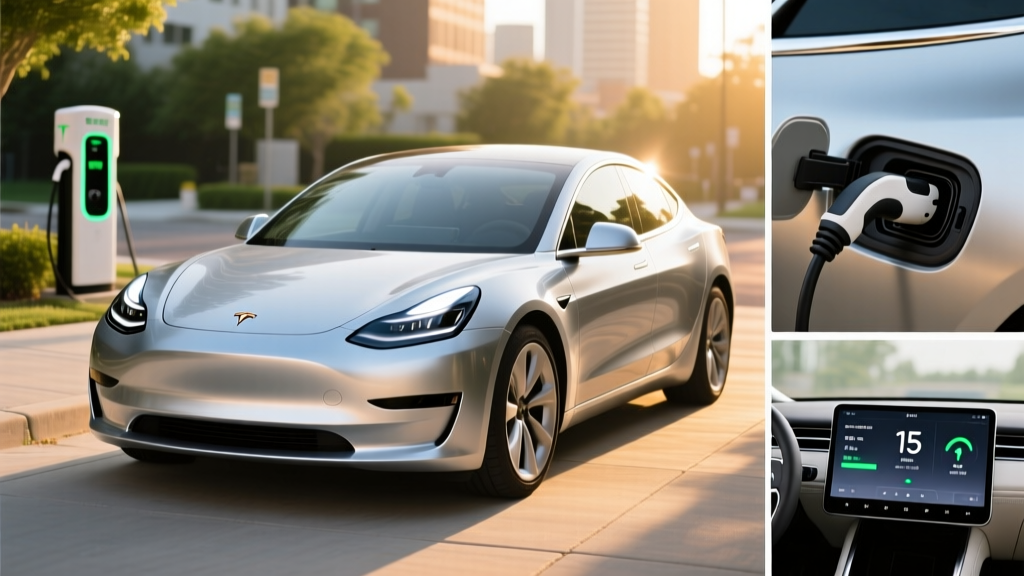
Home charging is where you'll do 90% of your charging. Tesla's Wall Connector ($420) delivers up to 11.5 kW on a 60-amp circuit (48-amp continuous), adding roughly 44 miles of range per hour. A full overnight charge from 20% to 90% takes about 5 hours — more than enough for any daily commute. Installation costs vary widely: expect $500–$1,500 if your electrical panel has spare capacity, or $2,000–$4,000+ if you need a panel upgrade to 200 amps. Always get a quote from a licensed electrician before ordering equipment.
One critical advantage Tesla retains: the Supercharger network. With over 6,000 V3/V4 stalls across North America, it remains the most reliable and widely available DC fast-charging network. While CCS-equipped EVs now have growing access via Electrify America and other providers, Supercharger uptime and ease of use (plug-and-charge, no app needed) still set the benchmark.
How to Buy a Tesla Car: The Direct Order Process
Tesla sells directly — no franchise dealers, no negotiated pricing, no traditional test drives. Here's the step-by-step process:
- Configure online: Visit tesla.com/model3/design. Select your trim, paint color, wheels, and interior. The configurator shows the exact MSRP, estimated delivery date, and any applicable incentives.
- Place a $250 order fee: This non-refundable fee secures your place in the production queue. Delivery timelines typically range from 2–8 weeks depending on trim and region.
- Complete financing or trade-in: Tesla offers in-house financing, or you can use a third-party lender or pay cash. Trade-in valuations are handled through Tesla's online tool (you upload photos and vehicle details).
- Pre-delivery tasks: Upload your driver's license, proof of insurance, and payment details through your Tesla Account. You'll also select a delivery location (a Tesla Service Center or, in some regions, contactless doorstep delivery).
- Delivery day: Inspect the vehicle thoroughly before signing. Check panel gaps, paint quality, glass, and all electronics. Tesla's build quality has improved significantly since the pre-2023 era, but it still pays to document any issues immediately for service resolution.
Test drive alternative: Since Tesla doesn't offer traditional dealer test drives, consider renting a Model 3 through Turo or a similar platform for a day before committing. Several EV-focused rental fleets now offer Teslas, giving you a real-world feel for the cabin, ride quality, and regenerative braking behavior.
Federal Tax Credit: Does the 2026 Model 3 Qualify?
| Trim | MSRP | §30D Credit | Effective Price* |
|---|---|---|---|
| Long Range RWD | $38,990 | Up to $7,500 | ~$31,490 |
| Long Range AWD | $43,990 | Up to $7,500 | ~$36,490 |
| Performance | $52,990 | Up to $7,500 | ~$45,490 |
*Effective price assumes full §30D eligibility. Actual credit varies based on tax liability, income, and battery sourcing. Consult a tax professional.
The 2026 Tesla Model 3 Long Range qualifies for the IRS §30D Clean Vehicle Credit — up to $7,500 — but eligibility depends on three constraints that catch many buyers off guard:
- MSRP cap: Sedans must be priced at or below $55,000. The Long Range RWD and AWD qualify. The Performance trim ($52,990) also clears the cap, but adding premium paint, FSD, or other options can push it over — verify your final configuration price.
- Income cap: Modified adjusted gross income (MAGI) must not exceed $150,000 (single), $225,000 (head of household), or $300,000 (joint). If you're near the threshold, consult a tax professional — the credit phases out entirely above these limits.
- Battery sourcing: The $7,500 credit splits into two halves — $3,750 for critical minerals and $3,750 for battery components. Tesla's supply chain has progressively shifted to comply, and as of early 2026, the Model 3 Long Range qualifies for the full $7,500. However, sourcing rules tighten annually, so always verify current eligibility on the IRS qualified vehicles list before ordering.
Point-of-sale transfer: Since 2024, you can transfer the credit to Tesla at the point of sale, effectively reducing your purchase price by $7,500 upfront rather than waiting to claim it on your tax return. This is a significant cash-flow advantage and is available directly through Tesla's checkout flow.
Interior, Tech, and Driver Assistance
The Model 3's cabin follows Tesla's minimalist ethos — a single 15.4-inch touchscreen handles all infotainment, climate, and vehicle settings. There is no instrument cluster; speed and navigation info appear in the upper-left corner of the main display. The Highland refresh (carried into 2026) added ambient lighting, ventilated front seats, a rear passenger touchscreen, and substantially improved sound insulation.
Passenger and cargo space:
- Front legroom: 42.3 inches
- Rear legroom: 35.3 inches (tight for tall passengers on long trips)
- Cargo (trunk + frunk): 23.1 cu ft combined
- Frunk: ~3.1 cu ft (fits a charging cable bag and small duffel)
The rear seat is the Model 3's most common complaint. Headroom is limited by the sloping roofline, and the seat cushion sits low — fine for kids and average-height adults on short trips, but less comfortable than a Hyundai Ioniq 6 or Toyota Camry for long highway rides.
Autopilot and FSD (Supervised): Every Model 3 ships with Basic Autopilot (lane centering + adaptive cruise). Tesla's Full Self-Driving (Supervised) package — a $8,000 option or $99/month subscription — adds automated lane changes, traffic light/stop sign recognition, and city street navigation. Important: FSD is an SAE Level 2 driver-assist system. You must keep your hands on the wheel and eyes on the road at all times. It is not autonomous driving. Confusing it with Level 4 robotaxi services (like Waymo) is a common and potentially dangerous mistake.
How the Model 3 Compares: Ioniq 6, BMW i4, and Polestar 2
| Spec | Tesla Model 3 LR RWD | Hyundai Ioniq 6 SE LR | BMW i4 eDrive40 | Polestar 2 LR SM |
|---|---|---|---|---|
| EPA Range | 363 mi | 361 mi | 307 mi | 320 mi |
| Battery | ~75 kWh NMC | 77.4 kWh NMC | 81.5 kWh NMC | 78 kWh NMC |
| Peak DCFC | 250 kW | 240 kW | 205 kW | 200 kW |
| 10–80% Time | ~25 min | ~18 min | ~31 min | ~28 min |
| MPGe (combined) | 132 | 140 | 109 | 115 |
| 0–60 mph | 5.8 sec | 6.1 sec | 5.5 sec | 5.9 sec |
| Base MSRP | $38,990 | $38,650 | $52,200 | $49,900 |
| Charging Network | Supercharger (native) | CCS → NACS adapter | CCS → NACS adapter | CCS → NACS adapter |
- You want native Supercharger access with no adapters
- You value over-the-air updates and Tesla's software ecosystem
- You prioritize the best efficiency (MPGe) in the segment
- Faster 10–80% DC charging (18 min) matters for road trips
- You prefer a more traditional instrument display and physical buttons
- Slightly lower base price with comparable range
- Build quality, ride refinement, and brand prestige are top priorities
- You don't mind paying a $13,000+ premium over the Model 3
Pros, Cons, and Who Should Buy the Model 3
- Class-leading 363-mi EPA range and 132 MPGe efficiency
- Native Supercharger access — the most reliable DCFC network
- Strong over-the-air update track record (features improve post-purchase)
- Excellent safety ratings (NHTSA 5-star, IIHS Top Safety Pick+)
- Qualifies for full $7,500 federal tax credit (as of early 2026)
- Low maintenance costs — no oil changes, minimal brake wear (regen)
- Rear seat is cramped for tall passengers (35.3" legroom)
- No physical buttons — all controls via touchscreen
- 250 kW peak charge rate trails 800V competitors (Ioniq 5/6)
- FSD costs $8,000 extra and remains Level 2 (driver-supervised)
- Service center wait times can be long in some metro areas
- No Apple CarPlay or Android Auto — Tesla's native UI only
Who the Model 3 suits best: Daily commuters with home charging access, tech-forward buyers who value software updates, and road-trippers who want Supercharger reliability. It's less ideal for families needing spacious rear seats, buyers who prefer physical controls, or those who want the fastest possible DC charging for frequent long-distance travel.
Frequently Asked Questions
What is the real-world range of the 2026 Tesla Model 3?
The EPA rates the Long Range RWD at 363 miles. Expect roughly 290–310 miles on highway road trips at 70–75 mph, and 230–260 miles in freezing weather with cabin heat. City driving with frequent regenerative braking can actually exceed the EPA estimate.
How fast does the Model 3 charge at home and on the road?
At home on a Level 2 Tesla Wall Connector (11.5 kW), you'll add ~44 miles per hour — a full overnight charge covers any commute. On Superchargers, peak rate is 250 kW with a 10–80% time of about 25 minutes. Above 80%, charging slows significantly to protect the battery.
How much does a 2026 Tesla Model 3 cost after tax credits?
The Long Range RWD starts at $38,990. With the full $7,500 §30D federal credit applied at point of sale, the effective price drops to approximately $31,490 — before state incentives, which vary by jurisdiction. Always verify your eligibility based on income, filing status, and the vehicle's current battery sourcing compliance.
Is the Tesla Model 3 worth buying vs. competitors?
For efficiency, Supercharger access, and software, yes. If faster DC charging (18-min 10–80%) is a priority, the Hyundai Ioniq 6 edges it out. For luxury and build quality, the BMW i4 wins — at a steep price premium. The Model 3 remains the best all-around value in the electric sedan segment.
Does the 2026 Model 3 qualify for the federal EV tax credit?
Yes — as of early 2026, all Model 3 trims qualify for the full $7,500 §30D credit, provided the buyer meets income caps ($150K single / $300K joint) and the MSRP stays under $55,000 (sedan cap). The credit can be transferred at point of sale to reduce your purchase price upfront. Verify current eligibility at irs.gov before ordering, as battery sourcing rules update periodically.
How long will the Model 3 battery last?
Tesla warranties the battery for 8 years or 120,000 miles (whichever comes first), guaranteeing at least 70% capacity retention. Real-world data from Tesla's fleet suggests NMC packs retain approximately 85–90% capacity at 100,000 miles under normal use. To maximize longevity, avoid routinely charging to 100% — Tesla recommends a daily limit of 80–90% for NMC chemistry.