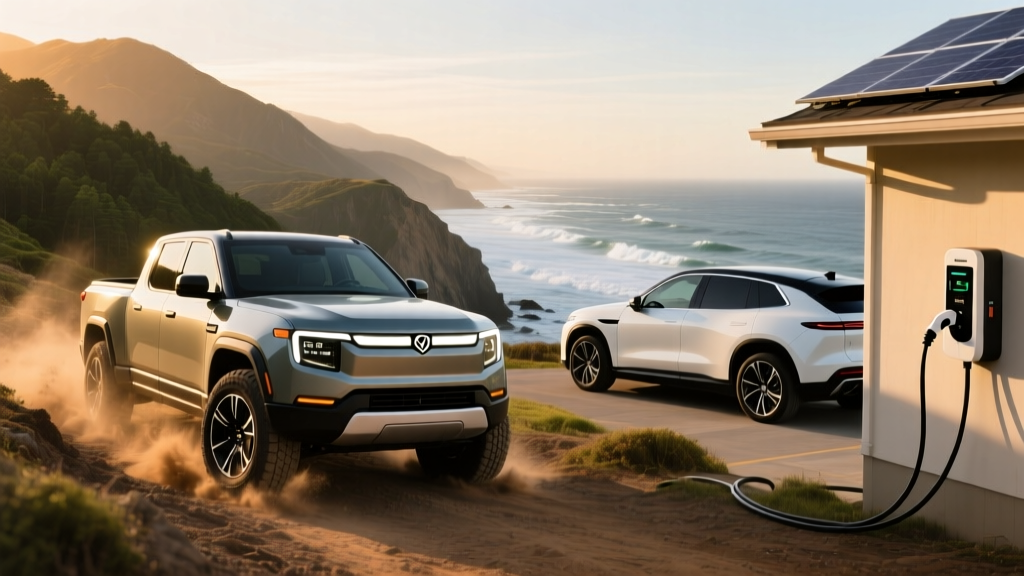
If you've been searching for an electric adventure vehicle and landed here wondering how do I buy a Rivian, you're not alone. Rivian's direct-to-consumer model skips the dealership entirely, which means the purchasing process differs significantly from a traditional car buy. This guide walks through every step — from choosing between the R1T truck and R1S SUV, to understanding real-world range, charging infrastructure, federal tax credit eligibility, and what it actually costs to get one in your driveway in 2026.
Rivian's 2026 Lineup: R1T Truck vs. R1S SUV at a Glance
Rivian currently sells two core vehicles built on its Gen 2 platform: the R1T (a four-door electric pickup) and the R1S (a three-row electric SUV). Both share battery packs, powertrain configurations, and most technology, but they serve different use cases. The R1T offers a 4.5-foot bed with the innovative Gear Tunnel for enclosed storage, while the R1S provides seating for up to seven and more traditional cargo versatility.
| Spec | R1T (Pickup) | R1S (SUV) |
|---|---|---|
| EPA Range (Standard Battery) | 270 miles | 261 miles |
| Battery Capacity (usable) | ~92 kWh (NMC) | ~92 kWh (NMC) |
| Horsepower (Dual-Motor) | 533 hp | 533 hp |
| 0-60 mph | 4.5 sec | 4.6 sec |
| Max DC Fast Charge | 220 kW (peak) | 220 kW (peak) |
| 10-80% DC Charge Time | ~21 minutes | ~21 minutes |
| Level 2 Home Charge Rate | 11.5 kW (~25 mi/hr) | 11.5 kW (~25 mi/hr) |
| Towing Capacity | 11,000 lbs | 7,700 lbs |
| Cargo Volume | Bed + 11 cu ft Gear Tunnel | Up to 104.7 cu ft (seats folded) |
| Base MSRP (Dual-Motor) | $69,900 | $75,900 |
For buyers prioritizing maximum range, Rivian also offers a Max Battery pack (approximately 141 kWh usable, NMC) that pushes the R1T to an EPA-estimated 420 miles and the R1S to around 410 miles — though at a significant price premium of roughly $10,000-$12,000 over the Standard pack and added vehicle weight.
Real-World Range: What the EPA Sticker Doesn't Tell You
EPA Estimate: 270 miles (R1T Dual-Motor, Standard Battery)
Expect in real-world highway driving (70-80 mph): ~230-245 miles
Cold weather (below 30°F): ~200-220 miles
Max Battery highway: ~350-370 miles (EPA 420)
The R1T and R1S are large, heavy vehicles with the aerodynamic profile of a brick — and physics doesn't forgive that at highway speeds. In independent testing and owner reports, the Dual-Motor Standard Battery models consistently deliver 230-245 miles at sustained highway speeds in moderate temperatures. Drop below freezing, and expect a 20-25% reduction from the EPA figure due to increased battery resistance and cabin heating demands. Rivian's heat pump helps mitigate this compared to resistive heating, but cold weather range loss is unavoidable in any EV.
The Max Battery pack is the answer for road-trippers who want a comfortable 300+ mile real-world buffer. If your typical drive is under 200 miles round-trip with home charging, the Standard Battery keeps cost and weight down while still covering daily needs with margin.
Efficiency lands around 2.0-2.2 kWh/mile (roughly 73 MPGe combined per fueleconomy.gov) for the Dual-Motor Standard — respectable for a 6,500+ lb vehicle but noticeably thirstier than a sedan or crossover EV.
Charging Speed: DC Fast Charging and Home Setup
Rivian uses the NACS (North American Charging Standard) connector on all 2026 models, meaning native compatibility with the Tesla Supercharger network — the most reliable and expansive DC fast-charging network in North America. This is a significant advantage over vehicles still relying on CCS adapters.
| Charging Level | Power | Speed (Approx.) | Use Case |
|---|---|---|---|
| Level 1 (120V household) | ~1.4 kW | ~3-4 miles/hour | Emergency/top-up only |
| Level 2 (240V home, Rivian Wall Charger) | 11.5 kW | ~25 miles/hour | Daily overnight charging |
| DC Fast Charge (Supercharger/EA) | Up to 220 kW peak | 10-80% in ~21 min | Road trips |
A critical nuance: that 220 kW peak rate is exactly that — a peak. Rivian's charge curve holds strong from roughly 10-50% State of Charge (SoC), then tapers progressively. Expect an average rate closer to 150-170 kW across the full 10-80% session. That still translates to adding about 180 miles of range in 20 minutes at a capable Supercharger V4 station, which is competitive with the broader large-SUV/truck EV segment.
For home charging, Rivian's Wall Connector (or any quality Level 2 unit like a ChargePoint Home Flex or Emporia Level 2 on a 60A circuit) delivers 11.5 kW — enough to fully replenish the Standard Battery from empty in about 8-9 hours. Most owners wake up to a full battery every morning. Installation typically runs $800-$2,000 depending on panel proximity and whether a 200A service upgrade is needed.
The Ordering Process: How to Actually Buy a Rivian
Rivian sells directly to consumers — there are no franchised dealerships. Here's the step-by-step:
- Configure online: Visit rivian.com and use the configurator to select R1T or R1S, battery pack, motor configuration (Dual-Motor AWD or Tri-Motor AWD), paint, interior, and packages.
- Place a $1,000 deposit: This is fully refundable and secures your place in the production queue.
- Wait for your build slot: Depending on configuration and demand, delivery timelines in 2026 typically range from 2-6 months for popular configurations. Max Battery and Tri-Motor builds may take longer.
- Finalize and pay: Once your vehicle enters production, Rivian will contact you to finalize financing (through partner lenders or your own bank/credit union), trade-in appraisal, and delivery logistics.
- Delivery: Rivian delivers to your door in many metro areas or to a nearby Rivian Service Center / Space (their retail showrooms). You'll do a walkthrough and drive away.
There is no price negotiation — Rivian uses fixed, transparent pricing. What you see on the configurator is what you pay, plus destination and applicable taxes/fees. This eliminates the dealership haggling that frustrates many EV buyers.
Pricing, Trims, and Federal Tax Credit Eligibility
Rivian's pricing has stabilized after several adjustments in recent years. Here's where the 2026 lineup sits:
| Configuration | R1T MSRP | R1S MSRP |
|---|---|---|
| Dual-Motor AWD, Standard Battery | $69,900 | $75,900 |
| Dual-Motor AWD, Max Battery | $81,900 | $87,900 |
| Tri-Motor AWD, Max Battery | $99,900 | $104,900 |
The Rivian R1T with a base MSRP under $80,000 may qualify for up to $7,500 under the IRS §30D Clean Vehicle Credit, but eligibility depends on several factors:
- MSRP Cap: Trucks (R1T) must be under $80,000; SUVs/vans (R1S) under $80,000. The R1S base Dual-Motor at $75,900 qualifies on MSRP, but adding options that push it above $80,000 disqualifies it.
- Buyer Income Cap: AGI must not exceed $150,000 (single), $225,000 (head of household), or $300,000 (joint filers).
- Battery Sourcing: Critical minerals and battery component requirements phase in annually. Check the latest IRS guidance for current-year sourcing compliance.
- Point-of-Sale Transfer: You can transfer the credit to Rivian at purchase to reduce your out-of-pocket cost immediately, rather than waiting to claim it on your tax return.
Note: Tax rules change. Consult a tax professional and verify on IRS.gov before purchasing.
The Tri-Motor configurations exceed the $80,000 MSRP cap and do not qualify for the federal credit. Some states offer additional rebates (California's CVRP, Colorado's state credit, etc.) — check your state's energy office for current programs.
Tech, Driver Assistance, and Ownership Experience
Rivian's software is proprietary and deeply integrated. The 15.6-inch center display runs a custom OS with built-in navigation that factors in charging stops, elevation changes, and battery preconditioning. Key features include:
- Driver+ (Level 2 ADAS): Adaptive cruise control with lane centering on highways. Competent but not class-leading — it requires hands-on-wheel attention and does not support hands-free driving like GM's Super Cruise or Ford's BlueCruise. This is an SAE Level 2 system, meaning the driver must remain fully engaged at all times.
- Over-the-air updates: Rivian regularly pushes software updates that add features, improve efficiency, and refine the driving experience.
- Adventure Network: Rivian's own DC fast-charging network along popular adventure routes (national parks, ski areas), though the broader Supercharger network is the primary road-trip backbone.
- Gear Tunnel (R1T): A lockable, weather-sealed 11 cu ft tunnel running the width of the truck behind the rear seats — perfect for skis, camping gear, or groceries.
- Camp Kitchen: An optional slide-out kitchen module for the Gear Tunnel (adds ~$5,000) with induction cooktop and sink.
Notable drawbacks: Rear-seat legroom is tighter than full-size trucks (36.6 inches vs. the F-150 Lightning's 40+ inches). The infotainment system, while visually clean, lacks Apple CarPlay and Android Auto — a dealbreaker for some buyers who prefer phone-mirroring interfaces. Insurance costs tend to run 15-25% higher than comparable gas trucks due to repair costs and EV claim severity.
Warranty, Reliability, and Long-Term Ownership
Rivian's warranty package is competitive for the segment:
- Battery & Drive Units: 8 years / 175,000 miles (whichever comes first), covering defects and capacity below 70% State of Health
- Limited Vehicle Warranty: 5 years / 60,000 miles bumper-to-bumper
- Roadside Assistance: 5 years / 60,000 miles
The 175,000-mile battery warranty is among the longest in the industry, reflecting confidence in the NMC cell supply chain. Battery degradation data from early Gen 2 owners (2022-2024 models) suggests roughly 5-8% capacity loss over the first 50,000 miles, which is typical for liquid-cooled NMC packs. LFP chemistry is not currently offered in Rivian vehicles — all packs use NMC for its higher energy density, which is necessary to achieve the range targets in these heavy vehicles.
Rivian operates its own service network through Service Centers and mobile service vans. Wait times for service appointments have improved significantly since 2023, but coverage in rural areas remains limited compared to legacy automaker dealer networks.
Who Should Buy a Rivian (And Who Shouldn't)
- You want an electric vehicle that can genuinely tow, haul, and handle light off-road duty
- You value direct-access to the Tesla Supercharger network via native NACS
- You prefer fixed, no-haggle pricing and a fully online purchase process
- Outdoor recreation (camping, skiing, biking) is central to your lifestyle
- You need maximum rear-seat space for tall adults (consider F-150 Lightning or Ioniq 5)
- You rely on Apple CarPlay / Android Auto
- Your budget is under $65,000 (consider used Rivian market or alternatives like the Chevy Silverado EV WT)
- You want hands-free highway driving (GM Super Cruise or Ford BlueCruise vehicles)
The Rivian R1T competes most directly with the Ford F-150 Lightning (lower starting price, more rear-seat room, but CCS-dependent and less premium interior) and the Chevrolet Silverado EV (more range on Max configurations, but massive and less agile). The R1S's three-row competitors include the Kia EV9 (significantly cheaper, less off-road capability) and the Tesla Model X (faster charging, polarizing styling, older interior).
Frequently Asked Questions
What is the real-world range of the Rivian R1T?
The EPA rates the R1T Dual-Motor Standard Battery at 270 miles. In real-world highway driving at 70-80 mph in moderate temperatures, expect 230-245 miles. In cold weather (below 30°F), plan for 200-220 miles. The Max Battery version (EPA 420 miles) delivers roughly 350-370 miles on the highway.
How fast does a Rivian charge at home and on the road?
On a Level 2 home charger at 11.5 kW, you'll add about 25 miles of range per hour, fully recharging the Standard Battery overnight in 8-9 hours. On a DC fast charger, the R1T and R1S peak at 220 kW and charge from 10-80% in approximately 21 minutes, though the charge curve tapers above 50% SoC.
Does the Rivian R1T or R1S qualify for the $7,500 federal tax credit?
The base R1T Dual-Motor ($69,900) and base R1S Dual-Motor ($75,900) fall under the $80,000 MSRP cap and may qualify — provided the buyer meets IRS income limits and the vehicle meets current-year battery sourcing requirements. Tri-Motor models exceed the cap and do not qualify. Always verify current rules at IRS.gov before purchasing.
Is buying a Rivian worth it versus the Ford F-150 Lightning?
It depends on priorities. The F-150 Lightning starts lower (~$55,000) and offers more rear-seat room, making it a better work truck and family hauler on a budget. The Rivian R1T is more premium, more capable off-road, natively accesses Tesla Superchargers, and offers the unique Gear Tunnel — but costs $15,000+ more at the base level. If adventure and build quality matter most, the R1T wins. If value and space dominate, the Lightning is the pragmatic pick.
Can I test drive a Rivian before ordering?
Yes. Rivian operates "Spaces" (showrooms) in select metro areas where you can schedule a test drive. In markets without a Space, Rivian occasionally hosts demo drive events, and some owners offer peer test drives through enthusiast communities. Given the non-refundable time investment of a 2-6 month wait, a test drive is strongly recommended.
What are the biggest pros and cons of owning a Rivian?
Pros: Genuine off-road and towing capability, native Supercharger access, premium build quality, Gear Tunnel utility, strong OTA update cadence, 175,000-mile battery warranty.
Cons: High starting price, no Apple CarPlay/Android Auto, tight rear-seat legroom for the class, higher insurance costs, limited rural service coverage, Driver+ ADAS lags behind Super Cruise/BlueCruise.