The explosive growth of Tesla's fleet on American roads has created a parallel boom in demand for technicians who can actually service these vehicles. If you've searched for how to become a Tesla mechanic, you're looking at a career path that blends high-voltage electrical systems, software diagnostics, and traditional chassis work — and one that pays a meaningful premium over conventional automotive repair.
This guide breaks down the exact steps, certifications, costs, and salary expectations for entering Tesla's service ecosystem in 2026, whether you're aiming for a factory-authorized role at a Tesla Service Center or an independent EV specialist shop.
Why Tesla Mechanic Careers Are Booming in 2026
Tesla's cumulative U.S. fleet now exceeds 4 million vehicles, with the Model Y alone accounting for over 1.2 million units on the road. Every one of those cars eventually needs brake service, suspension work, 12V battery replacements, HVAC repairs, and — critically — high-voltage system diagnostics that a traditional Jiffy Lube simply cannot handle.
According to the Bureau of Labor Statistics, automotive technician employment is projected to grow through 2034, but the EV-specialist subset is growing far faster. Tesla directly employs thousands of service technicians across its 200+ U.S. Service Centers and Mobile Service fleet, and independent EV shops are multiplying to absorb overflow demand.
What a Tesla Mechanic Actually Does Day-to-Day
Unlike a gas-car mechanic swapping spark plugs and timing belts, a Tesla technician's work centers on:
- High-voltage battery diagnostics: Reading cell-level voltage data, identifying degraded modules, and performing warranty evaluations on the 50–100 kWh battery packs (LFP or NMC chemistry depending on model and trim)
- Drive unit service: Replacing or rebuilding the permanent-magnet synchronous motors (single, dual, or tri-motor configurations)
- Thermal management systems: Servicing the octovalve, heat pump, coolant loops, and A/C compressor — the heart of Tesla's efficiency advantage
- Software and firmware: Running Toolbox diagnostics, executing ECU reflashes, and troubleshooting Autopilot/FSD hardware (cameras, sensors, the HW4 computer)
- Charging systems: Repairing onboard chargers (up to 11.5 kW AC), charge port assemblies, and DC fast-charge contactors
- Traditional mechanical: Suspension (control arms, air springs on Model S/X), brakes (including regen-related wear patterns), tires, 12V lithium-ion auxiliary batteries, glass, and interior trim
A typical day at a Tesla Service Center involves 6–10 work orders mixing mobile-ranger visits (where techs drive to the customer) and in-bay lifts. The diagnostic workflow is heavily software-driven — Tesla's proprietary Toolbox software connects to the car's CAN bus and surfaces fault codes, battery health metrics, and calibration needs that no OBD-II scanner can access.
Step-by-Step Path to Becoming a Tesla Mechanic
Step 1: Get Your Foundation (6–18 Months)
Most Tesla technicians start with one of these entry points:
| Path | Duration | Est. Cost | Best For |
|---|---|---|---|
| ASE-certified automotive program (community college) | 12–24 months | $5,000–$15,000 | Career changers wanting broad credentials |
| Tesla START program (direct) | 12–16 weeks | Free (paid training) | Those targeting Tesla employment directly |
| UTI / Lincoln Tech EV-track diploma | 9–12 months | $20,000–$35,000 | Hands-on learners wanting brand partnerships |
| Military automotive/MOS training + transition | Varies | GI Bill eligible | Veterans with electrical/mechanical background |
Step 2: Earn ASE Certifications (Ongoing)
The National Institute for Automotive Service Excellence offers the L3 (Light Duty Hybrid/Electric Vehicle) certification — the industry-standard credential proving you understand high-voltage safety, isolation testing, and EV drivetrain fundamentals. Many Tesla Service Centers require or strongly prefer ASE L3, plus at least one of:
- A4: Steering & Suspension
- A5: Brakes
- A6: Electrical/Electronic Systems
- A7: Heating & Air Conditioning
Step 3: Apply to Tesla START or Direct Hire
Tesla START (Student Technicians Accelerated Training) is Tesla's in-house accelerator. It runs at select community colleges (currently 10+ locations including California, Texas, Nevada, and New Jersey). You receive paid classroom and lab instruction on Tesla-specific systems, then transition into a full-time Technician or Mobile Service role upon graduation. Applications open quarterly on Tesla's careers page.
If you already hold ASE credentials, you can apply directly as a Service Technician (Levels I–IV) or Mobile Service Technician. Level I techs handle tire rotations and cabin filter swaps; Level IV techs perform drive unit replacements and high-voltage battery module service.
Step 4: High-Voltage Safety Certification (Mandatory)
Before touching any orange-cable component, Tesla requires internal High Voltage Safety training — typically a 2-day course covering PPE (Class 0 gloves rated to 1000V), lockout/tagout procedures, isolation verification with a CAT III/IV multimeter, and emergency de-energization of the battery pack. This is non-negotiable and refreshed annually.
Tesla Mechanic Salary & Career Ladder (2026 Data)
Compensation varies by region, level, and whether you're in a high-cost metro. Here's the current range based on Tesla career postings and technician self-reports:
| Role Level | Hourly Range | Annual (with OT) | Requirements |
|---|---|---|---|
| Technician I (Entry) | $24–$30/hr | $52,000–$68,000 | HS diploma, basic mechanical aptitude |
| Technician II | $30–$38/hr | $65,000–$85,000 | 1–2 ASE certs, 1+ year EV experience |
| Technician III (Senior) | $38–$48/hr | $82,000–$110,000 | ASE L3 + A6, HV certified, 3+ years |
| Technician IV / Master | $48–$60/hr | $105,000–$135,000+ | Full ASE set, battery/drive unit specialist |
| Mobile Service Technician | $28–$42/hr | $62,000–$95,000 | ASE certs, clean driving record, independent |
Tesla also offers RSU (stock) grants to technicians at Level II+, which can add 5–15% to total compensation depending on TSLA performance. Benefits include health coverage, 401(k) match, and free vehicle charging at work.
What You Need to Know About the EVs You'll Service
A competent Tesla mechanic must understand the engineering of each model in the fleet. Here's a reference table of the core specs you'll encounter daily:
| Spec | Model 3 (2026) | Model Y (2026) | Model S (2026) |
|---|---|---|---|
| Battery (usable) | 57.5 kWh (LFP) / 75 kWh (NMC) | 75 kWh (NMC) | 95 kWh (NMC) |
| EPA Range | 272–363 mi | 308–327 mi | 402 mi |
| Max DC Charge | 170 kW (LFP) / 250 kW (NMC) | 250 kW | 250 kW |
| 10–80% Time | ~25–28 min | ~22 min | ~28 min |
| Level 2 Rate | 11.5 kW (~44 mi/hr) | 11.5 kW (~44 mi/hr) | 11.5 kW (~34 mi/hr) |
| 0–60 mph | 3.1–5.8 sec | 3.7–6.5 sec | 1.99–3.1 sec |
| Drivetrain | RWD / AWD Dual Motor | RWD / AWD Dual Motor | AWD Dual/Tri Motor |
| Battery Warranty | 8 yr / 100,000 mi | 8 yr / 120,000 mi | 8 yr / 150,000 mi |
Tools & Skills That Set Tesla Techs Apart
Beyond standard hand tools, Tesla technicians work with a specialized toolkit:
- Tesla Toolbox 3 (software): Laptop-based diagnostic suite connecting via the vehicle's diagnostic port. Access to live battery telemetry, firmware updates, and component calibration.
- Insulation resistance tester (megohmmeter): Verifies high-voltage isolation integrity — a critical safety check before any HV service.
- Class 0 rubber insulating gloves + leather protectors: Mandatory for any work near orange-cabled components.
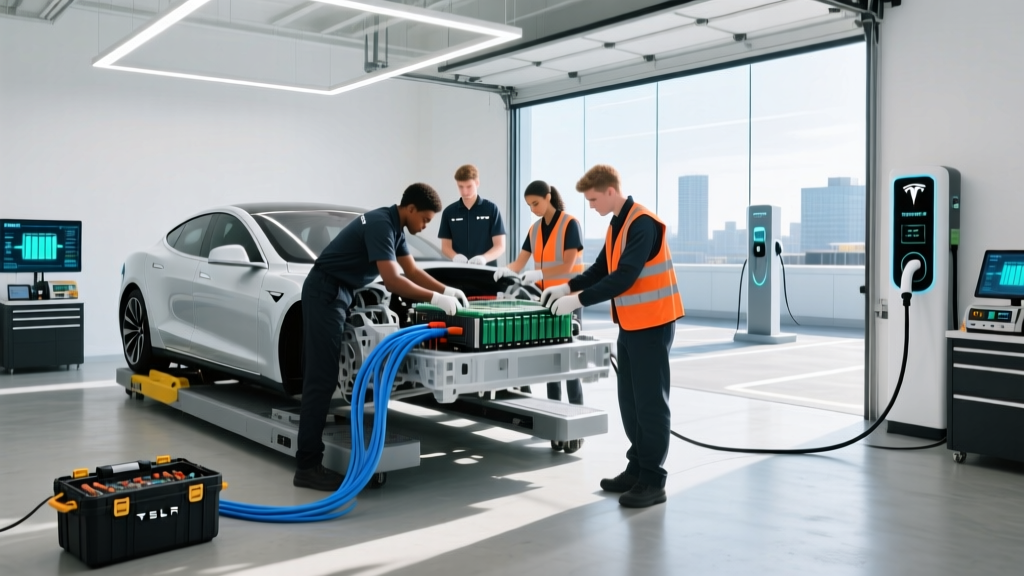
- Battery lift table / crane: Model S/X packs weigh 1,200+ lbs; Model 3/Y packs are ~900 lbs. Safe removal requires a transmission-style lift table rated to 1,500 lbs.
- CAN bus reader (if independent): Third-party tools like SavvyCAN or Scan My Tesla for shops without Toolbox access.
Soft skills matter equally: Tesla techs write detailed warranty narratives, communicate with customers via the Tesla app, and collaborate with remote engineering teams through internal ticketing. The role is more "mechatronics engineer" than "grease monkey."
Independent EV Mechanic vs. Tesla-Employed: Which Path?
Not every Tesla mechanic works for Tesla. The independent route has trade-offs:
Tesla-Employed Technician
- Access to Toolbox software and factory parts
- Paid training and certification
- RSU stock grants at Level II+
- Structured career ladder
- Cannot work on non-Tesla EVs on the clock
Independent EV Specialist
- Service all EV brands (Rivian, Ford, Hyundai, etc.)
- Higher hourly billing rates ($150–$200/hr shop rate)
- Must source aftermarket/used parts or Tesla salvage
- No Toolbox access — requires reverse-engineering skills
- Entrepreneurial upside (own shop)
For most people asking how to become a Tesla mechanic, the factory path is the faster, lower-risk entry. You can always transition to independent work later with the credential and experience advantage.
Frequently Asked Questions
Do I need an engineering degree to work on Teslas?
No. A high school diploma plus ASE certifications and Tesla's internal training is sufficient for most technician roles. An associate degree in automotive technology or electrical systems helps with faster promotion but is not required.
How long does Tesla START training take?
Tesla START runs 12–16 weeks depending on the host college. It combines classroom electrical theory, hands-on high-voltage labs, and supervised service bay work. Graduates are typically offered a Technician I or Mobile Technician role immediately.
Can I work on Tesla batteries without being employed by Tesla?
Yes, but with significant caveats. Independent shops can perform 12V battery swaps, brake service, and suspension work without Tesla's proprietary software. However, high-voltage battery module replacement, drive unit swaps, and firmware-dependent calibrations are extremely difficult without Toolbox access. Most independent EV shops focus on non-HV service and refer battery work to Tesla.
Is being a Tesla mechanic dangerous?
High-voltage systems carry real risk — the battery pack operates at 350–400V nominal (up to 800V in some architectures). However, with proper PPE, isolation verification, and lockout/tagout procedures taught in HV safety courses, the risk is managed effectively. Fatal EV-service incidents are exceedingly rare compared to the broader automotive repair injury rate, according to OSHA records.
What's the job outlook for EV mechanics through 2030?
Strong. The U.S. EV fleet is projected to exceed 30 million vehicles by 2030, and the current technician pipeline is not keeping pace. ASE and industry groups consistently report a shortage of L3-certified techs, making this one of the most recession-resilient trades in the automotive sector.
Does Tesla hire mechanics with no prior automotive experience?
Yes, at the Technician I level and through Tesla START. Candidates with electrical, HVAC, or military electronics backgrounds often transition successfully. Tesla values electrical diagnostic aptitude and software comfort over traditional wrench-turning experience.